The best personalized AI review response software in 2026, for Google reviews and other review sources, should do more than produce a fluent reply. It should understand what happened, select relevant approved business knowledge, follow brand and safety rules, route sensitive situations to a person, and preserve a clear record of what was published.
These capabilities matter because every response communicates with two audiences: the reviewer and prospective customers. A strong response acknowledges the customer, helps future customers understand the business, and gives the organization a practical way to manage this work at scale.
This guide explains how to evaluate AI review response software and shows how RightResponse AI’s 20-agent responder handles review understanding, knowledge selection, planning, writing, quality checks, publication, and human escalation.
What’s New in the 2026 Intelligent Review Responder
The 2026 release creates highly personalized review responses by changing the work from a single generation step into a coordinated response process. Each agent has a narrower responsibility, and the system carries the result from understanding through publication or escalation.
- Deeper review understanding: The system identifies what happened, what matters, and which parts of the review describe the customer’s experience with the business.
- Approved business knowledge: The responder selects company, brand, and location messages that the business has reviewed and authorized.
- Specialized judgment and checks: Separate agents plan the response, apply relevant rules, check safety and quality, and verify that the final draft uses the right information.
- Human escalation: Sensitive, uncertain, or high-authority situations can be routed to a person with the context needed to decide what happens next.
- Operational visibility: Teams can see the knowledge selected, the checks applied, the final action, and the history of approval or publication.
How to Evaluate the Best AI Review Response Software in 2026
Use these criteria to compare how well a platform understands reviews, uses business knowledge, manages risk, supports people, and fits the full response workflow.
| Capability | Why it matters | What to look for |
|---|---|---|
| Review understanding and approved knowledge | A useful response depends on understanding the customer’s experience and selecting information that is both true and relevant. | The system should identify topics, sentiment, people, questions, risk, and material context. The system should use real business knowledge that helps the reviewer or the next customer. |
| Brand and location control | Response quality must remain consistent across the organization while reflecting the location involved. | Enterprise standards should coexist with the local context required to answer well. |
| Judgment, safety, and human escalation | Some reviews involve uncertainty, sensitive facts, or decisions the software is not authorized to make. | Look for specialized checks, risk detection, and a clear route to a person with the context and authority to decide what happens next. |
| Flexible automation | Different reviews require different levels of control. | Policies should determine which responses can publish, which need approval, and which require escalation. |
| Ease of use | Review work arrives continuously and often needs attention at the point of work. | People should be able to review, edit, approve, publish, or escalate without leaving the flow of work. |
| Platform workflow and integrations | Response software must fit the systems that receive reviews, customer context, and final publishing actions. | Evaluate review monitoring, destination publishing, customer-data connections, roles, permissions, and workflow integrations. |
| Auditability | Leaders need to understand how the system reached each outcome and who was involved. | The business should be able to see the inputs, selected knowledge, decisions, approvals, and final outcome. |
Why AI Review Response Software Matters
Replying to customer reviews does more than just acknowledge the time and effort a customer took to provide feedback; it demonstrates a business’s commitment to valuing and respecting its customers. This act of engagement plays a crucial role in retaining existing customers by showing them that their opinions are heard and acted upon. Equally important is the message it sends to potential customers about the level of care and attention they can expect. Rich and thoughtful responses provide a platform to communicate key information about the business, further building the customer’s understanding and engagement with the brand.
A review profile is usually a live conversation between reviewers and prospective customers. Each business response adds a third voice. That voice can communicate trust, knowledge, care, context, and distinction. It also communicates back to the reviewer, especially when the business acknowledges a concern, explains what can happen next, or creates a path to recovery.
Response quality can also contribute to conversion. People reading reviews are often close to making a decision. A relevant response can answer an unspoken question, reduce uncertainty, and show how the business thinks and acts.
The pattern is visible in our 2024 Restaurant Diner Survey: 78% of respondents said they would prefer a restaurant with personalized and informative responses over one using generic replies, and 58% said a constructive response made them less concerned about a negative review.
A RightResponse AI consumer online engagement survey showed that only 41% of reviews with text comments were responded to. This reflects the challenge that businesses have in responding to reviews. It also reflects an opportunity because those who do respond are more likely to win in the battle for customers.
Why Review Responses Are Difficult to Automate Well
Historically, responding to customer reviews has been a labor-intensive task fraught with challenges. Small business owners, caught up in the whirlwind of daily operations, often find it difficult to carve out time for this crucial engagement. On the other hand, larger organizations struggle with maintaining consistency in responses while ensuring that the unique voice of the business shines through, especially when managing responses across multiple locations.
Three common approaches are leaving reviews unanswered, pasting generic AI output, and relying on fixed templates. Each approach limits the business’s ability to personalize the exchange or contribute useful information.
Ease of use is increasingly important because review work arrives continuously. A practical system should let a team member review, edit, approve, publish, or escalate a response while the work is in front of them. Multi-location organizations also need brand rules, permissions, location context, and audit history to remain in place without making routine actions cumbersome.
Responding to Negative Reviews
Negative reviews require more judgment because the public response may be only one part of the business’s next action. Our detailed guide to responding to negative reviews explains how to acknowledge the experience, avoid unsupported claims, move private details into the right channel, and create a path to recovery.
When AI Should Escalate to a Person
The goal is to use automation where the facts and authority are clear, then direct people toward the cases where human judgment can create more value. Escalation is appropriate when the response depends on private customer records, unresolved facts, a recovery decision, or authority the AI does not have.
- Allegations involving safety, privacy, discrimination, legal issues, or serious service failure.
- Reviews that name an employee or require internal investigation.
- Situations in which the reviewer’s identity or transaction cannot be confirmed from the available information.
- Requests for refunds, compensation, clinical guidance, or another decision reserved for an authorized person.
How to Use ChatGPT to Reply to Reviews
A general-purpose AI tool can create a fluent draft when it receives the review and clear instructions. The result depends on the context, business knowledge, constraints, and approval rules supplied in that interaction. A purpose-built responder carries those controls into a repeatable workflow, applies them consistently across reviews and locations, and records what happened.
Our guide to using ChatGPT for review responses explains when a general AI assistant can help and what a business must supply to get a response that is accurate, relevant, and safe to publish.
Inside RightResponse AI’s 20-Agent Review Response Software
RightResponse AI’s Intelligent Review Responder is an agentic system for ongoing review operations. It uses the review, rating, available customer context, approved company, brand, and location messages, brand rules, and workflow policy to determine what the response should communicate and how it should be handled. Learn how Message-Informed Review Responses select approved business messages and add useful information the reviewer did not supply.
The 2026 version distributes this work across 20 specialized agents. Each agent handles a narrower task, then passes structured work to the next stage. This division makes the decisions more explicit, testable, and governable than asking one large prompt to understand, research, write, check, and publish at once.
How the 20-Agent Response System Works
The 20 agents are organized around six connected responsibilities:
- Understand the review: Identify the customer’s experience, sentiment, topics, people, questions, and important context.
- Determine what matters: Separate material details from incidental language and identify risk, ambiguity, or missing information.
- Select approved knowledge: Find the company, brand, or location messages that are both true and relevant to this review.
- Plan the response: Decide what the response should acknowledge, explain, communicate, avoid, and ask the customer to do next.
- Write in the right voice: Produce a response that follows the brand’s tone, length, greeting, closing, language, and no-say rules.
- Check and route the result: Run specialized quality and safety checks, then publish, hold for approval, or escalate according to policy.
Twenty agents matter because response quality depends on a chain of decisions. When those decisions are separated, a business can improve one responsibility without destabilizing the rest of the system. It can also see why a message was selected, why a person was involved, and what was ultimately published.
Explore the Intelligent AI Review Responder for the current product workflow and controls.
Related Conversation: AI That Sounds Relevant

An Example of Intelligent Review Responses
To truly appreciate the impact of RightResponse AI’s Intelligent, AI-Powered Review Response technology, let’s explore a practical example that demonstrates how our system transforms customer feedback into an opportunity for enhanced communication and engagement.
Setting the Scene
Imagine a hearing aid clinic that promotes the convenience of walk-in appointments for services like hearing aid cleaning. A customer, expecting a quick visit, experiences a longer wait than anticipated and shares their disappointment in a review.
.webp)
What Is Approved Business Knowledge?
Earlier versions of RightResponse AI called verified business knowledge “Facts.” The 2026 product calls it approved business messaging. The purpose is the same: give the responder real information that the business has reviewed and authorized for use. The system evaluates the available messages and selects only those that are relevant to the specific review.
Preparing the Intelligent Response
The clinic has approved two messages for low-rated reviews involving wait time and customer recovery.
The first message explains that customers may call before a walk-in visit so the clinic can confirm that someone will be available quickly. This gives the reviewer and future customers a practical way to reduce uncertainty about wait time.

The second message gives dissatisfied reviewers a specific person to contact so the clinic can investigate and try to resolve the experience.

The Intelligent Response Unveiled
The responder identifies a wait-time complaint, recognizes the stress created by the customer’s next appointment, selects the two approved messages, and plans a response that acknowledges the experience, offers useful guidance, and creates a recovery path.
RightResponse AI incorporates the relevant approved messages into the reply. The response addresses the customer’s immediate frustration, offers practical advice for future visits, and opens a direct line of communication for further resolution. It demonstrates the clinic’s commitment to improving the patient experience and gives other customers useful information about reducing wait times.
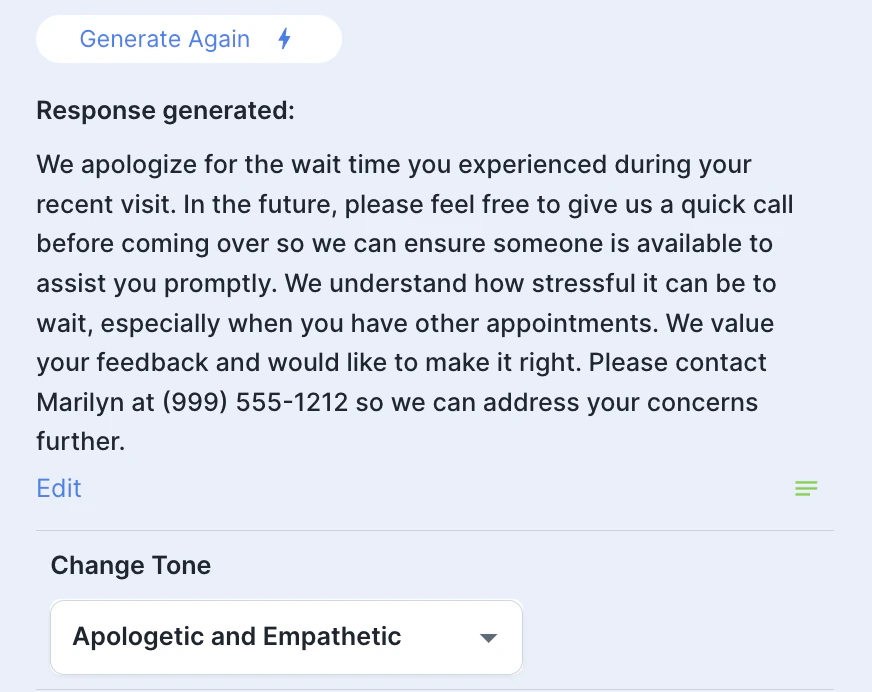
The quality of this response comes from several visible decisions:
- Understanding: The customer values the clinic overall and is frustrated by an unexpected 30-minute wait.
- Knowledge selection: Calling ahead and contacting Marilyn are relevant to the situation. Other clinic messages are not used.
- Response plan: Acknowledge the stress, provide practical guidance, and offer a direct recovery channel.
- Governance: The response uses information the clinic approved and avoids inventing an explanation for the delay.
The Impact of Intelligent AI Review Responses
This example illustrates the depth and relevance of responses that RightResponse AI can achieve by integrating specific business knowledge with customer feedback. The result is a response that goes beyond mere acknowledgment, offering solutions and engaging the customer in a meaningful way. It showcases the clinic’s proactive stance on customer service and its dedication to enhancing the overall patient experience.
The response serves two audiences. It gives the reviewer a useful next step, and it helps prospective customers understand how the clinic manages walk-in demand and customer recovery. That additional information can strengthen trust at the point where a reader is deciding whether to choose the business.
The RightResponse Advantage
Customer engagement can significantly influence loyalty and perception. With RightResponse AI’s Review Response Generator, businesses can ensure that every review—whether a compliment or a critique—is met with a thoughtful reply that reflects the business’s values and commitment to customer satisfaction.
Whether a business manages one location or hundreds, the responder combines approved knowledge with location context, brand controls, permissions, and an audit trail. Teams can work quickly at the point of need while leaders retain visibility into what was approved, published, or escalated.
Review response is one discipline inside a complete review management program. The Review Management Guide explains how response connects with review generation, analysis, competitor intelligence, and tracking to help a business get found, get chosen, and get better.
Conclusion
The strongest AI review response system does more than produce fluent text. It understands the customer’s experience, selects relevant approved knowledge, applies specialized checks, and routes uncertainty to people. That is the purpose of RightResponse AI’s 2026 agentic responder: make each response useful to the reviewer, credible to the next customer, and manageable for the business.
Explore the Intelligent AI Review Responder to see the current product workflow and controls.
AI Review Response FAQs
What is AI review response software?
AI review response software helps a business create, manage, approve, publish, and track replies to customer reviews. A basic AI review response generator creates a draft using the review text, rating, industry, tone, and length. Connected review response software adds approved business knowledge, workflow rules, approvals, publishing, escalation, and an audit trail.
How is a purpose-built AI review responder different from ChatGPT?
ChatGPT can write a useful draft when a person supplies enough context and checks the result. A purpose-built responder makes the required knowledge, brand controls, safety checks, and approval rules part of a repeatable operating system. See our detailed guide to using ChatGPT for review responses.
Why does RightResponse AI use 20 specialized agents?
Review response requires several different decisions: understanding the experience, identifying risk, selecting relevant approved knowledge, planning the message, writing in the correct voice, checking the result, and deciding what happens next. Specialized agents let RightResponse test, improve, and govern those responsibilities separately while coordinating them in one workflow.
How does the AI learn what is true about a business?
RightResponse builds a library of company, brand, and location messages from business sources such as websites, prior reviews, and prior responses. The business reviews and approves the messages. For each new review, the responder selects only the approved knowledge that is relevant to the customer’s situation.
Can AI respond automatically to Google reviews?
Yes. A business can define policies for which responses may publish automatically, which must enter an approval queue, and which should escalate to a person. Sensitive or uncertain reviews should remain under human control, and the system should retain an audit history of the final action.
How should AI handle negative or sensitive reviews?
The responder should identify risk, avoid inventing facts, use only approved recovery messages, and move private details into an appropriate channel. Reviews involving serious allegations, unclear facts, named employees, protected information, or authority-sensitive decisions should be sent to a person. Our negative review response guide covers the response principles in more detail.
Can responses match brand voice across multiple locations?
Yes. A multi-location system should apply shared brand standards while preserving approved local knowledge and judgment. It should also support tone and length controls, greetings and closings, multilingual responses, no-say rules, permissions, approval queues, and location-level audit history.
How does review response fit into review management?
Response is one part of review management. A complete program also generates authentic reviews, monitors new activity, analyzes customer themes, compares competitors, and tracks results over time. Read the complete Review Management Guide for the full operating model.
Book a demo to see the 20-agent responder work with real reviews, approved knowledge, checks, and e
See the 20-Agent Responder in Action
Work with real reviews, approved business knowledge, specialized checks, and human escalation.
Try RightResponse AI for Free!
*No credit card required.