REVIEWS.io vs Trustpilot Overview
Choosing between REVIEWS.io and Trustpilot usually comes down to what kind of trust signal you need reviews to create.
Comparison research: This article is part of the RightResponse AI review management software comparison library, which connects platform reviews, pricing analyses, alternatives, and head-to-head evaluations.
- Do you need a public review profile where anyone with a genuine experience can write a review, or a more controlled review program tied to customer and purchase workflows?
- Is the priority product reviews, photo and video UGC, and e-commerce social proof, or broader brand credibility on a third-party review network?
- Do you want reviews primarily on your own site and product pages, or do you need a public Trustpilot profile that can show up while buyers research your brand?
- Are you comfortable with annual, per-domain pricing for a recognized trust platform, or do you need a lower-cost review workflow that can scale by location and volume?
- After the review comes in, how much do response quality, Voice of Customer analysis, competitor insight, and local visibility matter?
In short, here is how to think about the shortlist:
REVIEWS.io is strongest when reviews need to become product-page and e-commerce social proof. It is built for product reviews, photo and video UGC, review widgets, Google Seller Ratings, and commerce integrations.
The tradeoff is that REVIEWS.io may be more platform than a local service business needs if the main goal is a public trust profile, local review response quality, customer-feedback analysis, or local visibility tracking.
Trustpilot is strongest when a business wants a recognizable public review profile and third-party trust signal. Its open review network, Trustpilot profile pages, TrustBox widgets, Google visibility, and trust-marketing assets are useful when buyers research the brand before they buy.
The tradeoff is that Trustpilot's public network is less controlled than a verified-buyer review program, and its paid plans are annual commitments with per-domain pricing.
Both platforms help businesses collect and publish reviews. The gap is what happens after the review comes in.
Prospective customers read review pages while deciding who to choose, and the response is the only part the business controls. That is where RightResponse AI fits: review and feedback growth for location-based businesses, with stronger responses, smarter requests, Voice of Customer analysis, competitor insight, and local visibility tracking.
This guide compares where each platform fits, where it falls short, and which one is likely to match your review strategy.
Methodology: how we compared REVIEWS.io, Trustpilot, and RightResponse AI
We compared REVIEWS.io, Trustpilot, and RightResponse AI around the decisions a buyer is actually making: business fit, review collection model, publishing, response quality, analytics, visibility, pricing, and integrations.
This comparison is based on public product pages, pricing pages, help documentation, and RightResponse AI product materials reviewed on June 15, 2026, with REVIEWS.io pricing and AI-reply plan gates rechecked on June 18, 2026.
The criteria were:
- Primary business fit: whether the platform is strongest for e-commerce review content, public trust visibility, or location-based review and feedback growth.
- Review collection model: how each platform asks for reviews, handles invited and organic reviews, and supports product, service, or business review workflows.
- Review publishing: how reviews become product-page proof, public trust signals, website widgets, ads, or local conversion assets.
- Response quality: whether responses are a basic engagement feature or a message-informed conversion opportunity.
- Analytics and feedback intelligence: whether the platform gives basic review reporting, public trust metrics, or deeper Voice of Customer and competitor analysis.
- Pricing and operational fit: whether the model matches the buyer's domain count, location count, review volume, and workflow needs.
These platforms solve different problems. REVIEWS.io is strongest when review content supports product pages and commerce conversion. Trustpilot is strongest when the business wants public trust visibility on a recognized third-party network. RightResponse AI is strongest when a location-based business wants better responses, smarter review requests, Voice of Customer analysis, competitor review intelligence, and local visibility tracking.
REVIEWS.io vs Trustpilot vs RightResponse AI at a glance
| Platform | Best for | Core strength | Main tradeoff | Starting price | Start here if... |
|---|---|---|---|---|---|
| REVIEWS.io | E-commerce brands and product-review-heavy businesses. | Product reviews, photo and video UGC, review widgets, Google Seller Ratings, and commerce integrations. | More product-review and e-commerce oriented than businesses may need when the main goal is public brand trust or local visibility. | Free plan available; Essentials from $29/month, with higher tiers shaped by invite volume, billing term, domains, and feature gates. | Your reviews need to become product-page proof and on-site conversion content. |
| Trustpilot | Businesses that want a recognizable public trust profile and third-party review network. | Public Trustpilot profile, open review network, TrustBox widgets, review invitations, Google visibility, and trust-marketing assets. | Paid plans use annual commitments and per-domain pricing, and the open review model gives businesses less control over who starts the review flow. | Free plan available; Starter from $99/month billed upfront annually; Plus from $319/month per domain. | Buyers research your brand in search and a public third-party trust signal matters. |
| RightResponse AI | Location-based businesses that want review and feedback growth. | Message-informed AI responses, smarter review requests, Voice of Customer analysis, competitor review intelligence, and local visibility tracking. | Not built for e-commerce product-review widgets, public consumer review profiles, or broad social proof distribution. | PAYGO from $10/month per location plus usage; Core from $19/month. | Your local review workflow needs better responses, smarter requests, customer-feedback intelligence, competitor analysis, and local visibility. |
Feature depth by platform
Use this table to compare the major capabilities side by side. These ratings are directional, not mathematical scores. The label helps readers scan quickly; the commentary explains what the rating means in practice.
| Capability | REVIEWS.io | Trustpilot | RightResponse AI |
|---|---|---|---|
| Review collection | |||
| Review model | |||
| Publishing and widgets | |||
| Review responses | |||
| Analytics and feedback | |||
| Local visibility | |||
| Pricing fit | |||
| Best overall fit |
Start with the review bottleneck you need to solve
Before comparing feature lists, identify the job you need the platform to do.
If your bottleneck is e-commerce social proof, start with REVIEWS.io. It is strongest when reviews need to become product-page assets: product reviews, photo and video UGC, review widgets, Google Seller Ratings, and commerce integrations.
If your bottleneck is public trust visibility, start with Trustpilot. It is strongest when a business wants a recognizable third-party profile, public review volume, TrustBox widgets, trust assets, and search visibility tied to a widely recognized review network.
If your bottleneck is turning reviews and customer feedback into growth, start with RightResponse AI. It is strongest when a location-based business wants message-informed AI responses, smarter review requests, Voice of Customer analysis, competitor review intelligence, and local visibility tracking.
The rest of this guide compares where each platform fits, where it falls short, and which one is likely to match your review strategy.
The core difference: product-review content, public trust visibility, or review and feedback growth
REVIEWS.io is built around product-review content and e-commerce social proof.
The platform is strongest when reviews need to support product pages, shopping decisions, and conversion. REVIEWS.io collects product and company reviews, supports photo and video UGC, displays reviews through on-site widgets, and connects review content to Google Seller Ratings and commerce integrations.
That makes REVIEWS.io a strong fit for brands that want review content to live close to the buying moment.
Trustpilot is built around public trust visibility.
Trustpilot's strength is the public profile. A business can collect invited reviews, receive organic reviews, respond publicly, and use TrustBox widgets and trust assets across its site, emails, ads, and search presence. Trustpilot says it has 361 million reviews accessible to all, more than 200,000 reviews written daily, and 1.17 million businesses globally with Trustpilot reviews.
That public network creates value when buyers recognize Trustpilot and search for independent signals before choosing a brand.
RightResponse AI is built around review and feedback growth for location-based businesses.
RightResponse AI is built for location-based businesses. The focus is what a business can do with the reviews it already has and the reviews it is trying to generate.
The clearest difference is response quality. RightResponse AI can incorporate relevant business messages into the reply itself, so responses can give the next reader useful reasons to choose the business. That response workflow sits alongside smarter review requests, Voice of Customer analysis, competitor review intelligence, and local visibility tracking.
Review collection works differently on each platform
REVIEWS.io gives e-commerce teams a broad collection toolkit.
Businesses can send post-purchase review invitations, build email and SMS flows, collect photo and video reviews, import reviews, use dynamic collection links, and route some review requests to third-party platforms through Reputation Manager.
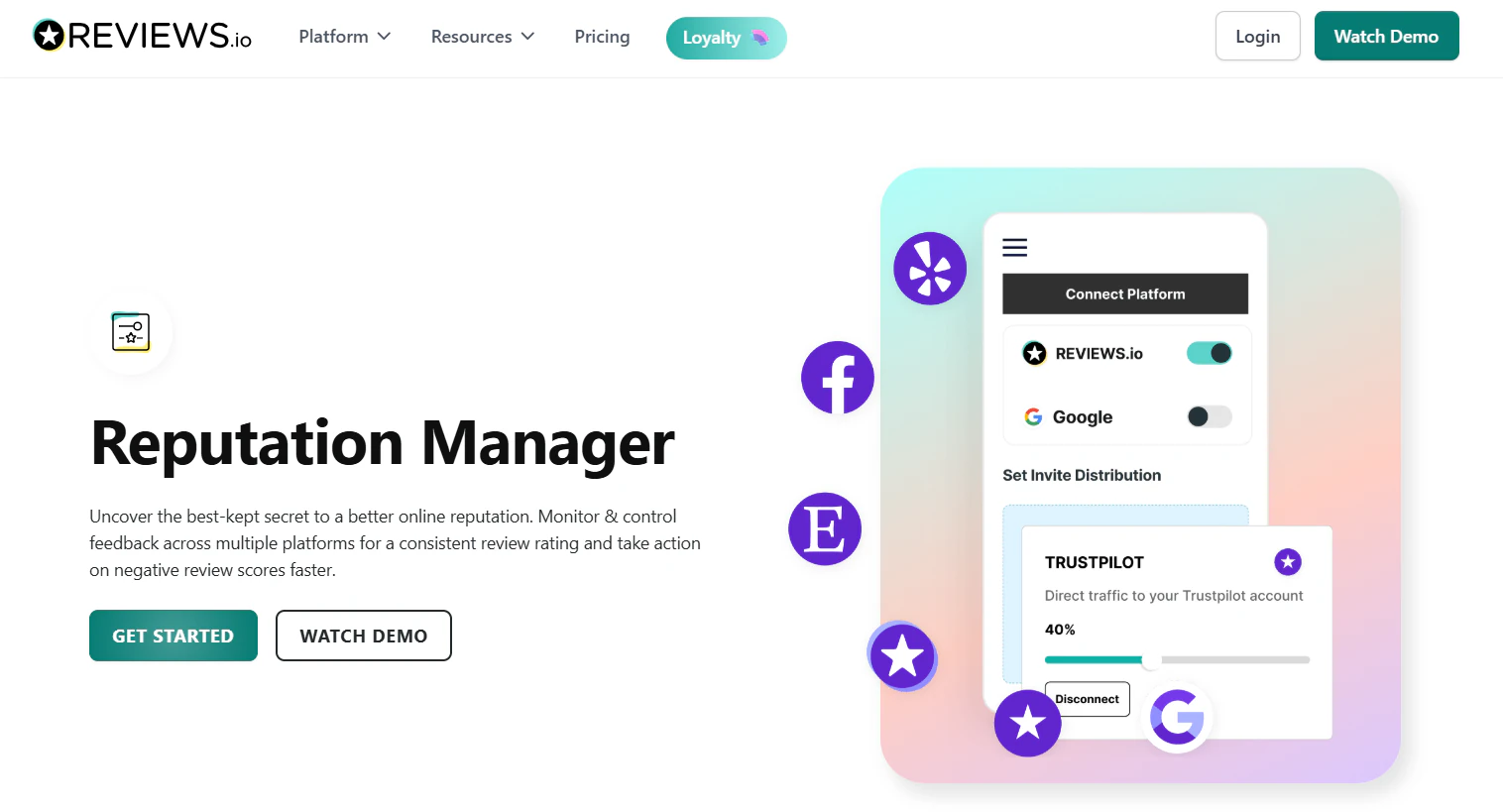
This works well when the business wants review content for product pages, UGC galleries, Google Seller Ratings, and on-site conversion.
Trustpilot combines invited reviews with organic public reviews.
Trustpilot's open model lets consumers write reviews about genuine experiences, while businesses can also invite customers through Trustpilot's collection tools. Trustpilot's Trust Report says reviews can be invited or organic, and all submitted reviews are assessed by automated detection systems before they appear on the platform.
That gives Trustpilot reach and visibility, but it also means the business is participating in a public review network. The value is broader public trust. The tradeoff is less control than a closed or purchase-triggered review program.
RightResponse AI focuses on improving review-request conversion for business reviews.
The platform can use customer details, service context, photos, QR codes, employee attribution, guiding questions, and follow-up rules to make review requests more specific to the customer experience.
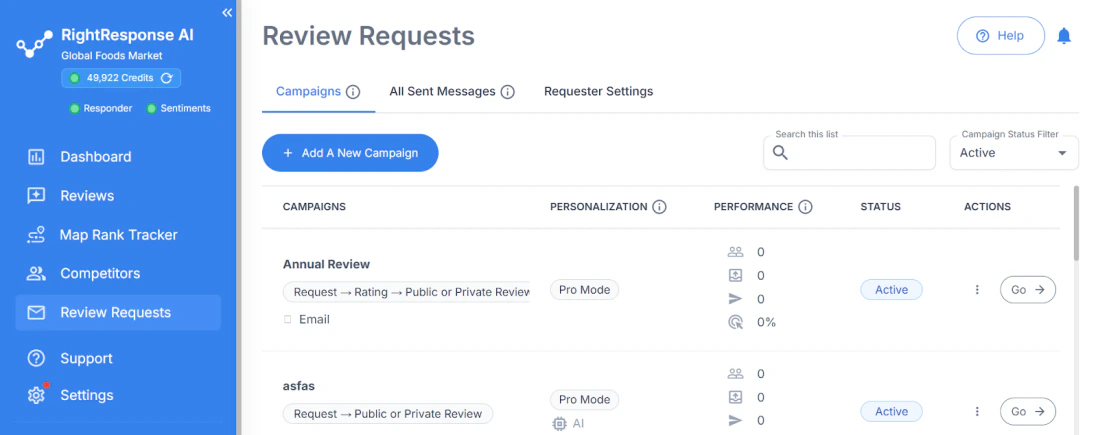
For location-based businesses, that matters because each review opportunity is valuable. A richer request can lead to a more useful review, and a more useful review can help the next customer understand why the business is worth choosing.
Review responses and publishing serve different jobs
REVIEWS.io is strongest when publishing happens on product pages and commerce surfaces.
Review widgets, product-review display, UGC galleries, Google Seller Ratings, and product review SEO all support the same job: making customers more confident while they shop.
Trustpilot is strongest when publishing happens on a public profile and through trust assets.
The Trustpilot profile gives buyers a recognizable place to inspect reviews. TrustBox widgets and marketing assets then let the business bring that third-party trust signal onto its own site, emails, and campaigns.
RightResponse AI puts more weight on the response itself.
When prospective customers compare businesses on review pages, the response is one of the few pieces the business controls. RightResponse AI uses message-informed AI responses to make replies more specific to the business and more useful to the next reader.
A strong response can mention relevant services, guarantees, staff, specialties, or other details that help explain why a customer should choose the business. That is different from a generic acknowledgement that readers skip.
Analytics and customer feedback vary by platform
REVIEWS.io provides useful reporting for review programs.
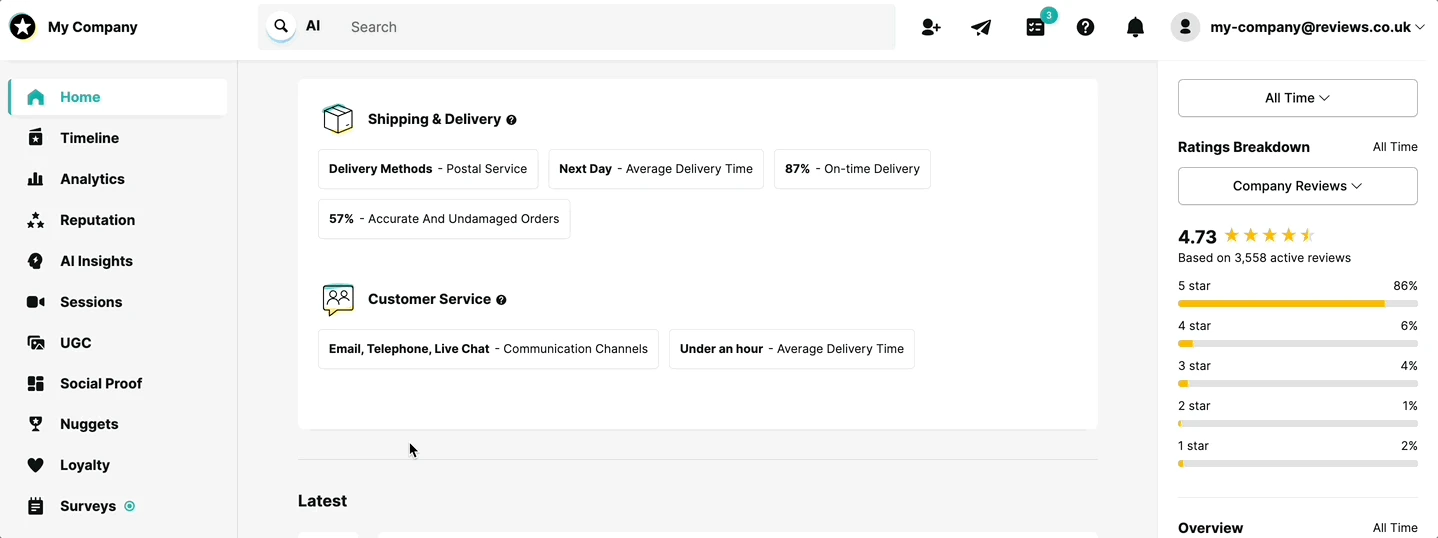
The platform includes review analytics, sentiment analysis, AI assistant features, competitor analysis, and reporting that helps businesses track review performance and customer feedback.

Trustpilot uses review data to support public trust, benchmarking, and brand visibility.
Trustpilot's higher plans include richer dashboards and insights, and its product pages describe Market Insights, Review Insights, data and analytics, review tagging, and visitor insights. These tools are strongest when the Trustpilot profile is part of the business's public reputation strategy.
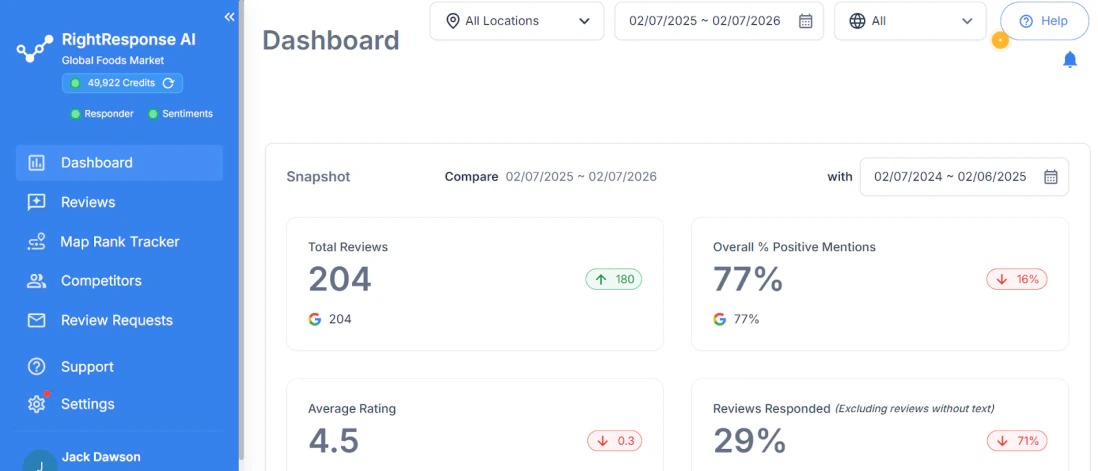
RightResponse AI goes deeper on location-based customer-feedback intelligence.
RightResponse AI's Voice of Customer analysis identifies specific topics customers mention, tracks sentiment around those topics, filters irrelevant content, and can compare competitor reviews using the same framework.
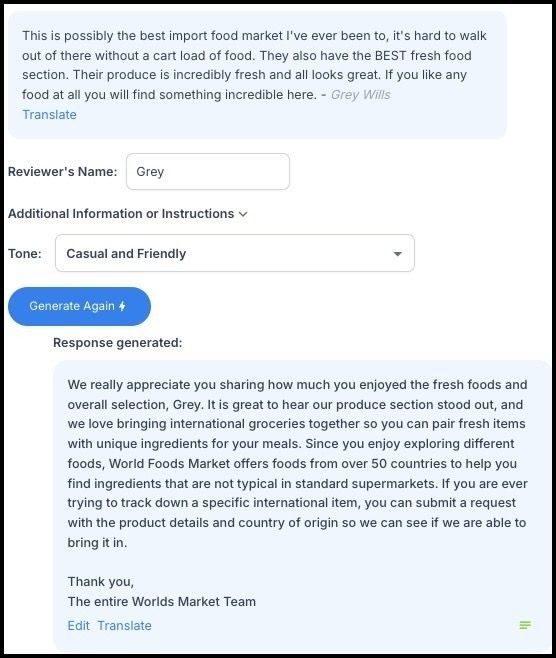
That makes the analysis more operational for a local business: which parts of the experience are creating praise, which issues are costing conversion, and where competitors are winning or falling behind.
Pricing models reflect different buyer commitments
REVIEWS.io uses slider-based pricing shaped by plan tier, review invite volume, billing term, feature gates, and domain count. The U.S. month-to-month pricing capture used for this update shows Essentials from $29/month, Start-Up from $79/month, Grow from $175/month, and Plus from $500/month.
- Free: 25 review invites.
- Essentials: starts at $29/month, with up to 300 review invites.
- Start-Up: starts at $79/month with 1,000 review invites, adding Google Seller Ratings, Google Rich Snippets, review importing, third-party review collection, Klaviyo integration, and 100 SMS invites by default.
- Grow: starts at $175/month with 1,000 review invites, adding Reputation Manager, AI Review Summary, Competitor Analysis, Dynamic Link, Custom Attributes, 100 SMS invites, and 100 survey replies by default.
- Plus: starts at $500/month with 7,500 review invites. It is the first public tier with AI Review Replies, and it also adds multi-language translation, widget development support, a customer success manager, onboarding support, Shoppable UGC Galleries, Bazaarvoice syndication, and API access.
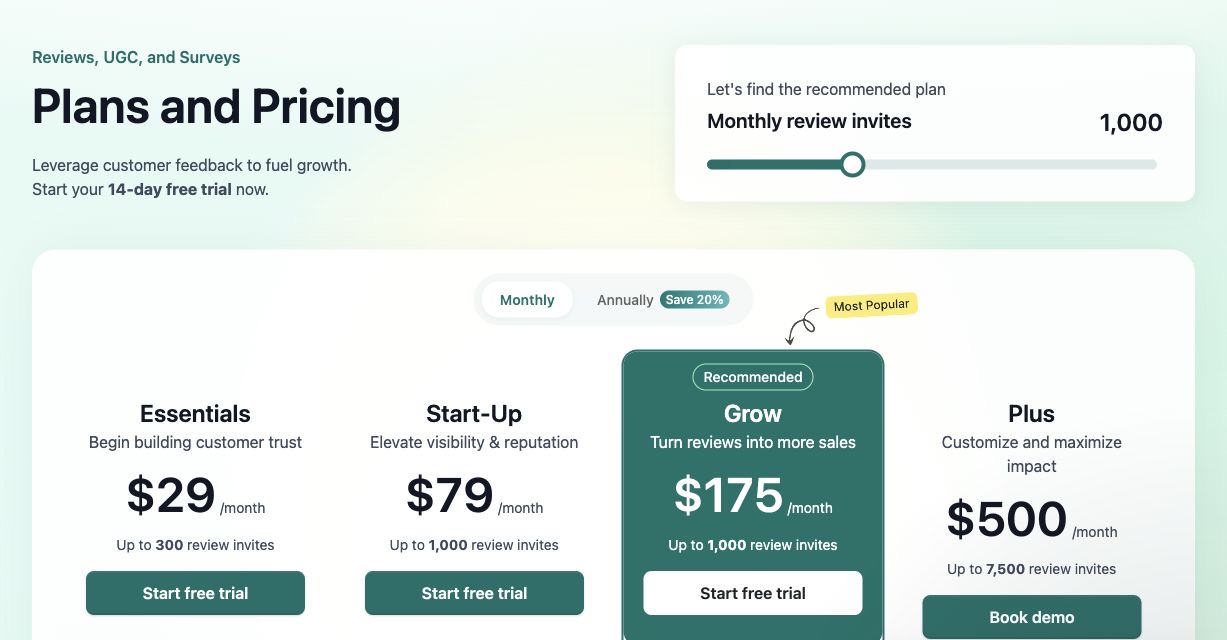
Two pricing details matter in this comparison. First, REVIEWS.io says pricing is calculated per top-level domain, with each top-level domain treated as a separate subscription. Second, current REVIEWS.io support documentation describes Auto-Generated Replies as available on Plus, not Grow. If AI-generated public review responses are part of the buying reason, the relevant REVIEWS.io tier starts with Plus in the current source set.
The live pricing page can present different monthly equivalents depending on the invite slider and billing toggle, so buyers should confirm the final checkout or quote before purchase.
Trustpilot uses annual contracts and per-domain pricing on paid plans.
- Free: available for businesses that want to claim a profile and start with limited tools.
- Starter: from $99/month, billed upfront annually, for new customers and small businesses up to $5M revenue.
- Plus: from $319/month per domain, billed upfront annually.
- Premium: from $799/month per domain, billed upfront annually.
- Enterprise: custom pricing.
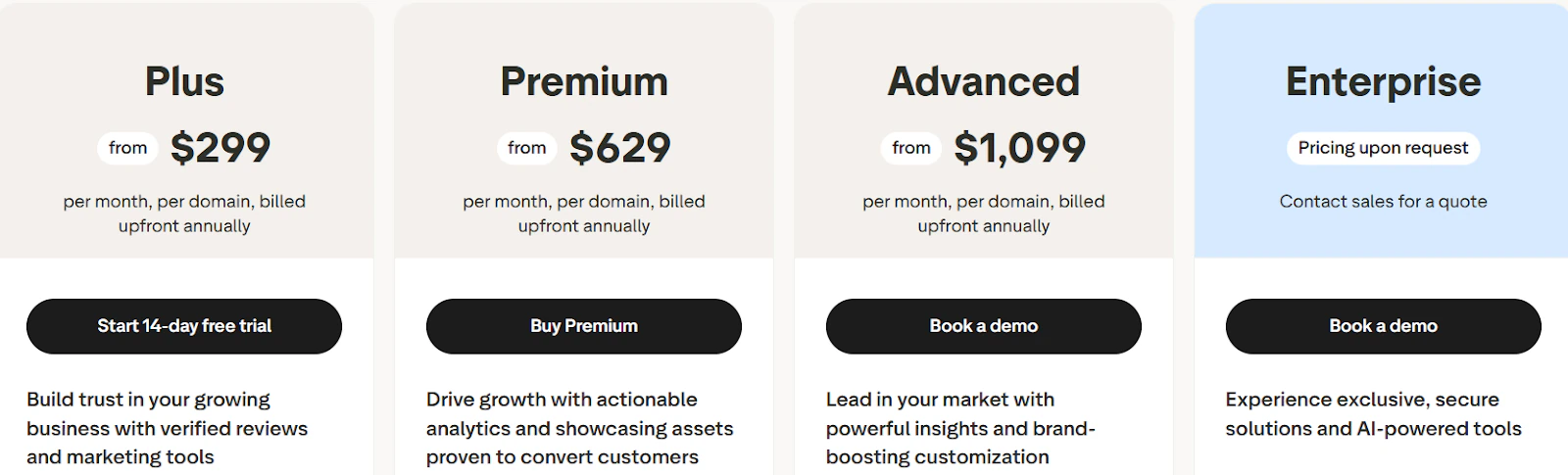
Trustpilot's pricing can make sense when the public trust profile is a major acquisition asset. Buyers should still pay close attention to the annual commitment, per-domain pricing, invitation limits, widgets, users, integrations, and the plan level needed for deeper analytics.
RightResponse AI uses flexible pricing for location-based review and feedback workflows.
Every plan includes RightResponse AI's message-informed AI responses. As you move up from PAYGO to Core, Pro, and Pro+, you get higher limits and additional features for review requests, Voice of Customer analysis, competitor analysis, and local visibility tracking.
For businesses just getting started or with limited review volume, PAYGO is $10/month per location plus usage.
For businesses that want predictable monthly costs, RightResponse AI also offers fixed-price plans:
- Core: $19/month per location, including responses and simple review requests in Essentials Mode.
- Pro: $29/month per location, adding more responses, AI-powered Pro requests, photos, employee QR codes, SEO questions, surveys, and starting packages of map rank tracking.
- Pro+: $44/month per location, providing the highest limits, the most sophisticated features, and API access.
Agencies and large multi-location businesses can create customized plans through the Enterprise / Agency tier.
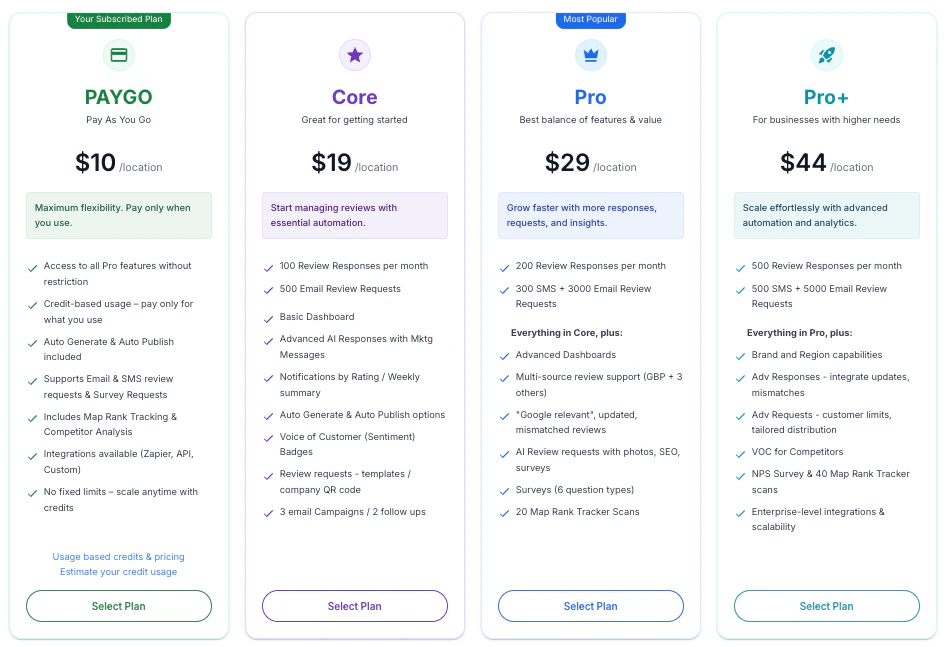
This model gives a local business more ways to match pricing to review volume, response needs, Voice of Customer, local visibility features, and competitor analysis.
Integration capabilities vary by platform
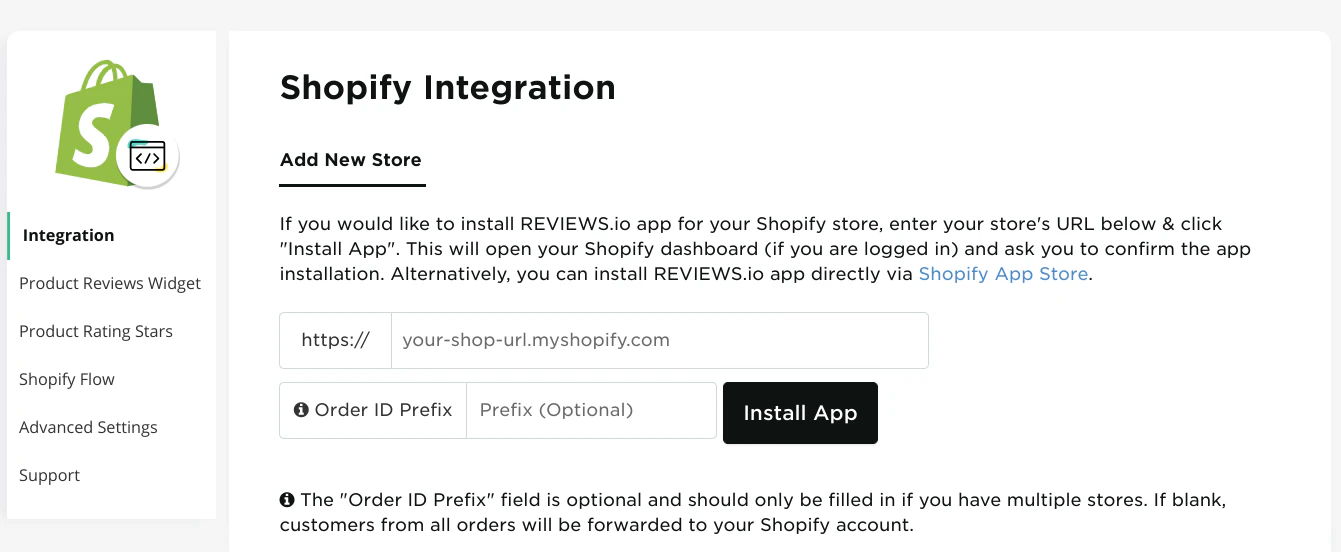
REVIEWS.io is strongest for commerce integrations.
The platform connects with Shopify, Magento, BigCommerce, WooCommerce, Klaviyo, Gorgias, Zendesk, Intercom, and other tools that matter for e-commerce review collection, UGC, and customer workflows.
Trustpilot is strongest when review data needs to support a public trust program across marketing and commerce systems.
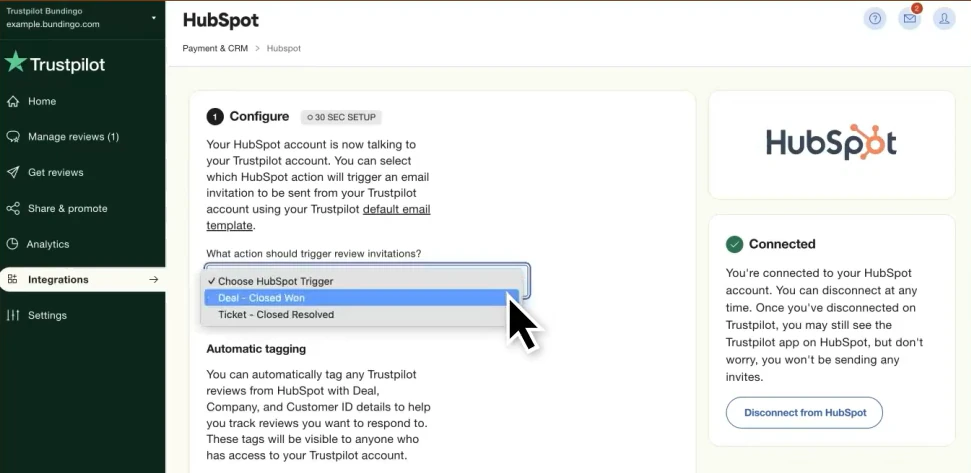
Trustpilot's pricing page lists integrations into marketing and e-commerce tools, and its integration directory includes tools such as HubSpot, Shopify, WooCommerce, Salesforce, Slack, PayPal, and Adobe Commerce. The integration value is tied to collecting reviews, displaying trust signals, and using the Trustpilot profile across buyer touchpoints.
RightResponse AI is strongest when integrations support review-source coverage, Google, review requests, and analysis.
The platform has a native Google integration and can source reviews from more than 125 review platforms into one dashboard. Review requests can be sent by email, SMS, and WhatsApp, with contacts entered directly, uploaded, pulled from remote Google Sheets, connected through Zapier, or handled through custom APIs.
Support and operational fit
REVIEWS.io is a good fit for teams that want a hands-on commerce review platform with support resources, setup paths, and documentation for online stores.
Trustpilot is a good fit for teams that can actively manage a public reputation program. The value comes from using its invitations, widgets, profile, analytics, and trust assets as part of the buyer journey.
RightResponse AI is a good fit for businesses that want review management to become operationally useful. The platform also offers a Done-For-You service for businesses that want human oversight, review response handling, dispute support, sentiment reporting, and strategy support without building the process internally.
REVIEWS.io vs Trustpilot vs RightResponse AI: Which should you choose?
The best platform depends on what reviews need to do for the business.
Choose REVIEWS.io if:
- You run an e-commerce business or product-review-heavy brand.
- You need product reviews, company reviews, photo and video UGC, and review widgets.
- Google Seller Ratings and product-page social proof matter to your strategy.
- You want review collection tied closely to customer and purchase workflows.
- You want a lower entry price than Trustpilot's paid public trust platform.
REVIEWS.io is probably not the right fit if:
- Your main goal is a recognizable public third-party review profile.
- You want Trustpilot's open network and public brand visibility.
- You are a location-based business focused on response quality, customer-feedback analysis, competitor review intelligence, and local visibility tracking.
- You do not need product-review widgets, UGC galleries, or commerce integrations.
Shortlist REVIEWS.io if product reviews and e-commerce social proof are the priority.
Choose Trustpilot if:
- You want a recognizable public trust profile buyers may already know.
- Your customers research your brand in search before buying.
- You want TrustBox widgets, review invitations, public profile content, Google visibility, and trust-marketing assets.
- You are comfortable with annual contracts and per-domain pricing because the public trust signal is commercially important.
- You want both invited and organic reviews to contribute to a public review profile.
Trustpilot is probably not the right fit if:
- You mainly need product-review content and UGC for your own e-commerce site.
- You want a review workflow that is not centered on Trustpilot's annual public-profile model.
- You need message-informed AI responses as a primary workflow.
- You want location-level Voice of Customer analysis, competitor review intelligence, and local visibility tracking in one focused system.
- You do not want to participate in an open public review network.
Shortlist Trustpilot if a public trust profile and third-party visibility are the priority.
Choose RightResponse AI if:
- You run a location-based business where reviews influence who gets the next call, booking, appointment, or visit.
- Response quality matters and you want message-informed replies that can incorporate relevant business messages into the response itself.
- You want smarter review requests with customer context, photos, staff attribution, guiding questions, and follow-ups.
- You want Voice of Customer analysis, competitor review intelligence, and local visibility tracking.
- You want PAYGO or fixed plan pricing that can scale by location and review volume.
RightResponse AI is probably not the right fit if:
- You mainly need e-commerce product reviews, UGC galleries, or on-site product review widgets.
- You want a public consumer review network where buyers can find your third-party profile.
- You need broad TrustBox-style brand assets, Google Seller Ratings, or public review-network visibility as the primary reason to buy.
- You have almost no review volume and no plan to generate more.
Shortlist RightResponse AI if reviews, responses, customer feedback, competitors, and local visibility all need to work together.
Frequently asked questions
What is the main difference between REVIEWS.io and Trustpilot?
REVIEWS.io is usually stronger for product reviews, UGC, on-site review widgets, and e-commerce social proof. Trustpilot is usually stronger when the business wants a recognizable public review profile and third-party trust signal.
Is Trustpilot better than REVIEWS.io for brand visibility?
Often, yes. Trustpilot's public profile, open review network, TrustBox widgets, and search visibility make it strong for brand-level trust. REVIEWS.io is stronger when the review content needs to live closer to product pages and commerce workflows.
When should a business choose RightResponse AI?
Choose RightResponse AI when the business is location-based and wants reviews to support better responses, smarter requests, Voice of Customer analysis, competitor review intelligence, and local visibility tracking.
Can RightResponse AI work alongside REVIEWS.io or Trustpilot?
Yes. A business can use REVIEWS.io or Trustpilot for collection, publishing, or public trust visibility, while using RightResponse AI for response quality, feedback analysis, competitor intelligence, and local visibility workflows.
Which platform has the lowest entry price?
REVIEWS.io and Trustpilot both offer free options, but their paid models are different. In the U.S. month-to-month REVIEWS.io pricing capture used for this update, paid plans start with Essentials at $29/month, while AI Review Replies start with Plus at $500/month. Trustpilot's Starter plan starts at $99/month billed upfront annually, with Plus from $319/month per domain. RightResponse AI starts with PAYGO at $10/month per location plus usage and Core at $19/month per location.
Try RightResponse AI for Free!
*No credit card required.