-1120w.webp)
What Is AI Reputation Management? Definition, Framework, and Key Components
This article is the first in a series on AI reputation management.
Most businesses think AI reputation management means using AI to do traditional online reputation management faster, usually by using generic AI to write review responses.
This is far too narrow. Using advanced AI in reputation management can be much more powerful than this.
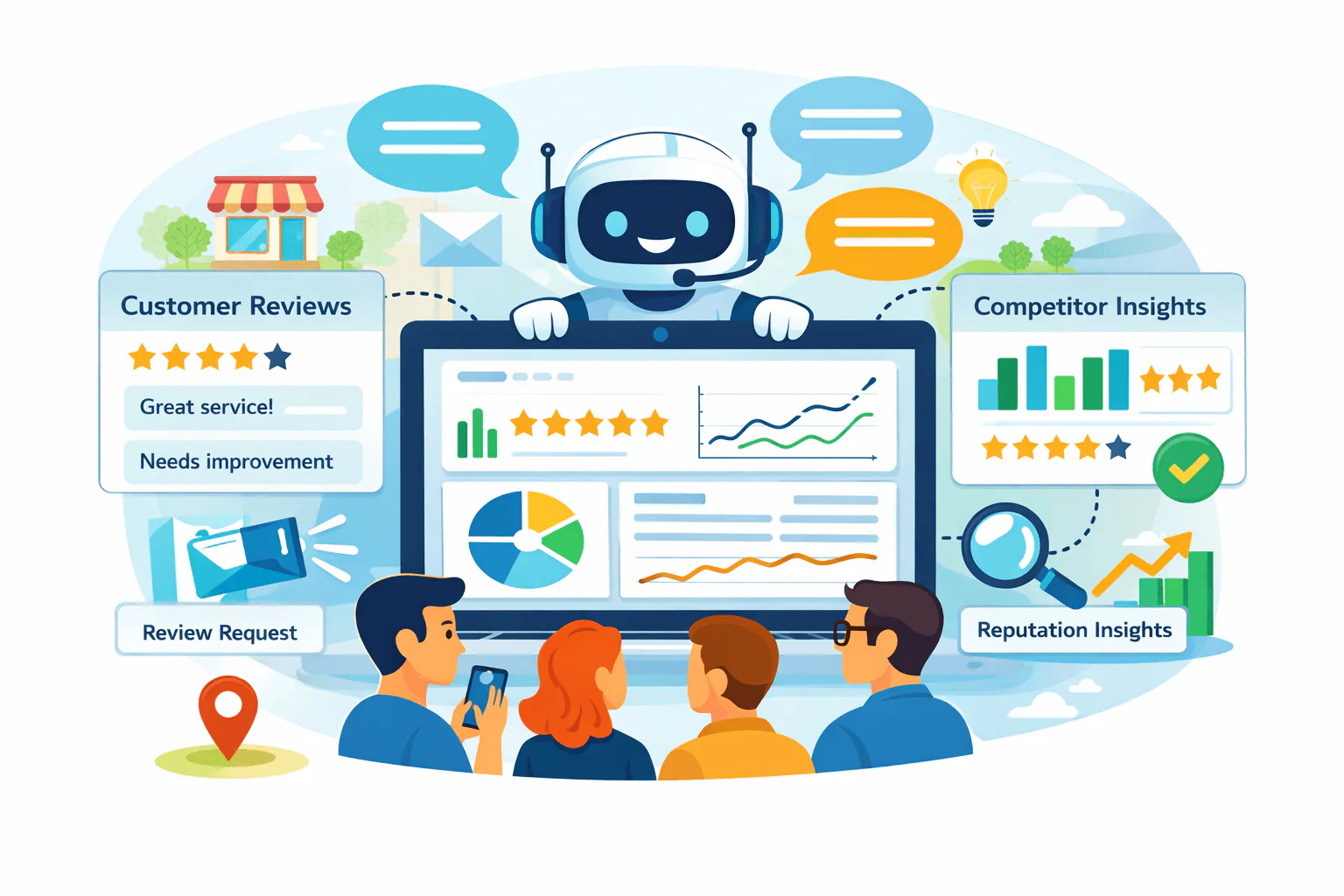
At its best, AI reputation management is not just about writing faster review responses. It is about improving the entire review ecosystem: review requests, Voice of the Customer (review sentiment analysis), competitor review analysis, and the public responses that shape trust on Google Business Profile and in local search.
As we will talk about later, generic AI responders can be worse than not responding at all. It is AI at its worst: polished language that feels inauthentic, says very little, and rarely gets mistaken for personalization.
What businesses are really managing are the elements of a conversation, much of it in public: how reviews are requested, what customers say in return, what the business learns through Voice of the Customer analysis, how competitors are perceived, and finally, how it responds in public.
Most businesses already understand one side of that system. More reviews and stronger ratings can improve local visibility. They can help a business perform better in local search, look stronger on Google Business Profile, and appear more credible at a glance.
What many businesses still miss is the other side.
The quality of review requests influences whether customers choose to speak. Voice of the Customer (review sentiment analysis) reveals what customers actually mean. Review responses are not just administrative follow-up, but public-facing marketing. They influence how prospects interpret the business, how much they trust it, and whether they decide to move forward.
Across that ecosystem, advanced AI can help. It can personalize review requests, surface Voice of the Customer insights across your business and your competitors, and create review responses that are more relevant, useful, and on-brand.
The opportunity is not just faster activity. It is more effective participation in the public conversation that shapes trust, conversion, local visibility, and customer acquisition. When used well, advanced AI helps businesses earn more feedback, understand what customers are actually saying, respond in a more meaningful way, and turn reputation data into marketing, operational, and growth insight.
At its best, AI reputation management moves a business from reactive review monitoring to a proactive system for review requests, review sentiment analysis, review response, and customer acquisition. In short: Request → Learn → Respond → Acquire.

What Is AI Reputation Management?
Here is the clearest definition:
AI reputation management is the use of advanced AI to help a business earn more real reviews, analyze customer feedback through Voice of the Customer and review sentiment analysis, create better public review responses, and turn reputation into customer acquisition, insight, and action.
In practice, a strong AI reputation management system is organized around four connected stages:
Request: Review Requests and AI Request Generation
Earn more real customer reviews through better messaging, personalization, and relevance.
Learn: Voice of the Customer and Review Sentiment Analysis
Analyze customer feedback for sentiment, patterns, priorities, risks, customer language, and competitive opportunity.
Respond: AI Review Response
Create stronger public review responses that are context-aware, promote key marketing messages, are brand-aligned, and relevant to future customers. The result: responses that include content.
Acquire: Customer Acquisition and Reputation Intelligence
Use review-driven trust, local visibility, and reputation intelligence to improve conversion, messaging, and growth.
A system that only drafts responses using generic AI is not an AI reputation management system. A complete advanced AI reputation management system helps a business generate more real reviews, understand what those reviews mean, respond more effectively, identify sentiment patterns, analyze competitors, and use feedback to make better business decisions.
Not every tool that uses AI deserves to be called AI reputation management. Many AI review responders use generic AI to write a response by parroting back what is already in the review itself. That may save time, but it does not create much value. In most cases, it actively weakens how the business is perceived.
Key Concepts
A few definitions make the rest of the article easier to follow.
Request → Learn → Respond → Acquire
A simple framework for AI reputation management: businesses request more real feedback, learn through Voice of the Customer and review sentiment analysis, respond in public with more relevance, and acquire more customers as trust and insight improve.
AI Reputation Management
Using advanced AI to improve how a business earns reviews, analyzes customer feedback, responds in public, understands competitors, and turns reputation into action.
AI Review Generation
Using advanced AI to increase the conversion rate of review requests into reviews through personalization and relevance. It does not mean generating fake reviews.
AI Review Management
The subset of AI reputation management focused on the review lifecycle: review requests, review monitoring, review analysis, and review responses.
AI Review Response
Using advanced AI to create better review responses by drawing on more than the review itself, including important marketing messages, service context, location context, brand standards, and messaging priorities.
Voice of the Customer
The recurring needs, frustrations, compliments, expectations, and language patterns expressed in customer reviews and feedback.
Review Sentiment Analysis
Using AI to analyze reviews for patterns in sentiment, topics, priorities, and changes over time so a business can understand what customers really think.
Competitor Analysis
Using competitor reviews and reputation data to understand how nearby or category competitors are perceived, where they are weak, and where your business can differentiate.
Reputation Intelligence
Turning review and feedback data into insight that informs marketing, operations, customer experience, local strategy, and leadership decisions.
These concepts overlap, but they are not interchangeable. AI reputation management sits above all of them as the larger system.
Generic AI vs Advanced AI Reputation Management
There is a significant difference between generic AI output and advanced AI reputation management.
Using AI review response as the clearest example, generic AI often works from the review alone. It can produce text that sounds acceptable while saying very little. It may miss the emotional tone of the review, ignore what makes the business different, flatten the brand voice, and fail to say anything useful to the next customer reading the exchange.
The same limitation shows up in other parts of the system too. Simple AI can generate shallow summaries. It can apply basic review sentiment analysis without surfacing the patterns that actually matter. It can create activity without improving outcomes.
Advanced AI does more.
Rather than creating inauthenticity, advanced AI can contribute to authenticity because it's informed by the business itself. It can help say to customers and prospective customers what you'd say to them if you were able to be with them in person. It helps the business make review requests more relevant and engaging, understand what to learn through Voice of the Customer and review sentiment analysis, and decide what to say in review responses.
When grounded in the real business, advanced AI is not inauthentic. It is helping the business scale authenticity.
.png)
Why Reputation Management Can No Longer Be Treated as Defensive
Review Responses as Marketing and Customer Acquisition
Traditional online reputation management treated reviews as something to control.
The goal was to minimize damage, calm negative experiences, and avoid looking unresponsive. In that model, responding to reviews was mostly administrative. Businesses acknowledged the reviewer, apologized when necessary, and moved on. It was, and for most businesses still is, a task to get done.
Businesses that have this view of reputation management are missing a major customer acquisition opportunity.
Reviews shape how future customers evaluate a business before they ever call, click, or visit. There is a conversation taking place between your customers and the rest of the world. How you participate in that conversation is important, and entirely up to you. A review response is not just a note to the reviewer. It is a signal to everyone who reads it later.
That is why review responses are not just customer service. They are public communication. At their most effective, review responses are marketing.
A weak response fills the space. A strong response does more. It can reinforce trust, acknowledge the real experience, highlight what makes the business different, and help a prospective customer feel more confident choosing it.
This is where most businesses still underestimate the channel.
They understand that more reviews and stronger ratings can improve visibility in local search and on Google Business Profile. They do not always realize that personalized review requests can improve the conversion of requests into reviews, or that better review responses can improve the conversion of prospects into customers. Reviews help bring a prospect to the decision point through local search. Responses help convert those prospects into customers.
Example: Generic AI Review Response vs Context-Aware AI Review Response
Let’s look at a simple example.
A guest leaves this review:
“I really enjoyed my meal at Bert’s Steakhouse. While it was a little loud, the NY Strip was probably one of the best I’ve ever had. Everyone at the table enjoyed the meal, our server was great, and we will certainly be back.”
A generic AI review response might sound polished, but it also sounds like it could have come from almost any restaurant:
“Thank you for your kind words and for sharing your positive experience at Bert’s Steakhouse. We’re delighted to hear you enjoyed the NY Strip and that our team provided great service. We appreciate your feedback about the noise level and will consider ways to enhance the ambiance. We look forward to welcoming you back soon!”
Sounds familiar, right?! There is nothing technically wrong with that response. It says the right things. It is polite, professional, and grammatically clean. The problem is that it feels interchangeable. Swap out the restaurant name, and the response still works.
Now compare that to a context-aware AI review response:
“We’re so glad you enjoyed the steak. We source our beef from a terrific ranch in Colorado that we’ve worked with for more than five years, and the NY Strip is one of the cuts we’re most proud of. We also appreciate the note about the noise. Our main dining room can get lively, so next time you make a reservation, ask for the rear dining room. It has fewer tables and is usually much quieter. We’d love to have you back.”
That response does more than acknowledge the review. It adds substance. It reflects the restaurant’s actual product, addresses the concern with a useful recommendation, and sounds like it came from a business that knows its own operation.
That is the difference between AI that simply generates words and AI that supports real hospitality. The first response checks the box. The second builds trust and supports customer acquisition.
Advanced AI matters here because it is the only practical way to provide relevant and useful personalization without writing the personalization yourself. Advanced AI can recognize what kind of response the moment calls for and weave brand-relevant messaging into the reply without sounding canned.
The Request → Learn → Respond → Acquire Framework
A strong AI reputation management system usually includes six connected capabilities inside four stages.
1. Request: Review Requests and AI Request Generation
AI reputation management starts before the review is written.
A business needs a steady flow of real customer feedback. That starts with review requests sent at the right time, through the right channel, with the right message.
The first real advantage of advanced AI here is personalization.
Personalized review requests increase the likelihood that a request becomes an actual review because the request feels connected to a real experience rather than to generic automation. That is one reason in-person requests often work so well: they are live, immediate, and genuine.
Advanced AI can bring that same relevance into digital review requests.
.png)
Instead of sending the same message to everyone, a business can tailor the request based on the service provided, the timing of the interaction, the location involved, the staff member connected to the experience, or the type of customer relationship. When appropriate and privacy-safe, the request can reference something concrete, such as the appointment attended, the project completed, the item purchased, or even a photo associated with the experience.
This is not fluff. It is personalization.
And personalization is what improves review request conversion.
2. Learn: Voice of the Customer and Review Sentiment Analysis
The Learn stage is where reputation management becomes more than a workflow. It becomes intelligence.
Voice-of-the-Customer Analysis
Reviews are one of the richest free sources of customer feedback most businesses have.
They reveal what people value, what frustrates them, what they expected, what they noticed, and what they remembered well enough to say publicly. That is valuable because it is the customer’s language, not the company’s.
AI can perform review sentiment analysis across large volumes of review text to identify recurring themes, emotional patterns, topic clusters, and shifts over time that are difficult to spot manually.
.png)
This is the Voice of the Customer layer.
It moves a business from anecdotal reading to structured understanding. Instead of saying, “We have seen a few complaints about wait times,” a team can see whether wait-time complaints are increasing, which locations they are concentrated in, what language customers use when they mention them, and which other issues tend to appear alongside them.
That is the point at which reviews stop being comments and start becoming insight.
It is also the point at which reviews become useful for messaging. The same language customers use in reviews can inform website copy, ad copy, review requests, sales messaging, and future review responses.
Review Monitoring and Prioritization
Once reviews have been analyzed through Voice of the Customer and review sentiment analysis, the next challenge is prioritization.
Businesses need to know what was said, where it was said, which location it affects, and whether it needs immediate attention. In a manual workflow, reviews often appear as a flat stream that teams work through one at a time.
Advanced AI makes that stream more intelligent.
It can use classifications such as topic, sentiment, location, business unit, and urgency to identify the reviews that should not sit in the normal queue.

For example, if a review mentions an injury, a safety issue, discrimination, fraud, harassment, or the threat of legal action, that is not just another negative review. It is a different class of event. A stronger AI system can flag it and alert the right people before someone posts a public reply to a high-risk situation.
That is what makes the workflow smarter, not just faster.
Competitor Analysis and Local Competitive Visibility
Reputation is always relative.
Customers rarely evaluate a business in isolation. They compare businesses within a local market or a category, even when they do not say so explicitly. AI can analyze competitor reviews to identify where those businesses are strong, where they are weak, and what gaps exist in the market.
For example, if nearby competitors are repeatedly criticized for poor communication, slow follow-up, or inconsistent service, that information is strategically valuable. It helps a business understand not just how customers feel about it, but how it can differentiate in a way that matters locally.
This is especially important for local businesses and multi-location brands, where customer choice is often shaped by nearby alternatives rather than by broad national comparisons. Google Maps rank tracking adds another layer by showing how those same competitors compare in local visibility and how the market is shifting over time.

3. Respond: AI Review Response and Review Response Optimization
AI review response is the most visible part of AI reputation management.
Yes, generic AI can help draft responses to positive, neutral, and negative reviews. But speed is not the real goal. Better review responses are.
A strong AI review response does five things at once:
- it recognizes the actual customer experience
- it matches the emotional tone of the moment
- it identifies relevant messages based on the subject of the review
- it reinforces the business’s standards, strengths, or differentiators
- it speaks to the future customer who will read it later
That is why review responses are not just a service task. They are a marketing asset.
A generic “Thank you for your feedback” technically counts as a response. But it does almost nothing for trust, conversion, or differentiation. In many cases, customers can tell when a response is templated or generic, and when they can, it rarely helps the business.
A stronger review response participates in the conversation in a meaningful way. It reinforces what the business does well, clarifies how the team thinks about service, and helps prospective customers understand what kind of business they are dealing with.
Other than writing every response yourself, an advanced AI review responder is the only practical way to do this consistently at scale.
That is also why a free AI review response generator or generic prompt is not enough. Generic AI usually works from the review text alone and repeats back the content of the review. Advanced AI can work from the review plus relevant business context, approved brand messages, location-specific information, service details, and response rules. That produces a much stronger public-facing result.
It also creates more specific public-facing content around the business. Over time, that can strengthen trust, improve conversion, and help search platforms and AI systems better understand what the business actually does well.
.jpg)
4. Acquire: Customer Acquisition, Local SEO, and Reputation Intelligence
Customer acquisition is the highest-value layer of AI reputation management.
This is where better review requests, better review sentiment analysis, and better AI review responses start producing visible business outcomes.
A business that requests reviews well can increase review volume and freshness. A business that learns from reviews through Voice of the Customer and review sentiment analysis can sharpen its positioning, improve operations, and spot local competitive gaps. A business that responds well can increase trust at the exact moment prospects are deciding whom to choose.
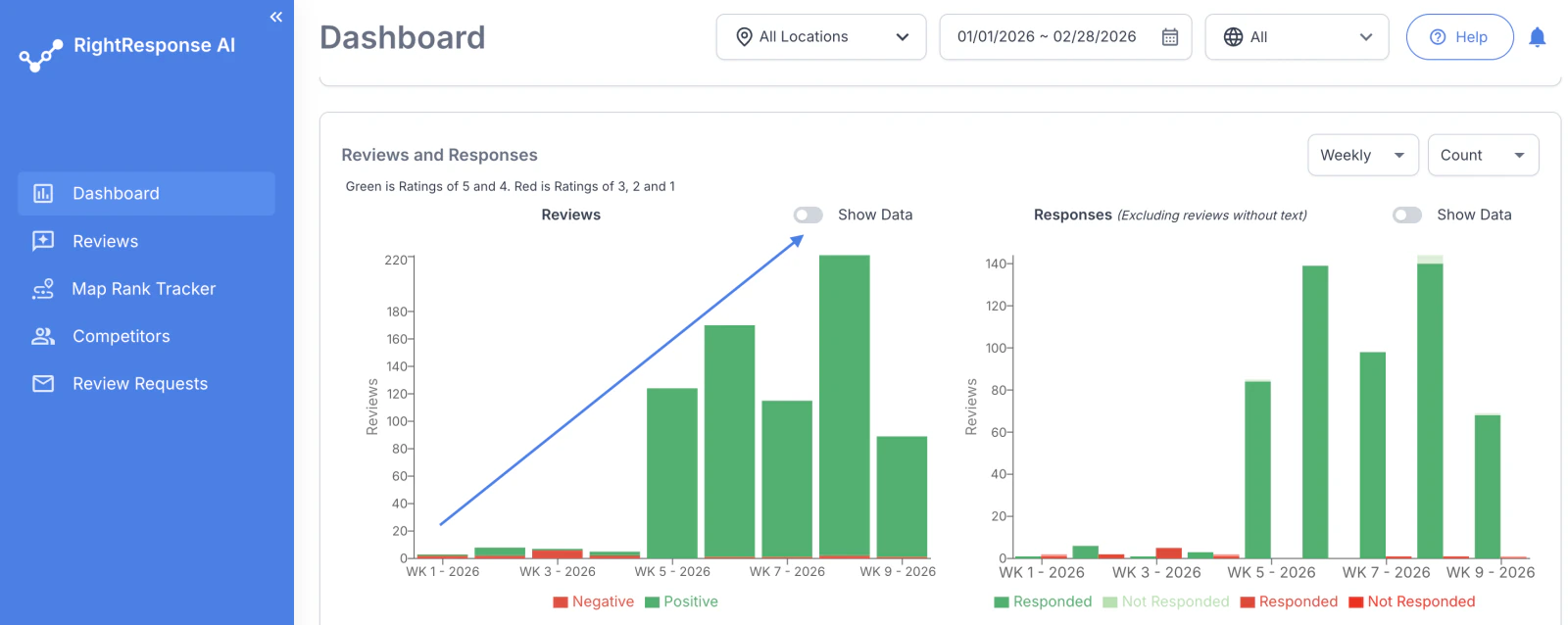
Together, those effects can improve local visibility, strengthen credibility on Google Business Profile, and increase conversion.
This is where reputation management becomes more than a monitoring workflow or a response workflow. It becomes reputation intelligence.
Over time, advanced AI reputation management should help businesses answer questions like:
- Which review requests generate the highest conversion into real reviews?
- Which themes appear most often in the reviews and review responses that prospects see first?
- What strengths should be reinforced in marketing?
- What problems keep appearing at one location, and how are they affecting trust?
- Which competitors are gaining local visibility, and where are they weak?
- How can the public conversation around the business do more to improve customer acquisition?
The real value is not just that AI can observe the conversation. It is that the business can use reputation intelligence to improve local SEO, win more customers, and make better decisions.
Traditional Reputation Management vs. Generic AI vs. Advanced AI Reputation Management
The difference is easiest to see side by side.
| Stage | Traditional Reputation Management | Generic AI Automation | Advanced AI Reputation Management |
|---|---|---|---|
| Request: Review requests | Generic asks sent manually or in bulk | N/A | Personalized review requests based on service, timing, location, and customer context |
| Learn: Voice of the Customer | Anecdotal reading and fragmented insight | Shallow summaries or simple sentiment labels | Voice of the Customer analysis, review sentiment analysis, prioritization, trend detection, and competitor analysis |
| Respond: AI review response | Written by hand or using templates | Fast replies based only on the review text | Context-rich responses using business facts, brand messaging, tone control, and rules |
| Acquire: Customer acquisition and reputation intelligence | Reactive cleanup with little reuse of insight | More activity, but limited strategic lift | Trust-building that improves conversion and customer acquisition |
The biggest shift is not that AI makes traditional online reputation management faster, although it can.
The biggest shift is that advanced AI changes the nature of the system. Traditional online reputation management is reactive. Generic AI makes it more efficient. Advanced AI improves review requests, turns customer feedback into Voice of the Customer and review sentiment analysis, strengthens AI review responses, and connects reputation to customer acquisition.
What Good AI Reputation Management Looks Like
A strong AI reputation management program is not defined by how many reviews it answers. It is defined by the quality of its review requests, Voice of the Customer analysis, review sentiment analysis, AI review responses, competitor analysis, and reputation intelligence.
Good AI reputation management is:
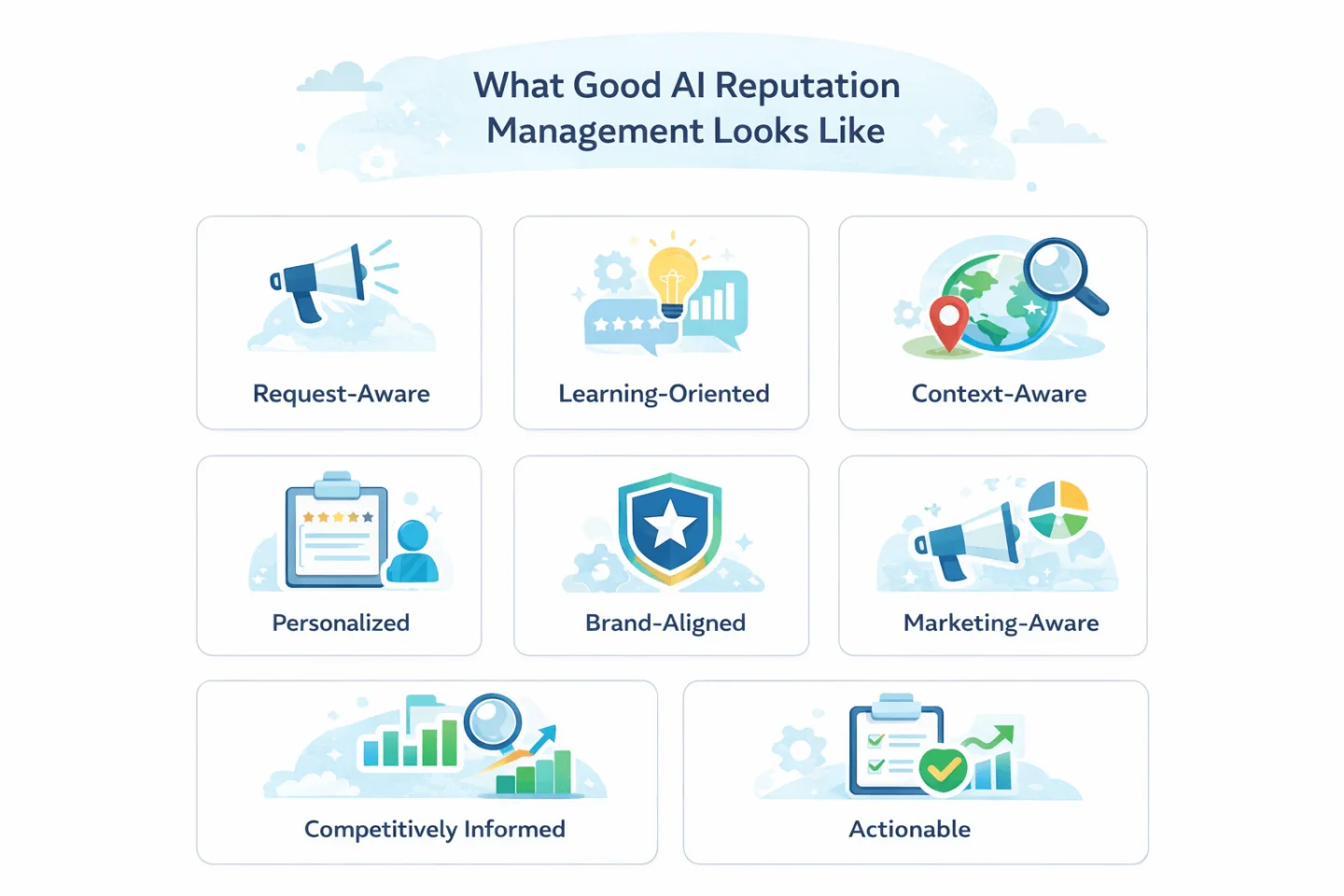
Review-request aware
It improves review requests through better timing, relevance, and personalization.
Voice-of-the-Customer driven
It uses Voice of the Customer analysis and review sentiment analysis to surface patterns, risks, strengths, and customer language that the business can actually use.
Context-aware
It knows something about the business, location, and interaction, not just the review text.
Personalized
Review requests and review responses feel relevant rather than generic.
Brand-aligned
The language sounds like the business and reinforces what matters to it.
Marketing-aware
It recognizes that review responses influence future customers, trust, and customer acquisition.
Competitively informed
It uses competitor analysis and local visibility data to show how the business is perceived relative to nearby alternatives.
Actionable
It turns reputation intelligence into decisions that marketing, operations, and leadership can use.
Governed
It can route sensitive cases to humans and apply different rules to different situations.
That is the standard the category should move toward.
Where Businesses Get AI Reputation Management Wrong
The biggest mistake businesses make is not technical. It is strategic.
They treat AI reputation management as a review response problem instead of a marketing opportunity.
Reviews are not just feedback to manage. They are public marketing assets.
Many businesses still see the review ecosystem as something to manage defensively instead of something to use offensively. They treat reviews as reputation hygiene rather than as a growth channel.
That causes them to miss opportunities at every stage.
First, better review requests can increase review volume, freshness, visibility, and credibility. Personalized review requests are one of the clearest ways to improve the conversion of request to review.
Second, better Voice of the Customer analysis and review sentiment analysis can surface the customer language, service issues, differentiators, and competitor weaknesses that should shape marketing and operations.
Third, better review responses can increase the percentage of prospects who choose the business. An authentic, helpful, and relevant response does not just acknowledge the past customer. It helps persuade the future one.
Fourth, better reputation intelligence turns all of that into action. It connects review requests, customer insight, review responses, local visibility, and customer acquisition.
Why AI Reputation Management Matters Now for Customer Acquisition and Local Search
Reputation management matters because customer decision-making has become more public.
People often encounter a business through its Google Business Profile, online reviews, and local search presence before they ever encounter its website. They scan reviews, look for negative experiences, and look to see how the business engages.
That means reputation is not just something to protect. It is something that helps shape demand.
Manual workflows usually create one of three bad outcomes: not enough fresh feedback, inconsistent review responses, or no meaningful Voice of the Customer or review sentiment analysis. Generic AI improves speed, but it often feels inauthentic and does little to improve the system behind the output.
The real opportunity is to use advanced AI to generate better review requests, better review sentiment analysis, better review responses, and better reputation intelligence.
Advanced AI makes it possible to earn more feedback, improve local visibility, respond in a way that supports customer acquisition, understand reputation at scale, and use customer language as a source of operational and marketing insight.
Frequently asked questions
What is AI reputation management in simple terms?
AI reputation management is the use of advanced AI to help a business earn more real reviews, analyze customer feedback, create stronger public review responses, and turn reputation into customer acquisition, insight, and action.
How do AI-powered review requests help businesses earn more reviews?
AI-powered review requests help businesses earn more reviews by improving what they say. More relevant, personalized review requests can increase the conversion of request to review because they feel connected to a real customer experience instead of generic automation.
What is review sentiment analysis and Voice of the Customer analysis?
Review sentiment analysis uses AI to identify patterns in customer reviews, including recurring themes, emotional tone, strengths, frustrations, and shifts over time. Voice of the Customer analysis builds on that by showing the language customers use and the issues they care about most, so businesses can improve operations, messaging, and review strategy.
Why are review responses part of marketing and customer acquisition?
Review responses are public-facing communication. They are read by future customers, not just past ones. A strong review response can build trust, reinforce what makes the business different, and influence whether a prospect chooses the business after seeing it on Google Business Profile or in local search.
Is AI reputation management the same as using ChatGPT or a free AI review response generator?
No. Using ChatGPT or a free generic AI review response generator can help draft a reply, but that is only one small part of AI reputation management. A stronger system also improves review requests, uses review sentiment analysis and Voice of the Customer insight, applies business context and response rules, and helps the business turn public feedback into better decisions and stronger customer acquisition.
How does AI reputation management improve local visibility and customer acquisition?
AI reputation management can improve local visibility and customer acquisition by helping businesses earn more fresh reviews, understand what customers are really saying, and respond in ways that build trust. Over time, that can strengthen how the business is perceived in local search and on Google Business Profile while helping more prospects feel confident choosing it.
What should an AI reputation management platform include?
At a minimum, an AI reputation management platform should support review requests, review sentiment analysis, Voice of the Customer insight, review monitoring and prioritization, AI review response, competitor analysis, and reputation intelligence. A stronger platform will also include approval rules, escalation logic, brand controls, and ways to turn customer feedback into marketing and operational action.
Conclusion
AI reputation management is not just the use of AI to write faster review responses.
It is the use of advanced AI to improve review requests, review sentiment analysis, Voice of the Customer insight, review responses, competitor analysis, and reputation intelligence so a business can turn public feedback into stronger trust, better decisions, and customer acquisition.
Today, many customers first encounter a business through its Google Business Profile, online reviews, and local search presence. That means reputation is no longer just something to protect. It is part of how demand is created.
The businesses that win will not be the ones that merely automate replies. They will be the ones that use personalized review requests to earn more feedback, review sentiment analysis to understand what customers are really saying, and marketing-first review responses to build trust at the moment of choice.
That is what makes AI reputation management a growth system rather than a defensive workflow. Request → Learn → Respond → Acquire is a useful framework for understanding how the review ecosystem can work for you.
Sources and further reading