Choosing between SOCi vs Yext for your multi-location business often comes down to these five critical questions:
Comparison research: This article is part of the RightResponse AI review management software comparison library, which connects platform reviews, pricing analyses, alternatives, and head-to-head evaluations.
- Do you need a comprehensive marketing cloud or a focused reputation management solution?
- Is review response quality, responses that actually win new customers, more important than platform breadth?
- Are you willing to pay enterprise-level prices for features you may never use?
- How important is transparent, usage-based pricing versus custom quotes requiring sales calls?
- Do you need a platform built from the ground up with generative AI, or one that added AI as an afterthought?
In short, here's what we recommend:
👉 SOCi positions itself as a "CoMarketing Cloud" for multi-location enterprises, offering a broad suite of tools spanning social media management, listings, reviews, local pages, and advertising. Its "Genius" AI platform provides automation across these functions, and it works with nearly 1,000 brands including Ford and Ace Hardware. However, SOCi's enterprise focus means steep pricing (estimated $15,000-$62,000+ annually), a platform with a learning curve that some users find challenging to navigate, and an AI that, while comprehensive, is spread across many functions rather than deeply specialized in any single area.
👉 Yext serves as the "Knowledge Graph" pioneer, building its reputation on maintaining accurate business listings across 200+ publishers. The platform offers reviews, pages, and search capabilities, all powered by its centralized data model. While Yext excels at data consistency, users frequently cite customer support issues, a confusing interface, and premium pricing. Its AI capabilities, while present, were added over time rather than being foundational to the platform.
Both platforms are powerful enterprise solutions designed for large multi-location businesses. However, their broad focus and enterprise pricing can mean that businesses pay for extensive features they don't fully utilize, while the core function of managing reviews and reputation becomes one capability among many.
👉 RightResponse AI takes a fundamentally different approach by focusing on what matters most for local business growth: turning reviews into a competitive advantage. The platform delivers response quality that actually wins new customers, not just generic acknowledgments, but personalized replies that market your business to prospects reading your reviews. Its three-pillar personalization system (Facts for what to say, Customizations for behavioral rules, and Brand Voice for tone) produces responses with endless variation while maintaining brand consistency. The platform also includes advanced AI-powered review collection, Voice of the Customer, and Google Maps rank tracking. With transparent pricing starting at just $10/month per location plus usage-based credits, businesses of any size, from single locations to enterprise, get capabilities that match what they actually use. For organizations that want reviews to drive real revenue growth, RightResponse AI offers the most direct path to results.
If you're looking for AI-powered reputation management that delivers immediate impact without the complexity, see how RightResponse AI can transform your review strategy with a 7-day free trial.
Table of contents:
- SOCi vs Yext vs RightResponse AI at a glance
- The fundamental divide: Marketing suites vs focused reputation tools
- AI quality matters more than AI quantity
- Review response is where reputation is won or lost
- Review collection drives review velocity
- Voice of the Customer reveals the platforms' true priorities
- Pricing transparency shows who values your business
- Google Maps visibility determines local success
- SOCi vs Yext vs RightResponse AI: Which should you choose?
SOCi vs Yext vs RightResponse AI at a glance
Here's the fundamental difference: While all three platforms help multi-location businesses manage their online reputation, they approach the challenge from distinctly different philosophies:
- SOCi attempts to be everything for multi-location marketing, covering social, listings, reviews, pages, and ads.
- Yext focuses on data consistency through its Knowledge Graph, syndicating information across a vast publisher network.
- RightResponse AI concentrates on what actually drives local business growth: intelligent review management that turns responses into conversion assets, plus AI-powered review collection and local SEO visibility.
SOCi | Yext | RightResponse AI | |
|---|---|---|---|
Primary focus | All-in-one marketing cloud | Knowledge Graph and listings | AI-powered reputation management |
AI foundation | Added to existing platform | Incorporated over time | Built from the ground up with AI |
Review response | Automated AI responses | AI-generated responses | Three-pillar personalization (Facts, Customizations, Brand Voice) |
Review collection | Review solicitation included | Review generation available | AI-personalized requests with photos, SMS, email |
Sentiment analysis | Included with opinion clusters | Keyword-level NLP with sentiment scoring | Voice of the Customer ABSA with custom topic mapping |
Pricing transparency | Custom quotes only | Custom quotes for enterprise; some SMB plans available | Transparent: PAYGO ($10/location + credits) plus fixed Core/Pro/Pro+ plans; Enterprise custom |
Starting cost | ~$15,000+/year (estimated) | Custom enterprise pricing; SMB from ~$199/year | $10/month per location |
Google Maps tracking | GeoRank geographic grid analysis | Competitive Intelligence search tracking | Detailed grid-based rank tracking |
Best for | Large enterprises wanting one platform | Enterprises prioritizing data consistency | Businesses focused on reviews and local SEO |
The fundamental divide: Marketing suites vs focused reputation tools
Understanding the philosophical differences between these platforms is essential before diving into features.
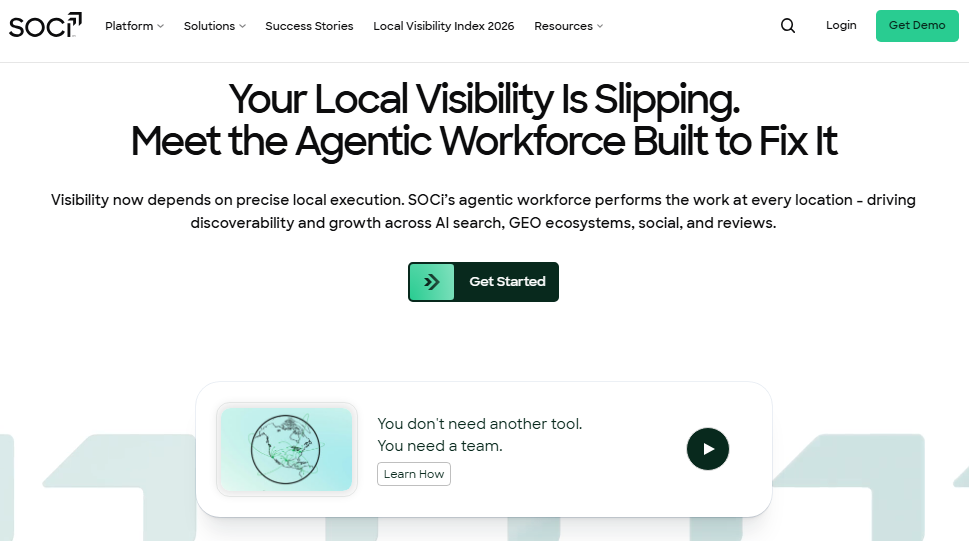
SOCi positions itself as a complete "CoMarketing Cloud" that aims to handle every aspect of multi-location digital marketing.
This includes social media scheduling, paid advertising, local pages, surveys, and chat functionality alongside reputation management. The company works with nearly 1,000 brands and emphasizes its ability to manage marketing for over three million business locations. For enterprise marketing teams wanting a single vendor for everything, this breadth has appeal.
The challenge with this approach is that breadth often comes at the expense of depth.
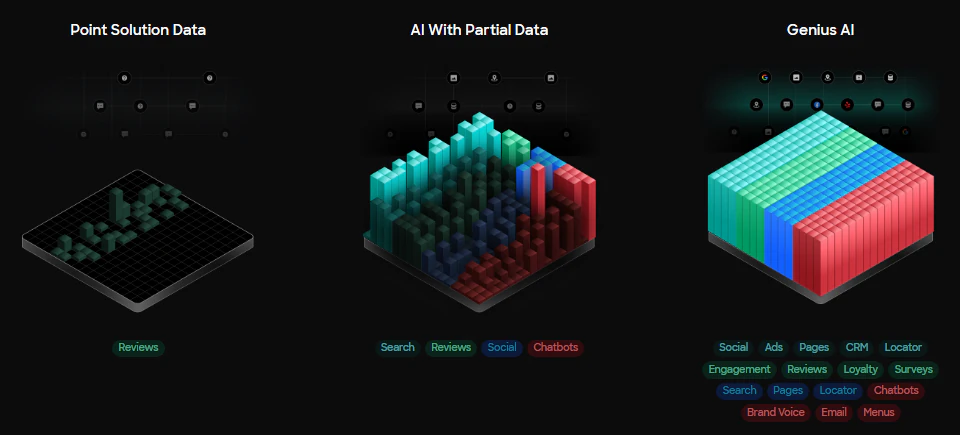
SOCi's AI, branded as "Genius," is distributed across social media, reviews, search, and advertising. While each function works, none receives the concentrated development focus that a specialized tool provides. A Forrester study commissioned by SOCi highlights efficiency gains, but user reviews mention a learning curve and complex interface, suggesting some users may only utilize a portion of the platform's capabilities.
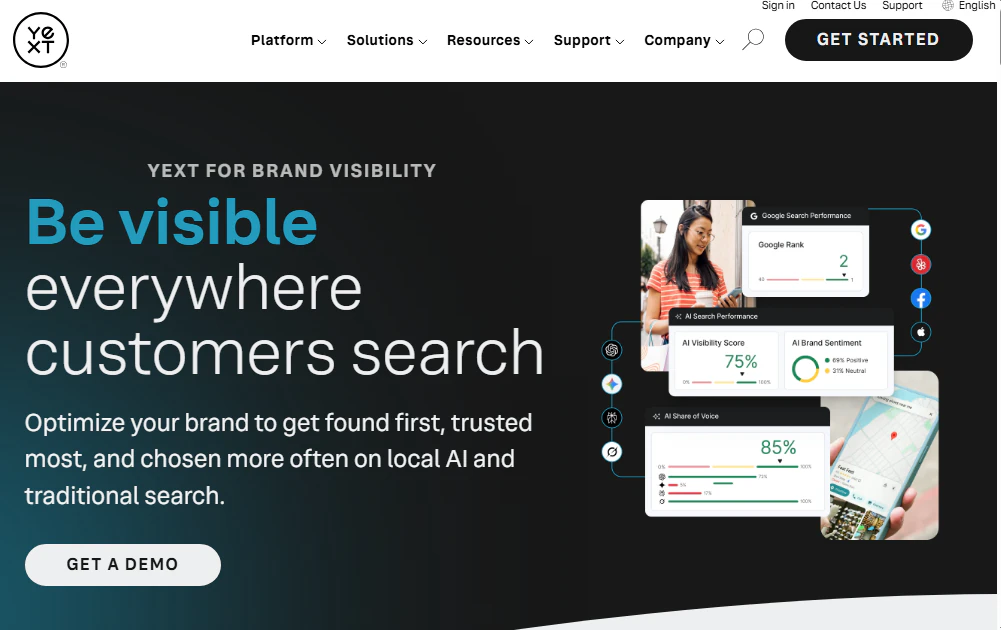
Yext takes a different but similarly expansive approach, built around its "Knowledge Graph" concept.
The idea is compelling: create a single source of truth for all business information that syndicates to 200+ publishers. This ensures your hours, address, and services are consistent everywhere. Yext has expanded to include reviews, pages, and search functionality, adding to its comprehensive suite.
The reality for many Yext users, however, has been mixed. User reviews frequently mention issues with customer support, interface complexity, and the gap between the platform's promise and its execution. One recurring theme is that Yext's listings management, while powerful in theory, sometimes delivers inconsistent results in practice.
RightResponse AI emerged from a different starting point entirely.
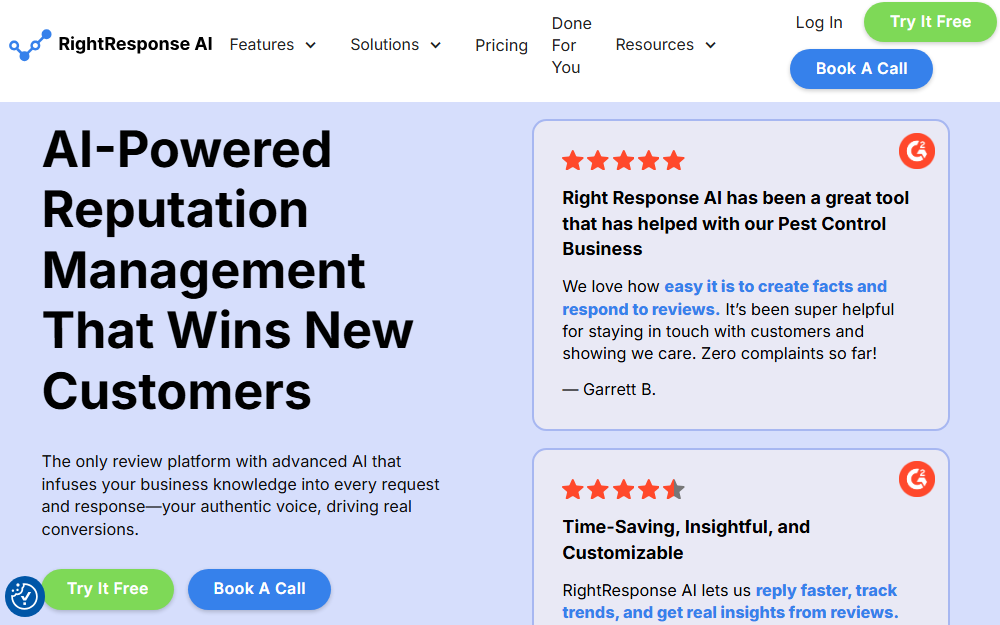
Founded by George Swetlitz, former CEO of a healthcare clinic network with over 200 locations, the platform was built to solve a specific problem: how to transform customer reviews into a genuine competitive advantage. Rather than attempting to do everything, RightResponse AI concentrates on doing reputation management exceptionally well.
This focused approach enables deeper AI capabilities. Instead of spreading generative AI across social, ads, and search, RightResponse AI uses an intentionally agentic approach that separates analytical functions from writing functions.
The system analyzes each review before generating a response, handles edge cases like review updates and rating-text mismatches, and for medical practices, avoids including Protected Health Information in responses. This multi-step pipeline reduces the risk of inappropriate responses while increasing relevance, something generic AI implementations can't match.
AI quality matters more than AI quantity
The difference between "AI-powered" as a marketing checkbox and AI as a foundational technology becomes clear when you examine how each platform handles review responses.
SOCi's "Genius Reviews" uses GPT-4 technology to generate responses to customer reviews. The system can be trained on a brand's voice and includes risk-mitigation features. For high-volume enterprises, this can provide efficiency gains. The AI handles routine reviews while allowing teams to focus on more complex situations.
However, SOCi's AI serves many masters. The same underlying technology powers social content generation, search optimization, and advertising recommendations. This breadth means the AI must be generalist rather than specialist.
A response generated for a review may be adequate, but it may not incorporate specific business facts or adapt its approach based on detailed analysis of what drives customer sentiment at particular locations.
Yext's AI approach centers on its Knowledge Graph and natural language understanding for search.
The company offers Generative Review Response that integrates with its Knowledge Graph to maintain data consistency. The platform allows customization of tone, length, and language for responses. Yext's strength lies in structured data management, and its AI reflects this heritage, excelling at ensuring information consistency across platforms.
RightResponse AI approaches response generation differently, treating the response itself as a product.
Here's the insight that drives this approach: people read reviews, but currently skip most responses because they're generic and useless. Quality responses represent an untapped opportunity to capture attention when prospects glance at them. A generic "Thank you for your feedback" accomplishes nothing; it wastes space that could market your business to the prospective customers reading reviews.
The platform's three-pillar personalization system addresses this:
Facts define what to say; business-specific messaging mapped to review themes. During onboarding, the platform reads existing reviews, responses, and the business website to identify the most important themes and map relevant facts to each. When generating responses, the system selects which facts apply to the specific review.
Customizations control how responses behave; rules for handling different scenarios, escalation triggers, and behavioral controls.
Brand Voice determines how it sounds; consistent tone and style across all responses.
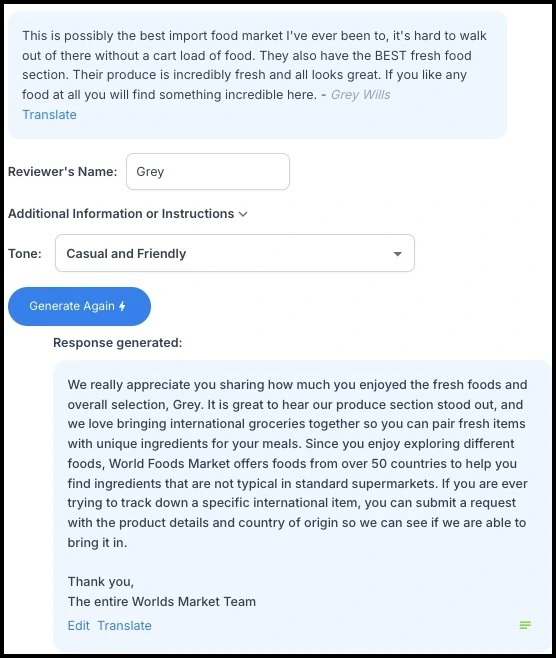
This creates responses that serve double duty: they engage the original reviewer while actively marketing the business to prospective customers. For example, when a customer praises your steak, the response might mention your acclaimed mezcal bar. When someone complains about price, the response can explain that you use organic, locally-sourced ingredients. This depth of personalization creates responses worth reading, responses that give your business a competitive edge.
Review response is where reputation is won or lost
The moment a customer leaves a review is a moment of opportunity. How your business responds determines whether that review becomes a liability or an asset, and whether prospective customers reading reviews choose you or a competitor.
SOCi provides workflow automation for review responses with escalation rules and content filters. The platform aggregates reviews from major sites into a unified inbox, and responses can be approved before publishing. SOCi's Genius Reputation Agent works across Google, Yelp, Facebook, and TripAdvisor, with the company claiming up to 80% of replies require no edits. For enterprises managing thousands of locations, this governance is essential.
The consideration is that SOCi's review response is one feature among many. When your tool manages social media, advertising, local pages, surveys, chat, and reviews all at once, each function competes for attention in the user experience.
Yext offers review monitoring from across its publisher network and provides AI-generated responses. The Generative Review Response feature allows businesses to set guidelines for language, tone, length, and contact information. Users can also make in-line adjustments or use AI to reword, translate, or change tone after generation.

Source: Yext
Customer support experiences with Yext have been notably mixed. Multiple reviews mention unresponsive support after contracts are signed, difficulty resolving issues, and frequent changes in account representatives. For a platform focused on customer experience, this disconnect is significant.
RightResponse AI treats review response as the core function rather than an ancillary feature. The platform sources reviews from 125+ review platforms with native Google integration. Key capabilities include:
Three-Pillar Response Generation produces hyper-personalized, brand-aligned responses with endless variation without losing control. The business defines what should be said when certain topics come up (Facts), how it should behave (Customizations), and how it should sound (Brand Voice).
Fact Transparency shows users exactly which facts were used in each response, and which weren't, so they can swap in more applicable messaging if needed. Facts can be set at company, brand, or location levels, and changes roll forward immediately.
Agentic Analysis Pipeline analyzes each review before writing, handling edge cases that trip up simpler AI implementations. This includes detecting review updates, identifying rating-text mismatches, and for medical practices, avoiding PHI in responses.
Rating-Only Review Handling generates tailored responses even for reviews without text, recognizing that these reviews still deserve thoughtful acknowledgment.
Reviewer and Employee Name Analysis avoids using names in greetings when they don't appear to be real names (avoiding awkward "Thank you, User123456") and correctly identifies and capitalizes employee names mentioned in reviews.
Review collection drives review velocity
Getting more reviews matters. Reviews improve search rankings and provide social proof. All three platforms offer review collection capabilities, though with different approaches.
SOCi introduced review solicitation through Genius Reviews, integrating request capabilities into its broader platform. This allows multi-location businesses to request reviews as part of their overall marketing workflow.
Yext offers review generation capabilities that expanded to include third-party sites beyond Google. The feature integrates with Yext's broader platform for managing digital presence.
RightResponse AI includes sophisticated AI-powered review collection that goes beyond template-based requests:
AI-Personalized Requests reference the actual customer experience, incorporating names, service history, tenure as a customer, and recent transactions. A request might say: "Hey Jim, your technician really enjoyed the visit. We love servicing your two air conditioners and really value the fact that you've been a customer for six years." This personalization increases conversion rates because customers feel seen rather than targeted.

Photo Attachments allow businesses to include images that remind customers exactly what was done, whether it's a completed project, a special moment, or a before-and-after. Particularly powerful for home services and real estate, customers can download and upload the photo to their review.
Multiple Delivery Channels including email and SMS, with local 10-digit phone numbers for SMS to increase open rates.
Guiding Questions give reviewers inspiration about what to write. Questions can rotate so reviews contain varied content.
Unlimited Follow-ups let businesses configure as many follow-up requests as needed; seven for a roofer, fewer for a lawyer. Many competing platforms limit follow-up counts.
The platform also offers QR codes at the employee level, not just business level. Each server, technician, or employee gets their own code to present to customers. Employees receive credit for reviews generated through their code, enabling incentive programs.
Voice of the Customer reveals the platforms' true priorities
Understanding what customers actually think, beyond star ratings, requires advanced analysis of review content. This is where the differences between broad platforms and focused tools become apparent.
SOCi includes sentiment analysis as part of its "Genius Reviews" offering.
The platform categorizes sentiment and can identify trends through "opinion clusters" that group similar feedback. The Voice of Customer feature makes it easier to compare sentiment by topic across stores or regions.
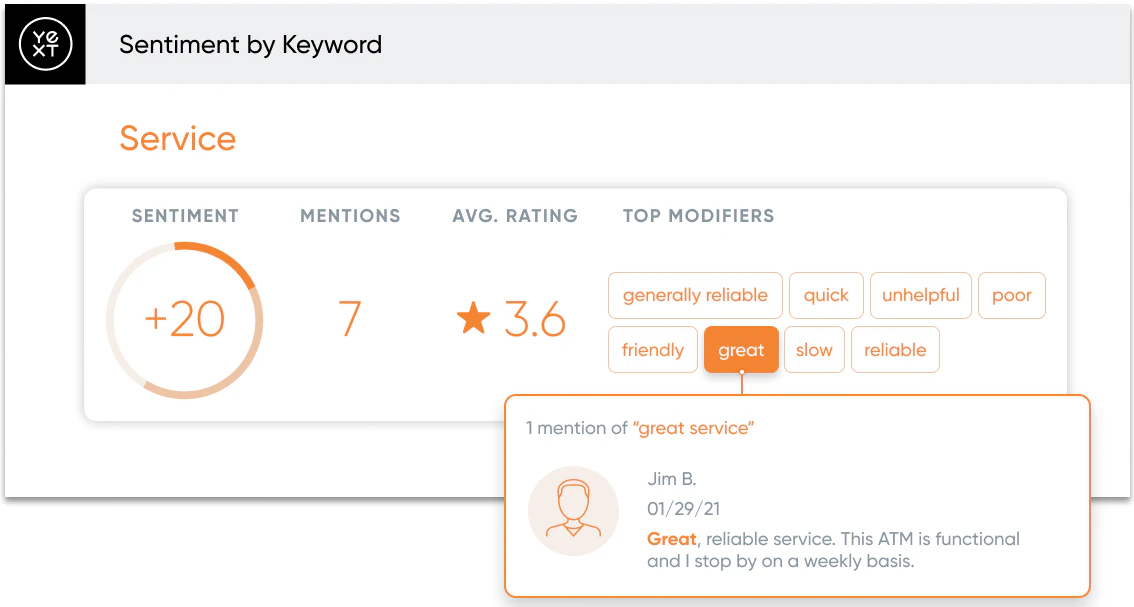
Yext provides sentiment analysis through its reviews feature with keyword-level natural language processing.
The platform assigns sentiment scores (ranging from -90 to +90) to individual keywords, allows drilling down via dashboards, and supports custom "Collections" of keywords for tracking specific topics. This provides more granularity than simple positive/negative classification.
Source: Yext
RightResponse AI approaches Voice of the Customer with the same focus it brings to review response.
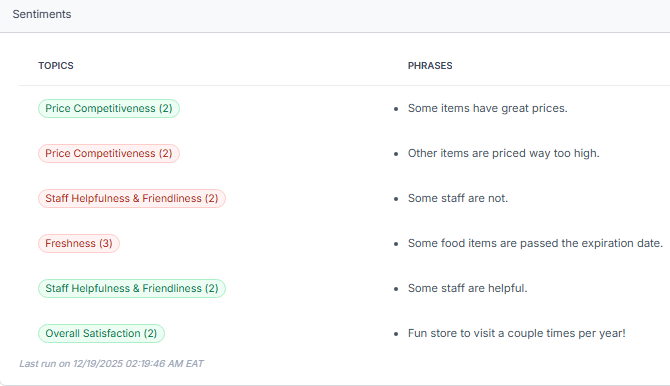
The platform uses Voice of the Customer Aspect-Based Sentiment Analysis (ABSA) combined with machine learning. Rather than just categorizing reviews as positive or negative, the system identifies the specific aspects of the business that customers are reacting to.
Custom Topic Mapping matches customer feedback to specific, defined topics. Businesses can customize these topics to align with their own operational priorities. A restaurant might track sentiment around food quality, service speed, ambiance, and value. A medical practice might track provider bedside manner, wait times, staff helpfulness, and facility cleanliness.
Unlimited Sentiment Topics means businesses aren't constrained to predefined categories. You track what matters to your specific operation.
% Positive Sentiment Metric provides a granular view beyond star ratings. You might have a 4.5-star average but discover that sentiment around wait times is consistently negative, revealing an operational issue that aggregate ratings obscure.
Sentiment by Location enables comparison across your business locations. If one location consistently scores lower on staff friendliness, you've identified a management or training opportunity.
See/Search Phrases By Topic lets you drill down to the exact customer language mapped to each sentiment topic. You're not guessing what "service quality" means to your customers; you're reading their actual words.
Process Prior Reviews means you can analyze your historical feedback, not just new reviews. This provides immediate insights upon signing up, rather than requiring months of data accumulation.
This depth of analysis transforms reviews from a metric to monitor into a genuine business intelligence tool. Understanding that customers love your product but hate your checkout process is actionable. Knowing your star rating is 4.2 is not.
Pricing transparency shows who values your business
How a company prices its products reveals what type of customer they truly want to serve.
SOCi does not publish pricing on its website.
Prospective customers must request a demo and go through a sales process to receive a quote. External estimates suggest annual costs ranging from $15,000 to over $62,000, with per-location costs between $100 and $500 per year. The company targets enterprise clients with dedicated marketing teams and substantial digital marketing budgets.
This approach makes sense for SOCi's business model. Enterprise sales cycles involve negotiations, custom configurations, and multi-year commitments. The platform's breadth means different customers will use different feature combinations, making standardized pricing difficult. However, this opacity creates friction for businesses trying to budget or compare options.
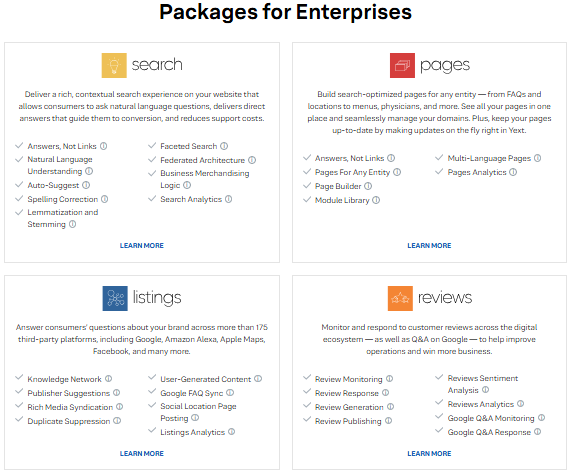
Yext similarly requires contacting sales for enterprise pricing information. The company offers packages for enterprises and reseller partners, with features varying by tier. SMB pricing ranges from approximately $199-$999 per location annually, with enterprise pricing customized based on volume and needs.
User feedback on Yext pricing has been mixed, with some businesses feeling the cost didn't align with the value delivered. This pricing-value perception appears in multiple user reviews.
Source: Yext
RightResponse AI takes a transparent, usage-based approach. The pricing page clearly states: $10 per month per location for access to all features on the Pay As You Go (PAYGO) plan. Actual usage is then paid through a credit system, where credits purchase specific actions:
- Review Response: 20 credits per review downloaded
- Voice of the Customer: 20 credits per review with text processed
- Map Rank Tracker: 1.5 credits per pin in a scan
- Email Review Request: 2 credits for a personalized email review request
Credit costs decrease with volume. Starting at $0.01 per credit for 1,000-3,000 credits, the price drops to $0.006 per credit for 400,000+ credits. This means response plus sentiment analysis costs approximately $0.40 per review at base rates, so a location with 10 reviews per month pays roughly $14 total.
A 7-day free trial with 1,000 free credits allows businesses to test the platform without financial commitment. Additional free credits are provided for each new location added during the trial.
This usage-based model means businesses pay for what they actually use, not for capacity they might theoretically need. Unlike flat per-location pricing that charges the same regardless of review volume, this approach ensures businesses aren't locked into paying for unused capacity, and agencies can scale cleanly across accounts. For businesses that prefer predictable monthly costs, RightResponse AI also offers fixed monthly plans with clear per-location limits:
Pay As You Go — $10/location per month plus usage credits: best for starting out, low review volume, or narrow needs, since you pay only for the actions you use.
Core — $19/location per month: 100 review responses, 1,000 email review requests, Essentials request templates, and a basic dashboard (no SMS, surveys, or map rank tracking).
Pro — $29/location per month (Most Popular): 200 review responses, 2,000 email requests plus 200 SMS, 200 surveys, AI-powered (Pro-mode) review requests, and Map Rank Tracking with competitor analysis (10 scans per month).
Pro+ — $44/location per month: 500 review responses, 5,000 email requests plus 500 SMS, 500 surveys, advanced automation and bulk processing, Competitor Voice of the Customer, and 25 map-rank and competitor scans per month.
Enterprise — custom pricing: white-label, API access, and advanced reporting for agencies and large multi-location businesses.
Whichever plan you choose, you pay for capacity that matches your actual review volume rather than the flat, feature-bundled pricing enterprise suites require.

Source: RightResponse AI
Google Maps visibility determines local success
For businesses with physical locations, Google Maps ranking strongly influences customer acquisition. Businesses appearing in the local pack receive significantly more clicks and customer actions. Being invisible in local search means losing potential customers to competitors.
SOCi offers local SEO capabilities through its "Genius Search" feature, which focuses on listings management and optimization.
The platform includes GeoRank, which provides geographic grid analysis of local search rankings. SOCi can audit and update listings across various directories while providing visibility into local search performance.
Yext's "Competitive Intelligence" feature provides visibility into search performance relative to competitors.
The Search Tracker monitors rankings for specific keywords. While Yext's primary strength remains data syndication through its 200+ publisher network, the competitive intelligence tools offer insight into local search positioning.
RightResponse AI includes a dedicated Google Maps Rank Tracking feature that provides street-level visibility into local search performance.
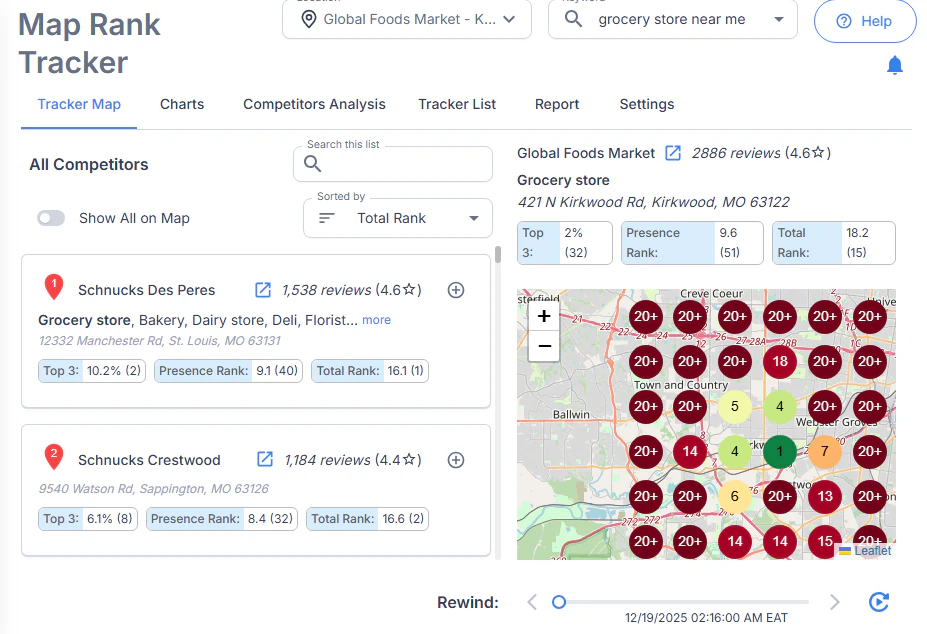
The system works by creating a grid of search points around a business's location, simulating user searches from each specific area. This reveals not just whether you rank, but exactly where and at what position.
Pin Level & Scan Level Rankings show where you and competitors rank at specific grid locations and across the entire scanning area. This granularity matters because your ranking can vary significantly from one block to the next.
Map "Rewind" allows you to view historical scans to see how rankings have changed over time. This helps correlate reputation efforts with actual ranking improvements, proving ROI rather than guessing at it.
Competitor Analytics compares your reviews per month, average ratings, and response rates against competitors over 60 and 180-day periods. Understanding the competitive landscape helps prioritize where to focus improvement efforts.
Competitor Sentiment Analysis applies the same Voice of the Customer ABSA to competitor reviews. This reveals not just that a competitor has lower ratings, but specifically what customers dislike about them, creating opportunities for your business to differentiate.
Key metrics tracked include:
- Top 3%: How often you appear in the top three local results, the critical visibility position
- Presence Rank: The percentage of grid points where you're visible in the top 20
- Total Rank: Your average ranking across all points in the grid
For local businesses, this level of visibility into map rankings transforms local SEO from guesswork into data-driven strategy.
SOCi vs Yext vs RightResponse AI: Which should you choose?
The right platform depends on your specific situation, priorities, and resources.
Choose SOCi if:
- You're a large enterprise needing a single vendor for all local marketing
- Your marketing team has the bandwidth to utilize social, advertising, local pages, and surveys alongside reviews
- You have a substantial annual budget ($15,000+) for digital marketing tools
- You prefer comprehensive platforms even if you won't use every feature
- You're willing to navigate complexity for the sake of consolidation
Explore SOCi's comprehensive marketing cloud for enterprise needs.
Choose Yext if:
- Data consistency across a vast publisher network is your primary concern
- You need accurate business information syndicated to 200+ platforms
- You're already committed to the Yext ecosystem for other functions
- Your main challenge is data management rather than review engagement
- You have resources for enterprise-level implementation
Discover Yext's Knowledge Graph approach to digital presence.
Choose RightResponse AI if:
- Review response quality matters; you want responses that win customers, not just check a box
- You need both sophisticated review collection and response capabilities
- Transparent, usage-based pricing fits your budget approach better than enterprise quotes
- Google Maps visibility is critical for your local business success
- You want a focused tool that does reputation management exceptionally well
- You're any size, from single location to enterprise, and want capabilities matched to actual usage
See how RightResponse AI transforms reviews into growth with a free 7-day trial.
RightResponse AI may not be the right fit if:
- Your core need is messaging, webchat, payments, or social posting; the platform stays focused on reputation management
- You have near-zero review volume with no plan to increase it
- You want a "set and forget" approach with generic responses; if response quality isn't an objective, this isn't the right platform
The multi-location marketing technology landscape has evolved significantly.
While SOCi and Yext built their businesses around comprehensiveness and data management respectively, RightResponse AI represents a different philosophy: that deep expertise in reputation management, with responses that actively market your business, delivers more value than shallow capabilities across many functions.
Reviews are the conversion gate. Prospective customers read reviews more than business websites, and the response is the only part you control. For businesses where reviews directly impact revenue, where Google Maps rankings determine foot traffic, and where understanding customer sentiment drives operational improvement, focused tools outperform broader suites.
Your online reputation is too important to be one feature among dozens.
Ready to see what AI-powered reputation management should actually look like? Start your free 7-day trial of RightResponse AI with 1,000 credits to test every feature.
Frequently Asked Questions
What is the main difference between SOCi and Yext?
SOCi positions itself as a comprehensive CoMarketing Cloud covering social media, listings, reviews, local pages, and advertising for multi-location enterprises. Yext focuses on data consistency through its Knowledge Graph, syndicating business information across 200+ publishers. SOCi emphasizes marketing automation breadth while Yext emphasizes data accuracy and syndication.
How much do SOCi and Yext cost?
Both platforms require contacting sales for enterprise pricing. Third-party estimates suggest SOCi costs range from $15,000 to over $62,000 annually with per-location costs between $100-$500/year. Yext offers SMB plans from approximately $199-$999 per location annually, with enterprise pricing customized based on volume and needs. RightResponse AI offers transparent pricing: Pay As You Go at $10/month per location plus usage-based credits, with fixed Core ($19/month), Pro ($29/month), and Pro+ ($44/month) plans.
Which platform has the best AI review responses?
RightResponse AI offers the most advanced AI review responses through its three-pillar personalization system: Facts (business-specific messaging mapped to review themes), Customizations (behavioral rules), and Brand Voice (tone and style). SOCi's Genius Reviews uses GPT-4 for automated responses, and Yext offers Generative Review Response with tone customization. RightResponse AI's approach treats the response as a marketing asset rather than an operational task.
Which platform is best for Google Maps ranking?
RightResponse AI includes detailed grid-based Google Maps rank tracking with a Rewind feature for historical analysis and competitor analytics. SOCi offers GeoRank geographic grid analysis through its Genius Search feature. Yext provides Competitive Intelligence search tracking. All three offer local visibility tools, but RightResponse AI's focused approach includes competitor analysis applied to the same grid data.
Is RightResponse AI a good alternative to SOCi and Yext?
RightResponse AI is an excellent alternative for businesses that prioritize review response quality, transparent pricing, and focused reputation management. Its Pay As You Go plan starts at $10/month per location with usage-based credits, and it also offers fixed Core ($19/month), Pro ($29/month), and Pro+ ($44/month) plans, compared to SOCi's estimated $15,000+/year and Yext's custom enterprise pricing. However, it does not include social media management, webchat, payments, or listings syndication—it focuses specifically on AI-powered review responses, review collection, Voice of the Customer, and Google Maps rank tracking.
Try RightResponse AI for Free!
*No credit card required.