Choosing between Synup vs Moz Local for your local marketing needs often comes down to these five critical questions:
Comparison research: This article is part of the RightResponse AI review management software comparison library, which connects platform reviews, pricing analyses, alternatives, and head-to-head evaluations.
- Do you need a comprehensive agency operating system, or a focused tool for managing local listings?
- Is AI-powered review response generation a nice-to-have, or essential to your workflow?
- Are you managing multiple locations or clients, or primarily focused on a single business?
- Do you want a platform that tells you what customers are saying, or one that helps you understand why they're saying it?
- Is your priority maintaining accurate listings, or turning customer feedback into actionable business intelligence?
In short, here's what we recommend:
👉 Synup is the comprehensive operating system for marketing agencies, combining listings management, reputation monitoring, social media tools, and a full sales pipeline into one white-labeled platform. Its agency-centric features make it ideal for managing multiple clients, with bulk editing capabilities and extensive customization options. However, Synup's breadth means you're paying for features you may never use, and some users report a steep learning curve alongside inconsistent customer support experiences.
👉 Moz Local excels at ensuring your business information is accurate and consistent across the web, backed by the trusted Moz brand known for SEO expertise. Its automated listing distribution, duplicate suppression, and integration with Google Business Profile make it a reliable choice for businesses focused on local search visibility. Yet Moz Local's value proposition around directory submissions has faced scrutiny as the SEO landscape evolves, and its feature set is narrower than competitors offering deeper analytics.
Both platforms provide solid foundations for local marketing. But here's what neither emphasizes: the real competitive advantage in local search isn't just about having accurate listings or monitoring reviews. It's about understanding customer sentiment at a granular level and responding in ways that build trust and drive conversions.
👉 RightResponse AI takes a fundamentally different approach by putting advanced AI and deep sentiment analysis at the core of reputation management. Built from the ground up with generative AI, it delivers high-quality review responses through a three-pillar personalization system, Facts (what to say), Customizations (rules and behavior), and Brand Voice (tone and style), that produces responses far beyond generic templates. The platform also includes AI-powered review collection with personalized requests, plus Voice of the Customer Aspect-Based Sentiment Analysis to understand what customers are actually saying. For location-based businesses of any size, from single locations to enterprise, that want to turn customer feedback into a competitive weapon rather than just a management task, RightResponse AI delivers insights and automation that traditional platforms typically don't offer.
If you're ready to move beyond basic review monitoring to AI-powered reputation intelligence, see how RightResponse AI transforms customer feedback into growth.
Table of contents:
- Synup vs Moz Local vs RightResponse AI at a glance
- The fundamental divide: Agency platform vs listings tool vs AI intelligence
- Listings management approaches reveal different priorities
- Review collection capabilities: All three platforms, different approaches
- Review response capabilities show the AI gap
- Voice of the Customer separates monitoring from understanding
- Google Maps rank tracking varies dramatically
- Pricing models reflect different value propositions
- Which platform should you choose?
Synup vs Moz Local vs RightResponse AI at a glance
Here's the fundamental difference: While all three platforms help businesses manage their local online presence, they approach the challenge from distinctly different philosophies:
- Synup positions itself as a complete agency operating system, bundling sales tools, client management, and marketing services into one white-labeled platform.
- Moz Local focuses on listing accuracy and consistency, leveraging Moz's SEO expertise to improve local search visibility.
- RightResponse AI leads with AI-powered intelligence, using a three-pillar personalization system to generate responses that actively market your business while extracting actionable insights from reviews.
Synup | Moz Local | RightResponse AI | |
|---|---|---|---|
Primary focus | Agency operating system | Listing management & local SEO | AI-powered reputation intelligence |
AI response quality | ⭐⭐⭐ AI features for content | ⭐⭐⭐ Reviews AI add-on available | ⭐⭐⭐⭐⭐ Three-pillar personalization system |
Sentiment analysis | ⭐⭐⭐ Sentiment tracking | ⭐⭐ Review sentiment via dashboard | ⭐⭐⭐⭐⭐ Voice of the Customer (VOC) |
Review response tools | ⭐⭐⭐⭐ AI-generated responses | ⭐⭐⭐ Centralized response dashboard | ⭐⭐⭐⭐⭐ Facts, Customizations & Brand Voice |
Review collection | ⭐⭐⭐⭐ Automated campaigns | ⭐⭐⭐ Basic request tools | ⭐⭐⭐⭐⭐ AI-personalized requests |
Listings network | ⭐⭐⭐⭐ 60+ directories | ⭐⭐⭐⭐ 90+ directories | ⭐⭐⭐ Core platforms (125+ review sources) |
Google Maps tracking | ⭐⭐⭐⭐ Grid rank tracking | ⭐⭐⭐⭐ GeoRank feature | ⭐⭐⭐⭐⭐ Map Rewind with competitor analysis |
Multi-location support | ⭐⭐⭐⭐⭐ Built for agencies | ⭐⭐⭐⭐ Scalable per location | ⭐⭐⭐⭐⭐ Single location to enterprise |
Starting price | $79/month (annual) | $16/month per location (annual) | PAYGO $10/mo per location + credits; fixed Core $19 / Pro $29 / Pro+ $44; Enterprise custom |
The fundamental divide: Agency platform vs listings tool vs AI intelligence
Understanding each platform's core philosophy reveals why feature comparisons often miss the point.
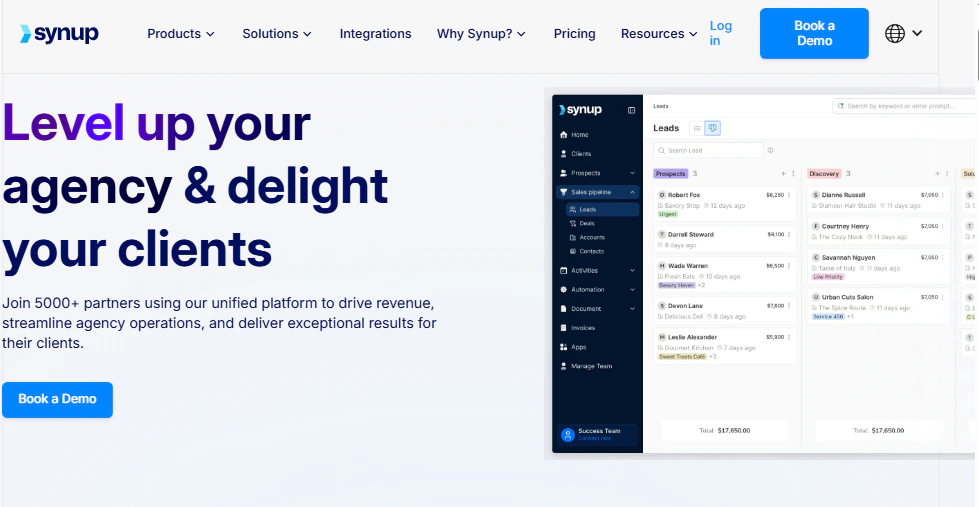
Synup evolved from a local marketing tool into a full agency operating system.
The platform now includes a sales pipeline, prospect lead generation, client invoicing, and e-signature capabilities alongside its marketing features. This makes sense for agencies juggling multiple clients who need everything in one place. But for businesses focused primarily on reputation management, much of Synup's platform goes unused.
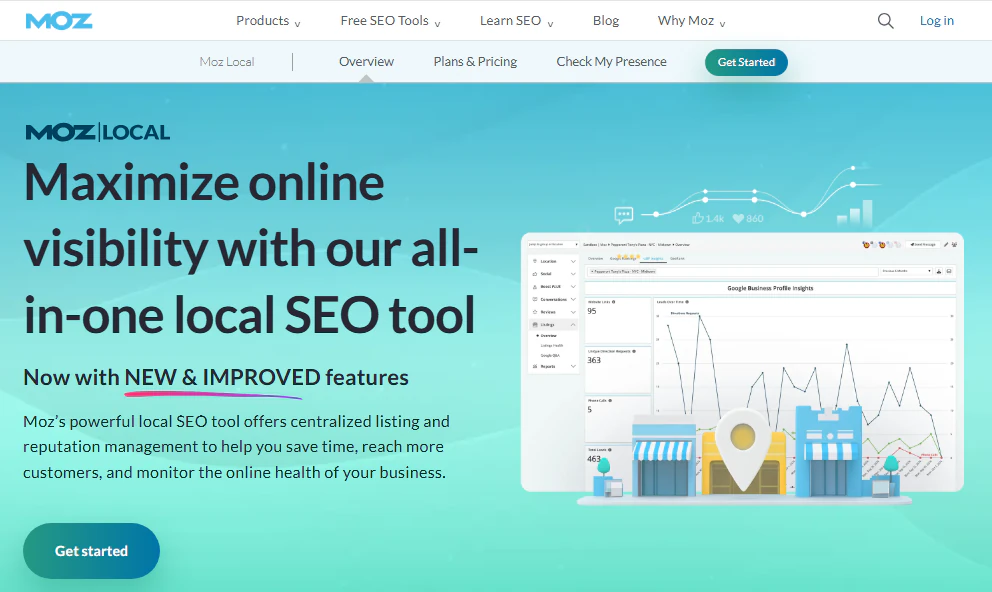
Moz Local takes a more focused approach, concentrating on the foundational elements of local SEO.
The platform emphasizes listing accuracy, data consistency, and distribution to directories. Moz's long-standing reputation in SEO lends credibility, and their GeoRank feature provides useful local ranking insights. However, some industry professionals have questioned whether the direct SEO impact of extensive directory listings has diminished over time, which affects the core value proposition.
RightResponse AI started with a different question entirely.
Founded by a former CEO who managed over 200 healthcare locations, the platform was built to solve a specific problem: how to turn the massive volume of customer reviews into actionable business intelligence. Rather than treating reviews as something to monitor and respond to, RightResponse AI treats them as a data source for understanding what drives customer satisfaction and how to improve operations.
The platform serves location-based businesses regardless of size, from single-location operators to enterprise brands, and stays focused on review response quality and related analytics rather than trying to be an all-in-one customer communication suite.
The philosophical differences become practical quickly.
Need to send proposals to prospects and manage billing? Synup has you covered. Want to ensure your NAP data is consistent across dozens of directories? Moz Local excels. But if you want to understand that customers consistently mention "wait times" negatively at your downtown location while praising "staff friendliness" at your suburban branch, RightResponse AI's Voice of the Customer Aspect-Based Sentiment Analysis provides insights that differ from traditional sentiment approaches.
Listings management approaches reveal different priorities
All three platforms offer listings management, but their implementations reflect different strategic priorities.
Synup provides listings distribution to 75+ directories through its Listings Pro add-on, with features like bulk editing, automated indexing, and duplicate suppression.
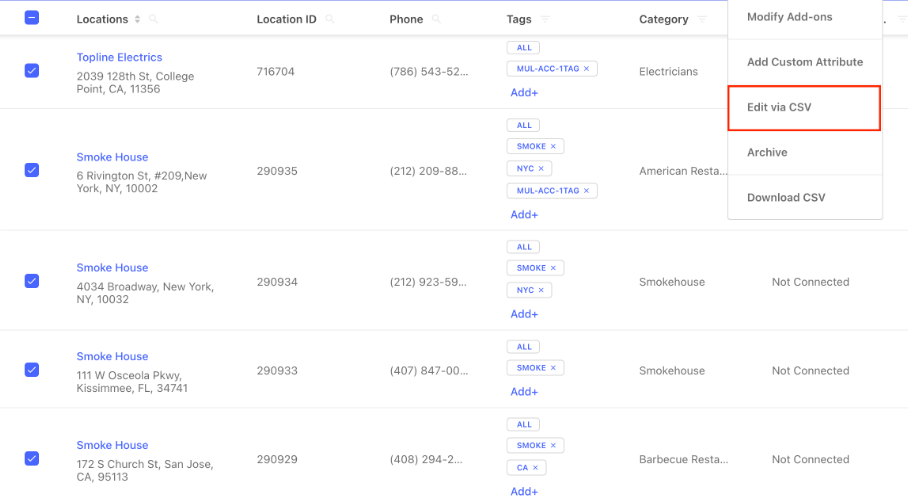
The platform emphasizes real-time API connections for faster updates and offers bulk CSV uploads for managing multiple locations efficiently. For agencies, the ability to manage all client listings from a white-labeled dashboard is valuable. However, the full listings capabilities require the $35 per location per month add-on beyond the base platform cost.
Source: Synup
Moz Local makes listing management its core competency, distributing business information to 90+ directories including major data aggregators like Data Axle and Neustar Localeze.
The platform's approach focuses on creating a cascade effect: by ensuring accuracy with key data aggregators, correct information flows to the thousands of directories they feed. Moz Local also includes automated duplicate detection and suppression. The Listings AI feature, available as an add-on, provides optimization recommendations based on competitor analysis and local search trends.
RightResponse AI takes a different approach to listings.
While the platform does offer listing management capabilities, it primarily emphasizes the platforms that matter most for reputation: Google Business Profile and key review sites. The platform sources reviews from 125+ review platforms through native integrations, focusing less on broad directory distribution and more on optimizing presence where customers actually leave reviews and make decisions.
For businesses that already have listings management handled elsewhere, this focused approach avoids redundant costs.
The practical difference?
If listing accuracy across dozens of directories is your primary concern, Moz Local's focused approach may serve you better. If you need listings plus a full agency toolkit, Synup bundles it all. If your listings are already in decent shape and you need to focus on what customers are saying about you, RightResponse AI lets you concentrate resources there.
Review collection capabilities: All three platforms, different approaches
Before comparing how platforms respond to reviews, it's worth noting that all three help businesses collect reviews in the first place, though with different levels of sophistication.
Synup offers automated review request campaigns as part of its reputation management suite.
The platform can trigger requests based on customer interactions and integrates with CRM systems to automate outreach. For agencies managing multiple clients, centralized campaign management is convenient.
Moz Local includes basic review request capabilities in its higher-tier plans, though this isn't its primary focus. The platform's strengths lie more in listings management than in sophisticated review collection workflows.
RightResponse AI approaches review collection differently.
The platform's AI-powered review requester generates personalized requests that reference the actual customer experience, incorporating details like names, service dates, and specific interactions to create messages that feel authentic rather than templated.
Requests can be sent via email or SMS, and businesses can attach photos (particularly useful for home services and real estate) that remind customers exactly what was done. The platform also offers unlimited follow-up requests, whereas some competitors limit follow-up frequency.

The differentiator isn't that RightResponse AI does review collection; most platforms do. The differentiator is what happens after the review comes in: the quality of the response and its ability to actively market the business. That's where the platforms diverge most dramatically.
Review response capabilities show the AI gap
This is where the platforms diverge most significantly. Review response is no longer just about acknowledging feedback. It's an opportunity to demonstrate customer care, highlight business strengths, and influence potential customers who may glance at your responses while reading reviews.
Here's the reality most platforms don't acknowledge: people read reviews, but they typically skip responses because most responses are generic and unhelpful. Quality responses represent the untapped opportunity to capture attention when readers do glance at them, and to market your business in that moment.
Synup offers AI-powered review responses through its platform, with the ability to automate replies.
The system includes sentiment analysis to categorize reviews and can generate responses based on review content. For agencies managing multiple clients, the centralized dashboard helps track response rates across all locations. The AI capabilities are functional additions to the broader platform.
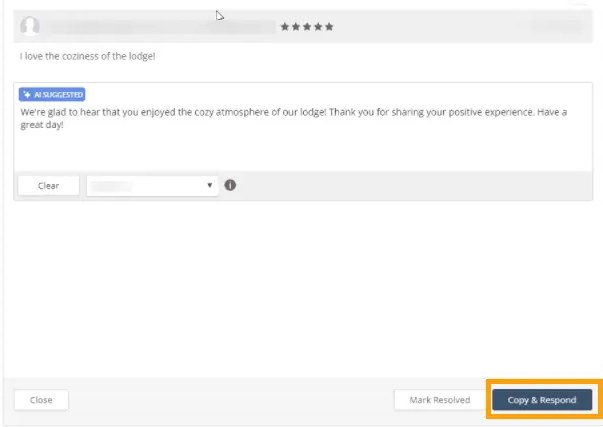
Moz Local provides a centralized review management dashboard where businesses can monitor, read, and respond to reviews from multiple platforms.
The platform includes alerts for new reviews and basic sentiment analysis. For higher-tier plans, Reviews AI generates response suggestions. The approach is functional but not particularly differentiated.
Source: Moz
RightResponse AI was built specifically around generating high-quality, personalized review responses at scale. The platform's three-pillar personalization system produces responses that differ significantly from generic AI output:
Facts (What to Say): During onboarding, the platform analyzes existing reviews, responses, and the business website to create a library of business-specific facts.
It identifies the most important themes in reviews and maps relevant facts to each. When generating responses, the system selects which facts apply, so a review mentioning a positive dining experience might trigger a response that includes information about the seasonal menu or weekend specials.
Customizations (Rules and Behavior): The platform detects contextual elements like names, language, and sensitive information to determine how responses should behave. It handles edge cases such as rating/text mismatches and, for medical practices, can detect Protected Health Information to help maintain HIPAA compliance.
Brand Voice (Tone and Style): Responses can be configured with specific tones, greetings, and closings. The system can rotate between multiple voice variations to avoid sounding repetitive while maintaining brand consistency.
The three pillars work together to produce what the platform calls "hyper-personalized, brand-aligned responses with endless variation without losing control." Users can see which facts were used in each response and swap in different ones if needed.
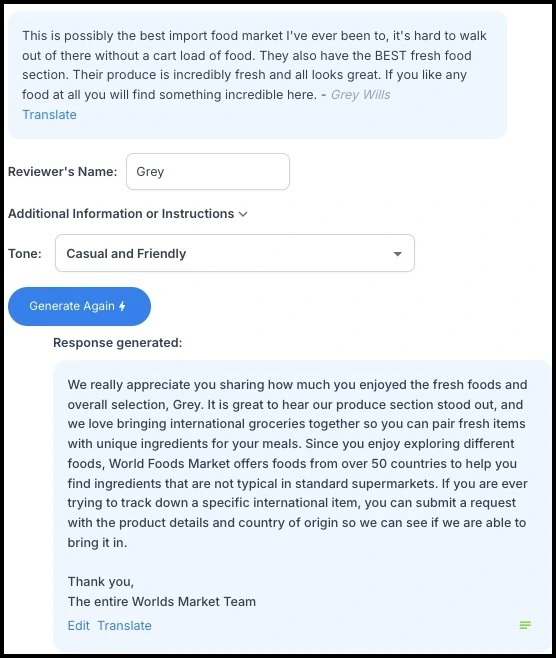
The quality gap matters. Generic "Thank you for your feedback" responses waste space, block readers from actual review content, and contribute nothing to winning the next customer. When a prospect compares two businesses with similar ratings, the one with richer, more engaging responses has the edge.
Quality responses don't just acknowledge customers, they actively market the business.
Voice of the Customer separates monitoring from understanding
Basic sentiment analysis tells you whether reviews are positive, negative, or neutral. Advanced sentiment analysis tells you why.
Synup includes sentiment analysis in its review management capabilities, categorizing reviews and identifying themes. The platform can track sentiment trends over time and across locations, which is useful for identifying patterns. The analysis operates primarily at the review level.
Moz Local's sentiment analysis operates through its review monitoring dashboard, providing overview metrics of positive, neutral, and negative reviews. The platform can identify trends and highlight common themes in customer feedback. For businesses looking for basic reputation tracking, this covers the essentials.
RightResponse AI implements what it formally calls Voice of the Customer Aspect-Based Sentiment Analysis (ABSA), which represents a fundamentally different approach. Rather than just scoring reviews as positive or negative, ABSA breaks down each review to identify specific aspects customers are discussing and the sentiment associated with each.
Here's what that means practically: A single review might say "The food was excellent but we waited 45 minutes for a table." Traditional sentiment analysis might score this as neutral or mixed. ABSA identifies "food quality" as positive and "wait times" as negative, mapping these to business-defined categories.
Key capabilities of RightResponse AI's Voice of the Customer include:
Customizable Topics: Businesses define the specific aspects they want to track, aligned with how they think about their operations. A restaurant might track food quality, service speed, ambiance, and value. A healthcare clinic might track wait times, staff friendliness, and treatment outcomes.
Direct Phrase Extraction: Users can see the exact phrases from reviews that map to each topic, providing full context rather than just aggregated scores.
Irrelevant Content Filtering: The AI filters out vague or off-topic content to focus analysis on genuine experience-based feedback.
Location Comparison: For multi-location businesses, sentiment can be compared across branches to identify which locations excel or struggle with specific aspects.
Competitor Sentiment Analysis: The same analytical framework can be applied to competitors' reviews, providing direct benchmarking on specific topics.
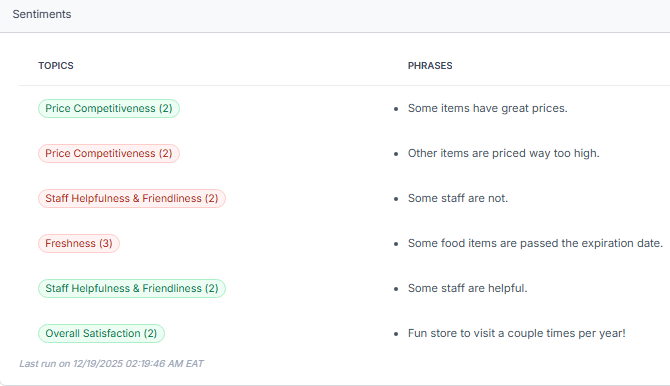
This level of analysis transforms review data from a reputation metric into operational intelligence. Knowing your overall rating is 4.2 stars is less actionable than knowing customers consistently praise your product quality but struggle with parking at your main location.
Google Maps rank tracking varies dramatically
For local businesses, visibility in Google Maps can directly impact foot traffic and calls. All three platforms offer rank tracking, but with different levels of sophistication.
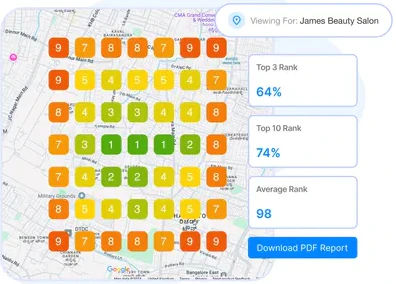
Synup provides grid rank tracking through its SEO features, allowing businesses to visualize their rankings across a geographic area.
The platform includes competitor tracking and historical data to monitor changes over time. The grid approach shows how rankings vary from location to location within a service area, which is valuable for understanding hyperlocal visibility.
Source: Synup
Moz Local offers GeoRank, which tracks local search rankings at a granular, hyper-local level.
Users can see their rankings for specific keywords on an interactive map, with competitor tracking capabilities. The feature helps identify geographic areas where visibility is strong or needs improvement.
RightResponse AI takes map rank tracking further with several distinctive capabilities:
Map Rewind: This feature allows users to visually replay how rankings have changed over time. Rather than just seeing static historical charts, users can watch the evolution of their and their competitors' positions across the grid with each scan. This makes it easier to identify what's working and correlate ranking changes with specific actions.
Integrated Competitor Analysis: The platform connects rank tracking with deep competitor review analysis. Users can not only see who outranks them but also analyze those competitors' review strategies, including volume, recency, response rates, and sentiment on specific topics.
Key Performance Metrics: The platform tracks specific metrics including Top 3 percentage, Presence Rank, and Total Rank (how often a business appears in the top three local results, percentage of grid points where visible in top 20, and average ranking across all points).
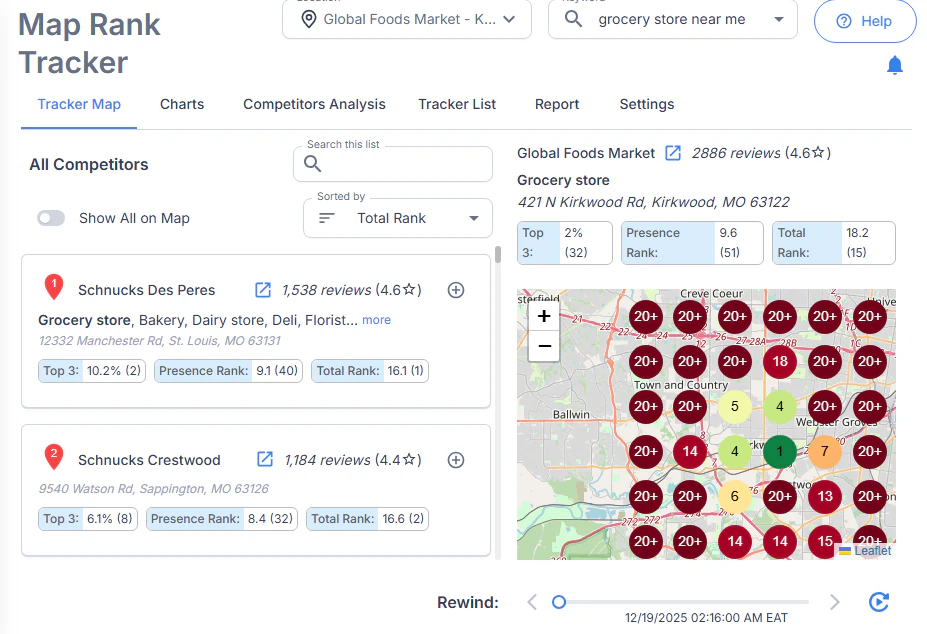
For businesses serious about local search visibility, the ability to connect ranking data with competitor reputation analysis provides a more complete picture of what's driving local search success.
Pricing models reflect different value propositions
The pricing structures tell you everything about each platform's target market and perceived value.
Synup uses tiered pricing designed for agencies, starting at $79 per month (annual billing) for the Startup plan with up to 5 team members and 25 locations.
The Agency plan at $199 per month covers 100 locations, while the Scale plan at $799 per month handles up to 500 locations. However, core features require add-ons: Listings Pro is $35 per location per month, Reviews Pro is $20 per location per month, and Reviews Gold with full automation is $50 per location per month.
For an agency managing 25 locations with full features, costs can add up quickly.

Source: Synup
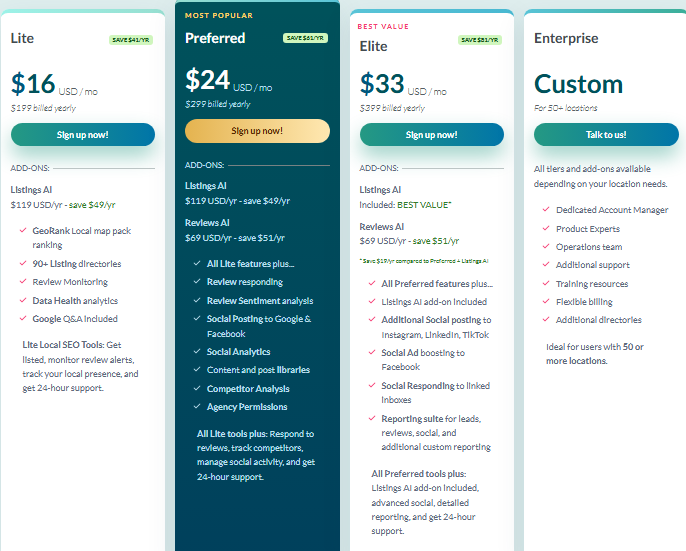
Moz Local charges per location with three tiers: Lite at $16 per month (annual), Preferred at $24 per month, and Elite at $33 per month.
The Lite plan covers basic listing management and review monitoring but lacks review responding. Preferred adds review response capabilities for Google and Facebook plus sentiment analysis. Elite includes the Listings AI add-on and advanced social features.
For businesses wanting AI features without the Elite plan, Listings AI costs an additional $14 per month and Reviews AI costs $10 per month.
Source: Moz
RightResponse AI offers a Pay As You Go (PAYGO) option with a low base fee of $10 per month per location plus usage-based credits—best for businesses just starting out, with low review volume, or narrow needs. Most businesses, though, get better value from one of the fixed monthly plans, which bundle predictable per-location limits:
- Core ($19/mo): 100 review responses, 1,000 email review requests, and Essentials request templates with a basic dashboard—no SMS, surveys, or map rank tracking.
- Pro ($29/mo, most popular): 200 review responses, 2,000 email requests plus 200 SMS, 200 surveys, AI-powered (Pro-mode) review requests, and Map Rank Tracking with competitor analysis (10 scans/mo).
- Pro+ ($44/mo): 500 review responses, 5,000 email requests plus 500 SMS, 500 surveys, advanced automation and bulk processing, Competitor Voice of the Customer, and 25 map-rank/competitor scans/mo.
- Enterprise (custom): white-label, API access, and advanced reporting for agencies and large multi-location businesses.
Under PAYGO, usage is billed through credits bought in volume tiers (cheaper per credit at higher volumes), so you pay only for the responses, requests, and scans you actually use—handy for locations with low or unpredictable review volume. A 7-day free trial includes 1,000 credits to test the platform.

Source: RightResponse AI
The pricing philosophy differences are clear: Synup bundles everything for agencies willing to pay for a comprehensive platform. Moz Local charges straightforward per-location fees with add-ons for advanced features.
RightResponse AI's flexible mix of PAYGO and fixed-price plans means businesses aren't locked into paying flat per-location rates for capacity they don't use, particularly valuable for locations with varying review volumes, and for agencies that need to scale cleanly across accounts without pricing rigidity.
Which platform should you choose?
The choice ultimately depends on your specific situation, priorities, and how you plan to use customer feedback.
Choose Synup if:
- You're a marketing agency managing multiple clients who need a white-labeled solution
- You want sales pipeline, invoicing, and client management alongside marketing tools
- Broad directory coverage across 60+ sites is important to your strategy
- You're willing to invest in add-ons to get the full feature set
- You're comfortable navigating a comprehensive platform with multiple modules
Explore Synup's agency operating system.
Choose Moz Local if:
- Listing accuracy and consistency across directories is your primary concern
- You value Moz's established reputation in the SEO industry
- You want a focused tool without the complexity of a full agency platform
- Your review response needs are basic and handled primarily on Google and Facebook
- Predictable per-location pricing fits your budgeting process
See how Moz Local can improve your local search visibility.
Choose RightResponse AI if:
- You care about review response quality, not just checking a box, but producing responses that actively market your business
- You want to understand the "why" behind customer feedback through Voice of the Customer Aspect-Based Sentiment Analysis
- AI-powered review collection and fact-infused responses would differentiate your customer engagement
- Google Maps rank tracking with integrated competitor intelligence is valuable to your strategy
- You prefer flexible pricing—usage-based or fixed-tier plans—that scales with actual needs rather than being locked into flat per-location fees
- You're a location-based business of any size, from single location to enterprise, that wants to turn reviews into a competitive advantage
The local marketing landscape has matured beyond simply maintaining accurate listings.
While Synup offers agencies a comprehensive operating system and Moz Local provides solid foundational listing management, the real competitive edge increasingly comes from what you do with customer feedback. Reviews get businesses higher in search rankings, that's the value of the review itself. The value of the response is winning the next customer.
Currently, most review responses are generic and go unread. But quality responses represent the opportunity to capture attention when potential customers do glance at them.
Research suggests approximately 60% of consumers expect a response to their reviews within two days, and when those responses are worth reading, they become conversion assets rather than wasted space. Choose the platform that aligns with how seriously you take that opportunity.
Try RightResponse AI for Free!
*No credit card required.

-1120w.webp)