Choosing between Synup vs Uberall for your reputation management needs often comes down to these five critical questions:
Comparison research: This article is part of the RightResponse AI review management software comparison library, which connects platform reviews, pricing analyses, alternatives, and head-to-head evaluations.
- Do you need a full-featured agency operating system, or a specialized platform focused on location marketing?
- Is AI-powered review response quality more important to you than breadth of features?
- Are you managing a single brand with multiple locations, or do you run an agency serving many clients?
- How important is transparent, usage-based pricing versus negotiated enterprise contracts?
- Do you need deep sentiment analysis to understand what's driving your ratings, or is basic review monitoring sufficient?
In short, here's what we recommend:
👉 Synup is an all-in-one local marketing platform that has evolved into what they call an "Agency Operating System." It combines listings management, review monitoring, social media scheduling, and client management tools under one roof. With features like AI-powered review responses, lead generation tools, and white-labeled client portals, Synup's focus leans toward marketing agencies managing multiple SMB clients, though it also serves direct businesses. However, its broad feature set can feel overwhelming, and some users report inconsistent customer support experiences and concerns about contract flexibility.
👉 Uberall positions itself as a "Location Performance Optimization" platform built for enterprise multi-location brands. With over 125 directory integrations, an AI agent called UB-I that proactively monitors and optimizes your presence, and a strong focus on connecting online visibility to offline revenue, Uberall excels at scale. The platform offers advanced analytics and is particularly strong for global brands needing localization across multiple countries. That said, Uberall's enterprise focus means pricing can be steep and requires custom quotes, and the platform may be more than smaller businesses need.
Both platforms offer comprehensive solutions for managing online presence. However, they approach the market from different angles: Synup as an agency-focused tool with broad functionality, and Uberall as an enterprise-grade location marketing powerhouse. For businesses that prioritize AI-powered review response quality, Voice of the Customer, and transparent usage-based pricing without the complexity of enterprise platforms, there's a third option worth considering.
👉 RightResponse AI takes a fundamentally different approach by focusing on what matters most for reputation: turning review responses into conversion assets that actually win new customers. While Synup and Uberall treat AI review responses as one feature among many, RightResponse AI treats the response itself as the product. The platform's three-pillar personalization system, Facts (business-specific messaging mapped to review themes), Customizations (rules and behavioral controls), and Brand Voice (tone and style), produces responses that actively market your business to prospective customers reading reviews, not just generic "thanks for your feedback" replies. The platform also includes sophisticated AI-powered review collection with hyper-personalized requests, plus Aspect-Based Sentiment Analysis that reveals the "why" behind your ratings. With sources from 100+ review platforms, Google Maps rank tracking, and transparent pay-per-use pricing starting at $10 per location per month plus credits on Pay As You Go (PAYGO), with fixed monthly plans from $19, RightResponse AI serves location-based businesses of all sizes, from single-location operations to enterprise, who care about response quality and understand the impact reviews have on growth.
If you want AI-powered review responses that actively market your business and pricing that scales with what you actually use, see how RightResponse AI can transform your reputation management with a 7-day free trial and 1,000 credits.
Table of contents:
- Synup vs Uberall vs RightResponse AI at a glance
- The fundamental difference: Agency tool vs enterprise platform vs response-quality-focused reputation management
- Review response quality separates the leaders from the rest
- Review collection capabilities: How each platform helps you get more reviews
- Voice of the Customer reveals what's really driving your ratings
- Listings management approaches reflect different priorities
- Pricing models tell you everything about their target customers
- Local SEO and rank tracking capabilities vary significantly
- Which platform should you choose?
Synup vs Uberall vs RightResponse AI at a glance
Here's the fundamental difference: While all three platforms help businesses manage their online reputation and local presence, they approach the challenge from distinctly different philosophies:
- Synup is an agency-focused operating system that bundles listings, reviews, social media, and client management into one platform
- Uberall is an enterprise-grade location marketing platform focused on connecting online presence to offline revenue at scale
- RightResponse AI is a response-quality-focused reputation management platform that turns every reply into a conversion opportunity
Free trial
Demo available
Demo available
7-day free trial with 1,000 credits
Learning curve
⭐⭐⭐
Moderate, many features
⭐⭐⭐
Moderate with training resources
⭐⭐⭐⭐
Straightforward, intuitive interface
White-labeling
⭐⭐⭐⭐⭐
Full agency white-label
⭐⭐⭐⭐
Available as add-on
⭐⭐⭐⭐
Agency white-label available
The fundamental difference: Agency tool vs enterprise platform vs response-quality-focused reputation management
Understanding each platform's core philosophy reveals why feature comparisons only tell part of the story.
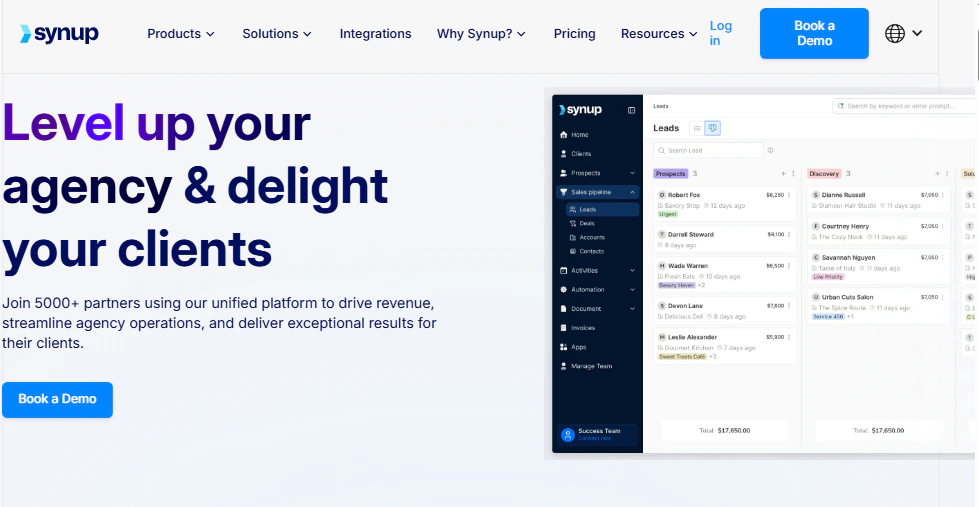
Synup started as a local SEO and listings management tool but has evolved into what they call an "Agency Operating System."
This means Synup isn't just trying to help you manage reviews; it's trying to be the central hub for everything a marketing agency does. The platform bundles lead generation tools, sales pipeline management, client invoicing, and service delivery into one package. For agencies, this consolidation can be valuable. For individual businesses, much of this functionality goes unused.
The agency-centric approach shows up in how Synup structures everything from pricing (per-client accounts) to features (white-labeled client portals).
Their recent acquisitions of tools like OptimoRank and Clientjoy signal a strategy of building out the complete agency stack rather than deepening any single capability. Synup also serves direct businesses, but their product roadmap clearly leans toward agency needs.
Uberall takes an enterprise-first approach, positioning itself as a "Location Performance Optimization" platform.
The German company has raised over $140 million in funding and serves brands with hundreds or thousands of locations globally. Their philosophy centers on connecting every online touchpoint to measurable real-world outcomes.
Uberall's strength lies in scale and sophistication. Their AI agent, UB-I, operates proactively across a brand's entire digital presence. For enterprise brands with dedicated marketing teams and significant budgets, this comprehensive approach makes sense. For smaller businesses or agencies, it can feel like buying an industrial kitchen to make toast.
RightResponse AI was built from the ground up with a different question in mind: What if you could make review responses genuinely valuable, not just to customers, but to the prospective customers reading them?
Founded by a former CEO who managed over 200 healthcare locations and experienced firsthand the inadequacy of existing review management tools, RightResponse AI focuses on turning every response into a conversion asset.
The platform's core insight is this: reviews get businesses higher in search rankings, but the response is what wins the next customer. When a prospect compares two businesses with similar ratings, the one with richer, more engaging responses wins. Generic "thanks for your review" replies waste space and block readers from actual content.
RightResponse AI's three-pillar personalization system, Facts (what to say), Customizations (how it should behave), and Brand Voice (how it should sound), produces responses that actively market the business to prospective customers, with endless variation while maintaining control.
The platform also includes sophisticated review collection with AI-personalized requests, but the core differentiator is what happens after the review comes in: the quality of the response and its ability to drive conversions.
Review response quality separates the leaders from the rest
The true test of any reputation management platform is what happens when a customer leaves a review. Here's how each platform handles this critical moment.
Synup's review management includes a unified inbox that aggregates reviews from various platforms, AI-powered response suggestions, and automated responses for certain review types.
The platform can generate responses and allows for customizable templates. For agencies managing many clients, the bulk response capabilities and workflow features are helpful.
Synup's AI responses are designed primarily with efficiency in mind for agencies handling high volumes. The platform does offer brand voice customization and dynamic fields for personalization, though the depth of business-specific training may vary compared to more specialized solutions.
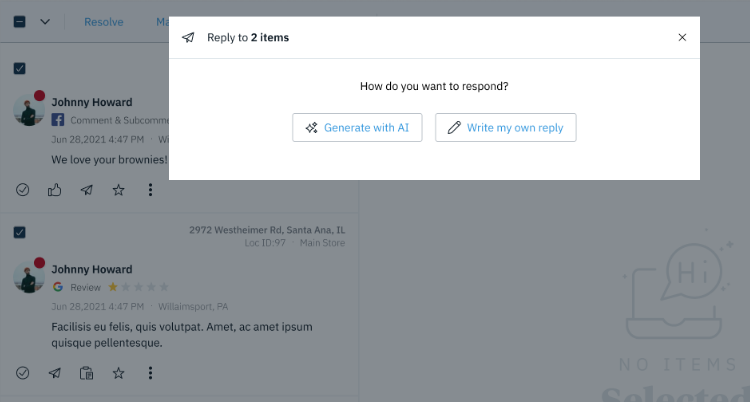
Uberall has invested heavily in AI capabilities, including AI-Bulk Replies that generate unique responses for multiple reviews at once and AI-Auto Responses for star-only reviews. Their AI can be trained on brand voice and supports multiple languages, making it effective for global enterprises.
Source: Uberall
Uberall's strength is in automation at scale. The UB-I agent can proactively identify reviews needing attention and prioritize high-impact responses. For enterprises dealing with thousands of reviews monthly, this automation is essential.
The trade-off is that the AI is optimized for volume and consistency rather than the kind of deep personalization that builds genuine customer relationships.
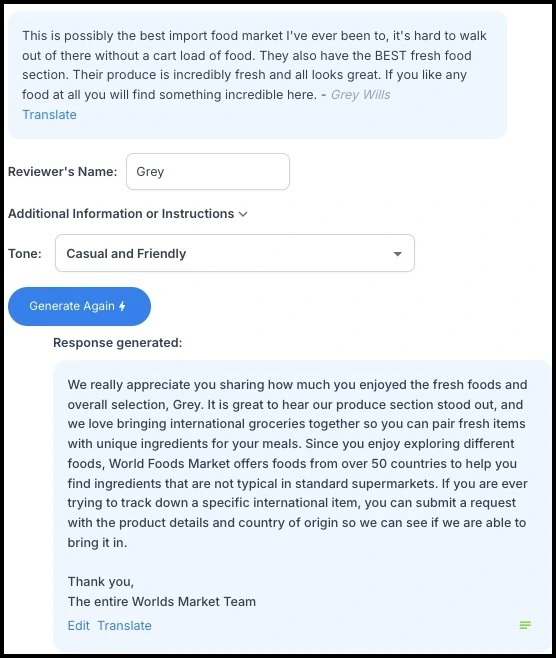
RightResponse AI approaches review responses with a fundamentally different philosophy: responses should actively market your business, not just acknowledge the customer.
The platform uses an intentionally agentic approach; it analyzes the review before writing the response, handles edge cases such as review updates and rating/text mismatches, and separates analytical functions from writing functions so the writing engine focuses purely on crafting compelling responses.
The three-pillar personalization system works together to produce responses that prospective customers actually want to read:
- Facts: During onboarding, the platform reads existing reviews, responses, and your website to create a library of business-specific facts mapped to common review themes. When someone complains about price, the response might mention that your restaurant uses organic, non-GMO ingredients sourced fresh daily. When someone praises your staff, the response reinforces your training philosophy.
- Customizations: Rules and behavioral controls that govern how responses behave: handling sensitive information, formatting employee names correctly, determining when escalation is needed.
- Brand Voice: Tone and style settings that ensure responses sound like your brand, with the ability to rotate between voice variations to avoid repetitive patterns.
Additional capabilities that set RightResponse AI apart:
- PHI Detection: For healthcare practices, the system automatically detects potential Protected Health Information in reviews to maintain HIPAA compliance, a critical capability that reduces the risk of AI generating inappropriate responses.
- Reviewer Name Analysis: The AI examines reviewer names to determine if they appear to be real names, avoiding awkward greetings for obvious pseudonyms.
- Employee Name Recognition: When customers mention staff members, the AI correctly identifies and formats employee names in responses.
- Language Detection: For rating-only reviews, the system detects the reviewer's likely language from their name to respond appropriately.
The result is responses that actively market your business to every prospective customer who reads them, not generic filler that wastes space and blocks readers from the actual reviews.
Review collection capabilities: How each platform helps you get more reviews
Getting more reviews is only half the equation, but it's an important half. Here's how each platform approaches review collection.
Synup offers review request features through automated campaigns with customizable templates.
The platform supports multiple delivery channels and integrates with their broader workflow tools. For agencies managing many clients, the ability to set up templated campaigns across accounts is valuable.
Uberall provides enterprise-grade review request workflows integrated with their broader location management system. The platform supports automated requests tied to customer interactions, though the specifics depend on your enterprise configuration and integrations.
RightResponse AI includes a sophisticated AI-powered review request system with two modes:
- Essentials Mode: A simple, template-based system with pre-built templates. Users turn it on and it runs automatically, ideal for businesses that want minimal configuration.
- Pro Mode: AI-powered requests that incorporate customer data like name, service history, tenure as a customer, and recent transactions. Example: "Hey Jim, your technician really enjoyed your visit. We love servicing your two air conditioners. We really value the fact that you've been a customer for six years and appreciate the last install you did in February."

Key review collection features include:
- Photo Attachments: Requests can include photos of completed work, particularly useful in real estate and home services; customers can download and include the photo in their review.
- Delivery Channels: Email and SMS support, with local 10-digit phone numbers to increase open rates.
- Flexible Configuration: Choose between templated or advanced AI approaches, with configurable fields from rep names to service types.
The platform helps businesses develop review request strategies tailored to their industry; timing matters, and sending to repeat customers allows for more personalized messaging and higher probability of positive reviews.
Voice of the Customer reveals what's really driving your ratings
Star ratings tell you how customers feel. Voice of the Customer should tell you why. The depth of this capability varies dramatically across platforms.
Synup offers standard sentiment analysis that categorizes reviews as positive, negative, or neutral and can identify recurring themes.
The analysis is functional for getting a general sense of customer satisfaction and tracking sentiment over time. For agencies reporting to clients, it provides the basics needed for dashboards and reports.
Uberall provides more advanced sentiment trend reporting with the ability to track changes over time and identify key themes.
Their analytics can show sentiment by location, helping multi-location brands identify which stores are excelling and which need attention. The platform integrates sentiment data with broader performance metrics to varying degrees.
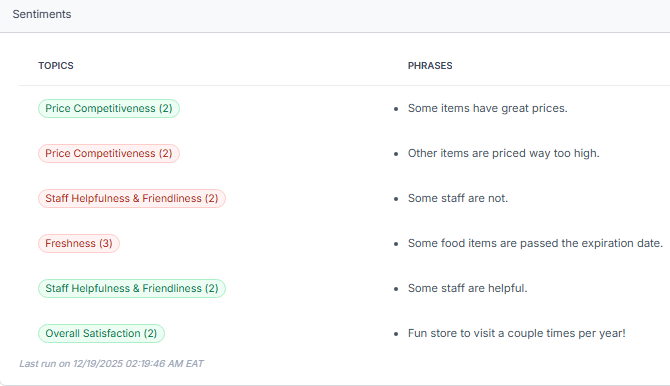
RightResponse AI employs what they call "Voice of the Customer Aspect-Based Sentiment Analysis (ABSA)". This approach doesn't just determine if a review is positive or negative; it breaks down the sentiment by specific aspects of your business that you define.
Key differentiators of RightResponse AI's Voice of the Customer include:
- Customizable Topic Definition: Businesses can define the specific topics they want to track, such as "wait times," "staff friendliness," "food quality," or "parking." This ensures the analysis is relevant to your actual operations.
- Irrelevant Content Filtering: The system automatically filters out vague or off-topic content to focus on genuine, actionable feedback.
- Phrase Extraction: Drill down to see the exact phrases customers used for each topic, providing full context behind the aggregated data.
- % Positive Sentiment Metric: Beyond star ratings, get a granular view of positive sentiment for each defined topic.
- Competitor Analysis: Apply the same analytical framework to your competitors' reviews for direct, apples-to-apples comparisons, understanding how customers talk about you vs. your competitors.
This level of detail transforms sentiment analysis from a reporting metric into an operational improvement tool. Instead of knowing that 30% of your reviews mention service, you know that 85% of service mentions are positive for "staff knowledge" but only 45% are positive for "response time."
Listings management approaches reflect different priorities
All three platforms help businesses manage their online listings, but the scope and approach differ significantly.
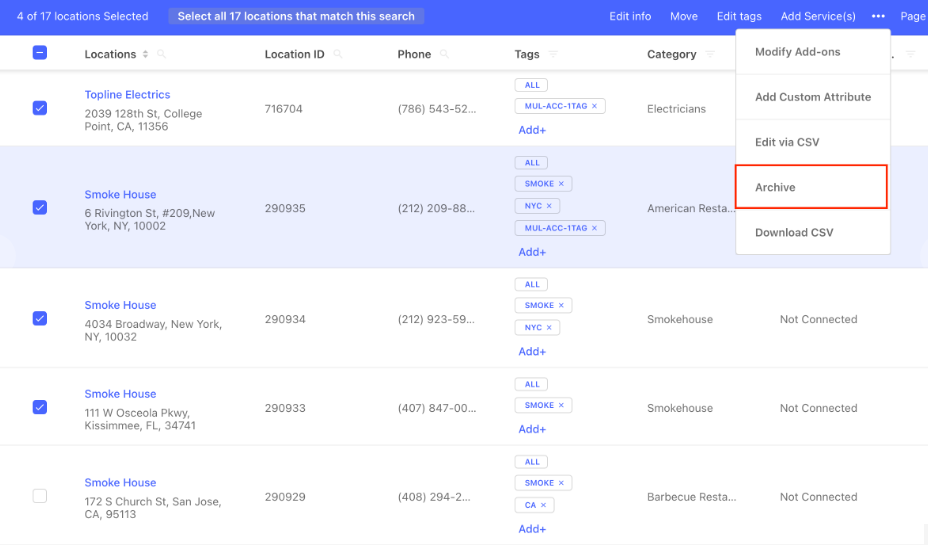
Synup offers listings management across 75+ directories with features like real-time synchronization, bulk editing, and duplicate suppression.
The platform emphasizes that businesses retain ownership of their listings even after cancellation, differentiating them from some competitors. For agencies, the ability to manage listings for multiple clients from a centralized dashboard is a key selling point.
Source: Synup
Synup's listings management is robust for its intended audience. The platform handles standard NAP (name, address, phone) data, business hours, photos, and descriptions. Integration with AI tools allows for auto-generated local posts. However, the feature set is comparable to other established players in the space.
Uberall boasts an extensive listings network with over 125 directories and direct API integrations with platforms like Google and Apple Maps. Their "Profile Protection" feature claims and locks brand profiles to prevent unauthorized edits, which is particularly valuable for enterprises concerned about brand consistency.
Unique to Uberall is their focus on emerging platforms and technologies.
The platform optimizes listings for voice search assistants and AI-powered search engines, and they've introduced "Generative Engine Optimization" (GEO) to ensure businesses appear correctly in AI-generated search results. For global enterprises, their localization capabilities across 50+ countries are a significant advantage.
RightResponse AI takes a more focused approach.
Rather than competing on directory quantity, the platform concentrates on Google Business Profile for listings while sourcing reviews from 100+ platforms. This reflects a philosophy that for most location-based businesses, Google is the primary battlefield for local search visibility.
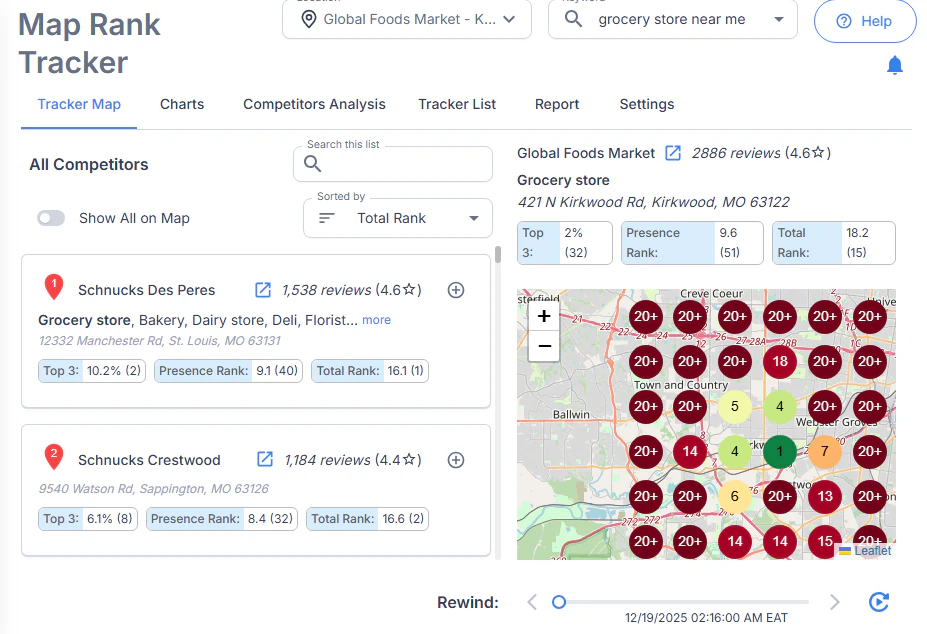
The platform's listings management is integrated with its Google Maps Rank Tracking feature, which provides a "street-level view" of visibility by creating a grid of search points around a business location. This shows exactly where a business appears for chosen keywords, including a unique "Rewind" feature that lets users visually replay how rankings have changed over time.
For businesses that need extensive multi-directory management, Synup or Uberall may be better fits. For businesses that recognize Google as where local reputation and rankings matter most, RightResponse AI's focused approach may be more valuable.
Pricing models tell you everything about their target customers
How a platform prices its product reveals who they're really built for.
Synup uses a tiered subscription model with three main plans:
- Startup: $79/month (annual) or $99/month (monthly) for up to 5 team members, 25 client accounts, and 25 locations for listings and review management
- Agency: $199/month (annual) or $249/month (monthly) for up to 10 team members, 100 client accounts, and 100 locations
- Scale: $799/month (annual) or $999/month (monthly) for up to 50 team members, 500 client accounts, and 500 locations

Source: Synup
Additional costs include $5/month per extra team member, $1.50/month per extra client account, and various add-ons for enhanced features like "Listings Pro" ($35/location/month) or "Reviews Gold" ($50/location/month).
This pricing structure works well for agencies with predictable client loads but can become complex when factoring in all the add-ons needed for full functionality. The per-location pricing for add-ons means costs can escalate quickly for businesses with many locations.
Uberall requires requesting a quote, which immediately signals their enterprise positioning.
Their website outlines three packages (Show Up, Stand Out, Connect) but prices are not publicly disclosed. Features like analytics enhancements, social ads, and collaboration tools are sold as add-ons.
The quote-based approach allows Uberall to customize pricing for large enterprises but creates friction for smaller businesses trying to evaluate options. Based on market positioning and competitor analysis, expect enterprise-level pricing that may be prohibitive for businesses with fewer than 50 locations.

Source: Uberall
RightResponse AI offers flexible pricing for location-based businesses of all sizes.
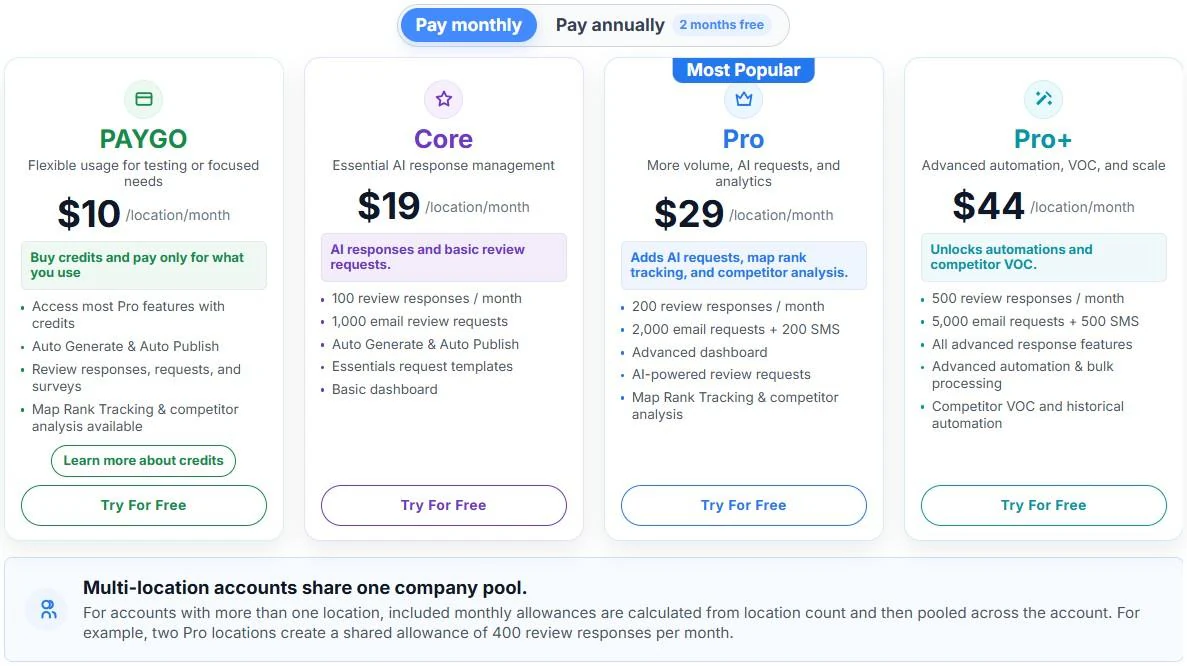
Fixed monthly plans lead:
- Core ($19/location) covers 100 review responses, 1,000 email review requests, and Essentials request templates on a basic dashboard — no SMS, surveys, or map rank tracking;
- Pro ($29/location, most popular) covers 200 responses, 2,000 email requests plus 200 SMS, 200 surveys, AI-powered Pro-mode requests, and Map Rank Tracking with competitor analysis (10 scans/month) on an advanced dashboard;
- and Pro+ ($44/location) covers 500 responses, 5,000 email requests plus 500 SMS, 500 surveys, advanced automation with bulk processing, and Competitor Voice of the Customer (25 scans/month).
- A custom Enterprise plan adds white-label, API access, and advanced reporting for agencies and large multi-location brands. For low-volume or narrow needs, Pay As You Go (PAYGO) bills per usage instead:
The base fee is $10/location/month plus usage credits, which grants access to all features. Usage credits are purchased separately and used for specific actions, for example:
- Review responses: 20 credits per review
- Voice of the Customer: 20 credits per review with text
- Map rank tracking: 1.5 credits per pin
- Email review requests: 2 credits
Credit pricing is tiered, starting at $0.01 per credit for the first 3,000 credits and decreasing to $0.006 per credit for volumes over 400,000.
This model means a business with 10 locations responding to 100 reviews per month would pay approximately $100/month base fee on PAYGO plus $20 in credits for responses, totaling $120/month for comprehensive reputation management. The 7-day free trial includes 1,000 credits to try most Pro features.
Prefer a hands-off option? Our Done-For-You team can manage review requests, monitoring, responses, reporting and reputation insights for you. See current Done-For-You pricing. The usage-based approach means businesses aren't forced into paying per-location for capacity they don't use, and agencies can scale cleanly across accounts without the pricing complexity of tiered add-ons.
Source: RightResponse AI
Local SEO and rank tracking capabilities vary significantly
Understanding where you appear in local search results is crucial. Each platform approaches this differently.
Synup includes local rank tracking in its higher-tier plans.
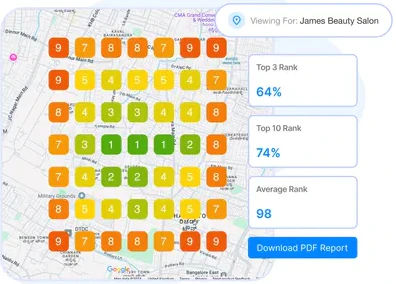
The Startup plan includes monthly tracking for 1 keyword, Agency for 3 keywords, and Scale for 5 keywords. The "SEO Pro" add-on ($5/location/month) provides 5 monthly grid reports and weekly tracking. Their "Grid Ranker" tool visualizes search rankings across specific geographic areas.
Synup's rank tracking is functional but limited in scope unless you purchase add-ons. For agencies needing comprehensive SEO reporting, the additional costs add up.
Source: Synup
Uberall provides analytics capabilities including location performance scores, competitor analysis, and a "Revenue Estimator" that translates online visibility into local revenue potential. Their "Analytics Plus" add-on includes competitive intelligence and industry benchmarking.
Uberall's analytics are advanced and particularly valuable for enterprises needing to justify marketing spend with clear ROI metrics. The Revenue Estimator attempts to quantify how online presence improvements translate to actual business outcomes.
RightResponse AI includes Google Maps Rank Tracking as a core feature. The tool creates a customizable grid around each business location to simulate searches from multiple geographic points, showing exactly where the business ranks for target keywords at each location.
Distinctive features include:
- Pin-Level Rankings: See rankings at each specific grid point, not just averages
- "Rewind" Feature: Visually replay how rankings have changed over time, including 60- and 180-day trend data
- Competitor Location Mapping: Identify where competitors rank and their precise locations
- Competitor Sentiment Analysis: Apply the same Aspect-Based Sentiment Analysis framework to understand competitors' strengths and weaknesses
The integration between rank tracking and sentiment analysis connects reputation management work directly to local visibility outcomes, helping businesses understand not just where they rank but what's driving their competitive position.
Synup vs Uberall vs RightResponse AI: Which should you choose?
The right platform depends on your specific situation, resources, and priorities.
Choose Synup if:
- You run a marketing agency serving multiple SMB clients
- You want an all-in-one platform for sales, client management, and service delivery
- White-labeling and client portals are essential to your business model
- You're willing to invest time learning a comprehensive platform
- You need integrated invoicing and proposal management
Synup may not be ideal if:
- You're a single-location business that won't use the agency features
- You want simple, predictable pricing without add-on complexity
- Review response quality is more important to you than breadth of features
Explore Synup's agency operating system with a demo.
Choose Uberall if:
- You manage an enterprise brand with many locations globally
- You need an extensive directory network and global localization
- Connecting online presence to offline revenue metrics is critical
- You have the budget for enterprise-grade software
- You need advanced automation with their UB-I AI agent
Uberall may not be ideal if:
- You're a smaller business or agency without enterprise budgets
- You prefer transparent pricing you can evaluate without sales calls
- You need specialized features like PHI detection for healthcare
Request pricing from Uberall to see their enterprise solutions.
Choose RightResponse AI if:
- You care about review response quality and understand the impact reviews have on growth; responses that actively market your business, not generic filler
- You want the three-pillar personalization system (Facts, Customizations, Brand Voice) for hyper-personalized, brand-aligned responses with endless variation
- Deep, customizable Voice of the Customer to understand what's driving your ratings is important
- You prefer transparent, usage-based pricing you can predict and control, no lock-in for capacity you don't use
- You're a location-based business (from single-location to enterprise) focused on Google visibility
- You need specialized features like PHI detection for healthcare or competitor analysis
- You want advanced AI-powered review collection alongside response quality
- You want to start quickly without enterprise sales cycles
RightResponse AI may not be ideal if:
- You need messaging, webchat, payments, or extensive listings management as your primary feature; the platform stays focused on response quality and related analytics
- You want a "set and forget" generic response style and don't care about differentiation
- You need product review capabilities; the platform handles business reviews for location-based companies only
See how RightResponse AI transforms reputation management with a 7-day free trial and 1,000 credits.
The reputation management space has matured, but the platforms have diverged in their approaches.
Synup has expanded horizontally to become an agency operating system. Uberall has moved upmarket to serve global enterprises. RightResponse AI has focused vertically on making review responses genuinely valuable, turning every reply into a conversion asset that markets your business to prospective customers.
For businesses that believe the quality of customer interactions matters as much as the quantity of features, and who understand that reviews get you higher in rankings while responses win you the next customer, RightResponse AI offers something the broader platforms don't: responses that actually build customer relationships, and insights that actually drive operational improvement.
Frequently Asked Questions
What is the main difference between Synup and Uberall?
Synup is an Agency Operating System designed primarily for marketing agencies managing multiple SMB clients, combining listings (75+ directories), reviews, social media, lead generation, sales pipeline, and invoicing with transparent tiered pricing starting at $79/month. Uberall is an enterprise-grade Location Performance Optimization platform for large multi-location brands, featuring 125+ directory integrations, the UB-I AI agent, global localization across 50+ countries, and analytics connecting online visibility to offline revenue, with custom quote-based pricing.
How does RightResponse AI differ from Synup and Uberall?
RightResponse AI focuses specifically on review response quality and review collection rather than being a broad marketing platform. Its three-pillar personalization system (Facts, Customizations, Brand Voice) creates hyper-personalized responses that actively market the business to prospective customers reading reviews. It also offers Voice of the Customer Aspect-Based Sentiment Analysis, Google Maps rank tracking with a unique Rewind feature, and transparent pricing starting at $10/location/month plus usage credits on Pay As You Go (PAYGO), with fixed monthly plans from $19 (Core), $29 (Pro), and $44 (Pro+).
How much does Synup cost compared to Uberall and RightResponse AI?
Synup offers tiered pricing: Startup at $79/month (annual), Agency at $199/month, and Scale at $799/month, with add-ons like Listings Pro ($35/location/month) and Reviews Gold ($50/location/month). Uberall requires custom quotes with enterprise-level pricing. RightResponse AI charges $10/location/month plus usage-based credits on Pay As You Go (PAYGO), or fixed monthly plans from $19 (Core), $29 (Pro), and $44 (Pro+), with 20 credits per review response.
Which platform has the best AI review response quality?
RightResponse AI offers the most advanced AI review response capabilities through its three-pillar personalization system. Facts map business-specific messaging to review themes, Customizations provide behavioral rules and edge case handling (including PHI detection for healthcare), and Brand Voice maintains consistent tone with natural variation. The agentic pipeline analyzes each review before writing, producing responses that actively market the business rather than generic template replies.
Which platform is best for agencies managing multiple clients?
Synup is specifically designed for marketing agencies with its Agency Operating System approach, offering white-labeling, lead prospecting, sales pipelines, invoicing, and multi-client management from $79/month. RightResponse AI also supports agencies with white-label capabilities and usage-based pricing that scales cleanly across accounts without rigid per-location commitments or complex add-on pricing.
Which platform has the best listings management?
Uberall has the most extensive listings network with 125+ directory integrations, global localization across 50+ countries, Profile Protection, and Generative Engine Optimization for AI-powered search. Synup covers 75+ directories with duplicate suppression and bulk editing. RightResponse AI focuses on Google Business Profile for listings while sourcing reviews from 100+ platforms, reflecting a philosophy that Google is the primary battlefield for local search visibility.
Try RightResponse AI for Free!
*No credit card required.