The 7 best GatherUp alternatives for review management in 2026 are RightResponse AI for AI review responses, customer-feedback analysis, and Google Maps tracking; NiceJob for completed-job review requests and repeat visits; ReviewTrackers for multi-location feedback and experience analysis; LocalClarity for controlled review replies and core listing operations; Birdeye for coordinating location feedback and assigned follow-up; Podium for customer texting, lead follow-up, and connected booking; and Broadly for a wider local-business front office and marketing bundle.
GatherUp combines public review requests with private feedback, surveys, AI replies, reports, review displays, and agency delivery. Its separately purchased listings and Review Defense services add other jobs. A business choosing a less expensive responder is making a different purchase from an agency replacing a branded client feedback program. Start with the work that needs to improve and the functions that must continue.
This guide serves local businesses, multi-location teams, and agencies managing businesses with physical locations or local service areas. It compares practical workflows, information used in replies, feedback evidence, administration, pricing, and replacement scope. Material product and price details were checked on October 21, 2026; proposal-specific limits remain identified where they affect the decision.
Quick Verdict: Which GatherUp Alternative Fits Your Business?
The right GatherUp alternative depends on whether the priority is a focused review workflow, a location or client program, or a wider customer operation:
- Best for AI review responses, customer-feedback analysis, and Google Maps tracking: RightResponse AI brings those jobs together on eligible plans and shows the relevant approved business Messages considered and selected for each reply. Pro is $29/location/month and Pro+ is $44 on monthly billing; Core is $19 with a narrower Google-review/basic-dashboard scope, and PAYGO starts at $10 plus purchased usage credits. Agency branding, client delivery, listings, and dispute-service requirements need their own comparison.
- Best for location feedback and agency-operated reputation work: ReviewTrackers combines requests, microsurveys, experience analysis, and partner account options. LocalClarity focuses on controlled replies and listing corrections while leaving request emails/texts to another system. Birdeye connects reviews, surveys, approvals, and assigned customer work. Birdeye has reported benchmarks around $299–$449/location/month (CostBench); Birdeye’s actual package requires a quote. ReviewTrackers’ reported starting benchmark is $89/location/month (G2, October 2024 price entry); LocalClarity Professional is USD $16/location/month monthly or $12/month billed yearly.
- Best for review collection and broader customer communication: NiceJob offers review campaigns on Starter at USD $75/month; Pro at $125 adds private NPS, referrals, and repeat-service reminders. Podium is relevant when customer texting, inquiries, payments, and supported booking need to operate together. Broadly advertises a $799/month AI Workforce bundle covering more front-office and marketing work; that is not a reviews-only price.
This comparison draws on company websites, public help documentation, product updates, and existing company research. A source summary by company appears at the end. RightResponse AI publishes this guide; the methodology explains the research and its limits.
How We Evaluate GatherUp Alternatives
GatherUp buyers can be replacing a single review task or a repeatable customer-feedback program. We use seven criteria to distinguish the alternatives:
- Requests and customer eligibility. Which completed event or contact record starts an invitation, how is the correct location chosen, how are reminders controlled, and what stops further messages?
- Useful reply information and release controls. Does the system generate new text or select a saved reply? What business knowledge can influence it, what can staff inspect or edit, and which reviews can publish automatically?
- Public and private feedback evidence. Can the team collect structured feedback, investigate a theme, open the supporting comments, and compare equivalent locations or periods? A public star rating and a private NPS answer are different measures.
- Agency and location administration. Which client accounts, user permissions, branding, sending domains, reports, and review displays can the agency operate? Who owns the customer data and connected accounts?
- Local visibility and adjacent services. Are listing corrections, geographic rank scans, competitor customer-feedback analysis, or suspicious-review disputes required? These are separate jobs with different evidence and purchase requirements.
- Total cost and commitment. Compare the same locations, request and reply volumes, modules, billing period, onboarding, integrations, retained software, and renewal or cancellation terms.
- Fit for daily work. Does the alternative address the actual bottleneck—reply editing, request follow-up, customer investigation, local data correction, or missed inquiries—without creating unowned work elsewhere?
For a focused review purchase, useful reply information, inspectable feedback, request controls, and clear plan limits carry more weight. For an agency replacing GatherUp, client administration, branding, reporting, and migration carry more weight. Broader communication tools are relevant when inquiries or booking are part of the problem. The ordering reflects qualitative buyer fit across these jobs, not a weighted feature score or a controlled comparison of finished AI replies.
GatherUp Alternatives at a Glance
These seven products belong to one comparison but replace different parts of GatherUp. Prices retain their published billing and location qualifications; a lower entry price does not establish a lower total cost for the same program.
| Platform | Best for | Price and scope | Commitment or trial | What to check |
|---|---|---|---|---|
| RightResponse AI | AI replies, requests, customer-feedback analysis, and Google Maps tracking | Per location/month monthly: Core $19; Pro $29; Pro+ $44; PAYGO $10 base plus credits. Feature and capacity limits differ. | Monthly or annual; seven-day trial with 1,000 credits and most Pro features, no card. Free use ends when credits run out. | Survey/source eligibility, pooled combined map/competitor limits, additional usage/SMS, and required client branding or retained services. |
| NiceJob | Completed-job requests, private NPS, referrals, and repeat visits | USD $75/month Starter; $125 Pro. AI Replies, NPS, Repeats, and referrals require Pro. | 14-day trial; no contracts advertised; confirm included locations and add-ons. | Event and contact matching, campaign overlap, survey template choices, Google reply authorization, and recent-review eligibility. |
| ReviewTrackers | Multi-location feedback and experience analysis | G2 starting benchmark (October 2024 price entry): $89/location/month; confirm the current plan and quote. | Public price basis is per location/month paid annually; confirm trial and actual agreement. | Microsurveys, experience and competitor analysis, white label, request/SMS volumes, and source-specific reply release. |
| LocalClarity | Controlled review replies and core listings | Professional USD $16/location/month monthly or $12/month billed yearly; agency/enterprise quoted. | Monthly and annual options; establish onboarding, trial, and proposal terms. | Retained request software: LocalClarity does not send review-request emails or texts. Check client branding and permissions. |
| Birdeye | Location feedback, approvals, and assigned follow-up | Reported benchmark: about $299–$449/location/month (CostBench); actual products, locations and contract are quoted. | Agreements typically annual; invoice frequency can differ. | Quote Reviews, surveys, insights, approvals, ticketing, agency access, integrations, and implementation explicitly. |
| Podium | Customer texting, inquiry follow-up, payments, and connected booking | Reported benchmark: ~$399 Core / ~$599 Pro per month (Pabau, Sept. 22, 2026; annual contracts). Current industry quote required; products and usage vary. | Confirm subscription term, onboarding, message limits, and trial/demo conditions. | The real scheduler, request trigger, human handoff, payment scope, and separate review-AI controls. |
| Broadly | Local-business front office and marketing bundle | AI Workforce bundle $799/month. Historical standalone benchmark (recorded Sept. 16, 2026): Reputation AI Standard $79/month; Pro $89/month; automated Premium quoted. Confirm current standalone availability, scope, and location limits. | Month-to-month and no setup/per-user fees advertised; optional ads extra. | Which calls, website, messaging, knowledge sources, Google/Facebook reply controls, and local SEO tools are included. |
Why Do Businesses Look for GatherUp Alternatives?
A useful comparison starts with a specific operational reason rather than an assumption that every existing GatherUp feature is inadequate:
- The main job has narrowed. A business with a working customer system may need focused replies, review analysis, or rank investigation more than an agency-branded feedback program.
- The team wants different analytical control. Managers may need a business-defined topic set, location comparisons, competitor experience analysis, or consistent geographic scans. Those questions require different reports.
- Customer follow-up needs to connect to service work. Job completion, a payment, a repeat-service interval, or an incoming inquiry may matter more than the review dashboard itself.
- Client and location administration has changed. An agency may need a different account structure, branded reporting arrangement, approval process, or path for handing a client its data and connected profiles.
- Listing and review work need separate ownership. Incorrect hours require a listing correction; a suspicious-review dispute requires an evidence and appeal process; an ordinary complaint requires customer follow-up. One completed reply does not finish every job.
- The current cost needs a comparable alternative. Count annual commitments, included credits, optional modules, retained tools, migration, and the staff time needed to administer the replacement.
Define a result the team can observe: fewer reply edits, a correctly triggered request, a traceable feedback theme, a resolved hours conflict, or an assigned customer issue. Software can support those results, but buying another platform does not define the process or assign its owner.
When GatherUp May Still Be the Right Choice
GatherUp remains a strong candidate when the business or agency actively uses public reviews, private feedback, requests, reports, and branded client delivery together. Its current request setup distinguishes Survey & Reviews, Ratings & Review, and Public Reviews flows. The public-review route skips the initial rating/private-feedback step; other flows collect different information first. Operators configure branding, wording, location, and reminders. Integrations can feed customer records into configured sequences, but the actual event, location mapping, eligibility, and sending queue still require setup.
Its reply tools provide several methods. SmartReply generates editable suggestions. Generated AutoReply can automatically publish eligible positive Google and Facebook responses under rating and ratings-only settings, with a custom prompt and creativity control. Auto Reply Templates instead selects among supplied complete replies. The purchased method and settings determine the operating process; a demonstration should show the actual input, editing, authorization, and public result.
Suggested responses for public and private feedback can arrive by email for review, editing, and approval. Connected Google/Facebook authorization changes whether a reply can publish there or requires copying to the source. A custom prompt can supply business guidance, so a fair comparison examines what information reaches the finished reply and what the operator can inspect.
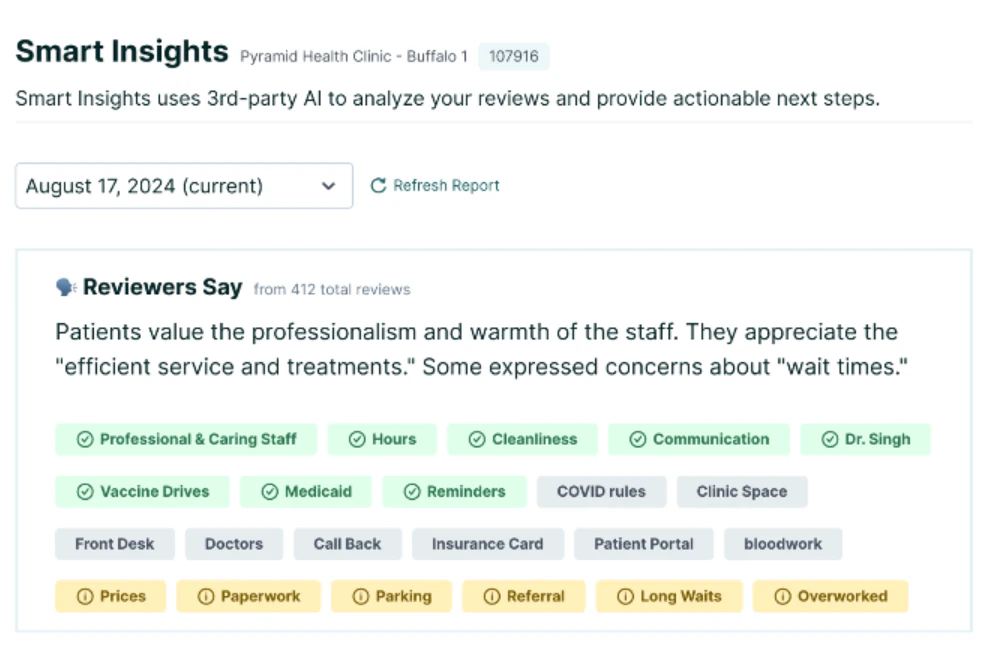
Enhanced Smart Insights analyzes public reviews and private feedback, labels themes with sentiment, and opens contributing comments in a dashboard for further filtering and review work. Its normal weekly refresh depends on enough new feedback; it is useful for recurring investigations rather than a promise that every new comment instantly refreshes a report. The separate competitor benchmark summarizes ratings, volume, and recency; do not assume every own-business theme report is available for rivals in the same form.
View full-size image (opens in a new tab)
For agencies, the white-label offer includes branded delivery, reporting, and review displays, with the agency paying GatherUp and setting its own client pricing. That can be more valuable than an isolated feature when the agency already has a repeatable service, client training, and a reporting relationship. Test the exact client login, email/domain branding, permissions, export, and offboarding arrangement required.
The core price is $124/month for one location on monthly billing, or a $99 monthly equivalent with annual billing. For 2–10 locations it is $75 or $60/location respectively. Published allowances include up to 300 SMS and 3,000 email credits/location/month; agency pricing is quoted. Listings Hub is a separate $40/location/month purchase. Compare the selected billing period and included modules rather than treating the annual equivalent as a cancel-anytime monthly offer.
Review Defense is another separate purchase. Its tiers distinguish suspicious-review assessment from managed dispute work, and its help specifies a minimum one-year commitment. Google decides whether a review is removed. A business relying on that service should evaluate the investigation, evidence, submission, and appeal process separately from ordinary monitoring or reply software.
A Note on Grade.us
Grade.us is a familiar name in agency review software, but its current new-buyer trial introduces an offer powered by GatherUp and sends the trial to GatherUp. Its demo route describes the same relationship. A buyer seeking an independent GatherUp replacement should establish which product and contract it would actually receive, rather than treating those routes as a separate alternative.
1. RightResponse AI: Best for AI Review Responses, Feedback Analysis, and Google Maps Tracking
RightResponse AI fits businesses that want requests and replies connected to customer-feedback and local-visibility investigation. It is a focused option when the team already has its customer system and wants more control over useful business information in responses, the comments behind a theme, and the locations where it appears on Google Maps. The required plan and retained agency or customer-service tools determine the total purchase.
Replies That Select Approved Business Messages
The AI review responder uses approved company, brand, and location Messages, along with business knowledge developed from the website and review history. It understands the review, selects relevant information, plans the reply, writes it, and checks the finished response. Staff can inspect the relevant candidate Messages and those selected for the reply, edit the wording, or tell the Planner what to include or exclude. Information that does not help the review can be left out.
For an illustrative appliance-service example, suppose a customer praises the technician’s clear explanation. An approved Message says that customers receive a written diagnosis before deciding on extra work. A reply could say: “We’re glad the explanation helped. We provide a written diagnosis before any additional work is approved, so customers can understand the options and decide how to proceed.” That sentence adds a useful process detail for a future customer. The same Message would not answer an unrelated complaint about an unanswered phone call.

View full-size image (opens in a new tab)
The system also supports publication rules, delays, chosen active hours, and approval emails from which staff can schedule, edit, or publish without a dashboard login. On plans that include updated-review tracking, changed content is evaluated against the earlier review and reply before a new response is planned. Direct publishing supports Google; monitoring other sources does not establish native publishing to each of them. Accurate Messages, configuration, and human exception handling remain necessary.
Requests and Private Feedback From Customer Context
Review requests can use customer or job details from a connected Sheet, Zapier, or direct entry. Eligible plans support AI-written invitations; email requests can include a relevant customer/project photo and questions that help a customer recall the experience. For example, a completed installation record can identify the actual work and ask about the handover, instead of sending every customer an identical general request. Email has more room for that context; SMS uses a shorter message.
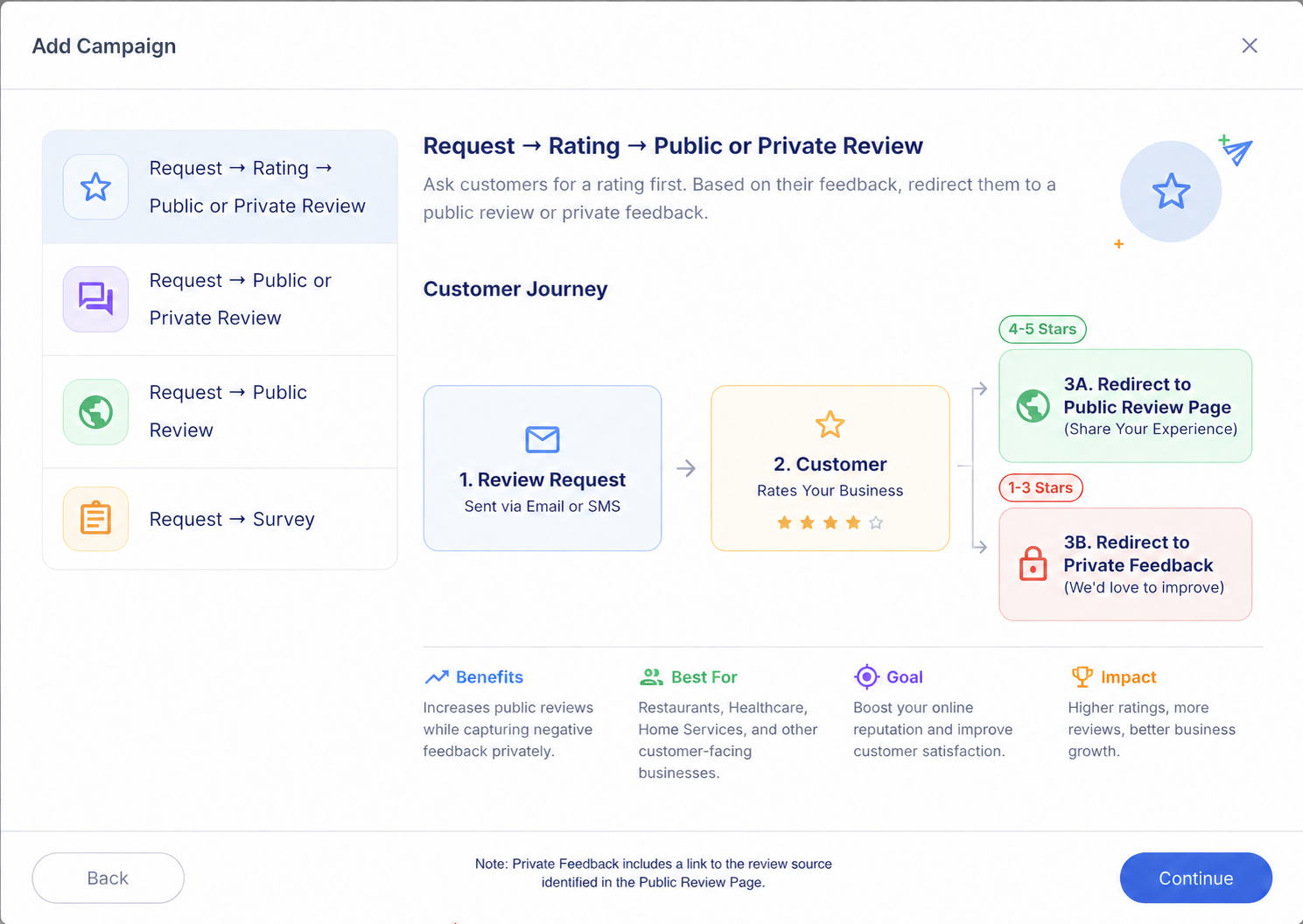
Public review and private feedback are distinct outputs. The requester includes private surveys and NPS on eligible plans, and its documented private-feedback path retains a link to the same public-review source. A private answer should not be confused with a published review. Pro includes 200 survey responses/location/month and Pro+ 500; the plan table governs eligibility and additional capacity. Test the actual location, consent, opt-out, sending hours, and campaign stop conditions before moving a live customer list.
View full-size image (opens in a new tab)
Follow-ups are limited by plan: Core includes two per campaign, Pro four, and Pro+ ten. Employee QR codes and request-link activity can help staff investigate outreach, but a click or scan is not confirmation that a review was posted. Maintaining customer records, relevant questions, and correct location mapping is part of operating the campaign.
Feedback Evidence, Competitor Experiences, and Local Grids
Customer-feedback analysis uses business-tailored categories and topics that the team can modify or supply. A customer can praise communication and criticize an unexpected price within one review; the relevant phrases are analyzed under their respective topics. Managers can compare positive-mention percentages and frequency, open supporting phrases and full reviews, and compare locations or periods. This gives a specific investigation task instead of asking every branch simply to improve its overall rating.

View full-size image (opens in a new tab)
Competitor analysis separates recent rating, review velocity, and response-rate comparisons from Pro+ customer-feedback analysis of competitors. The latter applies the business’s topics to rival reviews, helping a manager investigate what customers say about the same experiences. Useful comparisons still depend on equivalent topic definitions, locations, and periods.
The Google Maps tracker measures a selected search at points around a location, with manual or scheduled scans, comparable grids for detected businesses, and earlier scans available through history. It answers where a business appears for a specific search, rather than what its customers felt. A change in the grid alone does not establish that a particular review reply or software switch caused a sale or ranking improvement.
Pricing, Monthly Allowances, and Plan Boundaries
| Plan | Monthly price per location | Included response/request capacity | Analysis and surveys | Buyer fit |
|---|---|---|---|---|
| Core | $19 | 100 responses; 1,000 email requests; template requests; two follow-ups/campaign | Google-review scope and basic dashboard; advanced topic tools, NPS, Maps and competitor analysis excluded | A narrower Google reply and basic email-request purchase. |
| Pro | $29 | 200 responses; 2,000 email requests; 200 SMS segments; four follow-ups/campaign | 200 survey responses; 10 combined map scans/competitor analyses per location/month; eligible advanced analysis | Focused review, feedback, request and Maps work. |
| Pro+ | $44 | 500 responses; 5,000 email requests; 500 SMS segments; ten follow-ups/campaign | 500 survey responses; 25 combined scans/analyses; competitor customer-feedback analysis | Higher volumes, advanced automation, and topic-based competitor investigation. |
| PAYGO | $10 base plus purchased credits | Eligible activity uses purchased credits; most Pro features accessible through eligible usage | Check the detailed plan table for each required survey or analysis feature | Variable activity where both the subscription and usage are budgeted. |
The published pricing table distinguishes feature access from capacity. Monthly allowances pool across account locations; Pro’s ten and Pro+’s twenty-five cover map scans and competitor analyses together, not separate allowances for each. Pro/Pro+ add-on packs, additional SMS registration/numbers/delivery, and retained tools can change the total. Annual subscriptions provide twelve months for the price of ten monthly payments; usage, add-ons, and SMS charges remain separate.
The tradeoff: a focused review-and-analysis purchase can suit an agency or business keeping its existing customer tools. Replacing a complete GatherUp program also requires attention to private survey design, branded client access and reports, review displays, listings, and any Review Defense agreement. Those jobs should be retained or demonstrated in the proposed arrangement rather than assumed from a review-response feature.
What to verify: give both systems the same review, useful approved business detail, unrelated detail, and changed-review case. Inspect the finished reply and information selected, then submit a private survey and trace a feedback theme to its comments. Compare actual client/location access, request eligibility, source coverage, pooled capacity, and retained services in the written price.
2. NiceJob: Best for Completed-Job Review Requests and Repeat Visits
NiceJob fits service businesses that want completed jobs to lead into review requests, private feedback, referrals, and repeat visits while retaining their existing customer system. Its most useful distinction is the connection between a customer record, a service event, and the next campaign step.
Staff can edit campaign messages, merge fields, SMS/email steps, and delays, adding, deleting, or pausing steps as needed. Customer matching stops reminders when an imported review is matched to the invited contact. Different reviewer names can require staff correction or manual removal.
The CompanyCam integration attaches the most recently tagged NJReview job photo to an invitation when the customer and job systems are linked correctly. That gives the customer a recognizable reminder of the work performed.
Pro also includes a separate private NPS campaign: choose a rating-only template or a rating plus five predefined service questions. Entry rules can follow a job or payment; a same-month submission replaces the earlier answer. Location comparisons help a franchise investigate uneven experiences. The separate Feedback Routing setting retains public and private options for every customer; private feedback does not automatically stop the review campaign. Campaign timing matters when the same customer receives both a public invitation and a private survey.
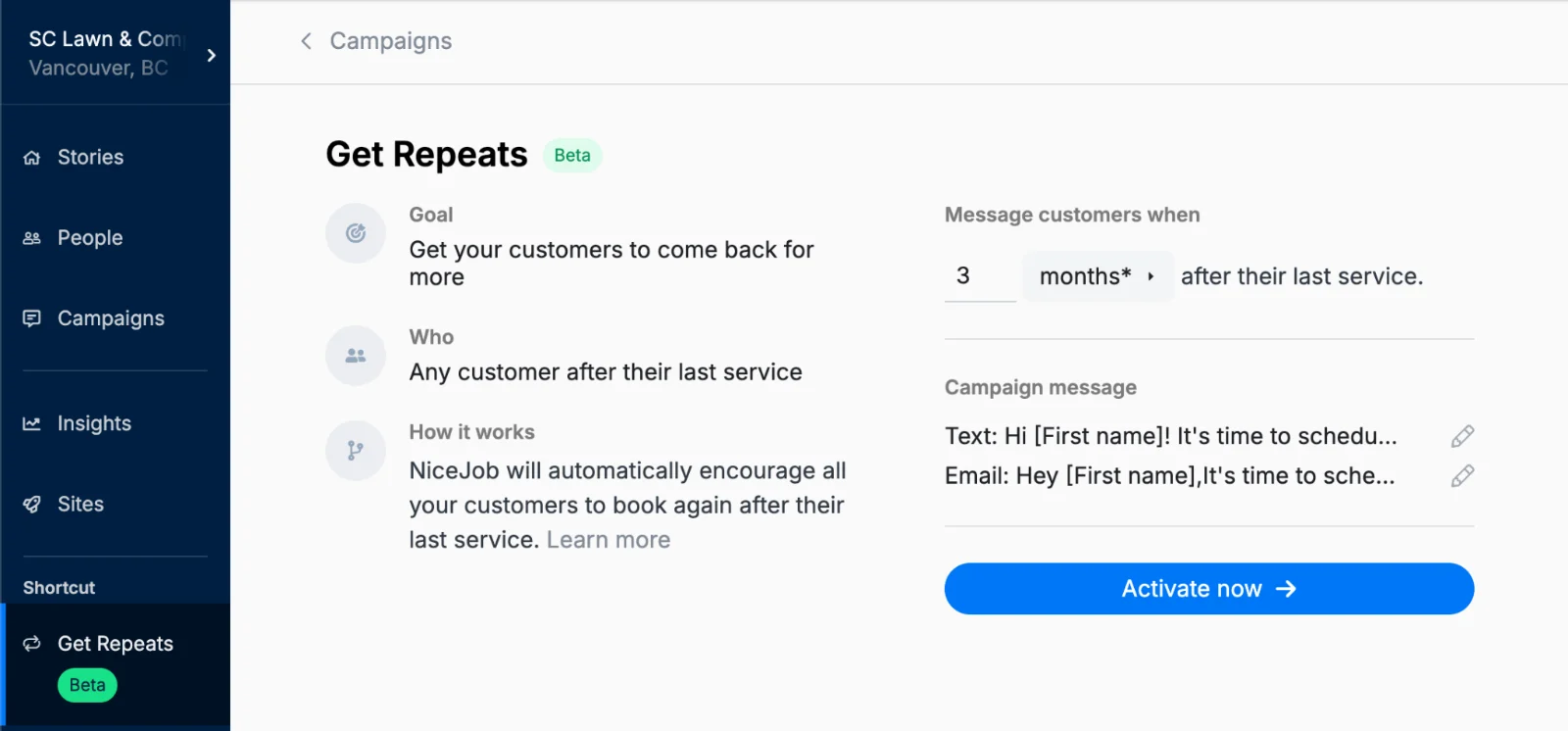
Topic Insights identifies contextual review topics and opens example comments. Pro Competitor Insights compares three selected Google competitors using review counts, ratings, velocity, and extracted topics. Repeats uses last-service dates and chosen intervals for rebooking reminders.
AI Replies provides an editable draft with tone, voice, and length settings. Pro automatic mode processes eligible recent Google reviews daily and requires publishing authorization; it does not automatically reply to historical reviews. Staff still handle excluded reviews and verify business-specific statements.
View full-size image (opens in a new tab)
Pricing, Tradeoffs, and What to Verify
Pricing: Current USD monthly plans are Starter at $75 and Pro at $125. AI Replies, NPS Surveys, Repeats, Referrals, and Competitive Intel are Pro features. The page advertises a 14-day trial and no contracts; establish the locations and add-ons covered by the actual account.
The tradeoff: The connected service-cycle workflow suits a lean team, but the predefined survey choices and daily reply process may not match a more elaborate feedback or approval program. Contact matching, campaign overlap, and customer-system maintenance remain practical operating work.
What to verify: Trigger a completed-job invitation, inspect the photo/contact match, and confirm that a matched review stops reminders. Submit private feedback and check its separate campaign effect. Compare location-level survey answers, competitor topics, Google authorization, and excluded-review handling on the proposed plan.
3. ReviewTrackers: Best for Multi-Location Feedback and Experience Analysis
ReviewTrackers fits businesses that want review work connected to a repeatable customer-feedback program across locations. A central team can combine review collection, local participation, experience analysis, and competitor comparisons. This is a relevant GatherUp alternative when the buying decision includes understanding customer experiences and coordinating locations, rather than simply sending more invitations.
Its Ask Tool supports email and SMS campaigns, branded landing pages, QR codes, and previews. Microsurveys combine a star-rating or Net Promoter Score question with up to five additional custom questions. Merge tags insert customer, business, and location information, with fallback wording for missing values. A regional operator can therefore collect a structured answer about a visit alongside the customer's overall assessment instead of relying entirely on an unsolicited public review.
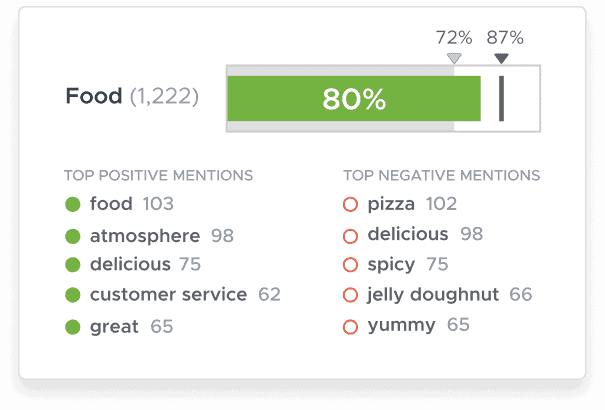
Customer Experience Analytics categorizes feedback and reviews using natural language processing and tracks sentiment and recurring words or phrases. A repeated complaint about food temperature can be investigated as an experience issue even when the location's overall rating is respectable. Its competitor analysis separately tracks rival performance, review velocity, and categorized feedback. These tools help a team compare customer experiences; the underlying reviews, time periods, and included locations still determine whether a comparison is useful.
The response product includes generated AI replies and Smart Response templates for on-brand automatic responding. A generated draft and a complete saved response are different methods: the team should select the method, information inputs, and release rules appropriate for each review. Direct reply support also needs to be checked for the actual review sources being connected, rather than inferred from the number of sites monitored.
For agencies, the partner offer adds a multi-tenant account structure, client scorecards, and API-based data delivery. White-label branding is a separately identified partner option. Those controls matter when the agency needs to administer distinct client accounts and demonstrate progress without treating every client as another location of one business.
View full-size image (opens in a new tab)
Pricing, Tradeoffs, and What to Verify
Pricing: As a budgeting benchmark, G2 lists a reported starting price of $89 per location/month. The underlying price entry was updated October 9, 2024 (checked October 21, 2026), so it is an attributed historical benchmark rather than a confirmed price for the current Starter or Essential package. Obtain a location-based quote; the public price basis is per location per month, paid annually, without a dependable displayed dollar amount. Starter covers the core platform, while Essential adds experience analysis and competitor insights. Data Only serves external analysis systems. White label, local listings, and local search rank are separately scoped options. Include request volumes, SMS, integrations, onboarding, and contract terms in the proposal.
The tradeoff: A location-and-feedback program can justify the additional setup, but a small team seeking only routine requests may not need the analytics, account structure, or add-ons. Templates, location mapping, and access still require administration.
What to verify: Send the same customer event to two test locations and inspect the recipient, branding, reminder, and stopping signal. Trace a feedback theme to its supporting comments, then compare a matched period with competitors. Separately demonstrate AI versus saved-template replies, source-specific publishing, client permissions, and the complete written price.
4. LocalClarity: Best for Controlled Review Replies and Core Listing Operations
LocalClarity fits agencies and multi-location teams whose main work is controlling review replies and keeping core local listings accurate. Its useful distinction is the combination of a working review inbox, configurable release controls, business-informed AI replies, and detailed listing correction. A business keeping an existing request system can evaluate these operations separately from a full feedback-program replacement.
Custom AI Agents accept brand background, business history, value proposition, star-specific writing instructions, language preferences, and response variability. Staff can maintain different agents for different response tasks. The internal agent description is for identification; the business background supplies information to the writing prompt. This gives the team concrete inputs to maintain and test when a generic tone setting would not describe how the business operates.
The Review Settings can send a reply to an Outbox or require approval by a selected editor. A configurable delay leaves time to edit a response before it posts. For a regional director responsible for local replies, the difference is practical: prepared wording can wait for a person with authority to release it. Confirmation prompts, source connections, and the handling of automatic campaigns should be configured deliberately rather than assumed from a general automation label.
RealityCheck compares the business's authorized records with public Google and Apple values. An operator can inspect an hours, phone, category, or other discrepancy and choose whether to preserve the authorized record or accept the suggested change. The same workflow supports filtered bulk corrections. This is useful when customer complaints originate from inaccurate location information: the team can correct the underlying listing instead of only replying to the resulting review.
The review platform also retains review and response history and supports templates and generated replies. Source permissions govern whether a reply can publish directly or needs work on the originating platform. A monitored source and a directly writable source remain different requirements.

View full-size image (opens in a new tab)
Pricing, Tradeoffs, and What to Verify
Pricing: The current visible Professional offer is USD $16/location/month on monthly billing, or $12/month billed yearly. Enterprise and agency arrangements are quoted by volume and functionality. Confirm white-label domains, required integrations, custom roles, onboarding, and any managed service separately; the software subscription and a staffed service have different scope.
The tradeoff: LocalClarity's help explicitly says it does not send review-request emails or texts. A GatherUp buyer relying on invitation campaigns must retain or separately replace that work. Listing and reply controls are therefore the reason to shortlist it, rather than an assumption of complete campaign replacement.
What to verify: Run a mixed review through an agent, editor approval, delay, and the actual publishing destination. Then resolve an hours conflict on Google and Apple, inspect the public result and history, and test which users can change or release it. Price the retained request system alongside the proposed subscription.
5. Birdeye: Best for Coordinating Location Feedback and Owned Follow-Up
Birdeye fits organizations that want reviews, surveys, and customer follow-up to move through coordinated location and central teams. A GatherUp replacement can therefore include how feedback becomes assigned work, alongside collection and reporting. The purchased products determine the scope of that wider operation.
The Review Response Agent can start when a review arrives or changes. It checks for spam, branches to an alert or analysis, and uses review details plus business information such as services and description when generating a reply. Template, autonomous, suggestion, and human-approval approaches are documented. Run test exposes step inputs, outputs, and response reasoning, helping a manager inspect a specific path before enabling it.
Review response approvals support multiple steps with designated approvers. An approver can reject a draft with a reason, after which staff can fix and resubmit it. That creates an explicit release process when local staff draft replies and another team reviews them.
The survey reporting product tracks response activity by date, channel, and location, summarizes surveys or individual questions, and compares NPS over time. Location and employee filters help investigate where feedback differs. Its separate Insights AI setup lets staff add categories, choose suggested or entered keywords, and block unwanted keywords. A useful demonstration follows a reported theme back to the relevant responses rather than stopping at a summary.
Birdeye also documents creating a service ticket from a review, assigning an owner, and changing status. For a repeated billing complaint, the public reply and the underlying investigation become distinct pieces of work. Posting the reply does not establish that the billing issue was resolved.
This combination is relevant when several branches or departments share responsibility. Someone must maintain location information, survey design, routing, and approvals; buying the suite does not define those operating decisions.
View full-size image (opens in a new tab)
Pricing, Tradeoffs, and What to Verify
Pricing: For budgeting, CostBench reports Starter around $299, Growth $349 and Dominate $449 per location/month (last verified August 26, 2026; checked October 21). Birdeye provides a custom quote. Its pricing explanation ties cost to products, locations, and contract structure, and describes agreements as typically annual with upfront or scheduled payments. Quote reviews, Surveys AI, Insights AI, approvals, ticketing, integrations, and implementation explicitly; monthly invoicing does not establish a monthly commitment.
The tradeoff: Coordinated work can reduce separate handoffs, but the breadth adds configuration and product choices. A team needing only invitations and a review display may not use the survey, reporting, and case-management scope that justifies the larger purchase.
What to verify: Run a changed review through its configured branch and approval steps, then inspect the public result. Create and assign the underlying ticket. Compare survey answers across the actual locations, and have an agency demonstrate the client access, branding, and reports it needs.
6. Podium: Best for Customer Conversations, Booking, and Payment Follow-Up
Podium fits a business that wants incoming conversations to progress toward appointments and paid work. Calls, website inquiries, texting, reviews, and payments form a wider customer operation. It is particularly relevant when the reason for changing platforms is slow lead follow-up or disconnected communication, rather than a need to reproduce an agency-branded feedback program.
The reviews product describes automated textable invitations and reminders, review records linked to customer profiles, and an AI Reputation Specialist that generates invitations and responses. This can keep the request and reply near the customer's wider conversation. The review responder's inputs, editing, and publishing controls should be demonstrated separately from the AI Employee's sales-conversation settings.
For customer inquiries, Podium’s AI Studio explanation describes configured instructions, playbooks, simulated conversations, and feedback used to revise behavior. A team can test a routine question and an exception before enabling its workflow. A successful simulation is useful preparation; the actual booking or human handoff still needs to appear in the destination system.
The current home-service FSM supplies a concrete native route for HVAC, plumbing, and electrical businesses. Customer and job history connect to dispatch, estimates, and payments; Larry books onto Podium’s dispatch board using technician availability. That establishes a specific industry product, rather than identical direct booking into every external scheduler. A business keeping its existing field-service system needs the purchased integration demonstrated.
Podium Payments attaches invoice links to text conversations, supports recurring payments, and offers readers or phone tap-to-pay for in-person collection. Staff can keep the inquiry, service discussion, and payment follow-up together. These payment operations and the home-service dispatch product have their own scope and fees; they should not be assumed to accompany every review-software proposal.
View full-size image (opens in a new tab)
Pricing, Tradeoffs, and What to Verify
Pricing: Request an industry-specific quote. For budgeting, Pabau’s September 22, 2026 guide reports Core at about $399/month and Pro at $599/month on annual contracts, with Signature quoted separately. These are third-party benchmarks for the general local-business platform, not a confirmed current rate for an industry product or your deployment. Itemize AI products, phones, users, messages, integrations, setup, and payment fees. Podium’s terms default to a twelve-month subscription and equal renewals with at least thirty days’ written non-renewal notice, unless the Subscription Documentation provides otherwise. Confirm the offered trial arrangement separately.
The tradeoff: Podium is a larger communication and operational purchase. It can add unnecessary overlap when an existing phone service, customer system, scheduler, and payment process already work. Businesses chiefly replacing requests, feedback analysis, or client-facing reports should compare those exact tasks before paying for the broader operation.
What to verify: Run an after-hours inquiry into the actual scheduler, staff escalation, and invoice-payment route. Change an appointment and establish whether booking is direct or staff-approved. Then show the review request and response controls, and obtain written location limits, messaging overages, processing costs, cancellation terms, and the offered trial arrangement.
7. Broadly: Best for a Managed Front Office and Local Marketing
Broadly fits a local service business that wants reviews connected to calls, customer messages, booking, a website, and local marketing. Its current workforce offer includes setup by the vendor. For an owner who cannot answer inquiries while completing jobs, the buying question is whether those connected front-office tools would replace real work or existing subscriptions.
Review replies can use maintained business information. The documented Premium AI Reputation Specialist requires knowledge sources before automatic replies are enabled. Its Knowledge Base accepts Business Profile details, website pages, uploaded documents, and manual entries. It retrieves relevant material when a lookup would help; the business still needs to maintain accurate services, policies, and instructions.
The Specialist supports automatic responses for connected Google and Facebook accounts, with rating, platform, and delay settings. Draft-ready emails also support a human route: the approval link opens the app and requires confirmation before publishing. Other review sources require manual destination work. Automation covers reviews received after its trigger is enabled. A changed review updates an unpublished draft, while an already-posted response does not produce another review-card draft.
Feedback and visibility extend beyond reply drafting. The Specialist can investigate review and NPS data through a conversational interface, identifying sentiment, themes, and changes over time. Broadly’s Local SEO tools add a geographic search grid, reporting for up to fifteen keywords, and weekly keyword refresh. The purchased edition should be checked for the analysis, history, and location coverage the team needs.
View full-size image (opens in a new tab)
Pricing, Tradeoffs, and What to Verify
Pricing: The advertised AI Workforce package is $799/month, with month-to-month service and no setup or per-user fees; optional advertising is extra. The offer also describes an annual discount with prorated unused-month refunds. A September 16, 2026 check of Broadly’s public pricing content recorded standalone Reputation AI Standard at $79/month and Pro at $89/month; Premium, with automated requests and replies, was quoted. These historical figures need confirmation: the rendered October 21 flagship page foregrounds Workforce. Confirm current standalone availability, prices, location limits, and included automation. Confirm the contracted locations, usage, integrations, and edition.
The tradeoff: Broadly’s breadth is useful when phone handling, messages, a website, and marketing need replacing together. An agency primarily operating branded client feedback, surveys, and review displays needs those delivery requirements demonstrated separately. Retaining working front-office systems can reduce the value of another broad bundle.
What to verify: Follow an inquiry through the actual calendar and staff handoff, then generate a reply using a maintained service fact. Inspect automatic versus approved release, an edited review, and manual handling for another source. Open the comments behind a feedback theme and compare the quoted grid, keyword, history, and location allowances.
Free Option: Google Business Profile
Google Business Profile lets an eligible business read and reply to Google reviews and share a review link or QR code. For one location with a small volume of Google reviews, staff can request feedback through an existing customer process and respond directly. A person remains responsible for monitoring the account, deciding what to write, and following up on customer problems.
This can be enough when Google is the required source and the daily process is manageable. It does not by itself replace GatherUp’s private surveys, cross-source monitoring, agency client delivery, reminder campaigns, displays, or Smart Insights. Include the manual work and any separate tools when comparing a free account with a managed program.
RightResponse AI vs. GatherUp: What Are You Replacing?
Both products combine requests, replies, and feedback work, but a buying decision can include different analytical and service requirements. Compare the actual methods and program scope:
| What matters | RightResponse AI | GatherUp |
|---|---|---|
| Business information in replies | Approved company/brand/location Messages; inspect relevant candidates and selected Messages; planned and checked output | Custom-prompt guidance, generated SmartReply/AutoReply, and a separate complete-template method; demonstrate the actual information and checks |
| Reply release | Google direct publishing; configurable rules, delays and approval emails; updated-review tracking on eligible plans | Generated automatic positive Google/Facebook replies; rating/ratings-only controls; suggestion emails and separate template automation |
| Feedback evidence | Business-defined topics, phrase/full-review evidence, location comparisons; private NPS and surveys on eligible plans | Public/private feedback, NPS and Smart Insights themes with source-review investigation; different request flows |
| Competitors and local visibility | Maps grids/history and competitor performance; Pro+ competitor customer-feedback topics; pooled combined scan limits | Ordinary competitor rating/volume/recency reports; Listings Hub and Review Defense are separate purchases |
| Agency delivery | Establish needed client access, reports, branding, retained displays and service scope in the actual arrangement | Dedicated agency billing/client-pricing and white-label options; demonstrate exact client roles, domains, reports and offboarding |
| Price basis | Core $19, Pro $29, Pro+ $44/location/month monthly; PAYGO $10 base plus credits | One location $124 monthly or $99 annual equivalent; 2–10 $75/$60 per location respectively; agency quoted; add-ons separate |
Sources: RightResponse AI pricing, responder, requester, GatherUp pricing, AutoReply, Smart Insights, and agency offer.
For one location, Pro’s $29 monthly base and GatherUp’s $124 monthly core subscription are different subscription amounts. A useful total-cost comparison also matches request, reply, SMS and survey volumes; feature access; branding and reporting work; add-ons; retained tools; and staff time. Comparing a $10 credit-based entry subscription with an inclusive program without counting usage would obscure those differences.
Which GatherUp Alternative Fits the Main Buying Job?
| Primary need | Consider | Why |
|---|---|---|
| Useful AI replies, feedback investigation, and Google Maps tracking | RightResponse AI | Inspectable approved Messages and business-defined topics, with eligible request/survey and local-visibility tools. |
| Completed-job requests, referrals, and repeat visits | NiceJob | Customer-linked campaigns, photo context, review matching, Pro NPS, and service-cycle follow-up. |
| Multi-location public/private feedback and experience analysis | ReviewTrackers | Requests and microsurveys connected to experience analysis, competitor comparisons, and partner options. |
| Reply approvals and Google/Apple listing corrections | LocalClarity | Controlled release and RealityCheck; retain or separately buy request sending. |
| Coordinated surveys, review approvals, and owned customer follow-up | Birdeye | Survey/location analysis plus configurable review-agent paths, approvals, and assigned tickets. |
| Customer texting, lead conversations, and supported booking | Podium | Connects inquiries, customer records, payments, and industry-specific appointment operations. |
| Managed front office, website, reviews, and local marketing | Broadly | A wider AI Workforce purchase when those connected jobs need to operate together. |
Try the Software Before You Switch
Give each shortlisted product the same real work. Remove private customer information from demonstration material and agree on success before the test:
- Use the same reviews and knowledge. Include praise, mixed feedback, a star-only review, a complaint, and a changed review. Supply one useful approved business detail and one unrelated detail. Inspect what the finished reply adds and what it omits.
- Run the actual request event. Start with the customer system or import the team will use. Check recipient and location mapping, consent/opt-outs, invitation content, reminders, and the signal that stops further messages.
- Follow every feedback path. Submit positive and negative private feedback and inspect the public-review option in each case. Distinguish a sent invitation, private answer, clicked link, and posted review.
- Test release and exception work. Generate a reply, edit or reject it, apply approval/delay rules, and inspect the actual destination. Test changed reviews and sources requiring manual work.
- Open the evidence behind a report. Follow a theme to contributing comments and compare the same locations and periods. Keep a rating benchmark, competitor topic analysis, geographic scan, and authenticity dispute as separate tests.
- Try the agency or location handoff. Use the real client role, branding, report, widget, and account structure. Check who can change settings, see customer records, approve replies, and export a departing client’s data.
- Record the complete price and work left over. Count subscription period, locations, messages/credits, surveys, scans, modules, setup, retained software, and ongoing staff time. If broader communication is required, demonstrate the actual scheduler and customer follow-up too.
Keep a record of completed actions, reply edits, exceptions, unresolved terms, and total cost. A polished draft or a successful preview is not evidence that the requested message was sent, a reply was published, or the customer problem was resolved.
Compare RightResponse AI plans and start a trial. The trial includes seven days, 1,000 credits, and most Pro features without a card; free use ends if the credits run out. Use the same reviews, business details, and feedback tasks tested with other candidates.
Questions to Ask Before Switching from GatherUp
- Which parts of the program must continue? List requests, public replies, surveys/NPS, feedback reports, widgets, client branding, listings, and Review Defense separately.
- What can be exported and reused? Inspect customer and consent records, opt-outs, private feedback, reviews/replies, reports, templates, source connections, and account ownership under the actual agreement. A file download is useful only if the replacement can use its fields.
- Which event starts and stops a campaign? Establish location mapping, eligibility, duplicate prevention, reminders, and the effect of a public review versus private feedback. Demonstrate the same customer returning for a later service.
- How will client access and branding work? Check sending domains, reports, login roles, website widgets, billing ownership, and what an agency hands over when a client leaves.
- What will automatically publish? Test each reply method, rating/text condition, approval, delay, changed review, and source authorization. Include the person responsible for exceptions.
- What are the actual billing and renewal terms? Match monthly versus annual core subscriptions, agency arrangements, add-ons, included capacity, usage fees, setup and cancellation. Review Defense has a separately documented commitment.
- What will still need another service or person? Separate reply completion from customer issue resolution, listing corrections from ranking measurement, and suspicious-review alerts from a managed dispute process.
How to Switch from GatherUp
- Map the existing program. List the request flows, feedback/survey types, reply methods, reports, widgets, connected profiles, client accounts and optional services currently used. Name an owner for each job.
- Export and inspect usable records. Save permitted customer, consent, opt-out, feedback, review/reply and report data. Open the files, identify field mappings, and confirm who owns connected business profiles, domains and client assets.
- Configure the replacement. Set up actual locations, client accounts, staff roles, approved business knowledge, request triggers, sending identity, feedback paths and reply rules. Preserve opt-outs and location associations.
- Run a small end-to-end test. Use a limited eligible customer group and sample reviews. Verify invitations, reminder stops, private feedback, approvals, public replies, reports and any client-facing access in their actual destinations.
- Coordinate the cutover. Pause old campaigns and reminders before enabling replacements. Update review links, widgets and reports deliberately, and make sure staff know which system owns each task.
- Train staff and check ongoing work. Inspect new reviews, private feedback, exceptions, assigned customer follow-up and reports. If there are several locations or clients, move them in groups the team can verify.
- Close only the services being replaced. Confirm exports and the replacement workflow work, retain any required listings or dispute service, and meet the actual core, agency and add-on cancellation or renewal requirements.
Further Research on GatherUp and Review Management
The review management software comparison library connects platform reviews, pricing analyses, alternatives, and head-to-head guides. The GatherUp review, pricing guide, and GatherUp vs. NiceJob comparison provide related context. Check current official pricing, product help, and the actual proposal when older screenshots or offer details differ; this guide’s dated checks apply to the claims presented here.
How We Compared the Products
This is a documentation-based comparison using existing company research, current public product pages, help documentation, product updates, and published pricing or procurement information. The same relevant operational, pricing, and workflow criteria guide the comparisons. We did not run a controlled hands-on test across all seven platforms or establish a finished-reply, review-growth, ranking, sales, or dispute-removal winner.
Screenshots illustrate product views, not a side-by-side execution test. Previously published site screenshots retain earlier interfaces; their original capture dates are not always established. Images drawn from current official pages illustrate published features; entitlements and prices come from the linked dated sources. Publicly undocumented details remain verification tasks rather than evidence that a feature does not exist. (Disclosure: RightResponse AI publishes this guide and evaluated the platforms against the same operational, pricing, and workflow criteria.)
Final Verdict: Choosing the Right GatherUp Competitor
- Best for focused review responses, feedback analysis, and Maps tracking: RightResponse AI combines inspectable approved business Messages with business-defined feedback topics and eligible request, survey, and local-visibility tools. Pro at $29/location/month covers the core combination; Pro+ at $44 adds higher capacity, automation, and competitor topic analysis. Core and PAYGO serve narrower or usage-based needs with different boundaries.
- Best for location and agency-operated reputation programs: ReviewTrackers fits public/private feedback and experience analysis; LocalClarity fits controlled replies and listing correction with request sending retained elsewhere; Birdeye fits coordinated surveys, approvals, and owned follow-up. Staying with GatherUp can be the right answer when its branded client program, feedback flows, Smart Insights, displays, and any separately purchased service already work well.
- Best for review collection or wider customer communication: NiceJob fits job-linked campaigns and repeat visits, Podium fits customer conversations and supported transaction/booking work, and Broadly fits a wider managed front-office and marketing purchase. Compare those additional jobs when they are the reason for switching; they are different purchases from a standalone feedback report.
Frequently Asked Questions
What are the best GatherUp alternatives for review management?
RightResponse AI fits focused AI replies, requests, customer-feedback analysis, and Google Maps tracking on eligible plans. NiceJob fits completed-job campaigns and repeat visits; ReviewTrackers fits multi-location feedback and experience analysis; LocalClarity fits controlled replies and listing corrections. Birdeye, Podium, and Broadly are relevant when the replacement includes wider location coordination, customer communication, or front-office work.
What is the most affordable GatherUp alternative?
Compare the required program and usage. RightResponse AI has a $10/location/month PAYGO base plus purchased credits, and monthly Core, Pro, and Pro+ prices of $19, $29, and $44. LocalClarity Professional is USD $16/location/month monthly or $12 billed yearly, but request emails/texts need another system. NiceJob is USD $75 Starter or $125 Pro. Lower subscription prices do not establish lower total costs for the same surveys, branding, messages, reports, and retained tools.
Which GatherUp alternatives fit agencies?
ReviewTrackers offers multi-tenant partner accounts, client scorecards, and separately scoped white-label options. LocalClarity offers agency arrangements for review and listing operations, while Birdeye can support a broader coordinated location program. Establish exact client access, branding, domains, reports, billing, data ownership, and request sending. GatherUp itself remains relevant when its established branded feedback program is the main purchase.
Does GatherUp generate AI replies or only select templates?
It supports distinct methods: SmartReply generates editable suggestions, generated AutoReply automatically replies to eligible positive Google and Facebook reviews under configured settings, and Auto Reply Templates selects among supplied complete replies. Prompts, rating rules, authorization, and the chosen method affect the result. Compare the actual information used and public release behavior with the same sample review.
Can a GatherUp replacement collect private feedback as well as public reviews?
Several candidates offer private feedback or surveys, but the inputs and plans differ. RightResponse AI includes private surveys and NPS on eligible plans; NiceJob Pro has a private NPS campaign with defined template choices; ReviewTrackers offers microsurveys; and Birdeye has survey reporting and location comparisons. Test the exact questions, campaign timing, customer/location mapping, reports, and public-review access required.
Is Grade.us an independent GatherUp alternative for a new buyer?
Its current new-buyer trial and demo pages describe a GatherUp-powered offer, and the trial links to GatherUp. A buyer seeking an independent replacement should verify the actual product and agreement being offered rather than treating those new-buyer routes as a separate platform.
Can Google Business Profile replace GatherUp for free?
It can cover direct Google review reading, replies, and sharing a review link or QR code for an eligible business. Staff still operate that process. It does not by itself replace cross-source monitoring, private surveys, agency branding and client accounts, reminder campaigns, review displays, or feedback analysis. It can be sufficient when those extra jobs are unnecessary or already covered.
Does customer-feedback analysis include Google Maps rank tracking?
They answer different questions. Topic and sentiment analysis investigates what customers describe; a geographic rank tracker measures where a business appears for a specified search across an area. Competitor rating metrics, competitor topic analysis, listing corrections, and authenticity disputes are also different jobs. Require the actual report and method the team needs rather than inferring it from a general reputation-management label.
Sources by Company
Key product, operating, and commercial sources are grouped below; the relevant passages link to supporting detail throughout. Documentation establishes the described method and offer, rather than a measured output or business-outcome advantage.
- GatherUp: Pricing and billing; Request setup; Generated AutoReply; Smart Insights; Agency delivery; Review Defense.
- RightResponse AI: AI review responder; Pricing and feature limits; Review requests and surveys; Customer-feedback analysis; Google Maps tracking; Competitor review analysis.
- NiceJob: Pricing; NPS campaigns; AI Replies; Competitor Insights.
- ReviewTrackers: Plans; Ask Tool; Experience analysis; Competitor analysis; Agency partners; G2 reported starting price (price entry updated October 9, 2024; checked October 21, 2026).
- LocalClarity: Pricing; Custom AI Agents; Reply settings; RealityCheck; Request-sending boundary.
- Birdeye: Review Response Agent; Survey reporting; Review-to-ticket workflow; Pricing and commitments; CostBench external price benchmarks (last verified August 26, 2026; checked October 21).
- Podium: Custom quote; Review tools; Home-service workflow; Payments; Contract terms; Reported Core/Pro pricing (Pabau, Sept. 22, 2026); Historical vendor-price observation (Aug. 23; removal reported Sept. 2, 2026).
- Broadly: Workforce offer and historical standalone content (recorded Sept. 16, 2026); Reputation Specialist; Knowledge Base; Local SEO.
- Google Business Profile: Reviews, replies, and review links.
- Grade.us new-buyer offer: Current trial; Current demo.