What Is Multi-Location Review Management?
Multi-location review management is the coordinated process of generating, monitoring, analyzing, responding to, and acting on customer reviews across a portfolio of locations. It gives the organization one operating system for local reputation while preserving the context and judgment that belong at each location.
The work becomes materially harder as a business adds locations. Each location has its own review profile, customers, employees, competitors, service patterns, and operating realities. The brand still needs consistent standards, approved corporate and brand knowledge that can be combined with accurate local facts, reporting topics that match the business, comparable measures, and a clear view of risk. A successful program connects those two levels.
This is why aggregate reporting can be misleading. Birdeye reported that, in an analysis of 1,762 multi-location brands, individual locations were roughly three times more visible in AI answers than the brand-level score suggested. It also found that 46.7% of brands had a visibility gap of at least 50 points between their best and worst locations. That is Birdeye's research, and the practical lesson is broader: customers experience and evaluate the location in front of them, not an average location.
BrightLocal's 2026 Local Consumer Review Survey found that 97% of consumers read reviews for local businesses, 74% focus on reviews written in the previous three months, and 31% will only use a business with at least a 4.5-star rating. The survey also found that consumers evaluate the business response itself. For a multi-location organization, uneven review recency, rating, and response quality can create very different customer experiences under the same brand.
The five jobs a multi-location program must perform
- Generate authentic reviews: Give each location a repeatable, low-friction way to ask customers for feedback.
- Monitor the full portfolio: See new reviews, unanswered reviews, unusual activity, and location-level performance without opening dozens of profiles.
- Respond with quality and control: Use the reviewer's experience, relevant business knowledge, brand rules, location context, and human judgment where needed.
- Understand customers: Turn review text into comparable themes, sentiment, supporting language, and assigned operating work.
- Understand competitors: Compare each location with the businesses customers actually see nearby, including ratings, volume, recency, themes, responses, and local visibility.
Why Multi-Location Review Programs Break
Most failures are management failures before they are software failures. The organization has not decided which work belongs centrally, which work belongs locally, what can be automated, when a person must become involved, or how a customer insight becomes an operating action. The tool then reproduces that ambiguity at scale.
The common sources of failure
- One portfolio average hides weak locations. A regional rating can look healthy while an individual location is losing trust, reviews, or visibility.
- Corporate teams lack local context. They can enforce standards, yet may not know the employee involved, the local process, or the recovery path.
- Local teams lack time or confidence. Managers know what happened but often handle review work between other responsibilities.
- Every response sounds the same. Templates and generic AI produce coverage while adding little useful information for the reviewer or the next customer.
- Review analysis stops at a dashboard. Themes are displayed but nobody validates them, assigns an owner, changes the operation, or measures recurrence.
- The program ignores the local competitive set. A location may improve internally while nearby competitors improve faster.
Who Owns What? A Practical Governance Model
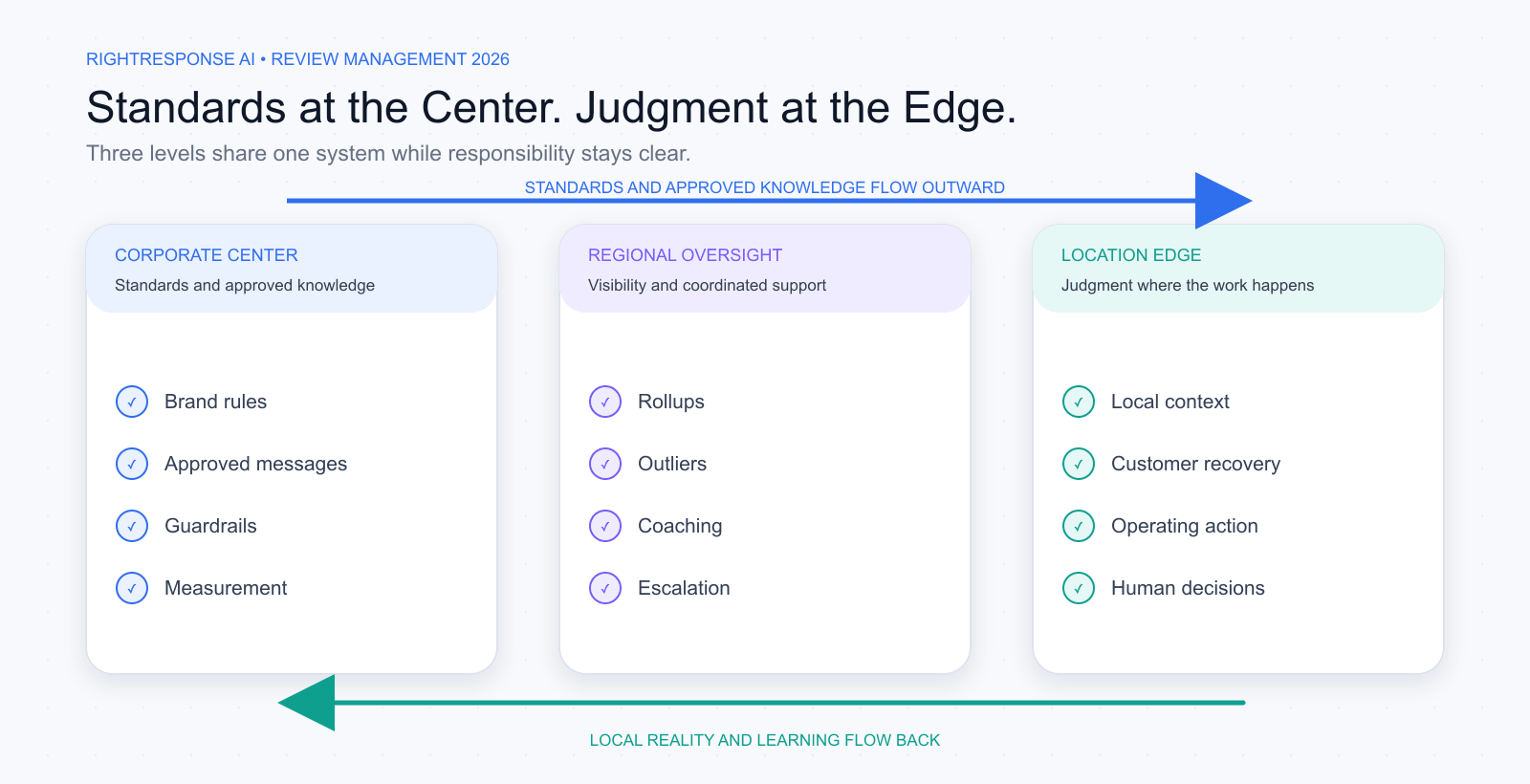
The right operating model is rarely fully centralized or fully local. Corporate teams should own the standards and infrastructure that benefit from consistency. Location teams should own the context, customer recovery, and operating decisions that require proximity to the work. Regional leaders connect the two.
| Level | Primary responsibilities | Decisions that should stay here |
|---|---|---|
| Corporate or franchisor | Brand rules, approved knowledge, platform configuration, risk standards, measurement definitions, enterprise reporting, vendor management | What the brand may say, what the system may automate, which exceptions require escalation, and how performance is measured |
| Regional or portfolio leader | Performance review, outlier detection, coaching, resource allocation, escalation support, cross-location learning | Which locations need intervention, which practices should be replicated, and which problems require central support |
| Location, franchisee, or multi-unit operator | Customer context, review requests at the point of work, local facts, customer recovery, employee coaching, operating action | What happened locally, who should contact the customer, and what should change in the operation |
| Shared or escalated | Legal, compliance, safety, discrimination, threats, privacy, suspected fraud, high-value customer issues, media risk | Who has authority to respond publicly, what evidence is preserved, and which parallel recovery or dispute process should begin |
Franchise systems require an additional distinction. The franchisor owns the brand and system standards. The franchisee owns the customer relationship and local operation. A franchisee group with one location has different capacity from a group with twenty, so permissions and reporting should accommodate both without treating every franchisee as a single store manager.
For Google Business Profile administration, Google supports bulk management and verification for eligible organizations with 10 or more locations. That solves part of the profile-management problem. The organization still needs its own decision rights for requests, responses, recovery, analysis, and follow-through.
One Review System, Four Business Outcomes
The easiest way to design the program is to organize it around the work the business needs to accomplish. Review management should help locations get more authentic feedback, respond in ways that build trust, understand what customers are saying, and understand the competitive environment around each location.
| Operating job | Question it answers | Outcome |
|---|---|---|
| Get reviews | How do we make it easy and relevant for real customers to share an experience with the correct location? | A steady flow of current, detailed, authentic reviews |
| Respond | How should the business acknowledge the reviewer and give the next customer something useful? | Coverage, trust, recovery, conversion, and a visible record of how the business participates |
| Understand customers | What do customers value, where is friction recurring, and which locations are changing? | Prioritized, evidence-backed operating action |
| Understand competitors | Who is winning nearby, what do customers say about them, and what would it take to close the gap? | Realistic location targets and sharper competitive positioning |
1. Generate More Authentic Reviews at Every Location
A multi-location review request has two jobs. It must reach the customer at a sensible moment, and it must connect that customer with the correct location. Strong programs also make the request feel relevant to the actual interaction so the customer has an easier starting point for writing.
Standardize the system while personalizing the request
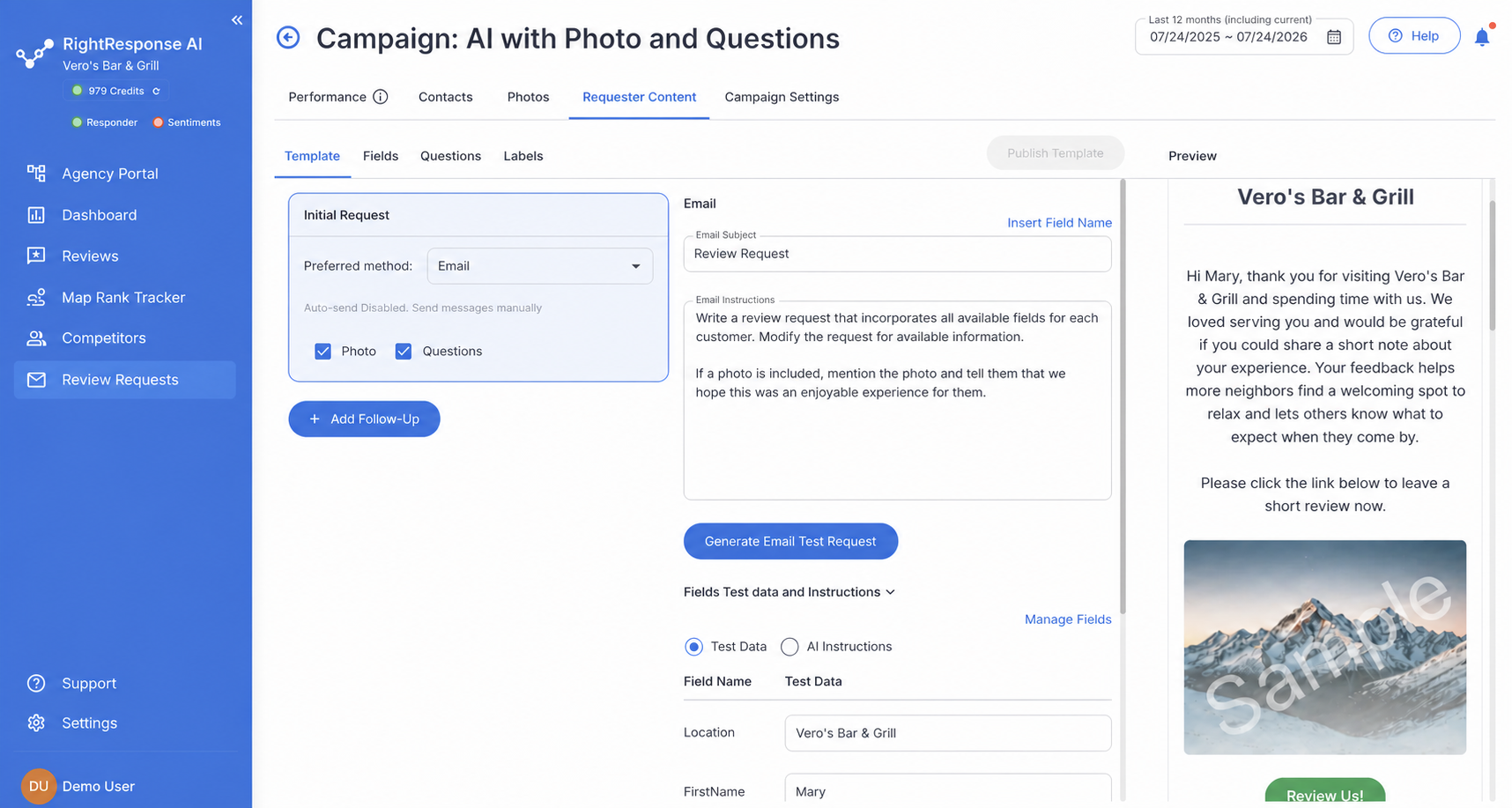
Corporate teams should standardize the channel options, permitted fields, follow-up cadence, location routing, opt-out handling, and measurement. They should also maintain approved corporate and brand messages while each location maintains accurate local details. The request can draw on this knowledge along with customer and service context such as the location, date, product, service, employee, milestone, or completed-work photo. A short neutral question can help the customer recall useful detail without telling the customer what opinion to express.
Choose the request method by operating context
- Triggered email or SMS
- Useful when a CRM, POS, scheduling, property, or practice system can mark the interaction complete.
- Manager or employee send
- Useful when the person closest to the customer knows the right moment and can enter the customer while the interaction is fresh.
- QR code or durable link
- Useful for receipts, leave-behinds, signage, events, and employee-specific attribution.
- Campaign or milestone request
- Useful for repeat relationships such as residents, patients, members, customers, and clients who have natural moments worth reviewing.
Measure the full request funnel
Review count alone does not explain whether the process works. Track eligible customers, requests sent, deliveries, opens or clicks where available, completed reviews, private feedback, time to review, rating, review text rate, and conversion by location, employee, channel, and campaign. These measures show whether a location has a customer-experience problem, an asking problem, or an execution problem.
Protect authenticity while growing volume
Google's Maps policy allows businesses to solicit genuine reviews without incentives or attempts to influence the rating or content. The FTC's Consumer Reviews and Testimonials Rule prohibits incentives conditioned on a particular positive or negative sentiment. A scalable program should therefore preserve neutral request language, customer choice, traceable campaign settings, and clear vendor practices across every location.
RRAI operating principle: A better request does not write the review. It uses real context to help the customer remember the experience and removes friction from sharing it.
For the broader review-generation system, see the Review Management: The Complete Guide for 2026 and RightResponse AI Review Requester.
2. Respond With Central Knowledge and Local Judgment
A public review begins with the reviewer, but the response has more than one audience. It communicates back to the reviewer, helps future customers decide whether to choose the business, and creates a visible record for employees and leaders. A useful response can acknowledge, clarify, recover, explain, differentiate, or direct the next step.
Coverage is the starting point. Contribution is the goal.
A generic response may satisfy a response-rate metric while contributing very little. The response becomes valuable when it understands what the customer said, chooses relevant approved business knowledge, follows company and location rules, and recognizes when a person should take over. This is especially important across many locations, where the same brand can offer different amenities, service paths, teams, or recovery instructions. A buyer should ask whether the platform has a real knowledge layer or only a tone selector and a general prompt. Our guide to Message-Informed Review Responses explains how that selection works, including Messages scoped to a company, brand, region, or location.
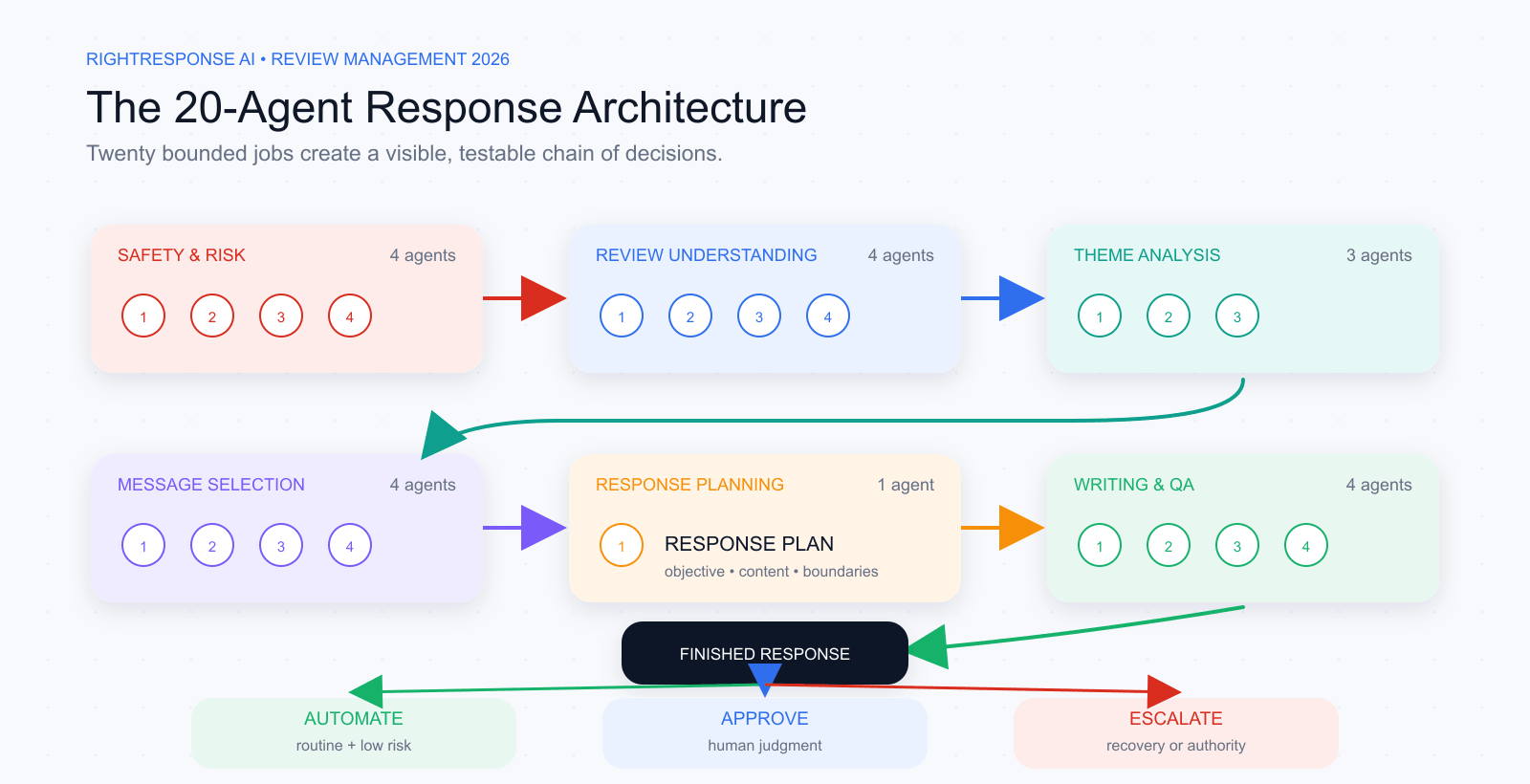
Use a multi-step response process
- Understand the review. Identify the experience, names, themes, sentiment, questions, rating-text mismatches, updates, and sensitive details.
- Check risk and routing. Detect privacy concerns, malicious instructions, threats, discrimination, safety issues, unresolved complaints, or other reasons for human attention.
- Select relevant knowledge. Choose only the approved corporate, brand, and location facts or marketing messages that genuinely fit the review. The system should know which level owns each message and when it may be used.
- Plan the response. Decide what the response should accomplish, what it should say, what it should avoid, and whether the conversation should continue privately.
- Write and review. Produce natural language from the plan, remove repetition, confirm the facts, and route the response to the chosen approval or publishing workflow.
Set approval rules around consequence, not convenience
Low-risk positive reviews may be eligible for automatic publishing after the same quality checks. Reviews involving complaints, privacy, rating-text mismatches, named employees, legal language, safety, discrimination, or unclear facts should route to a person. The goal is to involve the right person when the response carries real consequence. Every review type can benefit from relevant knowledge. The system should vary how it uses that knowledge based on the review, the location, and the risk.
| Review situation | Recommended workflow |
|---|---|
| Straightforward positive review | Use the review context and any relevant approved brand or location knowledge, complete QA, and publish automatically or on schedule if the organization has approved that rule |
| Positive review with a useful detail or question | Select approved knowledge that answers the question or reinforces the specific experience, then publish automatically or approve based on the business rule |
| Neutral or negative service issue | Use accurate service, policy, or location knowledge when it helps; generate a draft; route it to the location or customer-care owner; and begin recovery separately from the public response |
| Sensitive, disputed, legal, safety, or privacy issue | Use only knowledge approved for the situation, preserve evidence, escalate to the authorized owner, and separate public communication, customer recovery, and any platform dispute |
See the full RightResponse multi-agent review response process for the specialized roles, safeguards, knowledge selection, and mobile approval workflow.
3. Turn Review Text Into Customer Intelligence
An average rating is a summary. The written review contains the diagnosis. One four-star review can praise the employee, criticize scheduling, and mention a long wait. Multi-location analysis becomes useful when it preserves those separate judgments and makes them comparable across locations and time.
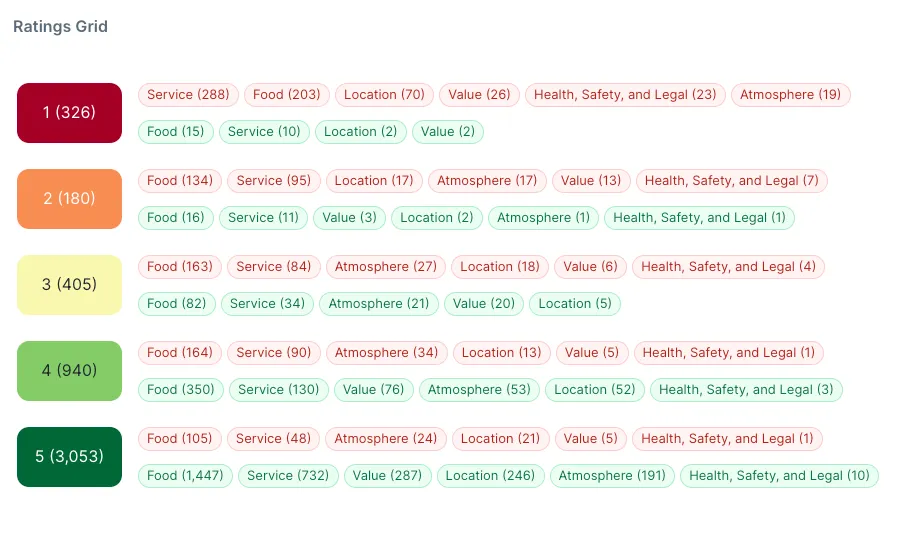
Customize the topics, then use the Ratings Grid
Generic categories are rarely enough for a multi-location organization. If the platform allows it, define the categories and topics that reflect how the business operates, then decide which are corporate, brand-specific, or local. A restaurant group may separate food, service, atmosphere, value, and location. A property manager may need maintenance, staff, amenities, communication, leasing, and move-in. The taxonomy should be editable as the business learns from customers.
For industry-specific workflows, explore RightResponse AI’s property management, retail, and law firm reputation management solutions.
The Ratings Grid shows which categories or topics drive each star rating and how those drivers shift as reviews move from five stars down to one star. This makes the overall distribution more diagnostic. Leaders can see which parts of the experience create strong ratings, which generate negative reviews, and which source reviews explain the pattern.
Compare locations without flattening the explanation
Two locations can have the same rating for different reasons. One may have strong service and weak access. Another may have fast service and inconsistent communication. A location comparison should therefore include overall rating, volume, recency, response coverage, and topic-level sentiment with the supporting phrases. That combination explains what is driving the number.
Move every meaningful insight through an operating loop
- Detect: Find a recurring pattern, a location outlier, an emerging change, or a repeatable strength.
- Validate: Read the underlying reviews and confirm the issue is meaningful.
- Prioritize: Choose the few issues that matter now based on frequency, severity, customer value, and strategic importance.
- Assign: Give the issue an owner, a next action, and a due date.
- Fix: Change the operation, message, training, staffing, product, process, or recovery path.
- Measure: Watch future reviews to see whether the pattern recurs and whether customer language changes.
Management test: If an insight cannot become an assigned operating action, the review program is reporting information without creating a management system.
4. Understand the Competitors Around Each Location
Multi-location teams often benchmark every location against a corporate average. That is useful for internal management, but customers do not choose between a location and the corporate average. They choose among the businesses available nearby.
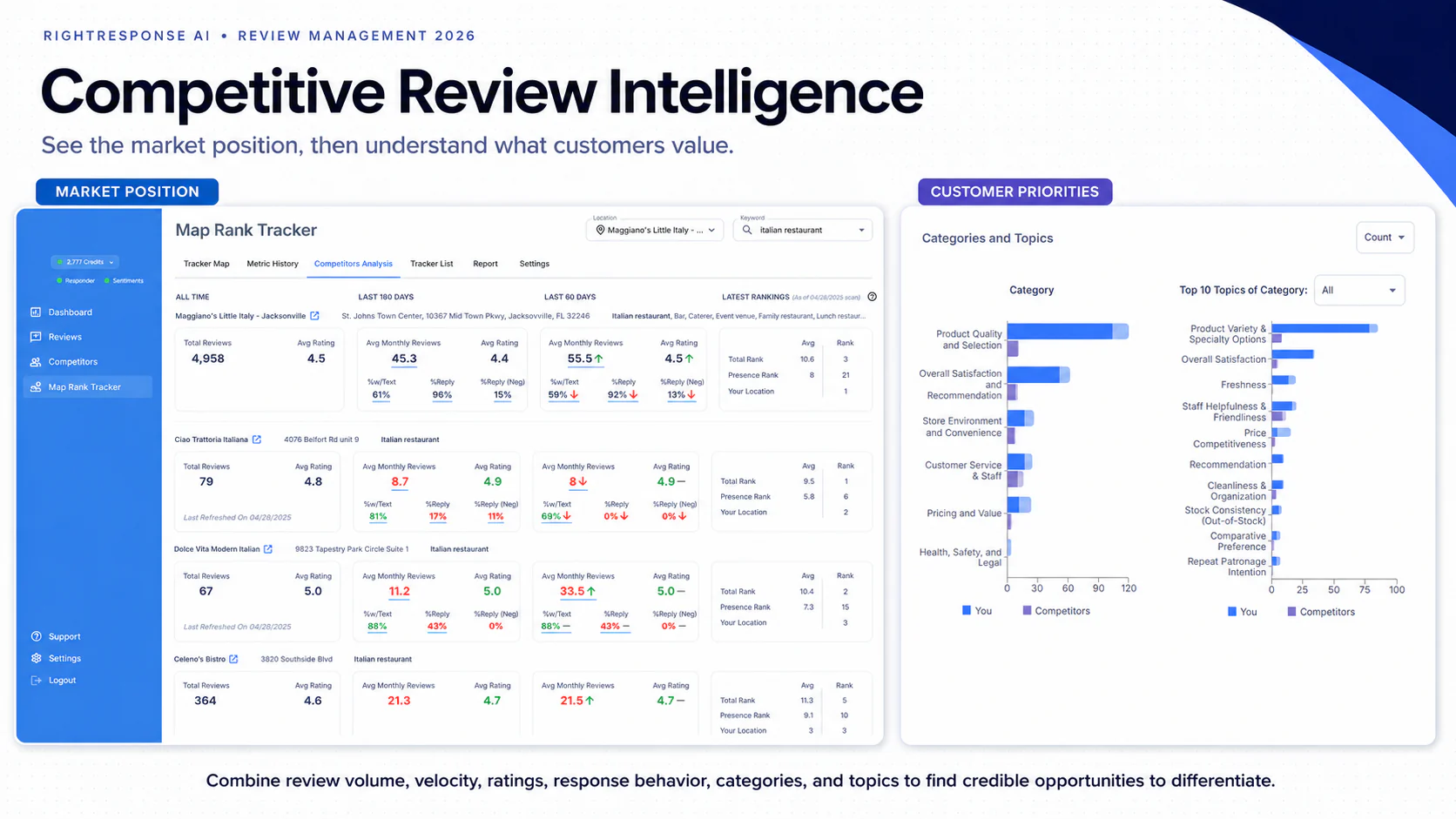
Use a local competitive set
For each location and important search term, identify the businesses that appear in the relevant area. Compare their rating, review count, recent volume, response rate, response quality, customer themes, and local visibility. A realistic target depends on what that location is up against. A four-star profile may be strong in one market and weak in another.
Translate the comparison into a location plan
- Review volume: How many new reviews per month would close the gap without relying on a short campaign spike?
- Rating: What service or recovery changes are needed to improve the experience behind the score?
- Recency: Is the location generating a steady stream of current customer evidence?
- Response quality: Does the business add useful knowledge, demonstrate care, and give future customers a reason to choose it?
- Customer themes: Where does the location lead or lag on the experiences customers discuss most often?
- Local visibility: Where does the location appear in Google Maps across the service area, and how is that changing over time?
RightResponse combines these measures in its Map Rank Tracker and Competitor Analysis, allowing teams to compare review momentum, customer themes, response behavior, and map visibility in the same operating context.
The Multi-Location Review Scorecard
The scorecard should be short enough to manage and rich enough to explain. Use a shared definition for every measure, then make the location, region, and portfolio views available from the same data.
| Measure | What it reveals | Useful cuts |
|---|---|---|
| Review volume and velocity | Whether each location is producing a steady flow of current customer evidence | Location, region, employee, campaign, channel, month |
| Rating and rating distribution | Overall performance and the mix hidden by the average | Location, platform, period, service line |
| Review recency | Whether the public profile reflects current operations | Days since last review, reviews in 30/90 days |
| Request conversion | Whether the ask, timing, channel, and execution are working | Location, employee, campaign, email/SMS/QR |
| Response coverage and time | Whether the business participates consistently | Location, rating, platform, workflow |
| Response quality | Whether replies are specific, accurate, useful, and compliant with business rules | Auto-published, approved, edited, escalated |
| Custom topic sentiment and recurrence | What customers value, where friction persists, and whether an action worked | Custom category or topic, location, region, time, supporting phrases |
| Competitive position | What each location is up against locally | Rating, volume, recency, response behavior, themes, map visibility |
Use a simple management cadence
| Cadence | Primary review |
|---|---|
| Daily or near-real-time | New negative reviews, sensitive issues, unanswered reviews, unusual activity, customer recovery, and publishing exceptions |
| Weekly | Request funnel, response coverage, location outliers, recent customer themes, unresolved actions, and emerging competitors |
| Monthly | Location scorecard, regional comparisons, root causes, coaching, resource needs, and progress against review and rating targets |
| Quarterly | Program design, platform configuration, category taxonomy, automation rules, governance, vendor performance, and strategic competitive gaps |
Best Multi-Location Review Management Platforms for 2026
Multi-location buyers often compare platforms that were built to solve different jobs. The strongest choice depends on whether the organization needs a focused review operating system, a broad reputation and customer-experience suite, a local-marketing platform, deep monitoring and analytics, a messaging hub, or a proven review-generation workflow.
The seven platforms below represent those major buying categories. We compared them on multi-location structure, review-request depth, response quality, customer intelligence, competitive intelligence, ease of use, adjacent capabilities, and pricing transparency. The individual profiles explain where each platform is strongest and what buyers should examine carefully.
Pricing note (checked August 17, 2026): Official prices are used when published. Reported figures are approximate market benchmarks. Actual pricing can vary by products, location count, implementation, usage, contract terms, and negotiation.
| Platform | Best for | Multi-location strength | Important consideration | Current pricing |
|---|---|---|---|---|
| RightResponse AI | Highly personalized review responses and requests | AI review requests, 20-agent responses, managed corporate, brand, and local knowledge, customizable customer intelligence, competitor analysis, and map rank tracking | Focused on reviews and the operating decisions around them rather than a broad listings, social, messaging, and payments suite | PAYGO $10, Core $19, Pro $29, and Pro+ $44 per location/month |
| Birdeye | Enterprise brands seeking a broad customer-experience suite | Centralized reviews, listings, social, messaging, surveys, and multi-location oversight | Buyers should decide whether they need the full suite and examine the depth of the review-specific workflows that matter most | Official custom quote; commonly reported at approximately $299–$449 per location/month for a single location; multi-location pricing negotiated |
| Reputation.com | Large enterprises combining reputation and customer-experience management | Enterprise workflows across reviews, listings, surveys, social, analytics, and location performance | The implementation effort and suite scope should match the organization’s resources and review-management priorities | Rep Core $80, Core + Pulse $115, and Core + Surveys $150 per location/month; Enterprise custom for 125+ locations |
| SOCi | Distributed brands prioritizing local presence and marketing | Listings, local pages, social, reputation, and localized marketing workflows across large networks | Review management is one part of a broader local-marketing platform, so buyers should evaluate its depth for requests, responses, and customer intelligence | SOCi Listings $30 per location/month with a 100-location minimum; full platform custom |
| ReviewTrackers by InMoment | Enterprises emphasizing monitoring and analytics | Monitoring across more than 100 review sources, location analytics, reporting, and competitive insight | Buyers should examine review generation, knowledge-grounded response depth, local action workflows, and how the product fits the broader InMoment ecosystem | Custom per-location pricing, billed annually |
| Podium | Service businesses where customer messaging is central | A unified inbox connecting SMS, webchat, leads, reviews, and payments | Buyers should test multi-location hierarchy, review analytics, competitive intelligence, and the depth of response generation | Commonly reported: Core approximately $399 and Pro approximately $599 per location/month; multi-location pricing negotiated |
| GatherUp | Agencies and local businesses prioritizing review generation and feedback | Review requests, first-party feedback, third-party monitoring, reporting, and agency workflows | Buyers should examine agentic response depth, managed business knowledge, competitive analysis, map tracking, and action assignment | One location: $124 month-to-month or $99/month billed annually; 2–10 locations: $75 per location/month or $60 per location/month billed annually |
1. RightResponse AI: Best for Highly Personalized Review Responses and Requests
Best for: Multi-location organizations that want one focused system for generating reviews, responding with substance, understanding customers, analyzing competitors, and tracking local visibility.
Why it stands out: RightResponse AI brings the full review loop together. Its review requester can use real customer and service context, photos, and neutral questions. Its responder uses 20 specialized agents to understand the review, select relevant approved corporate, brand, and local knowledge, plan the response, apply specialized checks, and route consequential situations to a person. Customer-intelligence topics can be customized to the business, and the same platform connects those insights with competitive review analysis and map rank tracking.
Consider: RightResponse AI is a specialized review and reputation platform. Organizations seeking a broad suite for listings distribution, social publishing, lead messaging, or payments may use it alongside those systems. It is strongest when review quality, local context, customer intelligence, and operating action are central to the buying decision.
2. Birdeye: Best for a Broad Enterprise Suite
Best for: Multi-location enterprises that want reviews, listings, social media, messaging, surveys, webchat, and related customer-experience capabilities from one large vendor.
Why it stands out: Birdeye is one of the most established platforms in the category and is designed for centralized oversight across large location networks. Its breadth can reduce the number of vendors an enterprise manages, particularly when reviews are only one part of a larger local customer-experience program. It also offers mature administration, reporting, integrations, and services for complex organizations.
Consider: Birdeye uses quote-based pricing and packages a wide set of capabilities. Buyers should identify which parts of that suite they will actually use, then test the review-specific work in detail. Ask the platform to demonstrate request personalization, business-knowledge selection, finished response quality, custom topic analysis, source-review validation, competitor insight, and the workflow for local action.
3. Reputation.com: Best for Enterprise Reputation and Customer Experience
Best for: Large organizations that want reputation management to sit inside a broader enterprise customer-experience program.
Why it stands out: Reputation.com combines review management with listings, surveys, social media, analytics, and location performance. Its enterprise orientation can fit organizations that need broad governance, executive reporting, and coordinated workflows across many locations. The proprietary Reputation Score also gives leadership a single summary measure for tracking progress across a portfolio.
Consider: A broad enterprise platform requires a clear implementation plan, internal ownership, and enough operational capacity to use the system well. Buyers should move beyond the portfolio score during a demonstration. Ask to see location-level evidence, review-request workflows, the response decision process, custom topics, supporting customer language, competitor comparisons, and the steps required to turn an insight into assigned work.
4. SOCi: Best for Multi-Location Presence and Local Marketing
Best for: Franchises and distributed brands that want listings, local pages, social media, reputation management, and localized marketing in one platform.
Why it stands out: SOCi is built around the relationship between a central brand and many local markets. Its platform supports corporate governance while helping locations maintain accurate presence and localized activity. That makes it a natural candidate when the buying committee owns the wider local-marketing stack and review management is one component of that responsibility.
Consider: Buyers whose primary objective is better review generation, more substantive responses, customizable customer intelligence, or detailed competitor analysis should test those workflows separately from the broader platform story. Ask how the system uses customer and service context, which approved knowledge it can select, how review topics can be changed, what source evidence remains visible, and how easily a local manager can act from a phone.
5. ReviewTrackers by InMoment: Best for Monitoring and Analytics
Best for: Multi-location enterprises that prioritize broad review monitoring, location-level reporting, and customer-experience analytics.
Why it stands out: ReviewTrackers has long focused on aggregating reviews from a large number of sources and helping enterprises understand performance across locations. Its place within InMoment can appeal to organizations that want review data connected with a broader experience-management ecosystem. Location comparisons, sentiment analysis, reporting, alerts, and competitive intelligence are central parts of its value.
Consider: Monitoring and analytics are only part of the operating loop. Buyers should also evaluate how the platform generates reviews, how its AI decides what belongs in a response, whether it can maintain corporate, brand, and location knowledge, how exceptions reach a person, and whether an insight can become assigned work with an owner, status, and recurrence measurement.
6. Podium: Best for Messaging-Led Local Businesses
Best for: Service businesses that want reviews connected with SMS, webchat, lead management, payments, and everyday customer communication.
Why it stands out: Podium approaches reviews through the customer conversation. Its unified inbox can be attractive for automotive, dental, home-services, legal, and other businesses where fast messaging and lead response are central. Review invitations can sit inside the same communication workflow employees already use, which can improve adoption at the location level.
Consider: A messaging-led platform and a review operating system solve overlapping jobs, but they place the center of gravity in different places. Multi-location buyers should test corporate and local permissions, portfolio reporting, review-response quality, managed business knowledge, custom topic analysis, competitor review intelligence, map rank tracking, and pricing as locations and messaging volume grow.
7. GatherUp: Best for Review Generation and Agency Workflows
Best for: Agencies, local businesses, and multi-location programs that prioritize review requests, first-party feedback, monitoring, and reputation marketing.
Why it stands out: GatherUp has a long history in review generation and customer feedback. It supports request campaigns, first-party feedback, third-party review monitoring, reporting, widgets, and agency-oriented workflows. That makes it a credible choice for teams that want a mature request and feedback system or need to manage programs on behalf of many clients.
Consider: Buyers should test how far the platform goes beyond collection and monitoring. Ask it to demonstrate response understanding, approved corporate, brand, and local knowledge, relevance selection, specialized checks, human escalation, customizable topic analysis, competitive review intelligence, map visibility, and the path from a detected theme to an assigned operating action.
How to Choose Review Management Software for Multiple Locations
The best platform depends on the scope of the job. Some organizations need a broad local-marketing suite that includes listings, pages, social, and reviews. Others need deeper review generation, a managed knowledge layer, response quality, customizable customer-intelligence topics, competitive review analysis, or local rank tracking. Define the operating system first, then decide whether one platform or a connected stack best fits it.
Use this capability checklist
- Portfolio structure: Company, brand, region, franchisee group, and location hierarchy with rollups that match the real organization.
- Roles and permissions: Clear control over who can view, generate, edit, approve, publish, change rules, and see customer data.
- Review request depth: Correct-location routing, email/SMS/QR, customer and service context, approved corporate, brand, and local messages, optional photos and neutral questions, follow-ups, employee attribution, and funnel reporting.
- Knowledge architecture and response quality: Managed corporate, brand, and location libraries; review understanding; relevance selection; response planning; specialized checks; brand rules; and useful finished responses. Ask who owns each knowledge level, how messages are updated, and whether the platform can show what it selected.
- Human escalation: Routing by risk and consequence, mobile approval, customer-recovery ownership, notes, status, and a clear record of the final action.
- Customer intelligence: A customizable category and topic taxonomy, phrase-level sentiment analysis, source-review validation, location comparisons, outlier alerts, assignment, and recurrence measurement.
- Competitive intelligence: Local competitor discovery, rating and review momentum, response behavior, comparable themes, and map rank tracking.
- Integrations and ease of use: A practical way to add customers, act from a phone, connect existing systems, export data, and support both low-capacity and sophisticated teams.
- Pricing at scale: Transparent per-location and usage assumptions, plan-specific feature access, included limits, add-ons, contract terms, and pooled volume where appropriate.
Ask vendors to demonstrate the hard parts
- Show how a request changes when the customer, location, service, and available context change. Ask which approved corporate, brand, or local knowledge was selected and why. Then show the conversion reporting behind those requests.
- Use one positive, one negative, one ambiguous, and one sensitive review. Ask the vendor to show what the system understood, which corporate, brand, or local knowledge it selected, where that knowledge is maintained, what it avoided, and why a person became involved.
- Ask the vendor to create or modify a reporting category and topic, then show how source reviews are classified. Move from a portfolio metric to the underlying location and source reviews, assign an action, and show how recurrence is measured.
- Compare a location with nearby competitors. Look at rating, volume, recency, response behavior, customer themes, and map visibility.
- Model the real organization. Test a corporate user, regional user, 20-location franchisee group, single-location franchisee, and local manager.
- Calculate the bill at current and future scale. Include locations, request volume, review volume, SMS, analysis, map scans, add-ons, support, and implementation.
RightResponse AI maintains a growing review-management software comparison library covering vendor reviews, pricing, alternatives, and head-to-head comparisons. Use those detailed pages after the category and capability questions have narrowed the field.
A 30/60/90-Day Implementation Plan
Days 1-30: Build the foundation
- Inventory every location, profile, review source, owner, system connection, current rating, review count, review recency, response status, and existing reporting categories.
- Define the organization hierarchy, decision rights, escalation paths, response rules, and the owners of corporate, brand, and location knowledge.
- Customize the reporting taxonomy if the platform allows it. Define the categories and topics that reflect how the business operates, which topics apply across the organization, and which need brand or local variation.
- Build the approved knowledge library if the platform allows it. Include key marketing messages and operating facts at the corporate, brand, and local levels, with a clear owner for accuracy and updates.
- Create a baseline by location and local competitive set.
- Pilot request and response workflows with a representative group of locations. Use the four review situations to confirm that the platform selects relevant knowledge and routes exceptions correctly.
- Agree on a short scorecard and the first management cadence.
Days 31-60: Prove the workflow
- Test request timing, channel, personalization, follow-up, employee attribution, knowledge or message selection, and conversion reporting.
- Test automatic publishing and approval rules with straightforward positive reviews, positive reviews with a useful detail or question, neutral or negative service issues, and sensitive reviews. Confirm that the knowledge used changes appropriately with the situation.
- Validate the customized category and topic taxonomy against source reviews. Confirm that the reporting language fits the business, then establish the first location comparisons.
- Train corporate, regional, franchisee, and location users on the actions they own.
- Run the weekly operating review and repair ownership gaps before expanding.
Days 61-90: Scale and manage
- Expand the working model across the portfolio in waves, preserving local facts, knowledge ownership, and user permissions.
- Set location-specific review and rating targets using local competitors and realistic review velocity.
- Assign the highest-value customer themes to operating owners and begin measuring recurrence.
- Add regional coaching, executive reporting, vendor performance review, and quarterly governance review.
- Document what the pilot changed, update the knowledge library and reporting taxonomy, and give future locations a better starting standard.
Common Multi-Location Mistakes
Managing the average location
Portfolio averages help executives orient themselves, but they do not reveal what a customer sees at a specific location. Always preserve the location view and the evidence behind it.
Centralizing every response
Corporate control can improve consistency, yet a corporate team may lack the local facts needed for recovery or a useful reply. Centralize standards and knowledge. Route context and decisions to the people who have them.
Giving every location unrestricted control
Local autonomy without common rules creates uneven voice, missed reviews, risky responses, and data that cannot be compared. Give local teams clear authority inside a defined operating system.
Using templates as the quality standard
Templates can help a team respond, but repetition becomes visible across a multi-location portfolio. Evaluate whether responses acknowledge the actual experience and add relevant knowledge selected from maintained corporate, brand, and location sources.
Letting the knowledge library go stale
Knowledge is operating content. A platform can select relevant knowledge only when corporate messages, brand positioning, local services, amenities, policies, people, and recovery instructions remain current. Assign an owner and review cadence to each knowledge level.
Treating insights as finished work
A chart is a finding. It becomes management when the pattern is validated, assigned, acted on, and measured.
Comparing every location with the same target
A location competes in its own market. Use internal benchmarks for operational discipline and local competitors for commercial reality.
Frequently asked questions
What is the best way to manage reviews across multiple locations?
Use one system with a verified location inventory, shared standards, location-specific knowledge, clear roles, a unified inbox, review-request workflows, response approvals, topic-level analysis, competitive benchmarks, and location-level reporting. Keep customer recovery and operating decisions close to the location while corporate owns the common rules and infrastructure.
Should corporate or local managers respond to reviews?
Most organizations benefit from a hybrid model. Corporate owns brand rules, approved knowledge, platform configuration, and escalation standards. Local teams contribute context, manage customer recovery, and handle operating actions. Automation can complete routine work, while consequential reviews route to an authorized person.
How can a franchise manage reviews across all locations?
Model the franchisor, franchisee group, individual franchisee, and location as distinct roles. Give the franchisor visibility and brand controls, then give franchisees and local teams the permissions and context needed to act. Use shared measures so performance is comparable without pretending every franchisee has the same capacity.
How can we get more Google reviews at every location?
Create a repeatable request path tied to an appropriate customer moment, route every customer to the correct profile, use email, SMS, QR, or employee-specific links, reduce the steps required to respond, and measure the request funnel by location. Relevant customer and service context can make the request easier to recognize and complete.
Can review requests be personalized without influencing the customer?
Yes. A request can reference real context such as the location, service, date, employee, product, milestone, or completed-work photo. Neutral questions can help the customer recall what happened. The customer still chooses whether to review and what opinion to express.
How quickly should each location respond to reviews?
Set a service level that the organization can consistently meet, then make sensitive reviews faster. Consumer expectations vary, but BrightLocal's 2026 research shows that response speed and response quality both affect trust. Automation should reduce delay while preserving review understanding, relevant knowledge, and human escalation.
How do we compare review performance across locations?
Use rating, review volume, velocity, recency, response coverage, response time, request conversion, and topic-level sentiment. Preserve the underlying customer phrases so leaders can validate what is driving the difference. Compare each location with both internal peers and its actual local competitors.
How do we handle fake, spam, or unfair reviews across many locations?
Create an incident workflow to detect unusual activity, validate the review against available records, preserve links and screenshots, assign an owner, separate the public response from customer recovery and the platform dispute, and track the outcome. Google provides a reporting and appeal process for inappropriate content. A strong program makes that process repeatable across the portfolio.
What should multi-location review management software include?
Look for portfolio hierarchy, roles and permissions, location-specific review requests, managed corporate, brand, and location knowledge, response quality and approvals, mobile action, customer-recovery routing, customizable topic and sentiment analysis, competitive review intelligence, map rank tracking, integrations, exports, and pricing that remains clear as location and usage volume grow.
What knowledge should a multi-location review platform use?
The knowledge should mirror the organization. Corporate-level content may cover company facts, shared policies, approved claims, and key marketing messages. Brand-level content can capture positioning, offerings, and voice. Location-level content should cover actual services, amenities, people, hours, local differentiators, and recovery instructions. The important capability is relevance selection. The platform should use only the knowledge that fits the review or request and show the team where that knowledge came from.
The Operating Advantage
Multi-location review management works when it becomes part of how the organization operates. Customers can share an authentic experience with the right location. The business can respond with useful knowledge selected from maintained corporate, brand, and location libraries. Leaders can analyze the topics that actually matter to the organization, see where friction is recurring, and understand which competitors are gaining ground. Local teams know what to do next.
RightResponse AI was built by operators who wanted that full loop in one focused system: AI-powered review requests, a 20-agent response process grounded in managed knowledge, customizable customer intelligence, competitor analysis, and map rank tracking. The objective is simple. Help every location get more customer evidence, communicate more effectively, and use reviews to improve.
Explore RightResponse AI, review current pricing, or return to the complete review management guide for a broader treatment of the full discipline.
Explore RightResponse AI
Help every location get more customer evidence, communicate more effectively, and use reviews to improve.
Sources and further reading
- RightResponse AI, Review Management: The Complete Guide for 2026: The broader review-management framework and RRAI operating perspective.
- BrightLocal, Local Consumer Review Survey 2026: Consumer use of reviews, recency, rating expectations, and response expectations.
- Birdeye, The silent brand killer: How to find your weakest locations: Location-level AI visibility disparities across 1,762 multi-location brands.
- Google Business Profile Help, Verify Business Profiles in bulk: Bulk management and verification guidance for eligible multi-location organizations.
- Google Maps User Contributed Content Policy: Rules for genuine reviews, incentives, fake engagement, and rating manipulation.
- Federal Trade Commission, Consumer Reviews and Testimonials Rule Q&A: Official guidance on fake reviews, review suppression, insider reviews, and conditioned incentives.