
rater8 has built a strong reputation as a purpose-built reputation management platform for healthcare organizations. With its integrations into clinical systems, automated review generation, and patient satisfaction surveys, it has become a trusted solution for medical practices looking to improve their online presence and attract new patients.
Comparison research: This article is part of the RightResponse AI review management software comparison library, which connects platform reviews, pricing analyses, alternatives, and head-to-head evaluations.
To write this rater8 review, I've analyzed the platform extensively. I believe it's the ideal choice if:
- You run a healthcare practice or hospital and need a HIPAA-compliant reputation solution
- You want automated review generation that integrates directly with your EHR or practice management system
- You value patient satisfaction surveys with industry benchmarking
- You need a hands-off solution with dedicated account management and quarterly strategy consultations
- You prioritize building reviews across healthcare-specific sites like Healthgrades, Vitals, and WebMD
However, rater8 might not be the best choice if:
- You need dedicated competitor intelligence tools to monitor and analyze rival practices
- You want Google Maps rank tracking to monitor your local search visibility
- You want AI review responses that actively incorporate your specific business messaging and market your practice to prospective patients
- You operate a non-healthcare business or a multi-vertical organization
- You prefer usage-based pricing that scales with your actual review volume rather than per-physician monthly fees
In this case, you should consider RightResponse AI: an AI-powered reputation management platform built for location-based businesses regardless of size, from single location to enterprise. Its core differentiator is review response quality. The platform treats every response as a conversion asset that actively markets your business to prospective customers reading your reviews. It pairs this with Voice of the Customer, competitor intelligence tools, Google Maps rank tracking, and a powerful review request capability to connect reputation work directly to local search visibility.
Because of that, I've included an overview of RightResponse AI at the end of this rater8 review, as the best alternative for businesses seeking higher-quality review responses and better reputation intelligence. If you'd like to explore it right away, you can start a free trial of RightResponse AI here.
Table of contents:
- What is rater8?
- rater8 Pros & Cons
- rater8 Review: How it Works & Key Features
- Where rater8 Falls Short
- Top rater8 Alternative: RightResponse AI
- rater8 or RightResponse AI: Comparison Summary
- Final Verdict
What is rater8?
rater8 is a healthcare-focused reputation management platform founded in 2015 by Evan Steele.

Steele, who spent nine years as a practice administrator for an ophthalmology group and later founded an EHR company called SRS Health, built rater8 after a frustrating hotel experience highlighted the lack of straightforward ways to provide service feedback. That personal frustration evolved into a platform designed specifically for medical practices and hospitals.
Today, rater8 positions itself as a leader in healthcare reputation management. The platform automates the collection of patient feedback and online reviews across sites like Google, Healthgrades, Vitals, and WebMD. Its proprietary pollin8™ algorithm strategically directs patients to the review sites where a practice needs the most attention.
Beyond review generation, rater8 offers patient satisfaction surveys, analytics dashboards with benchmarking against over 30 million data points, and AI-powered review summaries.
With approximately 80 employees and Series A funding from Elsewhere Partners (closed in April 2024), rater8 integrates with over 100 EHR and practice management systems.
The platform is HIPAA-compliant and SOC 2 certified. Its ideal customers are medical practices of all sizes, hospitals, health systems, and organizations with healthcare portfolios that want to improve their online reputation while gaining operational insights from patient feedback.
rater8 Pros & Cons
Pros | Cons |
|---|---|
✅ Purpose-built for healthcare with HIPAA compliance | ❌ Limited to healthcare organizations only |
✅ Integrates with 100+ EHR/PM systems | ❌ Basic competitor analysis compared to dedicated tools |
✅ pollin8™ algorithm for strategic review distribution | ❌ No Google Maps rank tracking |
✅ Patient satisfaction surveys with industry benchmarking | ❌ Per-physician pricing with $250 monthly minimum |
✅ Dedicated client success manager and quarterly consultations | ❌ AI responses lack structured fact-library integration for business-specific messaging |
✅ SOC 2 certified with strong data security | ❌ Limited training resources reported by some users |
✅ AI-powered summaries and verified reviews listings |
rater8 Review: How it Works & Key Features
pollin8™ Review Builder: rater8's goal-based algorithm directs patients to the review sites where your practice needs the most attention.
At the core of rater8's review generation is pollin8™, a proprietary algorithm the company calls "Healthcare's Only Goal-Based Review Builder."

The system integrates with your EHR or practice management system to automatically send review requests via email or text shortly after a patient's appointment.
What makes pollin8™ distinctive is its strategic approach to review distribution. Rather than sending every patient to Google or letting patients choose where to leave feedback, the algorithm analyzes your practice's current online presence across multiple platforms.
If a provider has strong Google reviews but a weak Healthgrades profile, pollin8™ will prioritize directing patients to Healthgrades. Administrators can set percentage-based allocation goals (for example, 50% Google, 30% Healthgrades, 20% Vitals) and customize preferred platforms for individual providers.
The system also includes configurable blackout periods to prevent over-messaging patients with frequent appointments. rater8 publicly states it does not practice "review gating" (selectively soliciting only positive reviews), which aligns with Google's guidelines.
Patient Satisfaction Surveys: Short, automated micro-surveys capture real-time feedback with strong response rates.
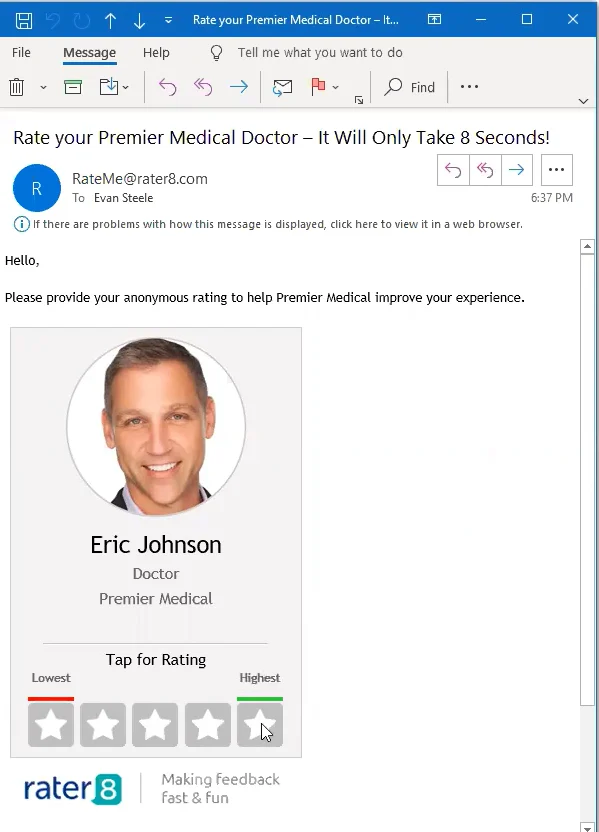
rater8's survey system sends five-question micro-surveys to patients immediately after checkout.
The brevity is intentional: the platform reports strong response rates (including figures around 31% to 35%), significantly higher than longer traditional surveys. Questions use a 5-point Likert scale with an optional comment section for detailed feedback.
Source: rater8
A useful design choice is the rotating question system. Instead of asking the same five questions every time, rater8 can cycle through a larger pool of questions. This keeps surveys fresh for returning patients while gathering comprehensive feedback across different aspects of the practice over time. The platform offers over 160 benchmarkable questions that practices can use.
Surveys can be segmented by appointment type, specialty, and other criteria. If a patient leaves a low rating, the system sends an immediate alert to the practice for service recovery.
This internal feedback stays separate from public reviews, giving practices the opportunity to address concerns before they become negative online posts. rater8 also offers employee satisfaction pulse surveys to help track staff morale and identify potential burnout.
Analytics Dashboard & Benchmarking: A centralized view of reviews and feedback with comparison data from over 30 million data points.
rater8's analytics dashboard aggregates both internal survey data and external online reviews into a single interface.
Users can monitor their reputation across Google, Healthgrades, Vitals, and WebMD from one place, with alerts for new reviews to enable prompt responses.
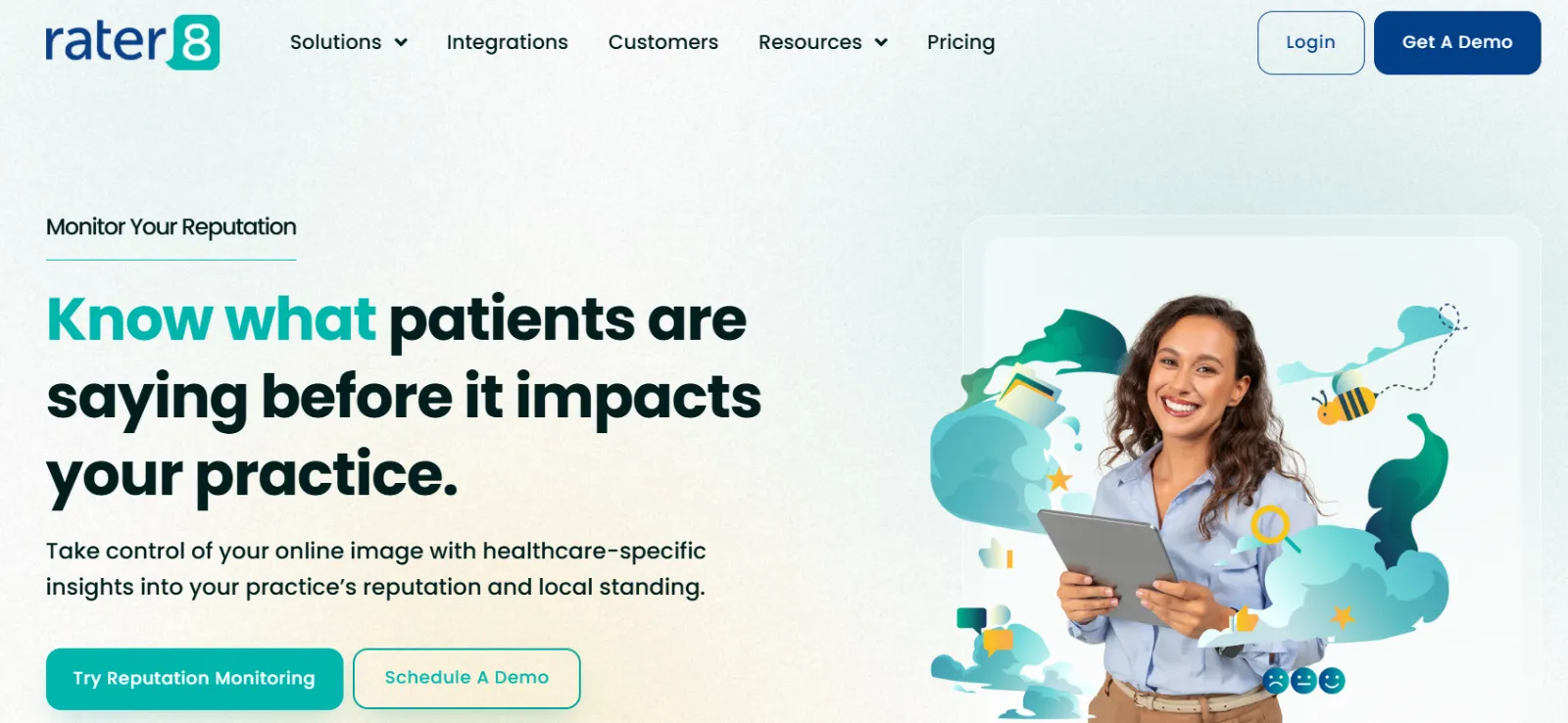
The benchmarking capability is a standout. rater8 provides comparison data drawn from over 30 million patient data points, allowing practices to measure their performance against peers in the same specialty. Administrators can compare providers side-by-side, tracking metrics like survey volume, Net Promoter Scores, and star ratings.
The dashboard includes AI-powered features: sentiment analysis that scores each comment by tone, AI summaries of review trends, and an "AI Insights" conversational tool that lets users ask natural language questions about their feedback data. "Reputation Scorecards" provide an at-a-glance summary of each provider's standing across major directories.
The platform also offers customizable organizational hierarchies for larger health systems, with role-based access controls and segmented reporting that can be rolled up or drilled down by department, location, or provider.
For managing responses, rater8 offers AI-assisted review responses alongside its ZipReplies template system. The AI-assisted option reads each review and generates personalized, HIPAA-compliant replies, while ZipReplies uses randomized, customizable templates for faster response workflows. Users retain final approval before any response is published.
Pricing Structure: Tiered per-physician pricing with a free monitoring plan and a $250 monthly minimum for paid tiers.
rater8's pricing is structured around four tiers:
Monitoring (Free):
- Patient feedback inbox dashboard
- AI-powered summaries
- Automated ratings digest
raVE Lite ($89 per physician/month):
- All Monitoring features
- Review generation with pollin8™
- AI-assisted review responses
- Advanced reporting
- Dedicated client success manager
raVE Pro ($109 per physician/month):
- All raVE Lite features
- Benchmarking against industry data
- AI-friendly verified reviews listings
- Patient satisfaction surveys
- Net Promoter Score tracking
raVE Pro+ (Contact Sales):
- All raVE Pro features
- Listings management
- Employee satisfaction surveys
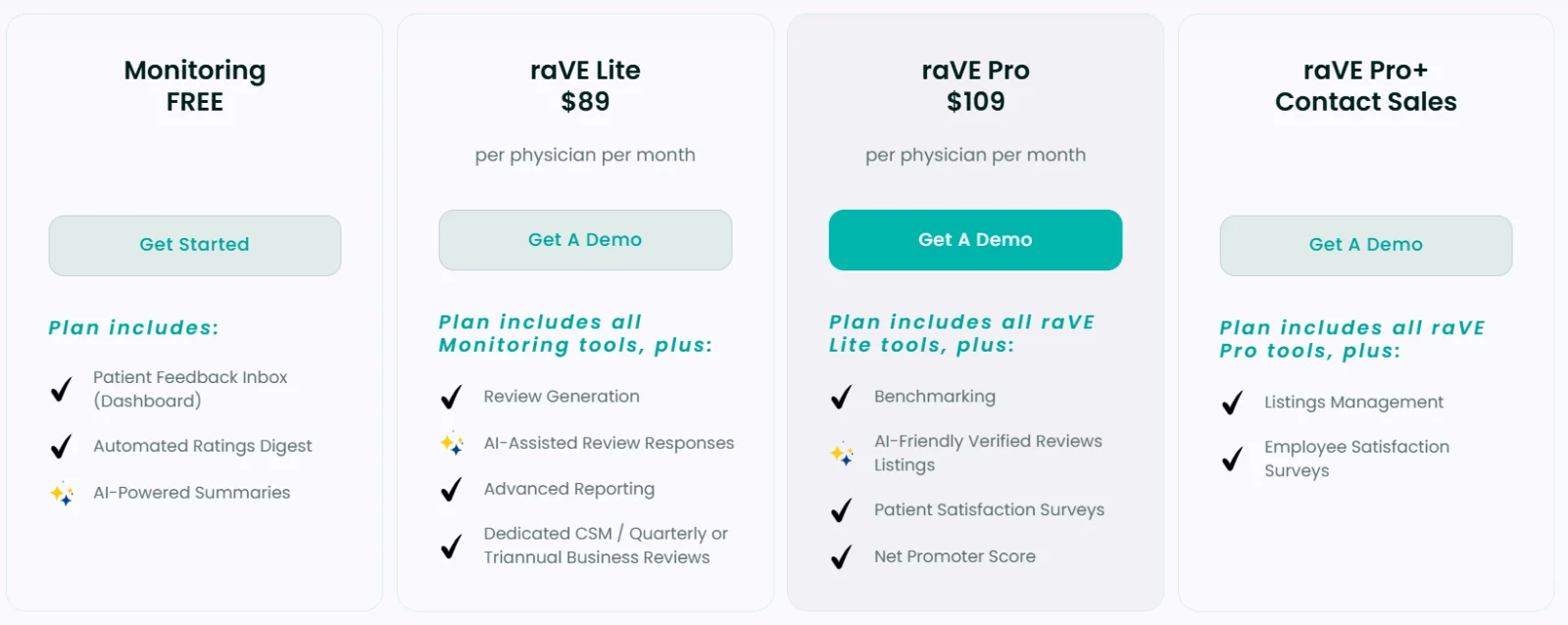
All paid plans carry a $250 monthly minimum. The platform offers flexible contract terms, with both monthly and annual options available. One-time setup fees apply and are not included in the monthly price.
Where rater8 Falls Short
While rater8 excels at healthcare-specific reputation management, several limitations become apparent when evaluating it against the broader needs of reputation-aware businesses.
These limitations reflect a platform deliberately optimized for automated review collection rather than comprehensive competitive intelligence.
Limited Competitor Analysis Tools: While some sources indicate rater8 may offer basic competitive features, the platform does not provide the kind of dedicated competitor intelligence tools that allow practices to monitor and analyze competitor reviews, ratings, and sentiment trends.
Practices can see how they benchmark against anonymized industry averages, but they cannot perform detailed tracking of specific local competitors. In a market where a prospective patient often compares two or three providers before booking, understanding what competitors are doing well (and where they fall short) requires better competitive analysis capabilities.
No Google Maps Rank Tracking: For healthcare practices, appearing in Google's local map pack is often the single most important factor for new patient acquisition. rater8 does not offer tools for tracking a practice's Google Maps rankings for relevant search terms or monitoring how those rankings change over time. Without this data, practices cannot easily connect their reputation efforts to actual search visibility.
No Structured Business Messaging in AI Responses: rater8 offers both AI-assisted and template-based response options, and its AI-generated replies are personalized to the content of each review.
However, the platform does not provide a structured system for weaving specific business messaging such as unique selling points, service specialties, or operational details into each response. People read reviews far more than they read a business's website, and the response is the only part of that exchange the business controls.
Without a way to strategically incorporate business-specific facts into responses, practices miss the opportunity to turn every reply into a marketing touchpoint for the prospective patients who are reading.
Healthcare-Only Scope: rater8 serves only healthcare organizations. Businesses that operate across multiple verticals, or non-healthcare businesses exploring reputation management, cannot use the platform at all. Even healthcare-adjacent businesses like wellness centers, veterinary practices, or dental spas may find the platform's rigid healthcare focus limiting.
Per-Physician Pricing Structure: The per-physician model means costs scale directly with practice size. A 10-physician practice on the raVE Pro plan would pay $1,090 per month before setup fees. The $250 monthly minimum also establishes a baseline cost that smaller practices must meet regardless of their actual usage.
These limitations are not failures. They are the natural result of building a specialized platform for healthcare review generation. But they create clear considerations for practices and businesses that want a fuller picture of their competitive landscape and local search presence.
Top rater8 Alternative: RightResponse AI
RightResponse AI offers an AI-powered reputation management platform built for location-based businesses regardless of size, from single location to enterprise.

Launched in 2024 by George Swetlitz (former CEO of a 200+ location healthcare network), Shiv Pujan Singh, and Sabrina Hu, the platform was built from the ground up with generative AI at its core.
Where rater8's primary value proposition centers on automating review collection within healthcare, RightResponse AI's core differentiator is what happens after the review comes in: the quality of the response and its ability to actively market the business.
The platform also includes an advanced, AI-powered review collection, but the philosophy starts from the premise that reviews are the conversion gate where prospective customers decide whether to choose your business, and the response is the only part of that exchange you control.
Most responses today are generic and easily skipped. RightResponse AI aims to change that by making responses worth reading, substantive, specific, and strategically messaged so they serve as conversion assets rather than wasted space.
Intelligent Review Response: An agentic AI pipeline that analyzes before writing, with three personalization pillars that turn every response into a marketing asset.
RightResponse AI's review response system uses an intentionally agentic approach that separates analytical functions from writing functions.
Before any response is drafted, the platform analyzes the review: it detects sentiment, identifies the relevant themes, handles edge cases like review updates and rating/text mismatches, recognizes and formats employee names, and for healthcare use cases, flags Protected Health Information (PHI) to prevent it from appearing in public responses.
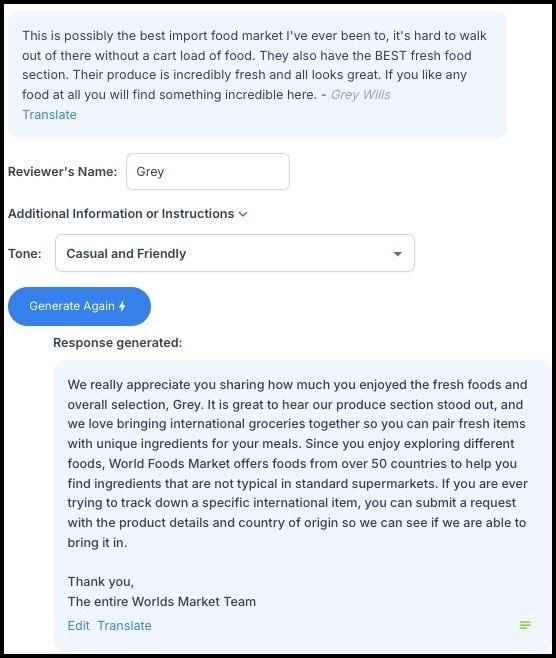
The writing engine then focuses entirely on crafting the response, informed by the analysis but unburdened by it.
The response personalization system consists of three distinct pillars:
- Facts (what to say): During onboarding, the platform reads all existing reviews, responses, and the business website to automatically generate a set of "facts" about the business. It identifies the most important themes in reviews and maps relevant facts to each theme.
When a customer leaves a review, the AI matches the review to the relevant theme and selects which facts to incorporate. For example, if a patient compliments a specific procedure, the response might highlight the practice's relevant expertise or related services.
The system also shows users which facts were used and which weren't, so they can make adjustments. Facts are easy to edit and changes roll forward immediately.
- Customizations (how the response should behave): Rules and behavioral controls that govern the response, including auto-publishing settings by star rating, instructions for handling specific situations, and edge case behaviors. This gives businesses granular control over what their AI can and cannot do.
- Brand Voice (how it should sound): Fully customizable tone and style profiles, with the option to create multiple voice profiles for different locations or brands.
All three pillars work together to produce hyper-personalized, brand-aligned responses with endless variation without losing control.
The result is responses that actively market the business. Instead of a generic "Thanks for your review," a response might say, "Glad you had a great experience with your consultation. Did you know we also offer [relevant service]?", giving prospective patients reading the exchange a reason to book.
Voice of the Customer Aspect-Based Sentiment Analysis (ABSA): Customizable analysis that reveals what specifically drives your ratings.
RightResponse AI's Voice of the Customer ABSA goes well beyond star ratings or simple positive/negative scoring.
The system breaks down each review to identify specific aspects customers are discussing, then assigns sentiment to each one individually.
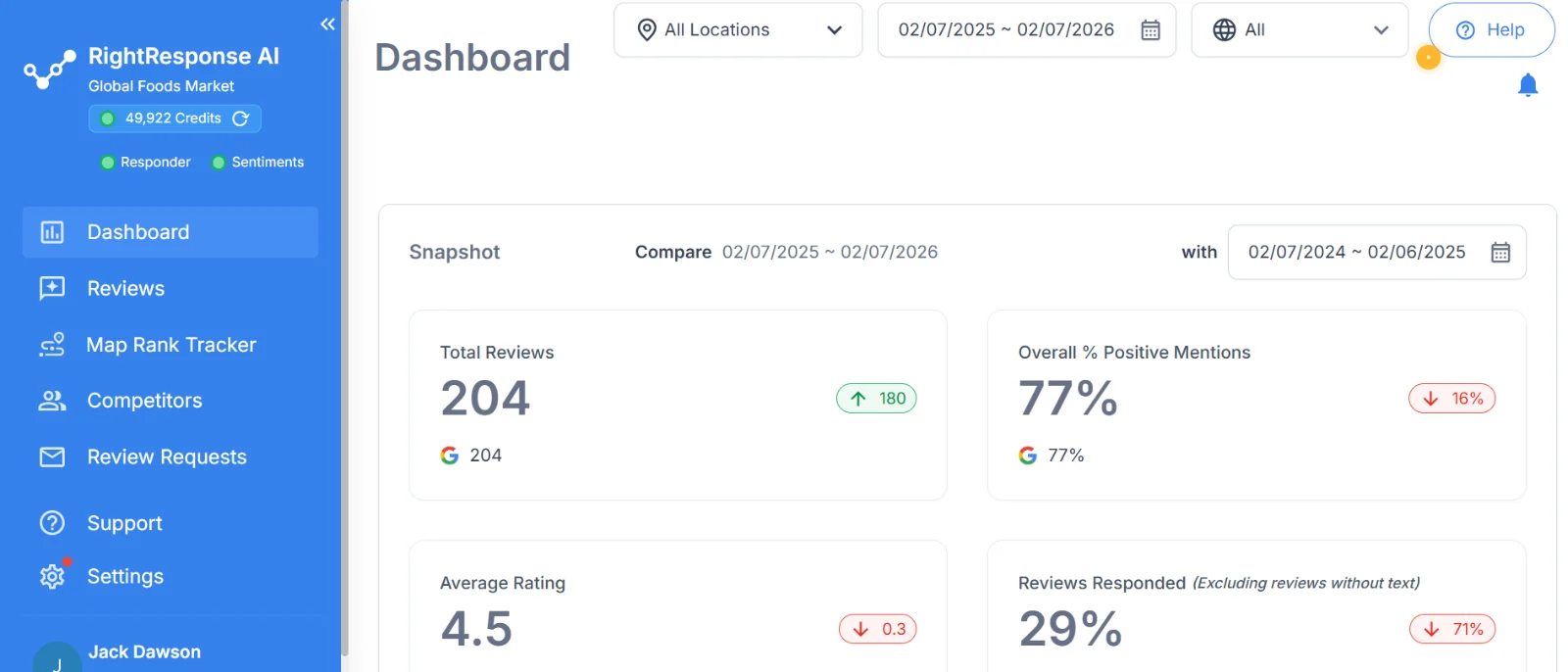
What makes this approach distinctive is the customization.
Businesses define the topics and categories that matter to their operations, rather than working with generic presets. A medical practice might define topics like "wait times," "staff friendliness," "billing clarity," and "treatment outcomes." The AI then maps every piece of customer feedback to these defined categories, showing exactly where the practice excels and where it needs attention.
The platform includes irrelevant content filtering to remove vague or off-topic comments from the analysis, direct phrase extraction so users can read the exact customer language behind each insight, and trend tracking over time to monitor how sentiment shifts month over month. All of this can be compared across locations for multi-site businesses.
CompetiWatch AI: Monitor competitor reviews, ratings, and sentiment with the same analytical depth you use for your own business.
RightResponse AI's CompetiWatch AI provides dedicated competitor intelligence capabilities beyond basic competitive features.
The tool allows businesses to add competitors and analyze their reviews using the same ABSA framework. This means you can compare your sentiment scores for topics like "customer service" or "wait times" directly against your competitors' scores on those same topics.
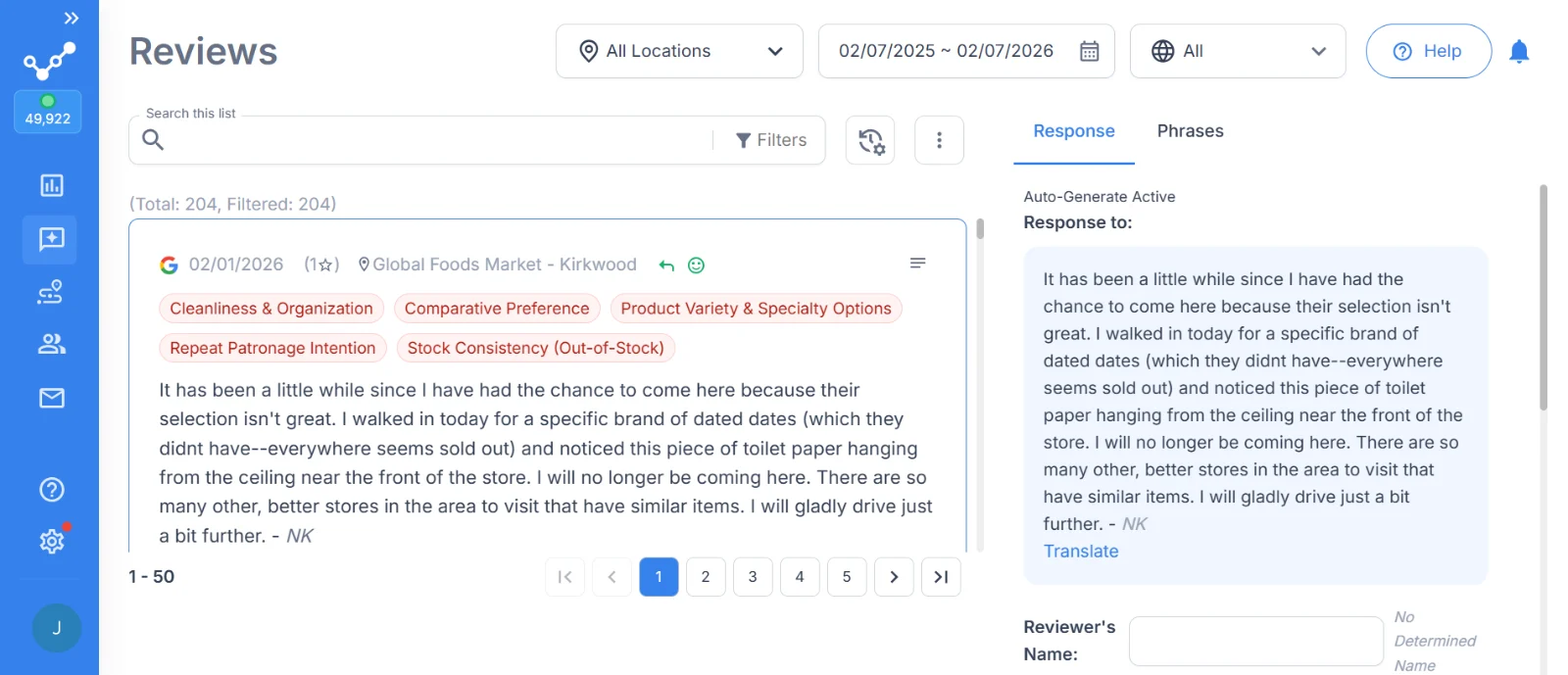
The system tracks competitor review volume, average ratings, and response rates over 60-day and 180-day periods. Users can read competitor reviews directly within the platform and see which topics drive positive or negative sentiment for rival businesses. This provides a clear picture of where competitors are vulnerable and where they outperform you, all based on what their actual customers are saying.
For healthcare practices competing in local markets, this kind of intelligence is valuable. Understanding that a nearby practice consistently receives complaints about long wait times, for instance, creates an opportunity to highlight your own efficiency in marketing and review responses.
Google Maps Rank Tracking: A grid-based system that shows exactly where you rank in local search results across your service area.
RightResponse AI's Map Rank Tracker creates a customizable grid around a business's location and simulates Google Maps searches from each point.
The result is a visual heatmap showing the business's ranking for specific keywords across the entire service area, not just at the business address.
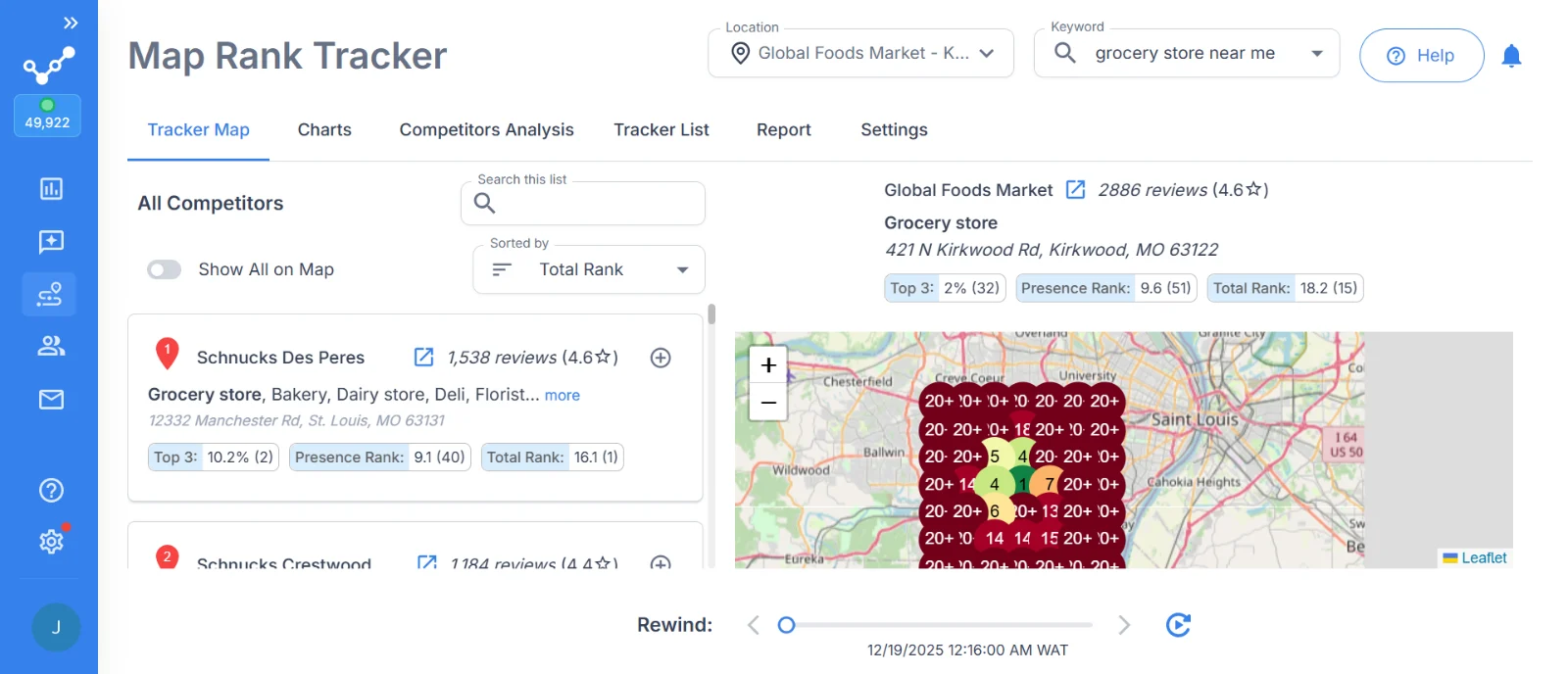
Users can configure grid size (5x5, 7x7, or larger) and set custom scanning schedules.
Key metrics include Top 3 ranking frequency (how often the business appears in the top three local results), Presence Rank (visibility within the top 20), and Total Rank (average ranking across all grid points). Clicking any point on the grid reveals a list of all businesses ranking in that area, providing immediate competitor context.
The "Rewind" feature allows users to review historical scan data. All previous scans are saved, and users can visually replay how rankings have shifted over time across the entire grid. This makes it easier to see the impact of reputation management efforts, seasonal changes, or algorithm updates on local search visibility.
AI-Powered Review Requests: Advanced review collection with AI personalization, photos, and employee-level QR codes.
While RightResponse AI's core differentiator is response quality, the platform also includes a full-featured review request system. Two modes are available:
- Essentials Mode: A straightforward, template-based system with pre-built templates. Turn it on and it runs automatically. It is suitable for businesses that want simple, reliable review collection without setup complexity.
- Pro Mode: AI-powered requests that generate highly personalized messages using customer data like name, service history, tenure, and recent transactions. Requests can include photos which are particularly effective in industries like real estate, home services, and healthcare, giving customers a visual prompt alongside the personalized ask.
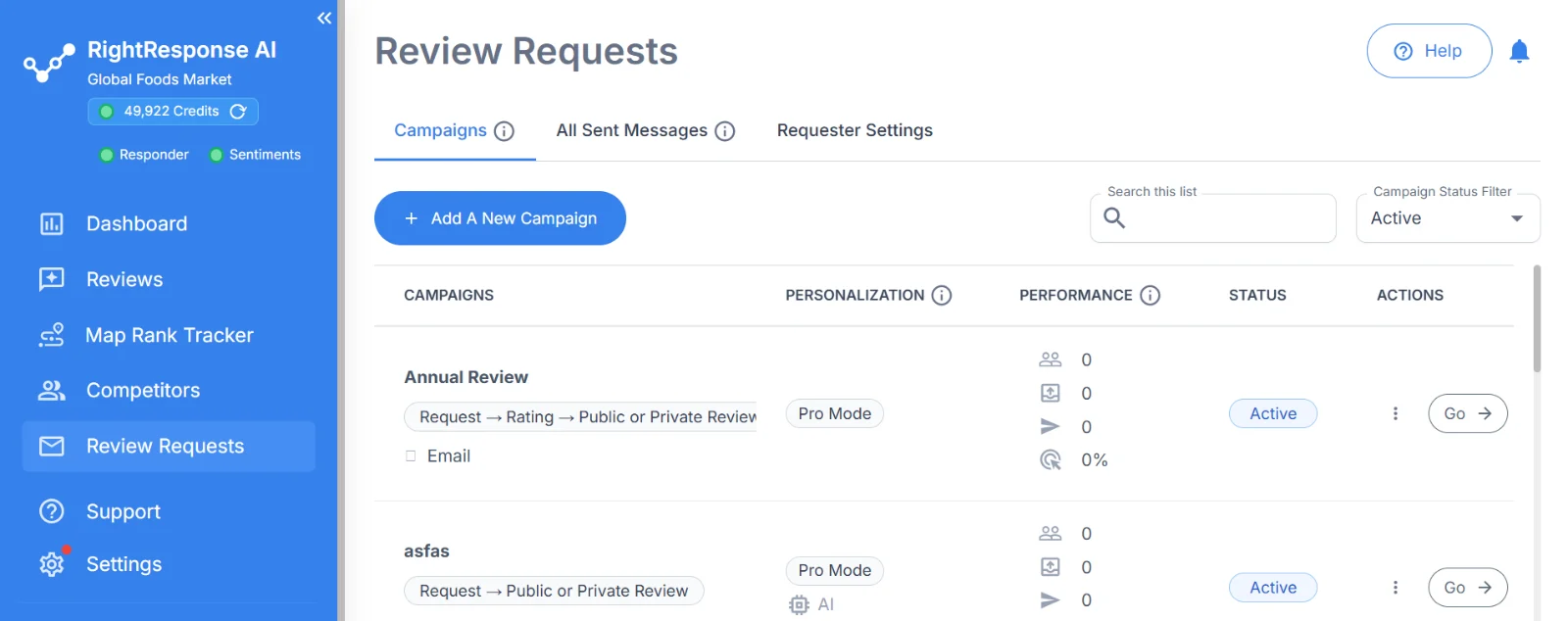
Businesses can add guiding questions that give reviewers inspiration about what to write, with questions that rotate so reviews contain varied content. The system supports unlimited follow-up requests (configurable per business; seven follow-ups for a roofer, fewer for a lawyer), and requests can be sent via email and SMS.
A distinctive feature is employee-level QR codes: each staff member gets their own code on a card they can present to customers. Employees receive credit for reviews generated through their code, enabling incentive programs. The system tracks scans and monitors for matching reviews to attribute them correctly.
Contact data for requests can be sourced via direct entry, file uploads, remote Google Sheets, Zapier integrations, or custom API connections.
Done-For-You Services and Review Disputes: Full-service management for businesses that want hands-off reputation management.
For businesses that prefer a fully managed approach, RightResponse AI offers done-for-you services where the platform team handles monitoring, responding, and managing the entire review operation.
This includes review dispute services like flagging and disputing fraudulent or policy-violating reviews on behalf of customers. For healthcare practices, where a single unfair negative review can materially impact patient acquisition, having a team that handles disputes is a meaningful safeguard.
Flexible Pricing: Pay As You Go or fixed monthly plans that scale with your needs.
RightResponse AI's pricing structure differs from rater8's per-physician model by offering flexible plans that scale with usage rather than headcount:
Self-Serve Plans:
- Pay As You Go (PAYGO): $10 per location/month plus usage-based credits, ideal for getting started or lower review volumes
- Core ($19/month): 100 review responses, 1,000 email review requests, Essentials request templates, and a basic dashboard (no SMS, surveys, or map rank tracking)
- Pro ($29/month, most popular): 200 review responses, 2,000 email requests plus 200 SMS, 200 surveys, AI-powered (Pro-mode) review requests, and Map Rank Tracking with competitor analysis (10 scans/month)
- Pro+ ($44/month): 500 review responses, 5,000 email requests plus 500 SMS, 500 surveys, advanced automation with bulk processing, Competitor Voice of the Customer, and 25 map-rank/competitor scans/month
- Enterprise: custom plans with API access and white-label options for agencies and large multi-location businesses
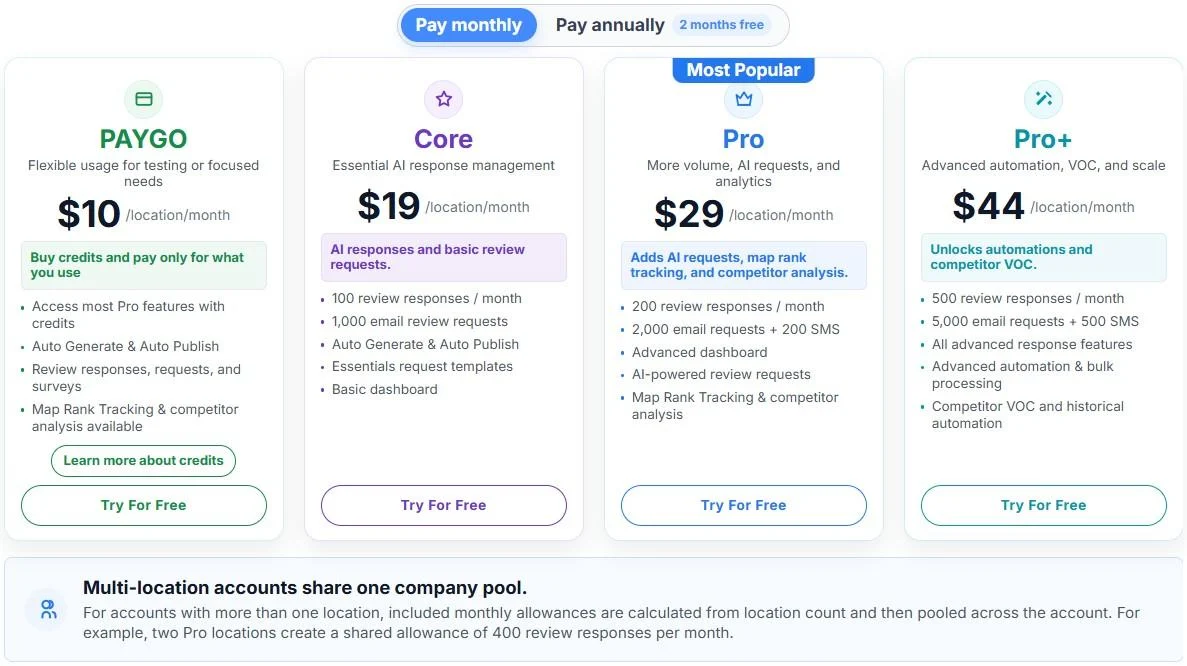
Source: RightResponse AI
The fixed plans above bundle set monthly limits, so most businesses simply pick a tier and stop thinking about metering. PAYGO is the exception: usage is billed through credits purchased in tiers, with the per-credit cost decreasing at higher volumes (from $0.01 per credit for the first 3,000 credits down to $0.006 above 400,000). Each action carries a set credit cost (for example, 20 credits per review response, 2 per email review request, and 1.5 per map rank tracker pin), which makes PAYGO best for getting started or lower, more variable review volumes.
The usage-based model means practices aren't forced into paying per-physician for capacity they don't use. A three-physician practice that receives 15 reviews per month pays only for those 15 reviews, while a 20-physician hospital system with high volume benefits from declining per-credit costs at scale.
This avoids the common friction point with per-physician or per-location flat-rate models, where smaller or seasonal practices subsidize unused capacity.
A 7-day free trial includes 1,000 usage credits and access to most Pro features, with no credit card required. Monthly and annual billing options are both available, with no long-term contracts required. Enterprise plans with custom pricing, API access, and white-label options are available for larger organizations and agencies.
RightResponse AI is competitively priced at the low end, but its value proposition is response quality and reputation intelligence, not being the cheapest option.
rater8 or RightResponse AI: Comparison Summary
rater8 | RightResponse AI | |
|---|---|---|
Target audience | Healthcare practices and hospitals | Any location-based business, regardless of size |
Core strength | Automated healthcare review collection with EHR integration | Review response quality with business-specific messaging |
Review generation | ⭐⭐⭐⭐⭐ pollin8™ goal-based algorithm with EHR integration | ⭐⭐⭐⭐ AI-personalized requests with photos, guiding questions, QR codes |
EHR/PM integrations | ⭐⭐⭐⭐⭐ 100+ healthcare systems | ❌ |
Review response quality | ⭐⭐⭐⭐ AI-assisted personalized replies, HIPAA-compliant | ⭐⭐⭐⭐⭐ Facts, Customizations, and Brand Voice personalization |
Voice of the Customer | ⭐⭐⭐ AI-powered summaries and scoring | ⭐⭐⭐⭐⭐ Voice of the Customer ABSA with phrase extraction |
Competitor intelligence | ⭐⭐ Basic competitive features | ⭐⭐⭐⭐⭐ Full competitor review and sentiment analysis |
Google Maps rank tracking | ❌ | ⭐⭐⭐⭐⭐ Grid-based tracking with historical data |
Benchmarking | ⭐⭐⭐⭐⭐ 30M+ data points, specialty-specific | ⭐⭐⭐ Via competitor comparison tools |
Patient/employee surveys | ⭐⭐⭐⭐⭐ Micro-surveys with NPS | ❌ |
Done-for-you services | ⭐⭐⭐⭐⭐ Dedicated success manager, quarterly consultations | ⭐⭐⭐⭐ Full-service management with review disputes |
HIPAA compliance | ⭐⭐⭐⭐⭐ Full compliance, SOC 2 certified | ⭐⭐⭐ PHI detection in agentic pipeline, BAA required |
Pricing model | $89-$109/physician/month, $250 minimum | PAYGO $10/location + credits; fixed plans Core $19 / Pro $29 / Pro+ $44; Enterprise custom |
Free option | Free monitoring plan | 7-day free trial with 1,000 credits |
Contract terms | Flexible (monthly or annual) | Monthly or annual, cancel anytime |
Best for | Healthcare-specific automated review management | Quality-focused reputation intelligence across industries |
Final Verdict
The choice between rater8 and RightResponse AI depends on what you value most: better healthcare integration with automated review collection, or high-quality review responses paired with competitive intelligence.
Choose rater8 if you run a healthcare practice or hospital and want a hands-off reputation management solution built specifically for your industry. Its integrations with over 100 EHR and practice management systems, HIPAA-compliant workflows, and the pollin8™ algorithm create a seamless connection between patient visits and online reviews.
The benchmarking data from over 30 million patient interactions and the dedicated client success managers provide the kind of healthcare-specific support that general platforms cannot match. For practices that want to set their reputation strategy and let the system run, rater8 delivers.
Choose RightResponse AI if you believe the quality of your review responses matters as much as the quantity of your reviews. Every prospective patient who reads your reviews also sees your responses, and most responses today are generic enough to skip.
RightResponse AI's three-pillar personalization system (Facts, Customizations, and Brand Voice) turns every reply into a conversion asset that actively markets your practice. Layer in the agentic AI pipeline that analyzes reviews before writing (with PHI detection for healthcare), a powerful review request capability, dedicated competitor intelligence, and Google Maps rank tracking, and you get a platform that connects reputation work directly to patient acquisition.
The usage-based pricing means you pay for what you use rather than per-physician headcount, and the platform serves location-based businesses of any size across any industry. For organizations that see reputation management as a strategic function not just a review collection task, RightResponse AI provides the depth to match that ambition.
Explore RightResponse AI’s medical practice, dental practice, and veterinary reputation management workflows to see how review requests, responses, and customer insights fit each setting.
Get started with RightResponse AI here.
Both platforms serve their audiences well. rater8 has built a reliable system for healthcare organizations to automate their review management with clinical precision. RightResponse AI offers the response quality and analytical tools to turn every review into both a data point that informs your competitive strategy and a marketing opportunity that wins the next customer.
Your choice depends on whether your priority is seamless healthcare automation or quality-driven reputation intelligence.
Try RightResponse AI for Free!
*No credit card required.

-1120w.webp)