Birdeye has established itself as one of the most recognized names in reputation management, serving businesses across healthcare, automotive, real estate, and dozens of other industries. With its comprehensive suite of tools for reviews, listings, messaging, and social media, it has become a go-to solution for multi-location businesses looking to manage their online presence from a single dashboard.
Comparison research: This article is part of the RightResponse AI review management software comparison library, which connects platform reviews, pricing analyses, alternatives, and head-to-head evaluations.
To write this Birdeye review, I've analyzed the platform extensively. I believe it's the ideal choice if:
- You need an all-in-one platform combining reviews, listings, social media, and messaging
- You're managing multiple locations and need centralized oversight
- You have the budget for enterprise-level software and prefer quote-based pricing
- You want webchat, surveys, and payment processing alongside reputation management
- You need integrations with your existing CRM or POS systems
However, Birdeye might not be the best choice if:
- You want transparent, usage-based pricing without sales calls
- You believe the quality of every review response matters for winning new customers and want a system built around Facts, Customizations, and Brand Voice to ensure each reply actively markets your business
- You prefer focused tools over feature-heavy platforms
- You value flexible contracts with straightforward cancellation
- You want customizable Voice of the Customer analysis with the ability to define your own tracked topics
In this case, you should consider RightResponse AI: a reputation management platform built with advanced AI at its core. Rather than bundling numerous features, RightResponse AI focuses on what matters most for reputation management: delivering significantly higher-quality review responses through a system of Facts (what to say), Customizations (how the response should behave), and Brand Voice (how it should sound), alongside advanced review collection, Voice of the Customer insights, competitor analysis, and local search rank tracking.
Because of that, I've included a detailed look at RightResponse AI later in this Birdeye review, as the best alternative for location-based businesses of all sizes seeking superior response quality and pricing transparency. If you're ready to explore a more focused approach to reputation management, you can start your free trial with RightResponse AI here.
Table of contents:
- What is Birdeye?
- Birdeye Pros & Cons
- Birdeye Review: How it Works & Key Features
- Where Birdeye Falls Short
- Top Birdeye Alternative: RightResponse AI
- Birdeye or RightResponse AI: Comparison Summary
- Final Verdict
What is Birdeye?
Birdeye is an all-in-one customer experience and reputation management platform founded in 2012 by brothers Naveen and Neeraj Gupta.
The founders, with tech industry backgrounds including experience at Yahoo, created Birdeye to help local businesses manage their growing volume of online reviews across numerous websites.
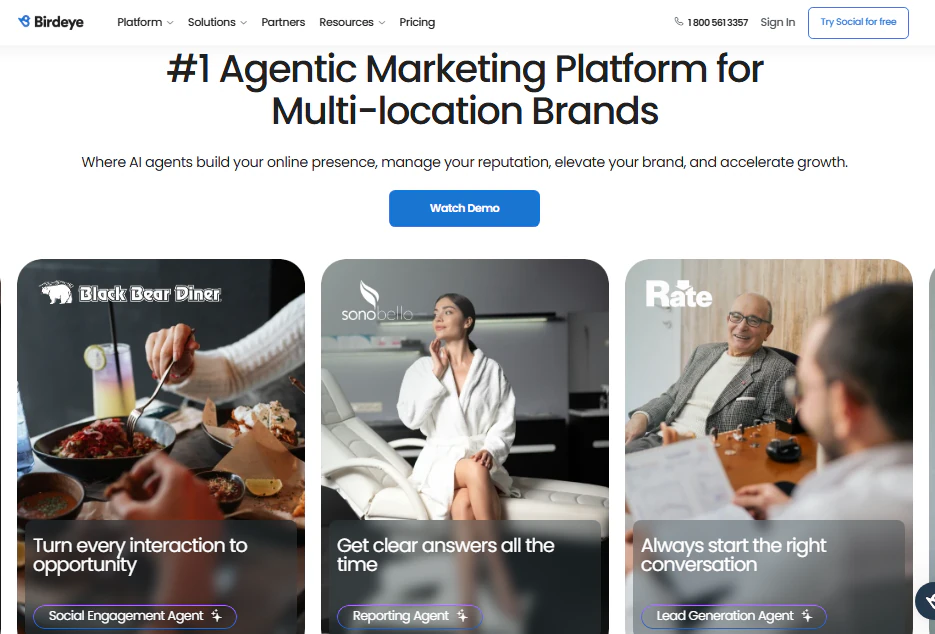
Over the years, Birdeye has evolved from a review monitoring tool into what the company now calls the "#1 Agentic Marketing Platform for Multi-location Brands." This positioning emphasizes AI agents that automate marketing tasks like responding to reviews, creating social media content, and engaging with leads. The platform's "BirdAI" technology is designed to learn a business's brand voice and industry context.
Today, Birdeye serves a wide range of industries including healthcare, dental practices, automotive services, home services, restaurants, retail, real estate, and financial services. The platform employs between 1,001 and 5,000 people and has raised approximately $93 million in funding.
Its ideal customers are multi-location businesses that need to manage their online presence, customer communications, and marketing activities from a centralized dashboard, though the platform serves businesses of various sizes.
Birdeye Pros & Cons
Pros | Cons |
|---|---|
✅ Comprehensive all-in-one platform for reputation management | ❌ No public pricing; requires sales consultation |
❌ Inconsistent customer support experiences | |
✅ Strong focus on multi-location businesses | |
✅ AI-powered review responses and content creation | ❌ Can be expensive for smaller businesses |
✅ Unified messaging inbox across channels | ❌ Feature breadth may be more than focused users need |
Birdeye Review: How it Works & Key Features
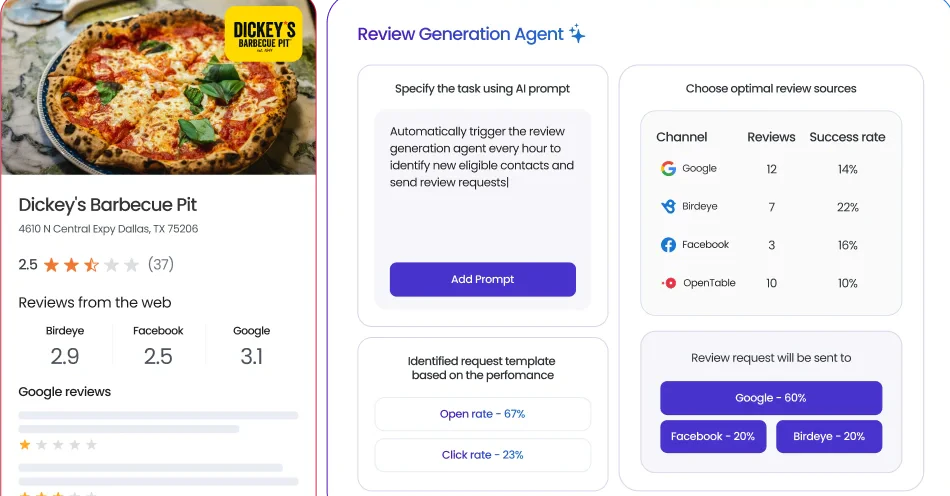
Reviews AI: Birdeye centralizes review management with automated collection and AI-powered responses.
At the core of Birdeye's platform is its Reviews AI feature, which aggregates customer reviews from over 200 sites into a single dashboard. This includes major platforms like Google and Facebook, as well as industry-specific review sites. The system eliminates the need to manually check multiple websites for new feedback.
Source: Birdeye
The review request automation sends invitations to customers via email and SMS after transactions or appointments. Businesses can customize templates and connect the feature to their CRM or POS system to trigger requests automatically. The platform claims that 99% of users rated it with 4 or 5 stars in G2's Fall 2023 Online Reputation Management Grid Report.
For responding to reviews, Birdeye's AI analyzes review content and generates replies based on the business's brand voice. The system supports translation, allowing businesses to respond to reviews in multiple languages.
Businesses can set up automated responses for certain star ratings or manually approve each response. Negative reviews can be converted into service tickets and assigned to team members for follow-up.
Listings AI: Manage business information across 100+ directories from one dashboard.
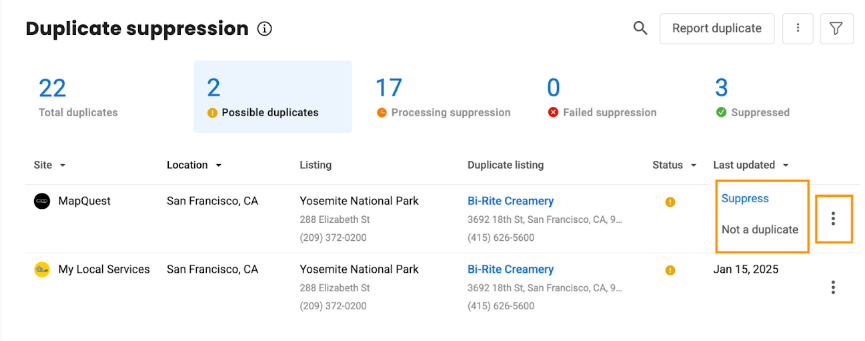
Birdeye's Listings AI helps businesses maintain accurate and consistent information across online directories, search engines, and navigation apps. The platform supports a network of over 100 sites, including Google, Facebook, Bing, and Apple Maps.
The system scans for existing listings, identifies errors and inconsistencies, and allows businesses to push updates from a centralized dashboard. Changes to business name, address, phone number, hours, and services are synchronized across the network. The platform also suppresses duplicate listings to avoid customer confusion.
Source: Birdeye
For multi-location businesses, Listings AI enables management of all locations from one interface. The AI-powered optimization agent can identify gaps and provide recommendations to improve search rankings. Businesses can also generate AI-written descriptions optimized for search engines.
Messaging and Webchat: A unified inbox for customer conversations across channels.
Birdeye's Messaging feature consolidates customer conversations from text messages, email, webchat, social media, and voicemails into a single inbox. This allows businesses to view and respond to messages from Facebook Messenger, Instagram, Google Business Messages, and other channels without switching between platforms.

Source: Birdeye
The Webchat feature adds an AI-powered chat widget to business websites. The chatbot can answer frequently asked questions, book appointments, and capture lead information 24/7. When visitors need human assistance, conversations transfer to live agents. If a visitor leaves the website during a chat, the conversation can continue via text message.
For businesses with landline phone numbers, Birdeye offers text-to-landline functionality. This allows customers to text a business's existing landline number, with messages appearing in the unified inbox. The platform also transcribes voicemails and delivers them to the inbox for text-based follow-up.
Social and Surveys: Manage social media presence and gather customer feedback.
Birdeye's Social feature enables businesses to create, schedule, and publish content across Facebook, Instagram, LinkedIn, and Google Business Profile.
The platform includes an AI content generator that can create posts based on industry and business type. A visual calendar helps plan content, and bulk publishing allows multi-location businesses to schedule many posts at once.

Source: Birdeye
The Surveys feature allows businesses to create NPS, CSAT, and custom surveys without coding. Surveys can be distributed via email, text, social media, or embedded on websites. The AI analyzes responses to identify sentiment and key themes, with results filterable by location. Positive survey responses can be channeled into requests for public reviews.
Birdeye also offers reporting and benchmarking through its Insights feature. The Birdeye Score provides a composite metric of online health based on reviews, ratings, and sentiment. Businesses can compare their performance against competitors on metrics like average rating and review volume.
Where Birdeye Falls Short
While Birdeye offers a comprehensive feature set, several limitations become apparent with regular use. These constraints reflect trade-offs inherent in building a broad platform.
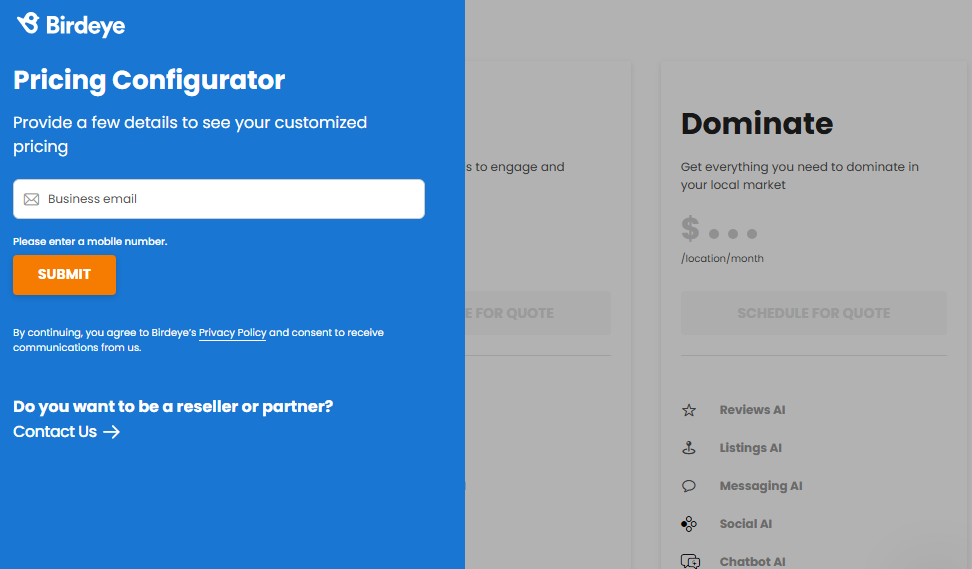
Opaque Pricing and Contracts: Birdeye requires prospective customers to contact sales for pricing, making it difficult to evaluate affordability without time investment. Multiple user reviews cite auto-renewing contracts and a challenging cancellation process. For businesses that prefer predictable, transparent pricing, this sales-driven model creates friction.
Source: Birdeye
Customer Support Inconsistency: User feedback reveals a divide in support experiences. While some praise dedicated representatives, others report slow response times, unhelpful interactions, and difficulty resolving billing issues. For a platform businesses rely on for customer-facing reputation, inconsistent support represents an operational risk.
Feature Breadth: The breadth of Birdeye's feature set may be more than some businesses need. A restaurant that primarily wants to manage Google reviews and respond efficiently may not require webchat, social media scheduling, and survey tools. The all-in-one approach means paying for access to capabilities that may go unused.
AI Response Quality Ceiling: Birdeye's AI can generate review responses and adapt to brand voice through its Brand AI and Industry AI customization.
However, some users report responses can feel repetitive over time. Birdeye offers personalization through profile data and FAQs, but the system lacks a structured way to map specific business facts to recurring review themes, meaning responses may acknowledge customer feedback without weaving in the operational details, unique selling points, or marketing messages that would make the reply valuable to prospective customers reading it.
For businesses that view every response as a conversion opportunity rather than a task to complete, this ceiling matters.
Cost at Scale: Several users report that Birdeye becomes expensive as needs grow, with additional features requiring upgrades to higher tiers. The per-location pricing model means costs scale linearly with each new location, regardless of how much review activity each location actually generates.
These considerations are natural trade-offs of building a broad, enterprise-focused platform. However, they create opportunities for solutions that prioritize different approaches to AI response quality, transparent pricing, and focused functionality.
Top Birdeye Alternative: RightResponse AI
RightResponse AI takes a fundamentally different approach to reputation management.
Launched publicly in early 2024 by George Swetlitz, Shiv Pujan Singh, and Sabrina Hu, the platform was built with generative AI capabilities at its core. According to the company, Swetlitz's background managing a large healthcare network informed the platform's focus on handling high volumes of customer feedback efficiently.
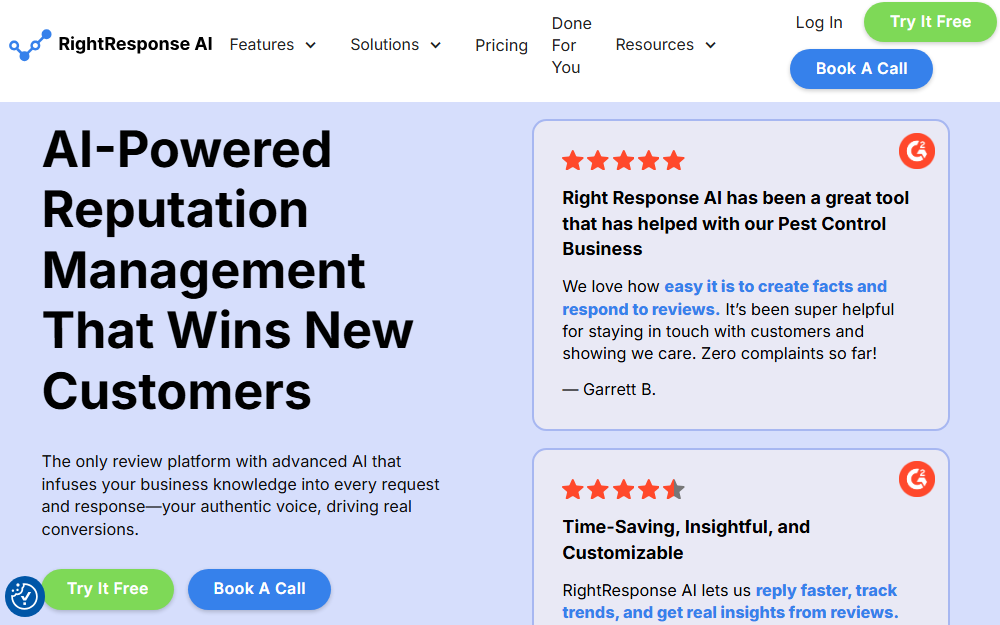
The platform's philosophy centers on a concept the team calls the "review gate": reviews are the conversion point where prospective customers decide whether to choose your business.
People read reviews more than they read a business's website, yet most review responses today are generic and skippable, a wasted opportunity. RightResponse AI is built to change that by making responses worth reading, turning each reply into a conversion asset that actively markets the business to prospective customers.
Intelligent Review Response: Three pillars produce responses that actively market your business.
RightResponse AI's response system is built on three distinct pillars of personalization that work together:
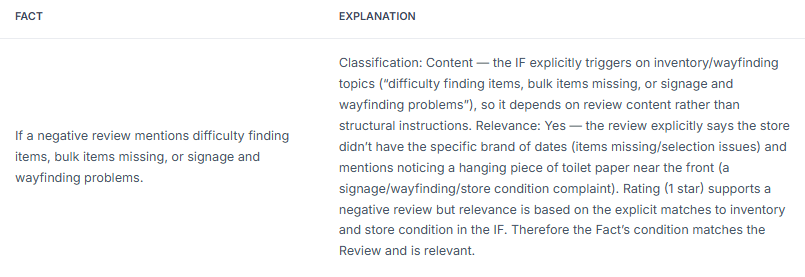
Facts define what to say.
During onboarding, the platform reads a business's existing reviews, past responses, and website to create a library of facts: unique selling points, operational details, brand values, and specific information the business wants shared with customers.
Facts are mapped to the most common themes in reviews, so when a review comes in, the AI identifies which facts are relevant and weaves them naturally into the response. Businesses can see exactly which facts were used and which weren't, making it easy to refine messaging over time.
Customizations define how the response should behave.
These are rules and behavioral controls: how to handle negative reviews, when to include contact information, how to format greetings using reviewer and employee names, and how to handle edge cases. For healthcare providers, a PHI detection feature ensures responses don't include protected health information, maintaining HIPAA compliance.
Brand Voice defines how it should sound.
Businesses set their tone, style, phrasing preferences, and variations to keep responses fresh and on-brand across all locations.
Together, these three pillars produce hyper-personalized, brand-aligned responses with endless variation, without losing control. For example, if a customer mentions enjoying their lunch, the AI might incorporate a fact about the restaurant's locally sourced ingredients and mention the new weekend brunch menu, giving prospective customers a reason to visit.
Instead of generic "thanks for your review" filler that wastes space, every response becomes a marketing touchpoint.
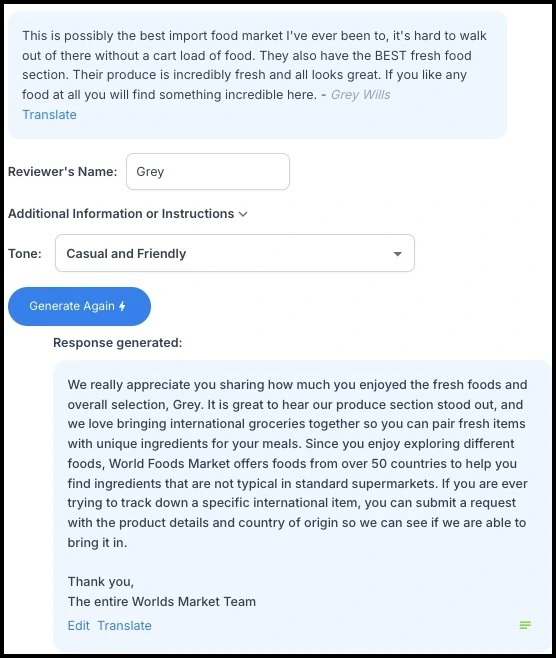
Under the hood, RightResponse AI uses an agentic pipeline that separates analysis from writing. The system analyzes the review first, identifying sentiment, themes, edge cases like rating/text mismatches, and review updates, before passing context to a dedicated writing engine.
This separation reduces the risk of the AI generating inappropriate responses while increasing relevance. For medical use cases, the pipeline includes PHI detection to prevent protected health information from appearing in responses.
Review Collection: AI-powered requesting that maximizes every opportunity.
RightResponse AI doesn't just respond to reviews, it includes a sophisticated review request system designed to generate more reviews and higher ratings through personalization. Personalization matters because it increases the conversion rate of review requests into actual reviews, making every opportunity count.
The platform offers two modes. Essentials Mode provides simple, template-based review requests that run automatically; businesses turn it on and it works. Pro Mode uses AI to generate highly personalized requests that incorporate customer data like name, service history, tenure as a customer, and recent transactions.
For example, a request might read: "Hey Jim, your technician really enjoyed your visit. We love servicing your two air conditioners and appreciate the fact that you've been a customer for six years." Requests can include photos, particularly effective in real estate and home services, where customers can download and attach the image to their review.

Requests can be sent via email and SMS, with contact data sourced through direct entry, file uploads, remote Google Sheets, Zapier integrations, or custom APIs. The system supports guiding questions that prompt reviewers to mention strategically relevant details, including SEO-relevant questions that improve both review quality and search value, with questions rotating to generate varied review content. Unlimited follow-up requests can be configured per business needs; seven follow-ups for a roofer, fewer for a lawyer.
A standout feature is per-employee QR codes.
Rather than generating a single QR code for the business, each employee gets their own code on a card they present to customers. The system tracks which employee generated each review, enabling incentive programs and accountability.
For multi-location businesses, a review grouping feature allows reviews from established locations to be directed toward a new location, helping it build review volume quickly, a technically complex capability that few competitors offer.
Voice of the Customer: Understand the "why" behind your ratings.
RightResponse AI's Voice of the Customer Aspect-Based Sentiment Analysis (ABSA) goes beyond simple positive/negative scoring. The system identifies specific aspects of the business that customers discuss and determines the sentiment associated with each aspect independently.
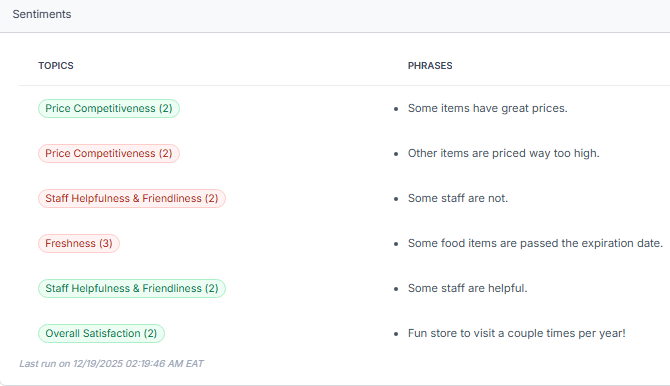
Businesses can customize the topics the AI tracks, ensuring the analysis aligns with their operational priorities. The system analyzes sentiment against the specific topics each business defines for itself, reflecting how that business or manager thinks about their operations, rather than relying on generic or predefined categories. This means businesses don't just know that overall sentiment is 75% positive; they can see exactly how customers feel about the specific topics that matter to them. This granularity enables targeted improvements.
The platform filters out irrelevant content and noise, focusing analysis on genuine experience-based feedback. Results are visualized in dashboards with the ability to compare sentiment across locations and time periods. Users can drill down to see the exact phrases mapped to each topic, providing full context behind every insight.
Google Map Rank Tracking and Competitor Analysis: Connect reputation work to local visibility.
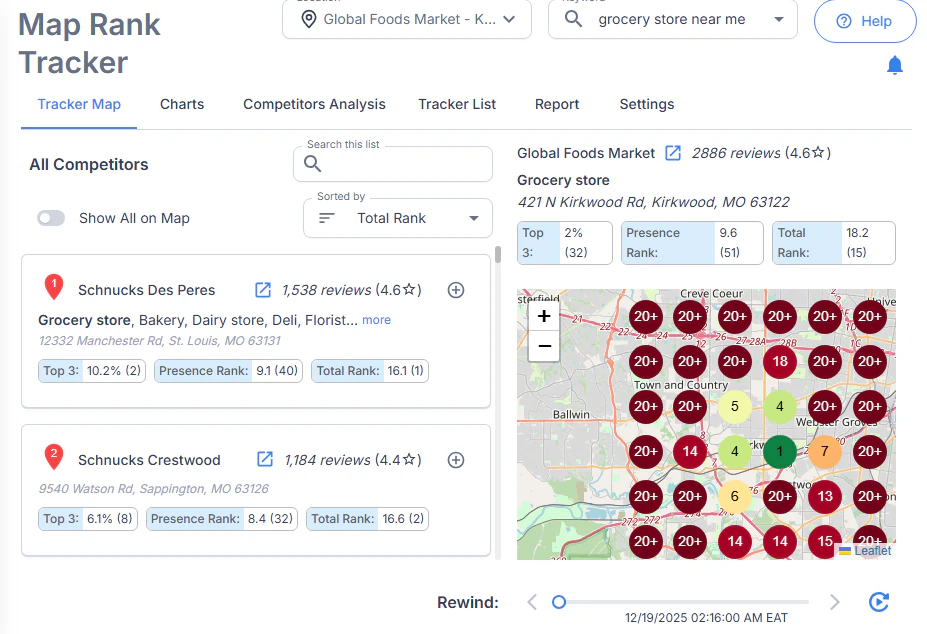
The Map Rank Tracker creates a customizable grid around a business location and simulates searches from each point to show exactly where the business ranks for specific keywords. This "street-level view" reveals geographic strengths and weaknesses; a business might rank first directly at its location but drop to fifth position a few blocks away.
All scans are saved, and the "Rewind" feature lets users visually replay how rankings have changed over time. Key metrics tracked include Top 3% (how often appearing in top three results), Presence Rank (visibility across the grid), and Total Rank (average position).
The CompetiWatch AI feature applies the same analytical lens to competitors. Businesses can see which competitors outrank them in specific locations, analyze competitors' review volume and response rates, and apply sentiment analysis to competitors' reviews. This reveals competitors' strengths and weaknesses from the customer perspective, informing strategic decisions.
Pricing and Services: Flexible plans with full-service options.
RightResponse AI publishes its pricing openly, offering multiple options to match different business needs.
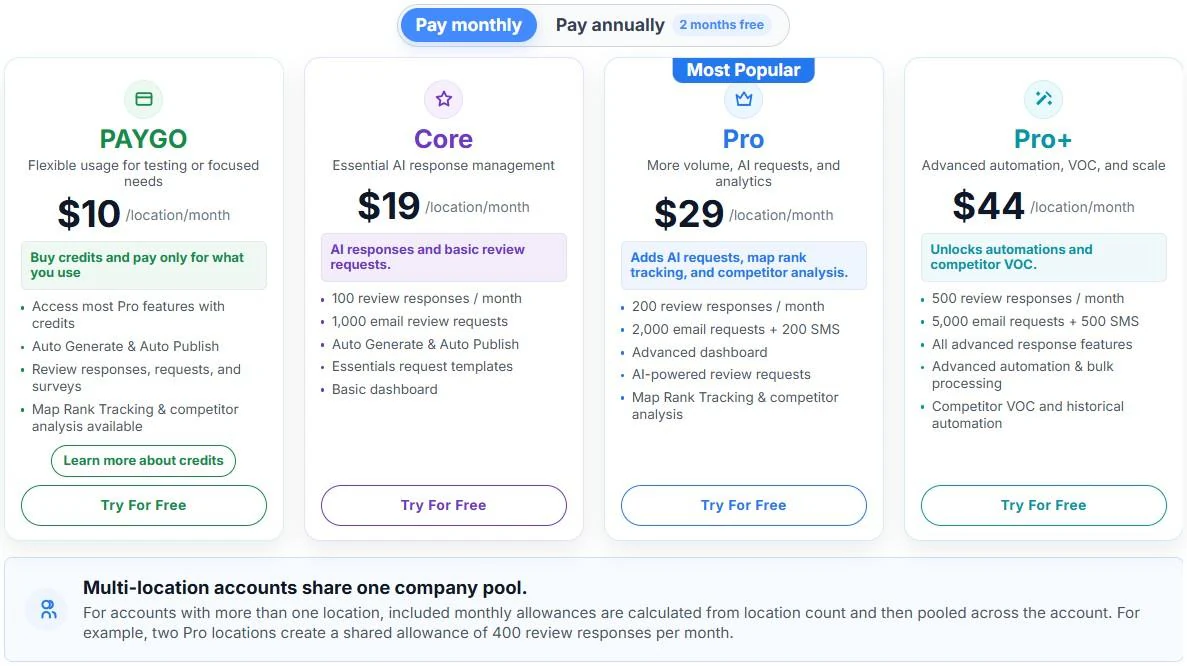
For businesses starting out, experimenting with features, or with limited review volume, the Pay As You Go (PAYGO) option provides a flexible entry point.
The base fee is $10 per month per location, which provides access to all features. Actual usage is billed through a credit system: 20 credits per review response, 20 credits per sentiment analysis, 2 credits per email review request, and 1.5 credits per map rank tracker pin.
Source: RightResponse AI
For businesses ready to commit to a plan, RightResponse AI offers three fixed-price tiers.
- Core at $19 per month includes 100 review responses, 1,000 email review requests, Essentials request templates, and a basic dashboard (no SMS, surveys, or map rank tracking).
- Pro at $29 per month, the most popular tier, adds 200 review responses, 2,000 email requests plus 200 SMS, 200 surveys, AI-powered Pro-mode requests, and Map Rank Tracking with competitor analysis (10 scans per month) on an advanced dashboard.
- Pro+ at $44 per month raises limits to 500 review responses, 5,000 email requests plus 500 SMS, and 500 surveys, and adds advanced automation with bulk processing, Competitor Voice of the Customer, and 25 map rank and competitor scans per month. Agencies and large multi-location businesses can create customized Enterprise plans with white-label access, API access, and advanced reporting.
This tiered approach means businesses can start with Pay As You Go to test the platform, then move to a fixed plan as their needs become clear.
A seasonal business with fluctuating review volume can stay on PAYGO and pay only for what it uses, while a growing multi-location brand can lock in a Pro or Pro+ plan for predictable costs. For agencies managing multiple clients, the model scales cleanly across accounts without per-location rigidity.
The platform is not positioning itself as the cheapest option, there are budget tools that use older AI models and produce generic responses, but the pricing structure makes it competitively priced at the low end while delivering significantly higher quality.
A 7-day free trial includes 1,000 usage credits and access to most Pro features, with no credit card required.
Prefer a hands-off option? Our Done-For-You team can manage review requests, monitoring, responses, reporting and reputation insights for you. See current Done-For-You pricing.
The platform team handles monitoring, responding, disputing reviews, and providing monthly sentiment analysis reports. The company also provides a free AI review response generator on its website for businesses that want to experience the response quality before committing.
Birdeye or RightResponse AI: Comparison Summary
Aspect | Birdeye | RightResponse AI |
|---|---|---|
Primary Focus | All-in-one marketing platform | AI-powered review management |
Target Users | Multi-location enterprises (serves various sizes) | Location-based businesses of all sizes, from single location to enterprise |
Pricing Model | ⭐⭐ Per-location, quote-based, requires sales call | ⭐⭐⭐⭐⭐ Public pricing across tiers: PAYGO ($10/location + credits), Core $19, Pro $29, Pro+ $44, plus custom Enterprise plans |
AI Response Quality | ⭐⭐⭐ Brand voice adaptation with profile data | ⭐⭐⭐⭐⭐ Facts, Customizations, and Brand Voice system with agentic pipeline |
Review Collection | ⭐⭐⭐⭐ Email and SMS requests with CRM triggers | ⭐⭐⭐⭐⭐ AI-personalized requests, per-employee QR codes, guiding questions, unlimited follow-ups |
Voice of the Customer | ⭐⭐⭐ Theme and keyword identification with ML scoring | ⭐⭐⭐⭐⭐ Customizable Voice of the Customer (ABSA) with topic drilling |
Feature Breadth | ⭐⭐⭐⭐⭐ Reviews, listings, social, messaging, webchat, surveys | ⭐⭐⭐⭐ Reviews, review requests, Voice of the Customer, rank tracking, competitor analysis |
Review Sources | 200+ sites | 125+ review platforms with native Google integration |
Free Trial | 30-day trial available | 7 days with 1,000 free credits |
Contract Flexibility | Annual contracts commonly reported by users | Month-to-month available |
Managed Service | Available through account representatives | Done-For-You service including monitoring, responding, and disputes |
Best For | Enterprises needing a comprehensive marketing suite | Businesses prioritizing response quality as a growth lever |
Final Verdict
The choice between Birdeye and RightResponse AI depends on what you value most in a reputation management platform.
👉 Choose Birdeye if you need a comprehensive marketing platform that consolidates reviews, listings, social media, messaging, webchat, and surveys into one system.
It's well-suited for multi-location enterprises with dedicated teams who can leverage its full feature set and have the budget for quote-based enterprise pricing. If you're managing dozens or hundreds of locations and want centralized control over your entire customer communication stack, Birdeye provides the breadth of tools to support that complexity.
👉 Choose RightResponse AI if you believe the quality of every review response directly impacts whether the next customer chooses your business.
Reviews are the conversion gate, prospective customers read them more than your website, and the response is the only part you control. RightResponse AI treats that response as a conversion asset, not a task to check off. Its system of Facts, Customizations, and Brand Voice ensures each reply actively markets your business with specific, relevant details rather than generic filler.
The platform also includes a powerful AI-powered review request capability, Voice of the Customer with customizable aspect-based sentiment analysis, competitor analysis, and local search rank tracking, all with transparent pricing and flexible plans. For location-based businesses of any size, from a single location to enterprise, that want a specialized, quality-focused approach to reputation management rather than an all-in-one suite, RightResponse AI is built for that.
Get started with RightResponse AI here.
The distinction between these platforms reflects different philosophies. Birdeye provides breadth with an extensive feature set under one roof, while RightResponse AI provides depth in the area that most directly impacts revenue: the quality of review responses and the Voice of the Customer insights that inform business decisions.
Your choice depends on whether you need everything in one place or whether you want a platform that treats every review response as an opportunity to win the next customer.
Frequently Asked Questions
Is Birdeye worth the price?
Birdeye is worth considering for multi-location enterprises that need a comprehensive all-in-one platform covering reviews, listings, social media, messaging, webchat, and surveys. However, its quote-based pricing requires a sales consultation, and users report annual contracts with challenging cancellation processes. Businesses primarily focused on review response quality and transparent pricing may find better value in alternatives like RightResponse AI, which offers flexible plans starting at $19/month as well as a pay-as-you-go option from $10/month per location.
What are the main limitations of Birdeye?
Key limitations include opaque pricing requiring sales calls, reports of rigid contracts and difficult cancellation, inconsistent customer support experiences, AI responses that can feel repetitive without structured fact-to-theme mapping, and cost scaling linearly per location regardless of actual review volume. The broad feature set may also include more than focused users need.
When should I choose RightResponse AI over Birdeye?
Choose RightResponse AI if you believe the quality of every review response directly impacts whether the next customer chooses your business. The platform's three-pillar system (Facts, Customizations, Brand Voice) ensures each reply actively markets your business with specific, relevant details. It also includes AI-powered review collection with per-employee QR codes, customizable Voice of the Customer aspect-based sentiment analysis with user-defined topics, Google Maps rank tracking, and competitor intelligence—all with transparent pricing via flexible plans starting at $19/month or pay-as-you-go from $10/month per location.
Can Birdeye and RightResponse AI be used together?
While both platforms handle review management, they serve different primary purposes. Birdeye provides breadth with listings, social media, messaging, and webchat alongside reviews. RightResponse AI provides depth in response quality, Voice of the Customer insights, and competitor analysis. Businesses using Birdeye for its broader marketing suite could potentially use RightResponse AI specifically for its superior AI response generation and Voice of the Customer capabilities.
Try RightResponse AI for Free!
*No credit card required.