The 11 best Birdeye alternatives for review management in 2026 are RightResponse AI (our top pick for AI review replies using business details, feedback analysis, and Google Maps tracking), Podium for customer texting and booking, SOCi for multi-location marketing, NiceJob for review and referral automation, Broadly for bundled business tools, ReviewFlowz for connecting reviews to team tools, GatherUp for review requests and surveys, Reputation.com for tracking customer issues, ReviewTrackers for monitoring reviews across locations, Yext for business listings, and BrightLocal for local SEO reporting.
RightResponse AI helps you write replies using approved details about your business and spot recurring praise and complaints; Pro and Pro+ also include competitor comparisons and Google Maps tracking.
Birdeye does more than manage reviews. It also offers messaging, listings, social media and other marketing tools. If you use those features, switching means deciding how to replace them. This guide compares eleven alternatives so you can choose the tools you actually need.
This guide focuses on location-based businesses: companies serving customers at physical locations or within local service areas, whether they have one location or many. Their needs center on business reviews, local search visibility and customer feedback. That differs from an online-only retailer choosing tools primarily for product reviews. Our comparison reflects those priorities.
RightResponse AI: Our Top Pick for AI Review Responses, Feedback Analysis, and Google Maps Tracking
Start with Pro at $29 per location per month if you want AI review replies and requests, customer feedback analysis, Google Maps tracking and competitor comparisons. Pro+ is $44 and adds higher limits, advanced automation and analysis of what competitors’ customers say. Core is $19 without maps or competitor analysis. PAYGO starts at $10 per location per month, plus usage credits.
The difference starts with your replies. Tell the AI about your business—such as your services, policies or what makes you different—and it can include those details when they help answer a review. A complaint about parking, for example, is a chance to explain where customers can park. You can check which details the AI used and edit the reply before it goes out.
Other products may make more sense if your biggest problem is elsewhere. Look at Podium for customer texts and booking, SOCi for managing marketing across many locations, Reputation.com for assigning and tracking customer issues, Yext for business listings, and BrightLocal for local search reporting.
This comparison draws on company websites, public help documentation, blogs and other public information. A short source summary by company is at the end.
How We Evaluate Birdeye Alternatives
We used seven criteria to compare the alternatives. The right choice depends on the work you need to replace:
- Review collection: How businesses request reviews, collect private feedback, and use referrals or review displays.
- Reply quality and controls: What the AI can use when writing a reply, such as business details or earlier responses, and how staff inspect, edit, approve or hold replies.
- Monitoring and reporting: Review sites covered, location reports, and how clearly the product shows what customers praise or criticize.
- Multi-location and agency management: How teams work across locations or clients, including documented permissions, shared settings and agency reports.
- Setup and integrations: What must be connected or configured, and whether the product works with tools the team already uses.
- Pricing and commitment: Cost for comparable locations and features, usage allowances, extra fees, trials, billing options and contract terms.
- Buyer fit: Whether the product solves the business’s main problem at the right scale, from a single location to a regional network to an enterprise with hundreds or thousands of locations, without adding tools the team will not use.
For businesses replacing Birdeye mainly for review management, useful replies, customer feedback and value lead our recommendation. A wider suite can be the better choice when messaging, listings, social media or customer issue management drive the purchase.
Birdeye Alternatives at a Glance
The other ten products offer different strengths, from customer texting to listings and local SEO. The table shows where each fits and how it charges. Prices were checked on October 12, 2026. Compare plans for the same number of locations and the same features; some annual prices are shown as monthly equivalents.
| Platform | Best for | Pricing | Contract or trial | What to check |
|---|---|---|---|---|
| RightResponse AI | AI review replies using approved business details, customer feedback analysis, and Google Maps tracking (Our Top Pick) | USD per location/month, billed monthly: Core $19; Pro $29; Pro+ $44. PAYGO starts at $10 plus credits. Maps and competitor analysis are excluded from Core. | Monthly or annual billing. Seven-day trial with 1,000 credits and most Pro features; no card required. Free use ends if credits run out. | Pro includes 10 combined map scans/competitor analyses per location/month; Pro+ includes 25. Phone, social and broad listings tools are separate. |
| Podium | Customer texting and booking, with reviews in the same system | Custom quote | Ask about the contract, setup fees and messaging limits | Whether you need its communication tools as well as reviews |
| SOCi | Managing search, social media and reviews across many locations | Custom quote for the products and locations you need | Ask about setup, contract length and renewal | What head office and local managers can each do |
| NiceJob | Automated review requests, referrals and sharing customer reviews | USD $75/month Starter; $125/month Pro. Confirm the number of locations included. | 14-day trial; advertised without a contract. Check your account terms. | Which reply and analysis features come with your plan |
| Broadly | Combining reviews, calls, messages, listings, social media and a website | Advertised AI Workforce bundle: $799/month. Ask about location limits and the separate Reputation AI offer. | Bundle advertised without a long-term contract; confirm your quote | Whether you will use enough of the bundle to justify the cost |
| ReviewFlowz | Review monitoring, AI replies and connections to team tools | Per location/month: Pro $50 or Premium $80. Annual billing: $45 or $70 per month equivalent. | Free trial; confirm its limits. Sending invitations costs extra. | Which plan includes the analysis, reports and API access you need |
| GatherUp | Review requests, private feedback, customer surveys and agency services | Monthly billing: $124 for one location; $75/location for 2–10. Annual billing: $99 or $60 per month equivalent. | Monthly or annual billing; 14-day trial. Agencies receive separate quotes. | Listings Hub and Review Defense cost extra. Check whether the displayed price assumes annual billing. |
| Reputation.com | Analyzing customer feedback and assigning follow-up work | Per location/month: Rep Core $80; Core + Pulse $115; Core + Surveys $150 | Custom Enterprise plans for 125+ locations; confirm contract terms | Which reports, integrations and ticketing features are included |
| ReviewTrackers | Monitoring reviews and comparing customer experiences across locations | Custom quote based on locations, plan and add-ons | Confirm any location minimum, billing term and renewal rules | Listings and local search rank tracking cost extra |
| Yext | Keeping business listings and location information up to date | Custom quote for the products and locations you need | Ask about setup, contract length and renewal | Whether the quote includes Reviews as well as listings |
| BrightLocal | Local search rankings, business listings, audits and agency reports | USD $65/month for one-location Grow, or $584/year. Bundles for more locations are priced differently. | 14-day trial; monthly or annual billing | Grow includes reputation management; Track and Manage have different features |
RightResponse AI vs. Birdeye: Which Should You Choose?
Choose RightResponse AI if you mainly want to improve how you request, understand and respond to reviews. Keep Birdeye on your shortlist if you also need its messaging, social media and listings tools. The right comparison is the set of tools your business will use, rather than every feature either company sells.
| What matters | RightResponse AI | Birdeye |
|---|---|---|
| Our recommendation | Our top pick for AI review replies, customer feedback analysis and Google Maps tracking | Worth considering when you also need several marketing and communication tools |
| Pricing | USD per location/month: Core $19, Pro $29, Pro+ $44 on monthly billing. PAYGO starts at $10 plus credits. | Custom quote based on products, locations and contract |
| Billing and contract | Monthly or annual. Annual subscriptions cost the equivalent of ten monthly payments. Usage, add-ons and SMS charges are separate. | Usually an annual agreement. Check payment dates, renewal and cancellation terms in your offer. |
| How AI replies work | Uses relevant details you have approved about your business. You can see what it considered and included, and review the reply before publishing. | Uses business information and review analysis to write replies. You can configure approvals and inspect how a test response was produced. |
| Maps and competitor analysis | Excluded from Core. Pro includes 10 combined scans/analyses per location/month; Pro+ includes 25. Allowances are shared across your locations. | Ask which map features, scan limits and reports your quote includes |
| Trial | Seven days, 1,000 credits, most Pro features, no card required. Free use ends early if the credits run out. | Ask about a trial or demonstration |
Sources: RightResponse AI pricing, how RightResponse AI uses business details in replies, Birdeye pricing and Birdeye’s explanation of its costs.
RightResponse AI makes it easy to check which business details went into a reply. Birdeye offers more ways to configure review handling within its wider platform. Ask both to respond to the same reviews so you can judge the result.
Why Do Businesses Look for Birdeye Alternatives?
You may be happy with parts of Birdeye and still want an alternative. Perhaps you are paying for tools you rarely use, want clearer pricing, or need better replies and reports. Start with the problem you want to solve.
What Will You Actually Pay?
Birdeye gives you a custom quote based on your products, locations and contract. Ask for the price of the features you need. A low starting price from another vendor does not tell you how much your whole business will save.
RightResponse AI publishes prices per location, which makes the subscription easier to estimate. Include any extra usage, SMS fees, add-ons, setup work and tools you will keep. Apply the same calculation to every product you compare.
How Long Are You Committing?
Birdeye says its agreements are usually annual. Check when the contract renews, how much notice you must give, and whether setup or cancellation fees apply. Paying monthly can still mean committing for a year. RightResponse AI offers monthly and annual subscriptions; annual billing costs the equivalent of ten monthly payments, with separate usage and other charges still payable.
Which Tools Do You Need to Replace?
If your phone, booking and social media tools already work, you may only need a better way to handle reviews. If Birdeye runs those other jobs too, list them before switching. Otherwise, a cheaper review subscription can leave you shopping for several replacements.
What Are Your Customers Telling You?
An average star rating can hide a recurring problem. A useful review report shows what customers praise or complain about, lets you read the comments behind a trend, and helps you compare locations. You still need someone to act on what you find. Our review management guide explains how to put that feedback to work.
When Birdeye May Still Be the Right Choice
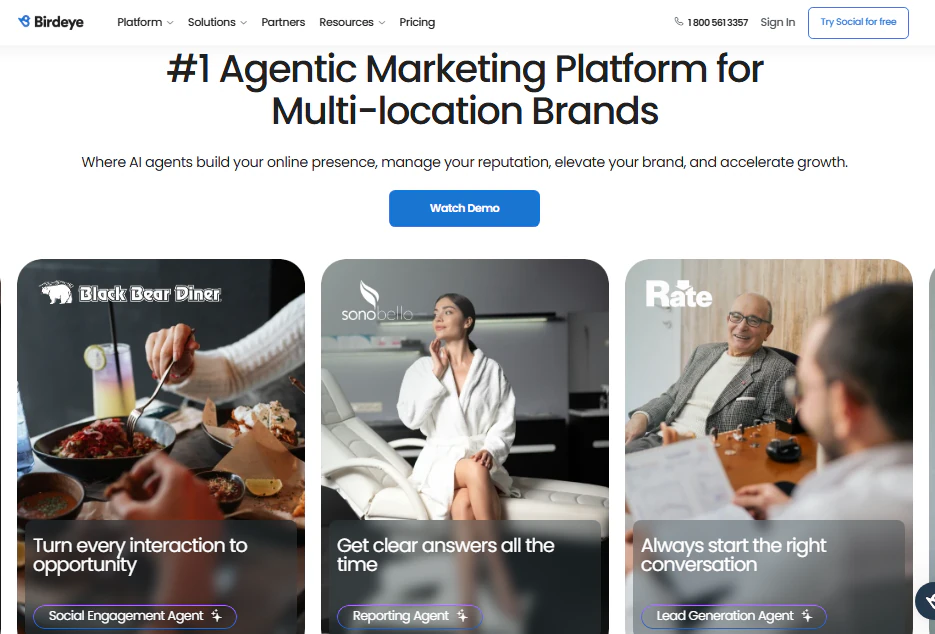
Birdeye may still be the right choice if your team uses several of its products. Its Review Response Agent can analyze a review, use business information to write a reply, and send it for approval. You can test a response and inspect how it was produced.
Its wider platform also covers review requests, listings, conversations, surveys, social posts and customer issues. Those tools matter if you need head office and local teams to work together, or want a complaint assigned to someone for follow-up.
- Keep Birdeye on your shortlist if your team uses several of its products and its integrations work well.
- Ask it to demonstrate the AI settings you already have before assuming you need a different product.
- Include the cost and effort of moving data, retraining staff and replacing other tools.
- Stay with it if the tools and contract suit your business better than the alternatives.
1. RightResponse AI: Our Top Pick for AI Review Responses, Feedback Analysis, and Google Maps Tracking
RightResponse AI brings four useful jobs together: replying to reviews, understanding customer feedback, comparing competitors and tracking Google Maps rankings. Pro and Pro+ include maps and competitor analysis alongside review management, with published prices per location.
Why RightResponse AI Is Our Top Pick
Your reply is read by more than the person who left the review. Future customers read it too. A reply that explains how your business works can help them decide whether to choose you. RightResponse AI lets you provide details for the whole company, a brand or an individual location, so the reply uses information that applies to that business.
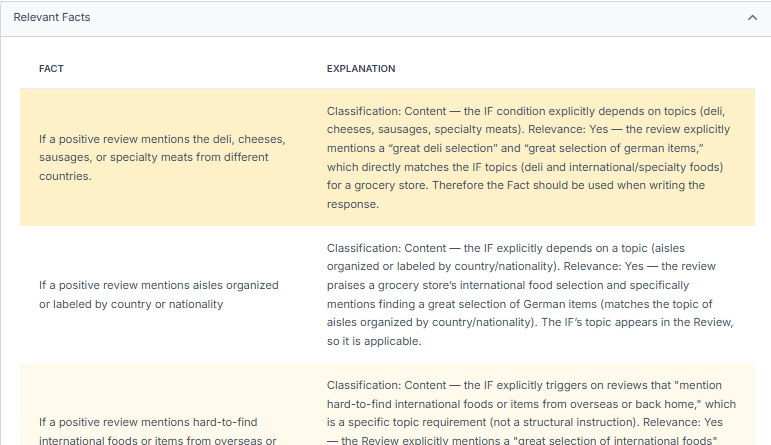
The AI responder reads the review, chooses relevant details from the information you have approved, writes a reply and checks it against your instructions. You can see which details it considered and used. If none would help, it can leave them out. You can then correct the business information or edit the response.
You also decide what gets published automatically and what needs approval. Set rules by star rating and whether the review contains text, choose a delay and publishing hours, and edit or hold a response. Direct publishing is supported for Google. Reviews from more than 100 sources can be monitored, but that does not mean replies can be posted directly to all of them.

What a More Useful Reply Looks Like
Suppose a customer writes: “Alex explained the brake repair clearly and had my car ready earlier than expected.” If your shop provides a digital inspection with photos, the AI can mention that in its reply: “We’re glad Alex made everything clear. Our inspection photos help you see what needs attention before you decide on a repair.” Future customers learn something about your service, rather than just seeing another thank-you.
That detail would not belong in every reply. A complaint about an incorrect bill needs an answer to the billing problem. The AI should use your business information when it helps the conversation, and leave it out when it does not. See more examples of how this works.
How Other Products Use Business Information
Birdeye’s Review Response Agent can check for spam, assess what the customer is saying and use business information to draft a reply. You can configure approvals and inspect test results. It is worth comparing if you want those controls alongside Birdeye’s other products.
Broadly’s AI Reputation Specialist also uses business information. Its knowledge base can draw from your website, documents and details you enter. The AI looks for information that may help answer the review. Ask Broadly to show what it used in a review reply; the explanation available for customer conversations may not be shown on review cards.
LocalClarity’s custom AI agents can use saved business background, instructions for different star ratings and information about individual locations. That gives the AI more to work with than a tone setting alone. You still need to keep the information current and choose how replies are reviewed and published.
Our preference is RightResponse AI because you can check which business details the AI selected for a reply, then use its other tools to understand reviews and compare locations. If you need more complex approvals across several marketing tools, Birdeye may fit better. Give each product the same reviews and business information when you compare them.
Find the Problems Behind the Ratings
A four-star review might praise the technician but complain about a long wait. RightResponse AI’s feedback analysis separates those comments so the overall rating does not hide the problem. You can choose the topics you care about, compare locations and time periods, and open the original reviews. You can also receive an alert about a negative comment on a topic, even when the star rating is positive.
Pro compares competitors’ review performance. Pro+ also analyzes what their customers praise and criticize, using the same topics you use for your business. That helps you ask more useful questions: do nearby competitors get fewer complaints about waiting, or more praise for explaining their work? Read the comments behind the comparison before deciding what to change.
The Map Rank Tracker shows where your business appears on Google Maps for a search such as “auto repair near me.” It checks points around your location, shows competing businesses and lets you compare earlier scans. That tells you where you are visible and where competitors appear ahead of you. It measures rankings; it does not tell you how many visits or sales came from a particular reply.
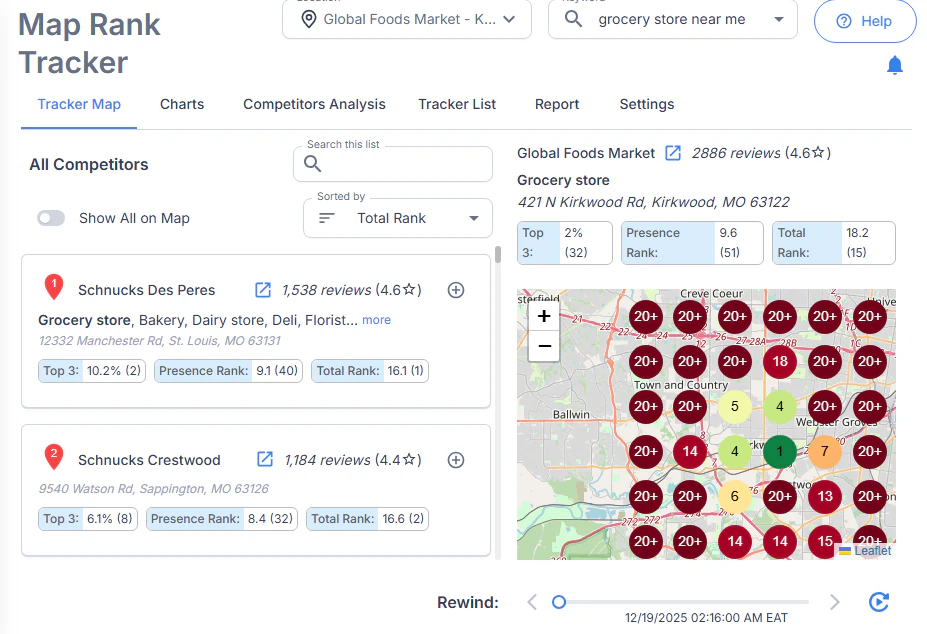
You can also send review requests using customer or job details from a Sheet, Zapier or manual entry. Depending on the plan, requests can use AI-written wording, photos, questions and reminders. Set sending hours and blackout periods, and make sure each customer is linked to the right location. Request-link clicks and QR scans show activity, rather than confirming that a review was posted.
Which RightResponse AI Plan Should You Choose?
On monthly billing, Core is USD $19, Pro is $29 and Pro+ is $44 per location per month. PAYGO starts at $10 per location per month, plus usage credits. It gives you access to most Pro features through those credits, so your total depends on how much you use.
| Plan | Review replies and requests | Maps and competitor analysis | Who it suits |
|---|---|---|---|
| Core — $19/location/month | 100 review responses and 1,000 email requests; request templates | Not included | Businesses that need review replies and requests without maps or competitor analysis |
| Pro — $29/location/month | 200 responses, 2,000 email requests and 200 SMS segments; AI-written requests | 10 combined map scans or competitor analyses per location/month | Our recommended starting point for reviews, feedback analysis and maps |
| Pro+ — $44/location/month | 500 responses, 5,000 email requests and 500 SMS segments; advanced automation | 25 combined scans or analyses per location/month; analysis of competitors’ customer feedback | Businesses that need higher limits, more automation or deeper competitor comparisons |
| PAYGO — $10/location/month base | Usage credits purchased separately; access to most Pro features | Map scans and competitor analyses use credits | Lighter or changing usage; budget for both the subscription and credits |
Monthly allowances are shared across your locations. Pro’s 10 and Pro+’s 25 cover map scans and competitor analyses together, rather than a separate allowance for each. Pro and Pro+ can buy additional packs. SMS registration and number charges are separate. Annual billing gives you twelve months for the price of ten monthly subscription payments; it does not discount those separate charges.
The seven-day trial includes 1,000 credits and most Pro features, with no card required. Free use ends if the credits run out before the seven days are up. Check the plans and limits against your expected review volume, requests, map scans and reporting needs.
RightResponse AI focuses on reviews. If you also need social publishing, broad listings distribution, payments or a shared inbox for every communication channel, plan for those separately. Ask for a demonstration of any staff permissions or approval arrangements your business requires.
2. Podium: Best for Customer Texting and Booking
Choose Podium if customer texting, lead follow-up and booking are your main priorities. Reviews are part of the same customer conversation.
Staff can send a review request after a sale or service, use saved wording and reminders, and continue the conversation in a shared inbox. That is useful when the same team handles inquiries, follows up and asks for feedback.
Podium’s AI review reply guide describes writing a suggested reply for a connected Google or Facebook review, which you can edit or regenerate before posting. Automatic replies can be limited to selected star ratings and include a signature. The guide dates from December 2024, so confirm the current controls in your demonstration.
Its AI Employee handles a different job: customer inquiries. You configure instructions and business information in AI Studio, assign locations, test conversations and decide when staff should take over. Ask Podium to show how that differs from its review replies; the information available to one feature may not feed the other.
Booking also depends on the product and integration. Automotive Service AI names scheduling through Xtime and Tekion, while its home-services system describes a dispatch board. Ask to see an appointment appear in the system your team actually uses.
Podium is worth paying for when missed inquiries and disconnected follow-up cost you business. If your inbox and booking tools already work, its wider platform may be more than you need for reviews. Test a difficult review and an unusual booking request to see when a person must step in.
Pricing, tradeoffs and what to verify
Pricing: Podium uses custom quotes for the products and locations you need. The total depends on AI Employee, phones, messaging volume, setup and integrations as well as the contract. Compare the cost of the tools Podium would replace, not just the review features.
The tradeoff: Podium earns its place when texting, lead follow-up and booking are the reason you are switching. If your inbox and scheduler already work, another communication suite adds tools you may not use.
What to verify: Have Podium demonstrate AI Employee and AI review replies separately, including the business information each uses. Then have it book an appointment in your actual scheduling system and show how a difficult review reaches a person. Put the included messaging volume, AI products and contract term in the quote.
3. SOCi: Best for Managing Marketing Across Many Locations
Choose SOCi if head office and local teams need to manage reviews, search and social media together.
SOCi gives central teams a way to set brand guidance and permissions while local managers handle their locations. Reviews, surveys, listings and social media sit within the wider system. The important question is whether local staff can do their work without sending every decision back to head office.
Genius Reputation writes replies using brand voice, keywords and rules for reviews that need a person’s attention. You can also set approval requirements.
Its customer feedback tools group similar comments, show customer quotes and compare locations and regions. That helps a regional manager spot a recurring service problem and read what people said. Check the examples behind a summary before acting on it.
SOCi also offers Shield to check content against configured policies and hold flagged content before publication. Ask which products it covers, what it costs and who reviews a flag. A policy check still needs human oversight.
SOCi makes sense when coordinating many teams, social calendars and listings is a major part of the job. Shared templates and permissions can reduce repeated setup. For a business mainly looking after reviews, the wider system may require more administration than it needs.
Pricing, tradeoffs and what to verify
Pricing: SOCi quotes the products, locations, users and implementation you need. A listings price is not a price for reviews, social and search together. Check the products and committed term in the order form, including rollout services and renewal pricing. See SOCi’s contract guidance.
The tradeoff: SOCi makes sense when central and local teams need one system for reviews, listings and social media. Shared guidance and permissions are useful when several teams need to coordinate. For a business mainly managing reviews, the added setup and administration may outweigh the value of replacing working social and listings tools.
What to verify: Have a local manager handle a review containing both praise and a complaint. Have a regional manager open the customer comments behind a reported trend. The demonstration should show who can reply, who must approve and which products your quote includes.
4. NiceJob: Best for Review and Referral Automation
Choose NiceJob if you want more reviews, customer referrals and ways to show those reviews on your website.
NiceJob uses connected customer or job details to send review invitations and reminders. You can edit the steps, timing and tags that control a campaign. A CompanyCam job photo can make the request feel familiar to the customer.
Its AI Reply feature writes an editable Google reply using your tone, voice and length settings. Pro can post replies automatically for selected ratings. It processes these once a day around 6 p.m. Eastern, using the previous 24 hours of reviews. Older reviews and ratings outside your settings still need attention. Ask how it handles a serious complaint inside a high-star review.
Topic Insights groups comments by experience, separates praise from complaints and lets you open example reviews. You can compare time periods, locations and staff. The linked guide dates from May 2021; ask to see the current version and available settings.
Pro also compares local competitors. You can select three suggested businesses or provide their Google Maps links, then compare Google ratings, review activity and topics. The help guide requires a public business address. Choose competitors that serve similar customers, rather than accepting every suggested match.
NiceJob is a good option for owners who want review requests, reminders, website review displays and referral tools working together. If you want the AI to use specific details about your business in replies, ask it to demonstrate that with your own examples. Compare the analysis and map tracking you need as well.
Pricing, tradeoffs and what to verify
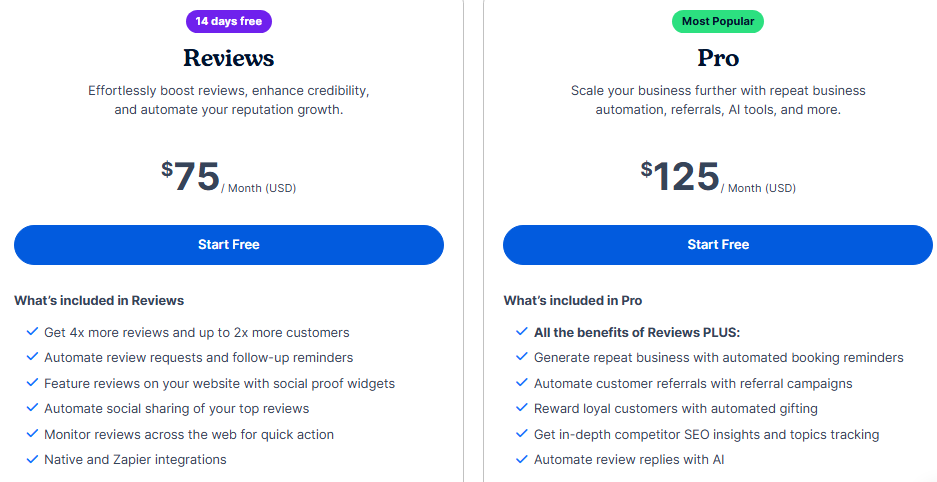
Pricing: Starter costs US$75/month and Pro US$125/month, with a 14-day trial and advertised no-contract terms. The website service is separate. Get the number of locations and included AI and analysis features stated in the offer. The screenshot above uses the former Reviews plan name; the current entry plan is Starter.
The tradeoff: NiceJob is a good choice when review requests, referrals and displaying customer reviews on your website are the main jobs. Its documented automatic AI reply mode runs once a day, so consider that timing if you want to respond throughout the day.
What to verify: Test a high-star review that contains a serious complaint, not only straightforward praise. Have NiceJob show how the reply can be held for a person, which business details guide it and which reports are included for your locations.
5. Broadly: Best for Combining Several Business Tools
Choose Broadly if you want reviews, a receptionist, messages, a website, listings and social media in one package.
Broadly is aimed at local businesses whose owners are juggling several jobs and tools. Calls, messages, customer follow-up and reviews can use shared business information. The value depends on how many of those jobs you need it to handle.
The Premium AI Reputation Specialist requires you to assign business information before turning on automatic replies. You set the instructions, review platform, star ratings and delay. The guide lists Google Business Profile and Facebook recommendations as direct automatic destinations. Check that your proposed package includes this version.
Its knowledge base can use business profile details, website pages, uploaded documents and information you enter. The AI looks for passages that may help answer a review. You can assign different sources to different AI assistants and give instructions that take priority over reference material.
That is useful if you already have clear FAQs and policies, but someone must keep them current. Test a complaint and ask to see which information the reply used. Broadly documents an explanation feature for conversations; ask whether review replies show the same information. The guide also says it updates drafts after a review changes only if the reply has not yet been published.
Broadly is worth considering when you need its calling and lead-handling tools as well as review management. If those jobs are already covered, compare its review-only offer with a dedicated review platform.
Pricing, tradeoffs and what to verify
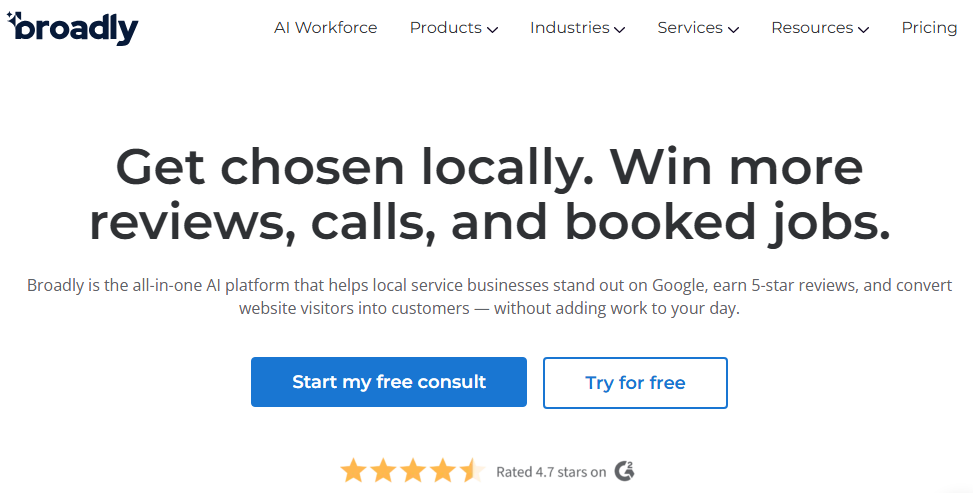
Pricing: Broadly advertises its AI Workforce bundle at $799/month without a long-term contract. That is a bundle price, not a standalone review-management price. The other pricing cards describe different offers. For a reviews-only purchase, get a separate written price for Reputation AI and the Premium specialist version, with locations, setup and usage included.
The tradeoff: The bundle can earn its price if you need a receptionist, website, messages, listings and social media as well as reviews. If those tools already work, $799/month is harder to justify for reviews alone.
What to verify: Have Broadly generate a review reply using a policy from your website or documents. Check whether the review card shows which information it used. Confirm that your quoted package includes the Premium specialist and automatic replies for the review sites you need; those capabilities should not be inferred from the bundle name.
6. ReviewFlowz: Best for Connecting Reviews to Your Team’s Tools
Choose ReviewFlowz if you want review alerts, replies and reports to fit the tools your team already uses.
ReviewFlowz’s AI reply system learns from your published review replies. It finds similar examples by brand, rating, language and the type of review, favoring replies written by people. It uses those examples and your instructions to draft a response. That can help it sound like your team, but old replies are not necessarily a reliable guide to current services or policies.
Rules decide which replies to post, hold or ignore. You can match locations, platforms, ratings and whether a review includes text. The first matching rule wins, so put exceptions before broad rules. Held reviews get an editable draft for approval.
Premium’s review analysis finds topics and subtopics, separates positive and negative comments and shows the phrases behind the result. You can also create your own labels for filters, alerts or review displays. Ask how much control you have over analysis topics, especially if you want the same categories applied to competitors.
Review requests can be triggered by an event and sent by email, SMS or WhatsApp. You can change the destination behind a link without reprinting it, and connect review data to other tools through the API and reports on the appropriate plan. A tracked click tells you someone opened the link; it does not confirm they left a review.
ReviewFlowz is especially interesting if you have a library of good replies and want flexible rules and integrations. Check old examples for outdated information before using them to guide new responses. Compare that approach with giving the AI a current set of business details you have approved.
Pricing, tradeoffs and what to verify
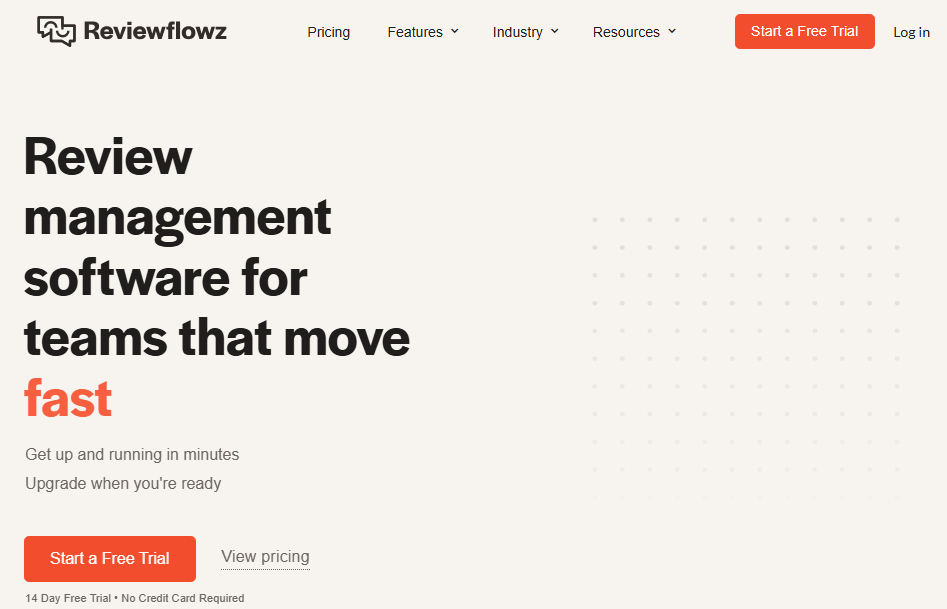
Pricing: Pro and Premium cost $50 and $80 per location/month on monthly billing, or $45 and $70 per month equivalent with annual billing. Invitations are extra: $5 per 1,000 emails and $5 per 100 SMS; Meta bills WhatsApp separately. Unlimited AI reply generation does not make invitation delivery unlimited. Budget for both the subscription and the requests you will send.
The tradeoff: ReviewFlowz is a good fit when you want replies modeled on your team’s earlier responses and review data connected to other tools. That can help replies sound like your team, but past replies need to be accurate and current. Check older examples for policies or services that have changed before relying on them to guide new responses.
What to verify: Have ReviewFlowz show which publishing rule handles a review containing both praise and a complaint. The first matching rule wins. Demonstrate the reports, analysis and API access in the quoted plan, and calculate invitation charges at your expected volume. Premium’s analysis should be part of the demonstration if customer topics are why you are buying.
7. GatherUp: Best for Review Requests, Surveys and Agencies
Choose GatherUp if you want public reviews, private feedback and customer surveys in one program. Agencies can also use it to serve clients.
GatherUp sends requests from imported or connected customer records. You choose a location, branded wording, reminders and daily sending limits. API, Zapier and webhooks can bring customer details into the system. Records enter a queue, so check when requests will go out rather than assuming an import sends them immediately.
GatherUp can generate replies using your brand instructions or choose a complete saved response. AutoReply selects saved wording based on the review’s content and sentiment. The 2024 release notes describe custom instructions and a library of up to 50 complete responses.
Smart Insights brings public reviews and private feedback together, groups praise and complaints, and shows the reviews behind each theme. Its April 2025 guide describes weekly updates, normally after ten new reviews, plus saved report history. Confirm current availability. Private feedback and surveys can reveal issues customers never mention in public.
The competitor report compares review volume, ratings and recency. Do not assume it applies the same detailed feedback analysis to competitors. Review Defense is a separate add-on that flags suspicious Google-review patterns and helps with disputes. Google still decides whether to remove a review.
GatherUp is a useful choice for a business or agency that needs branded requests, public and private feedback, and client reports. Ask to see the AI reply options, how often reports update and how clients access their accounts. If competitor feedback analysis and maps are priorities, compare those separately.
Pricing, tradeoffs and what to verify
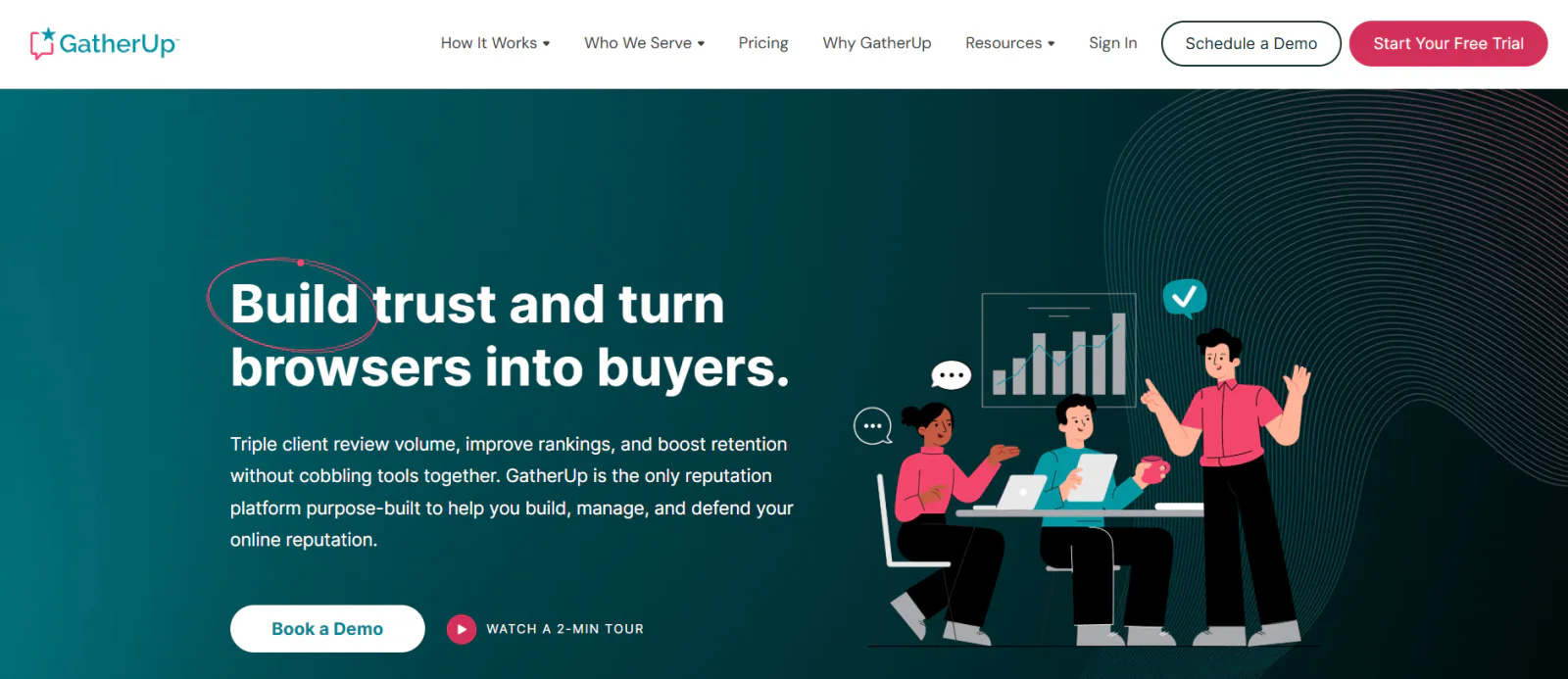
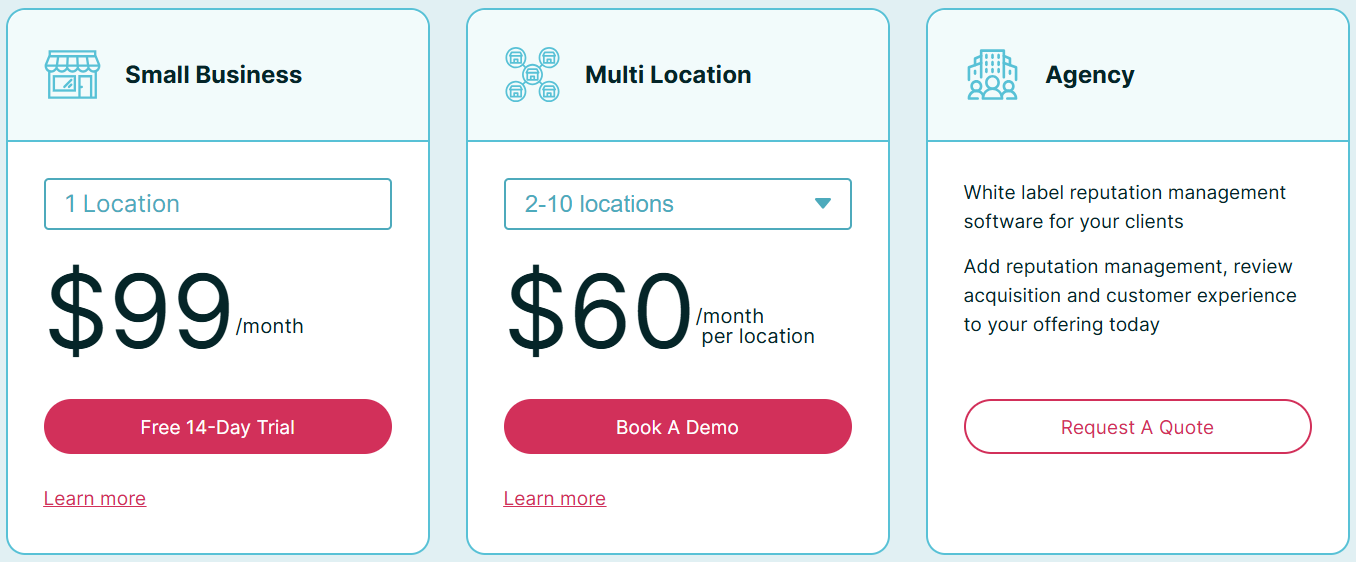
Pricing: GatherUp costs $124/month for one location or $75 per location/month for 2–10 locations on monthly billing. Annual billing works out to $99 for one location or $60 per location/month for 2–10, with the annual commitment. Both billing settings were checked October 12, 2026. The plans list up to 300 SMS and 3,000 email credits per location/month and a 14-day trial. Listings Hub, Review Defense and agency arrangements are separate; do not apply another annual discount to the annual figures.
The tradeoff: GatherUp is a strong candidate for branded review requests, private feedback, surveys and agency client reports. Its documented competitor report compares review volume, ratings and recency. Comparing what rivals’ customers praise and complain about is a different job. If competitor feedback themes or map rankings drive the switch, confirm those separately rather than assuming they are part of the same report.
What to verify: Have GatherUp show generated replies separately from AutoReply’s complete saved responses. See how often Smart Insights updates at your review volume and open the comments behind a theme. Agencies should also see the actual client access and branding included in their quote.
8. Reputation.com: Best for Tracking and Resolving Customer Issues
Choose Reputation.com if you need to turn feedback from many locations into work that someone owns and follows through.
Its review-request integrations include checks for customer details, locations, exclusions and timing. You can preview imported data and run a test without sending. A history of skipped records helps staff find out why a request did not go out or went to the wrong location.
Voice of Brand uses instructions, keywords, business messages and personality settings for each location. The Insights guide describes testing replies and checking finished wording against brand guidance. Staff can override a warning and publish anyway, so the check does not replace reviewing promises or remedies offered to a customer.
The Reviews guide distinguishes a reply awaiting approval from one submitted, published or failed. This helps staff see whether a response is actually live. Ask which AI replies and saved responses can be published automatically in your plan.
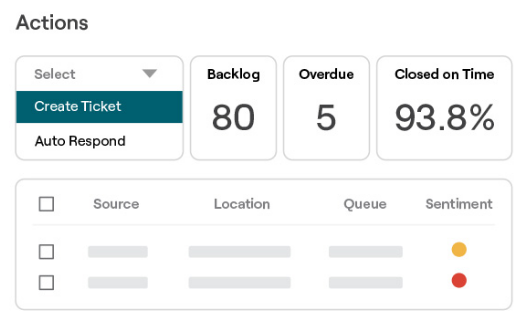
The analysis tools compare customer experiences across topics and locations, with comments you can read to understand the results. Actions & Ticketing can assign follow-up work and escalate issues when included in your package. That is useful if identifying a recurring complaint is only the first step and managers also need to track its resolution.
Reputation.com is worth considering when your team needs detailed feedback reports, integrated requests and accountable follow-up across many locations. Someone still needs to manage the setup, and your quote should spell out the products required for the whole process.
Pricing, tradeoffs and what to verify
Pricing: Published packages cost $80 for Rep Core, $115 for Core + Pulse and $150 for Core + Surveys per location/month. Enterprise pricing is custom for 125+ locations. Several capabilities depend on the products purchased. The order should explicitly include the analysis, competitor reports, Actions & Ticketing, integrations and implementation you need, especially where an overview and detailed plan description differ.
The tradeoff: Reputation.com earns its place when managers must assign customer issues, escalate them and track resolution across locations, alongside surveys and broader reporting. Buying analysis alone does not supply that whole process. The broader platform pays off when your team needs that follow-through. For review replies alone, the additional products and implementation can be more than the job requires.
What to verify: Follow a complaint from its review to an assigned owner and a resolved ticket in the proposed package. Then show the difference between a reply awaiting approval, one submitted and one actually published. This verifies the two things you are paying the wider platform to do: follow through on issues and complete the public response.
9. ReviewTrackers: Best for Monitoring Reviews Across Locations
Choose ReviewTrackers if you need one place to monitor reviews, compare locations and understand customer experiences.
ReviewTrackers organizes reviews by location and group, sends alerts and exports review data. Its request tool uses customer records, a location identifier, a template and your selected channel. Check location identifiers carefully when importing multiple branches. An email reminder can follow an invitation whose link was not clicked; a click does not confirm a completed review.
Its AI Responder offers suggested replies you can edit or regenerate. Administrators can also set instructions for automatic replies by review type, rating, language and location, then preview examples. Ask it to demonstrate both written reviews and star-only ratings, because the available options differ between manual replies and automation.
You can put business guidance into those instructions. Ask how the AI chooses what to include in a particular reply and whether you can inspect that choice. Test a review that contains both praise and a complaint, and check how staff can intervene before an unsuitable response is posted.
Experience Analysis groups feedback into industry categories, separates positive and negative phrases, and lets you read the contributing reviews. Competitor Insights compares selected businesses and customer experiences. Check which sources are covered for monitoring, competitors and direct replies; those lists can differ.
ReviewTrackers is useful for managers who want consistent reports across locations. Test whether its categories reflect your business and whether staff can easily read the reviews behind a trend. If you need custom topics or more control over the business information used in replies, include those in the demonstration.

Pricing, tradeoffs and what to verify
Pricing: ReviewTrackers uses a location-based quote. Get the rate, any location minimum, billing term and required competitor features in writing. Listings and local search rank tracking are add-ons, so their cost belongs in the total when local visibility is part of your Birdeye replacement.
The tradeoff: ReviewTrackers suits managers who need broad review monitoring and consistent reports across locations. Its industry categories and saved AI instructions can be useful, but category fit matters: a tidy dashboard will not explain a service problem if the topics miss what your customers discuss.
What to verify: Use your reviews to test the categories and open the comments behind a trend. Demonstrate both written reviews and star-only ratings in automatic mode. Check coverage separately for monitoring, competitor reports and direct replies; support for a site in one list does not establish support in all three.
10. Yext: Best for Listings and Digital Presence Management
Choose Yext if keeping business details accurate across listings and location pages is a major part of the job.
Yext maintains information such as hours, contact details and services across publishers. That can save repeated updates when you manage many locations. It can also use those stored details in review replies, but listings management is a large part of why businesses buy the platform.
Its AI review response guide describes account instructions, location details and example review replies. For instance, a reply to a complaint can include that location’s support email. You can test different reviews and languages and regenerate the response before using it.
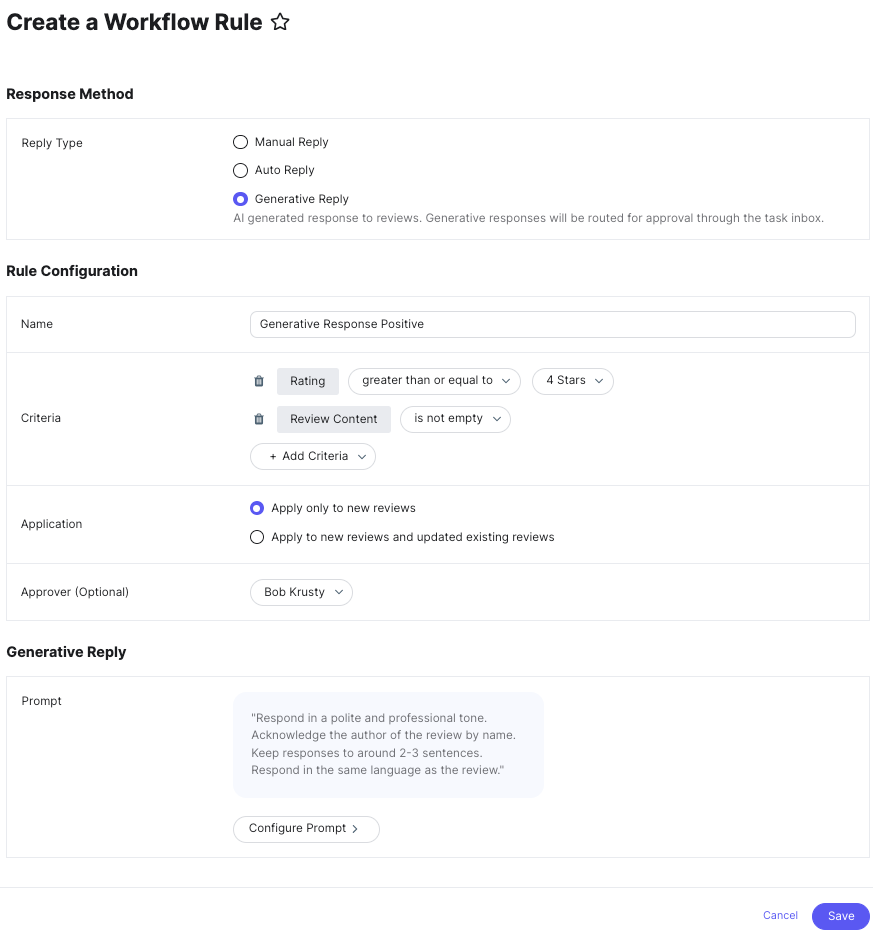
Rules can send a review to a person, post saved wording or generate a reply with automatic or human approval. Financial-adviser firms can add Hearsay Compliance checks and supervision when the integration is enabled. Confirm that separately from standard Reviews features.
Reviews Insights lets you create up to 30 topics, such as waiting times or staff helpfulness. It analyzes the previous 90 days and new reviews, then shows summaries and excerpts from the comments. Custom topics support all languages; prebuilt topics and AI summaries have more limited English coverage.
Yext makes sense when listings, location pages and centrally managed business information are priorities. If you mainly need reviews, compare the cost and setup with a dedicated platform. Ask how its review tools use your business details and handle approvals.
Pricing, tradeoffs and what to verify
Pricing: A Yext Reviews quote should separate Reviews from listings, location pages and other products, and include locations, users, setup, usage and renewal. Review generation may require an additional license. Price the products you will use rather than treating a listings proposal as a complete reviews package.
The tradeoff: Yext is a strong choice when keeping location information accurate across publishers and local pages is the central problem. That wider platform is harder to justify if your listings are already managed and you mainly need better review replies.
What to verify: Generate replies for two locations with different contact details and confirm each uses the correct support information. Demonstrate direct replies on the review sites your team uses, not just monitoring. If you work in several languages, test the Reviews Insights topics and summaries in those languages as well as the replies.
11. BrightLocal: Best for Local SEO and Agency Reporting
Choose BrightLocal if you manage local search rankings, business listings and reports for your business or agency clients.
BrightLocal checks where businesses appear in local searches and Maps. You choose the search term and area to scan, then compare visibility with nearby competitors. Audits and citation services help you investigate other parts of local search. Keep scan settings consistent when comparing dates, and remember that rankings alone do not tell you which change brought in a customer.
Reputation Manager, included in Grow, adds review requests, monitoring and client access. In Manage Reviews, staff can filter by location and status, use saved replies and edit AI suggestions. Connected Google and Facebook accounts support direct replies where available; other sites may require opening the review on the publisher’s website.
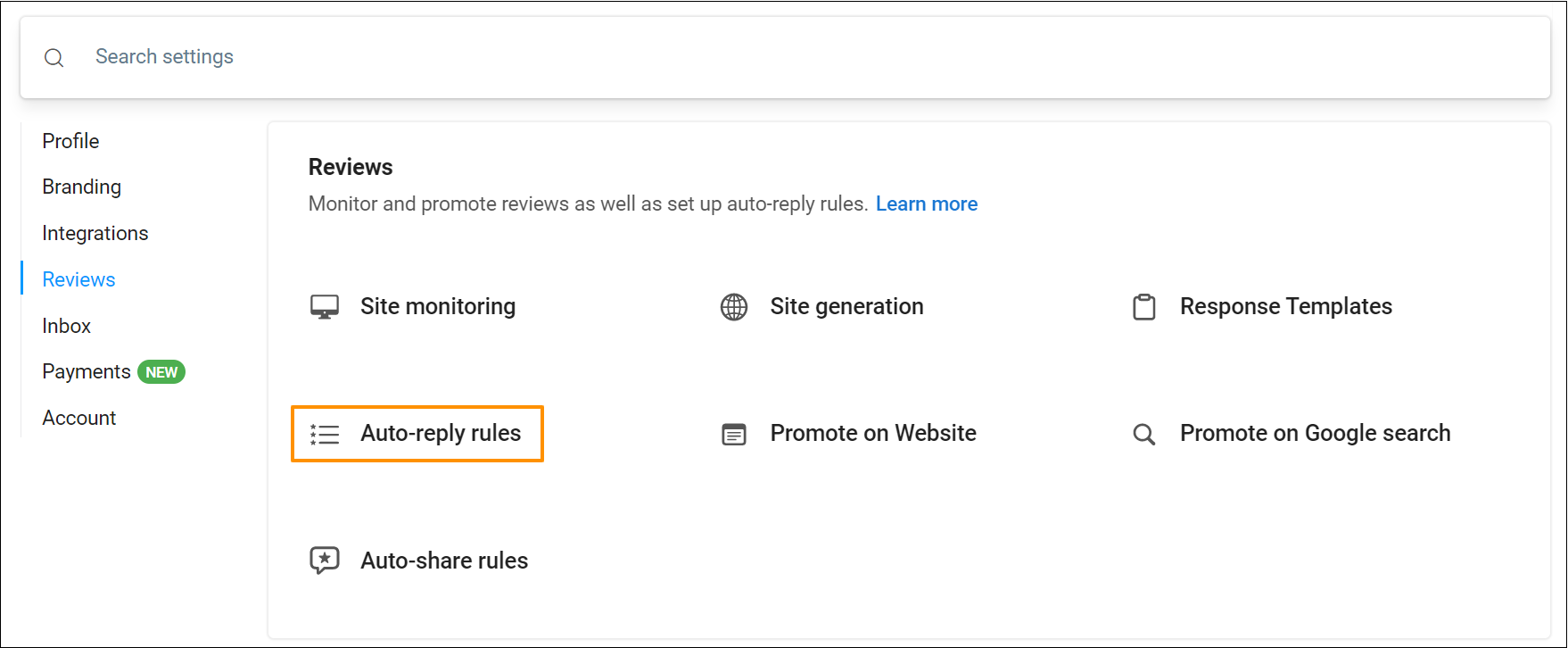
Auto-Replies is a separate feature that chooses complete saved responses using location, rating, text presence and delay rules. Its guide lists Google, while the broader review guide also mentions Facebook. Confirm which applies to your account. A rule that checks for written text will not, by itself, recognize a serious complaint inside that text.
Request campaigns can use email, SMS, links and kiosks, with your wording and reminders. Clients can work within the settings you provide. The documented QR option uses a review link and an external QR generator. SMS and citation credits are purchased separately.
BrightLocal is a strong option for an SEO team or agency that wants review tools alongside rankings and client reports. If writing more useful replies and analyzing customer feedback are your main priorities, compare those features with a dedicated review platform as well.
Pricing, tradeoffs and what to verify
Pricing: One-location monthly plans cost US$41 for Track, $54 for Manage and $65 for Grow. Reputation management is included in Grow, not Track or Manage. Grow costs $584 when billed annually. Multi-location prices are bundles: the location pricing guide lists Grow for 11–20 locations at $197/month in total, not $197 per location or $65 multiplied by every branch. SMS and citation credits cost extra. The trial is 14 days.
The tradeoff: BrightLocal is a strong choice for local SEO teams and agencies that need rankings, listings, audits and client reports alongside reviews. Its automatic replies choose complete saved responses; staff can separately edit AI suggestions. Choose BrightLocal when its wider SEO and agency work is what you need to buy.
What to verify: Demonstrate automatic saved replies separately from editable AI suggestions, including which review sites each can publish to. Price the correct active-location bundle with the scan limits, SMS volume and citation work your clients need. The one-location price is not the right way to estimate a multi-location bill.
Free Option: Google Business Profile
If you only need to manage a small number of Google reviews, Google Business Profile may be enough. Verified businesses can read and reply to reviews and share a review link for free. Google’s guide explains how.
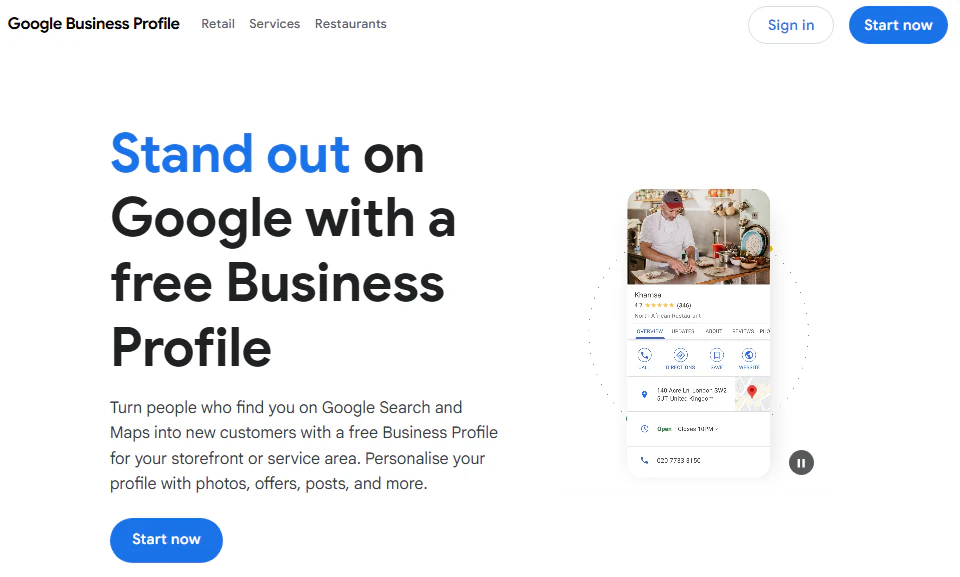
A paid platform becomes more useful when you need to handle several review sites, work as a team, understand recurring feedback or track Maps rankings over time. Google Business Profile covers the Google channel; it will not replace Birdeye’s other marketing and communication tools.
Which Birdeye Alternatives Should You Consider?
Start with the job you want to make easier. Add another product to your shortlist if you also need its particular strengths.
| You need | Consider | Why |
|---|---|---|
| Useful AI review replies, customer feedback analysis and Google Maps tracking | RightResponse AI | Uses relevant business details in replies, helps explain customer feedback and includes maps on Pro and Pro+ |
| Customer texting and booking | Podium | Keeps reviews alongside customer conversations and follow-up |
| Marketing across many locations | SOCi | Brings local search, social media and reviews together for central and local teams |
| Customer feedback and assigned follow-up work | Reputation.com | Combines analysis and surveys, with Actions & Ticketing available for follow-up |
| Accurate listings and location information | Yext | Maintains business information across publishers, with review management alongside it |
| Local search rankings and agency reports | BrightLocal | Combines rank tracking, business listing work, audits and review tools |
| Review requests, referrals or customer surveys | NiceJob or GatherUp | NiceJob focuses on review and referral automation; GatherUp combines reviews, private feedback and agency services |
| Connections to team tools and flexible reports | ReviewFlowz | Offers review integrations, reports and API access on the appropriate plan |
| Review monitoring across sources and locations | ReviewTrackers | Organizes reviews and customer feedback into location and group reports |
| Several local business tools in one package | Broadly | Bundles reviews with calls, messages, listings, social media and a website |
If you use several Birdeye products, compare the cost of replacing all of them. A dedicated review platform can be the better choice while leaving you with other tools to keep or replace.
Try the Software Before You Switch
Use a trial or demo to see how each product handles your actual reviews and daily work. Give every vendor the same examples so you can compare the results.
- If you have multiple locations, test different branches. Try a busy branch as well as a quieter one, with examples of the issues each receives.
- Use a mix of reviews. Include praise, complaints, ratings without text and a review that contains both positive and negative comments. Remove private information before sharing examples.
- Give the AI useful business details. Include services, policies and contact information you have checked. See what it uses, what it leaves out and how much editing the reply needs.
- Send a test review request. Check the wording, channel, reminders and customer information. Make sure customers can leave a public review regardless of whether their feedback is positive or negative.
- Read the reviews behind a report. Check whether the summary reflects what customers said and whether it helps you decide what to do next.
- Compare Maps scans fairly. Use the same location or locations, search terms, area and dates. Check both your rankings and nearby competitors, and note how much of the plan’s allowance each scan uses.
- Measure the work it saves. Track staff time, reply edits, turnaround and extra usage costs. A longer feature list is not necessarily a better tool for your team.
Decide what a successful trial would look like before you start. At the end, you should know whether the product handles your important tasks, what still needs a person and what it will cost to keep using.
Compare RightResponse AI plans and start a trial. You get seven days, 1,000 credits and most Pro features without providing a card. Free use ends if you exhaust the credits. Try it with your reviews and business details to see whether it saves your team work and produces replies you would be happy to publish.
Questions to Ask Before Switching from Birdeye
Before signing, make sure you can answer these questions:
- What is the full price? Ask for first-year and renewal costs, including setup, usage, messaging, support and any tools you will keep.
- How long is the contract? Check renewal, cancellation notice and the cost of adding or removing locations. Separate the contract length from how often you receive an invoice.
- What data can you keep? Confirm how to export reviews, replies, contacts, reports and templates before disconnecting Birdeye.
- Who checks AI replies? Test business information, editing, approvals and automatic publishing with your own examples.
- Who follows up on complaints? Decide who receives alerts, owns the issue and tracks progress. Include any ticketing tool or integration in the price.
- What can local staff do? Check access to business details, replies and approvals. If you have multiple locations, also check access to each one; support for many locations does not tell you how permissions work.
- Will it connect to your tools? Confirm the review sites, customer system, request channels and reports your team uses.
- How much map tracking is included? Check search terms, scan area, frequency, shared allowances and extra charges.
How to Switch from Birdeye
Move carefully enough that reviews and requests keep working during the change. If you have multiple locations, start with a small group before switching everyone.
- Put someone in charge. List your location or locations, people, tools and integrations you are moving, keeping or stopping.
- Save your data. Export available reviews, replies, contacts, reports, templates and survey results. Open the files to make sure they are usable.
- Set up the new account. Add your location or locations and users, check permissions, enter your business information and choose reply and approval settings. Decide who handles exceptions.
- Connect and test. Link the review sites and customer systems, then check incoming reviews and outgoing requests with a small test.
- Avoid duplicate requests. Pause the old campaigns and reminders before enabling replacements. If you have multiple locations, move them in groups you can check.
- Check the daily work. Confirm that reviews arrive, replies can be approved and published, alerts go to the right people, and reports and local access work.
- Train staff, then close the old account. Explain what each person needs to do and where to get help. Cancel Birdeye only after the replacement works and you have met the contract’s notice requirements.
More About Birdeye
For a closer look at Birdeye or a particular comparison:
- Birdeye review: features, strengths and limitations
- Birdeye pricing analysis
- Birdeye vs. NiceJob
- Birdeye vs. Yext
- Birdeye vs. BrightLocal
- Birdeye vs. Synup
- Birdeye vs. Uberall
How We Compared the Products
We publish RightResponse AI, so our recommendation includes our own product. We compared product information, help guides, pricing and contract terms, focusing on what each tool helps a business do. We have not run a controlled hands-on test of all eleven products. We identify older guides and screenshots rather than treating them as current evidence.
Our Recommendation
Start with RightResponse AI if your main priorities are AI review replies, customer feedback analysis and Google Maps tracking. It can write replies using relevant details about your business, show what customers praise and complain about, compare nearby competitors and track where you appear on Google Maps.
Pro at $29 per location/month is our recommended starting point for that combination. Pro+ at $44 adds higher limits, advanced automation and deeper analysis of competitors’ reviews. Core at $19 leaves out maps and competitor analysis; PAYGO starts at $10 plus usage credits. Check your expected volume and any extra SMS or usage charges before choosing.
Choose another product when its strengths match a bigger need: Podium for texting and booking, SOCi for marketing across many locations, Reputation.com for tracking customer issues, Yext for listings, or BrightLocal for local SEO. Staying with Birdeye may also make sense if you use its wider platform and it works well for your team.
Frequently Asked Questions
What is the best Birdeye alternative for review management?
RightResponse AI is our top pick when your main priorities are AI review replies using approved business details, customer feedback analysis, and Google Maps rank tracking. Pro is $29 per location per month and Pro+ is $44; Core is $19 without maps or competitor analysis, and PAYGO starts at $10 per location per month plus usage credits. Other alternatives may fit better: Podium for customer texting and booking, NiceJob for review and referral automation, GatherUp for private feedback and surveys, SOCi for multi-location marketing, Reputation.com for tracking customer issues, Yext for business listings, BrightLocal for local SEO reporting, ReviewFlowz for connecting reviews to team tools, ReviewTrackers for multi-location review monitoring, and Broadly for bundled local business tools.
Which Birdeye alternative is best for small businesses?
We recommend starting with RightResponse AI if you want to improve review replies, requests and feedback analysis. Pro costs $29 per location/month and includes maps and competitor comparisons; Core is $19 without those features, and PAYGO starts at $10 plus credits. Compare NiceJob for review requests and referrals, or Broadly if you need several business tools in one package.
Which Birdeye alternative is best for multi-location businesses?
RightResponse AI is our first choice when AI review replies, customer feedback analysis and Google Maps tracking are the priorities. You can provide business information for different brands and locations, compare feedback and track maps. Monthly allowances are shared across locations; Pro+ adds deeper competitor feedback analysis. If you also need central control of listings, social media or assigned customer issues, compare SOCi, Yext and Reputation.com. Test staff permissions before buying.
How much does RightResponse AI cost compared with Birdeye?
RightResponse AI’s monthly subscriptions are USD $19 for Core, $29 for Pro and $44 for Pro+ per location. PAYGO starts at $10 per location/month plus usage credits. Core excludes maps and competitor analysis. Pro includes 10 combined map scans/competitor analyses per location/month and Pro+ includes 25. Additional usage and SMS fees can apply. Birdeye provides a custom quote, so compare the total for the same locations and features before estimating savings.
Do Birdeye alternatives offer AI review responses?
Yes, but they work differently. RightResponse AI uses relevant business information you have approved. Birdeye and Broadly also support business information in replies. ReviewFlowz uses examples of your earlier responses, while other tools use instructions, tone settings or complete saved replies. Give each product the same reviews and ask it to show what information it used and how a person can check the result.
Can a Birdeye alternative track Google Maps rankings?
Yes. RightResponse AI shows where you and nearby competitors appear for searches at points around a location. You can compare scans over time. Pro and Pro+ include combined allowances for maps and competitor analysis; Core excludes them, and PAYGO uses credits. BrightLocal also offers local search tracking. Compare the search terms, scan area and frequency included in each plan.
Can Google Business Profile replace Birdeye for free?
It may be enough if you only need to read and reply to a manageable number of Google reviews and share a review link. It will not replace a platform that handles several review sites, detailed feedback analysis, recurring Maps scans or Birdeye’s other marketing tools.
How should a business switch from Birdeye?
Check your contract and save the data you can export. Set up your location or locations, staff, business information and reply settings in the new product, then test the setup. If you have multiple locations, start with a small group. Pause old review-request campaigns and reminders before turning on replacements. Confirm reviews, approvals, publishing, alerts and reports work, train staff, and meet Birdeye’s cancellation notice requirements before closing the account.
Sources by Company
Key sources for the comparison. The product sections link to more detailed guides.
- RightResponse AI: AI review responder; pricing.
- Birdeye: Review Response Agent guide; pricing explanation.
- Podium: Reviews product; AI Studio guide.
- SOCi: Genius Reputation; contract FAQs.
- NiceJob: pricing; AI review replies guide.
- Broadly: AI Workforce pricing; AI Reputation Specialist documentation.
- ReviewFlowz: pricing; AI review replies guide.
- GatherUp: pricing; Smart Insights guide.
- Reputation.com: pricing; Insights user guide (PDF).
- ReviewTrackers: plans; Experience Analysis guide.
- Yext: Reviews product; Reviews Insights guide.
- BrightLocal: pricing; Manage Reviews guide.