Choosing between Birdeye vs NiceJob for your reputation management needs often comes down to these five critical questions:
Comparison research: This article is part of the RightResponse AI review management software comparison library, which connects platform reviews, pricing analyses, alternatives, and head-to-head evaluations.
- Do you need an all-in-one platform with AI agents that automate everything, or would a simpler, focused tool serve you better?
- Is your business a multi-location enterprise requiring centralized control, or a single-location service business looking for ease of use?
- How important is deep Voice of the Customer versus straightforward review collection?
- Are you willing to pay premium pricing for comprehensive features, or do you prefer transparent, usage-based billing?
- Do you need advanced competitor analysis and Google Maps rank monitoring, or is basic review management sufficient?
In short, here's what we recommend:
👉 Birdeye is the enterprise-grade powerhouse for multi-location businesses seeking comprehensive customer experience management. With its AI-powered platform monitoring over 200 review sites, automated review responses, listings management, social media tools, and unified messaging inbox, Birdeye provides a broad solution for managing customer experience at scale. The platform does much more than reputation management; social media, text messaging, webchat, payments, surveys, and listings management are all part of the suite. However, this comprehensiveness comes with premium pricing, reports of rigid contracts that some users have found difficult to cancel, and a feature set that may overwhelm businesses primarily focused on review quality.
👉 NiceJob excels as a straightforward, user-friendly review generation tool built for small to medium-sized service businesses. Its automated review request campaigns, social proof widgets, and simple referral program make it easy to collect more reviews without technical expertise. While NiceJob's ease of use and no-contract flexibility are appealing, the platform's focus on review collection means response capabilities, while improved with AI, remain secondary. Businesses wanting advanced analysis or response personalization may find the platform limiting.
Both platforms have established themselves in the reputation management space, but they represent different eras of software design. Birdeye offers breadth at premium prices, while NiceJob offers simplicity with limitations on depth. For businesses seeking the best of both worlds, there's a third option worth considering.
👉 RightResponse AI represents the next generation of reputation management, built from the ground up with generative AI at its core. Unlike platforms that bolted AI onto existing infrastructure, RightResponse AI treats the review response as a conversion asset, not a chore. The platform's three-pillar personalization system (Facts for what to say, Customizations for how responses behave, and Brand Voice for tone and style) delivers hyper-personalized, brand-aligned responses with endless variation while maintaining control. With flexible pricing plans starting at just $10 per location per month, a powerful review request capability, Google Maps rank tracking, and comprehensive Voice of the Customer, it serves location-based businesses of all sizes, from single locations to enterprise.
People read reviews more than they read a business's website, and the response is the only part you control. If you're looking for advanced AI capabilities that turn responses into opportunities to win the next customer, see how RightResponse AI can transform your reputation management with a 7-day free trial.
Table of contents:
- Birdeye vs NiceJob vs RightResponse AI at a glance
- The fundamental divide: All-in-one platform vs focused tool vs AI-native solution
- Review generation approaches reveal different philosophies
- AI capabilities show where innovation truly lives
- Voice of the Customer: From basic scores to actionable insights
- Competitor analysis separates the serious from the simple
- Pricing transparency varies dramatically
- Multi-location management capabilities differ significantly
- Birdeye vs NiceJob vs RightResponse AI: Which should you choose?
Birdeye vs NiceJob vs RightResponse AI at a glance
Here's the fundamental difference: While all three platforms help businesses manage their online reputation, they represent three distinct approaches to the challenge:
- Birdeye functions as an enterprise-grade, all-in-one customer experience platform with AI agents across reviews, listings, social, messaging, and more
- NiceJob serves as a streamlined review generation tool optimized for simplicity and ease of use
- RightResponse AI delivers AI-native reputation management with sophisticated response personalization and transparent pricing
Birdeye | NiceJob | RightResponse AI | |
|---|---|---|---|
Primary focus | All-in-one customer experience | Review generation and social proof | AI-powered response quality and reputation intelligence |
Best for | Multi-location enterprises seeking consolidation | Small service businesses seeking simplicity | Businesses prioritizing response quality, from single location to enterprise |
Starting price | Quote-based (premium) | $75/month | $10/mo per location + credits (PAYGO), or fixed plans from $19/mo |
Free trial | Free trials available (30-day for some products) | 14 days, no credit card | 7 days with 1,000 free credits |
Review site monitoring | 200+ sites | Limited sites | 125+ review platforms |
AI review responses | AI with brand voice settings | AI replies with tone customization | Three-pillar system: Facts, Customizations, Brand Voice |
Voice of the Customer | Natural language processing | Basic topic insights | Voice of the Customer Aspect-Based Sentiment Analysis (ABSA) |
Competitor analysis | Available with Competitors AI | Pro plan only (basic) | Comprehensive with sentiment comparison |
Google Maps rank tracking | Available within Listings AI | Not available | Dedicated grid-based tracking with "Rewind" |
Contract requirements | Annual contracts reported | No contracts | Cancel anytime |
Multi-location support | Excellent, built for enterprise | Separate license per location | Scalable with usage-based pricing |
The fundamental divide: All-in-one platform vs focused tool vs AI-native solution
Understanding each platform's philosophy reveals why feature comparisons often miss the point.
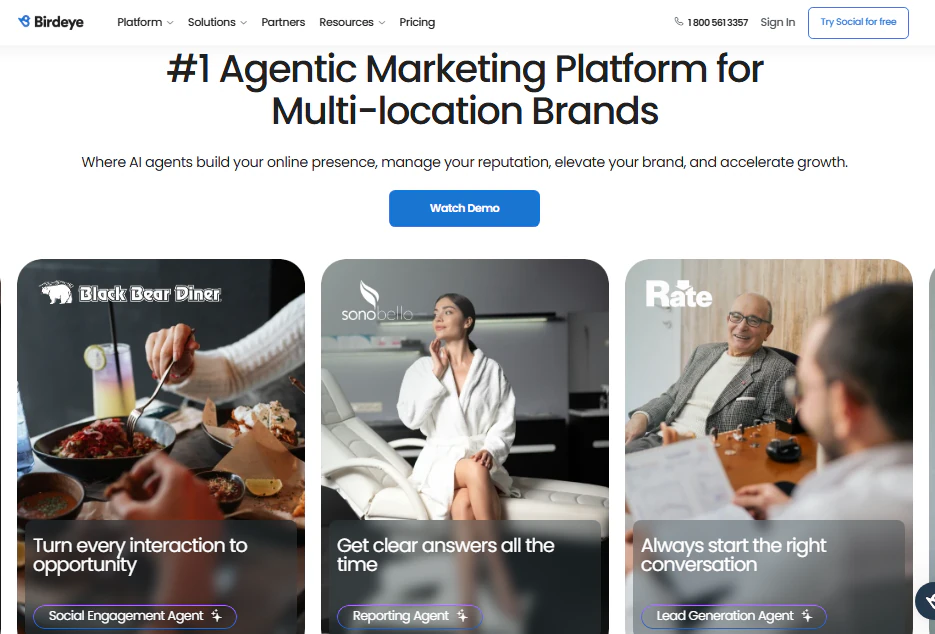
Birdeye positions itself as the "#1 Agentic Marketing Platform for Multi-location Brands."
The company has rebranded around "Service-as-a-Software," where AI agents autonomously execute marketing workflows. This comprehensive approach includes reviews, listings, social media, messaging, surveys, and webchat in one platform.
For multi-location businesses with dedicated marketing teams and substantial budgets who want everything consolidated, this breadth makes sense. The platform monitors over 200 review sites and offers tools for nearly every aspect of customer experience management.
The trade-off is that Birdeye is built as a broad customer-communication suite first, with AI review replies as one feature among many. Smaller businesses may find themselves paying for capabilities they don't need, and some businesses focused specifically on review quality may find the platform's attention spread across too many use cases. Reports from some users describe difficult cancellation processes and rigid contract terms.
NiceJob took the opposite approach.
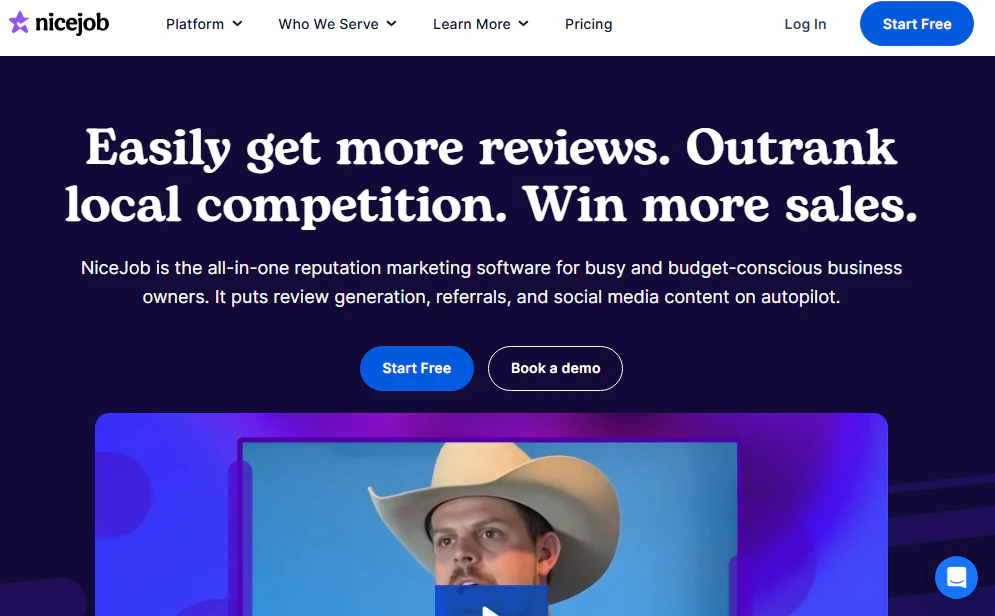
Founded in 2017 with the mission to help "great companies get the reputation they deserve," NiceJob focused on making review collection dead simple. The platform automates review requests via email and SMS, creates shareable "Stories" from positive reviews, and provides social proof widgets for websites.
Its acquisition by Paystone in 2021 signaled a move toward broader customer engagement, but the core product remains a review-collection-centric tool.
The trade-off? NiceJob's simplicity means limited depth on the response side. Users report basic analytics, limited customization options, and challenges managing multiple locations. For single-location service businesses primarily concerned with generating more reviews, this simplicity is a feature. For anyone wanting deeper response personalization or sophisticated analysis, it becomes a limitation.
RightResponse AI represents a fundamentally different approach.
Launched in 2024 by founders with experience in multi-location business management, the platform was built from the ground up with generative AI at its core, not as a feature added to an existing suite. Co-founder George Swetlitz, former CEO of a healthcare clinic network with over 200 locations, understood firsthand the challenge of managing high volumes of customer feedback without effective tools.
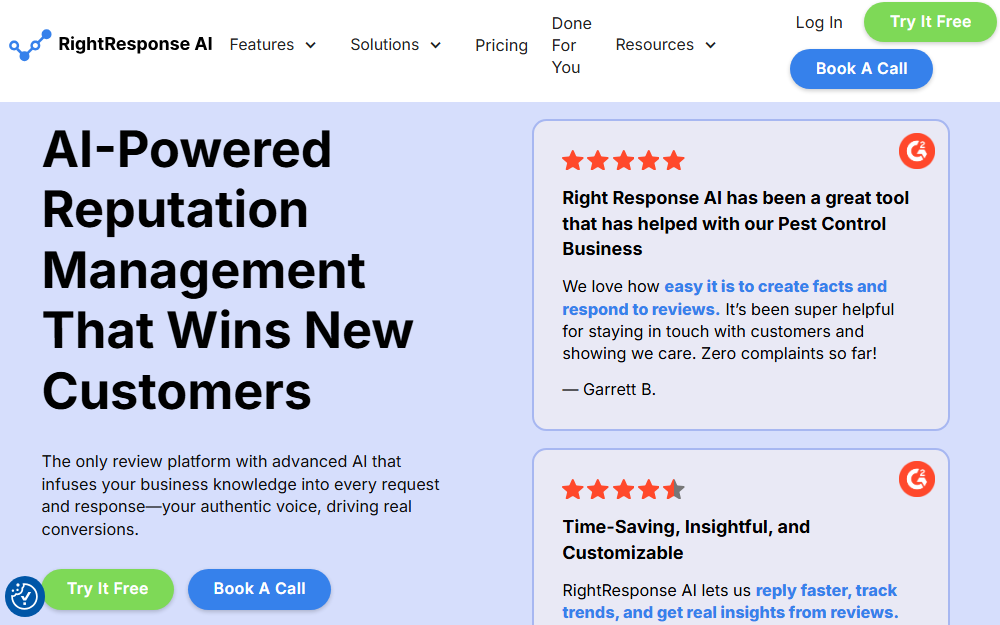
The platform's philosophy centers on a key insight: reviews are the conversion gate where prospective customers decide whether to choose your business.
People read reviews more than they read business websites, and the response is the only part the business controls. Currently, most people skip responses because they're generic and useless, but quality responses represent an untapped opportunity to win the next customer. Rather than building another broad suite, RightResponse AI focused on making responses worth reading while also providing advanced review collection, Voice of the Customer, and competitor analysis.
Review generation approaches reveal different philosophies
How each platform helps businesses collect reviews tells you everything about their priorities.
Birdeye's review generation relies on its Reviews AI, which automates review requests and can guide customers to the most impactful review sites.
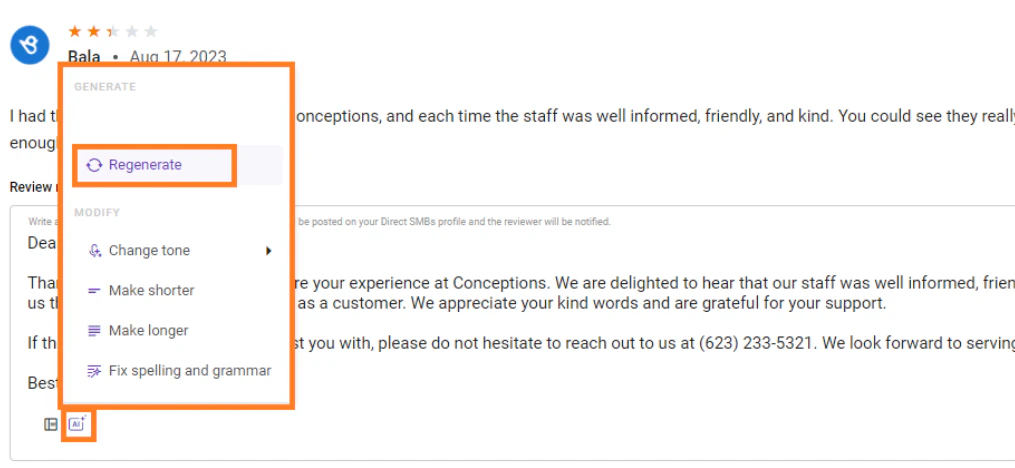
The platform integrates with over 3,000 applications, enabling automated triggers based on business events. For enterprise clients managing hundreds of locations, this integration depth is valuable. The AI can respond to reviews in the customer's language and incorporate brand voice settings.
Source: Birdeye
However, Birdeye's approach assumes you have the infrastructure to support these automations. Smaller businesses may find themselves paying for capabilities they can't fully utilize, and the review collection features exist within a much larger platform.
NiceJob keeps review generation simple.
When a job completes in an integrated CRM system, an automated review invitation goes to the customer. If they don't respond, a sequence of follow-up emails nudges them over 14 days. The smart funnel directs satisfied customers to high-impact review sites. Once a review comes in, the system stops sending reminders.
This straightforward approach works well for service businesses with clear transaction points. The automated follow-ups reportedly help businesses get "4x more reviews." But the simplicity cuts both ways. Some users have expressed a desire for more control over messaging and customization options, and the platform's strength clearly lies in collection rather than what happens after reviews arrive.
RightResponse AI approaches review collection as both advanced and secondary to the core differentiator of response quality.
The Review Requestor offers two modes: Essentials Mode provides simple, template-based automation that users can turn on and let run, while Pro Mode uses AI to generate highly personalized requests that reference specific customer details: name, service history, tenure as a customer, and recent transactions.

What sets RightResponse AI's collection apart:
- Photo attachments: Include images of completed work or customer moments that remind customers exactly what you did. When customers upload these photos alongside their reviews on Google, they create more engaging, persuasive content for prospective customers evaluating options.
- Guiding questions: Add prompts that give reviewers inspiration about what to write. Questions can rotate to ensure reviews contain varied, search-relevant content.
- Unlimited follow-ups: Configure as many follow-up requests as needed; seven for a roofer, fewer for a lawyer. Many competing platforms limit follow-up counts.
- Multiple delivery channels: Send requests via email and SMS to reach customers through their preferred method.
The framing is clear: RightResponse AI does review collection, and does it well with AI-powered personalization. But the core differentiator is what happens after the review comes in: the quality of the response and its ability to actively market the business.
AI capabilities show where innovation truly lives
All three platforms claim AI capabilities, but the implementation depth varies dramatically.
Birdeye has invested heavily in what it calls "BirdAI" and markets itself around "Agentic AI."
The platform offers AI-powered review responses that can be customized to brand voice, AI content creation for social media, and AI-driven insights. Reviews AI can generate responses, while Social AI can create and publish content. The vision is compelling: AI agents that autonomously handle marketing tasks across the entire platform.
In practice, many AI features are recent additions to a platform that was built before the generative AI era. Users have praised the AI capabilities while noting that some features feel like add-ons rather than core functionality. The platform's comprehensiveness means the AI must work across many different use cases, reviews, listings, social, messaging, potentially limiting depth in any single area.
NiceJob added AI Replies to help businesses respond to reviews more efficiently.
The feature scans for new reviews daily and generates reply suggestions that users can approve, edit, or auto-publish. Users can customize the tone and length of AI replies to match their brand.

Source: NiceJob
For a platform focused on simplicity, this represents a sensible addition. However, NiceJob's AI capabilities offer basic tone and rules customization; helpful for saving time, but without the deeper personalization system that prevents responses from feeling generic. Businesses looking for AI as a time-saver may find this sufficient; those wanting responses that actively market the business will find limitations.
RightResponse AI was built from the ground up with generative AI at its foundation, not as a feature added later. This architectural difference enables capabilities the other platforms can't easily replicate.
The platform's response personalization operates through three distinct pillars:
- Facts: During onboarding, the platform reads existing reviews, responses, and the business website to create a "Fact Library" about the business. It identifies the most important themes in reviews and maps relevant facts to each theme.
When generating responses, the system finds the relevant theme and selects which facts apply. For negative reviews, the system can include facts that address the complaint; if someone complains about price, the response can mention that the restaurant uses organic, non-GMO ingredients sourced fresh daily.
- Customizations: These are rules and behavioral controls that govern how responses behave: length, structure, when to use reviewer names, how to handle employee mentions, and more.
- Brand Voice: Tone and style settings ensure responses sound like the business, with customizable greetings and closings that maintain consistency while varying enough to feel fresh.
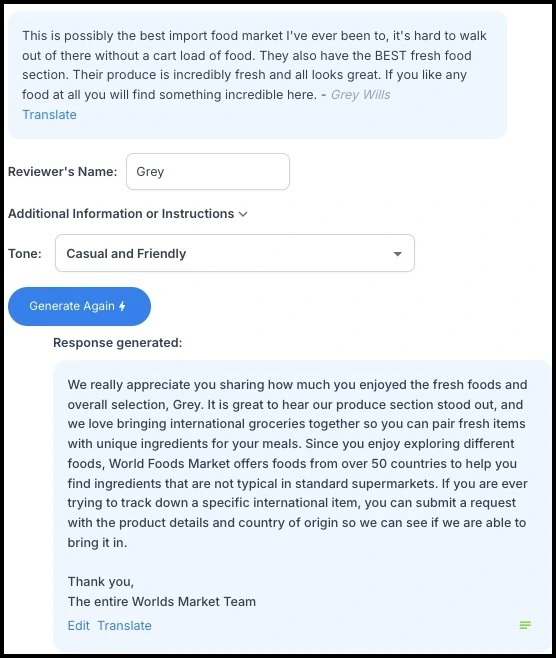
All three pillars work together to produce hyper-personalized, brand-aligned responses with endless variation, without losing control. The system shows users which facts were used and which weren't, allowing adjustments. Changes roll forward immediately.
Beyond personalization, RightResponse AI uses an intentionally agentic approach that separates analytical functions from writing functions. The platform analyzes the review before writing the response, handles edge cases such as review updates and rating/text mismatches, and for medical businesses, analyzes reviews to detect and exclude Protected Health Information (PHI) to ensure HIPAA-compliant responses. This reduces the risk of AI generating inappropriate responses while increasing relevance.
The key insight: generic AI responses actually hurt businesses. They waste space, block readers from actual reviews, and contribute nothing. When a prospective customer reads "Thanks for your 5-star review, we appreciate your feedback!", that's space that could have marketed the business. Quality responses are enjoyable to read because there's substance. RightResponse AI's architecture is designed specifically to produce responses worth reading.
Voice of the Customer: From basic scores to actionable insights
Understanding what customers actually mean in their reviews separates useful analytics from vanity metrics.
Birdeye offers sentiment analysis through its Athena natural language processing engine.
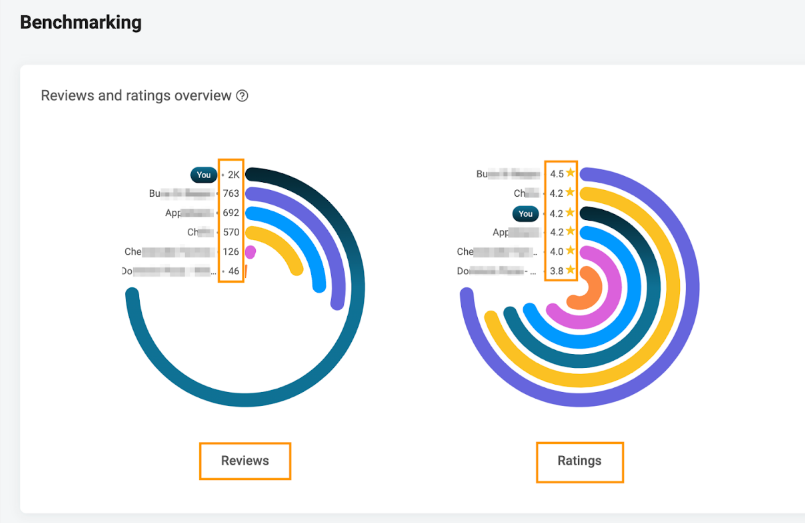
The platform can categorize feedback by sentiment and identify key themes. The Insights AI feature provides recommendations based on review and survey data, while Competitors AI allows benchmarking against rivals. For multi-location businesses, sentiment can be compared across branches.
Source: Birdeye
The analysis capabilities are solid and benefit from integration with the broader platform. However, sentiment analysis exists as one feature among many rather than a core focus.
NiceJob provides "Topic Insights" using machine learning to analyze review content.
The system identifies frequently mentioned topics and categorizes them as positive or negative. Users can see which aspects of their business customers praise or criticize. A "Team Leaderboard" shows which employees are mentioned most positively.
For basic understanding of customer sentiment, this works. But the analysis remains surface-level compared to more advanced approaches. Users wanting to understand exactly why customers feel a certain way about specific aspects of their business will hit the platform's limitations quickly.
RightResponse AI implements Voice of the Customer Aspect-Based Sentiment Analysis (ABSA), a more advanced approach that breaks down reviews to identify specific aspects being discussed and assigns sentiment to each. Rather than just knowing a review is "negative," businesses learn that the customer was negative about wait times but positive about staff friendliness.
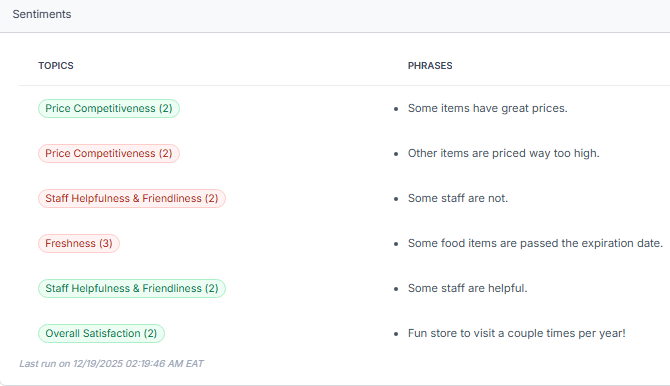
The key differentiator is customization.
Businesses can define the topics and categories that matter to their specific operations. A restaurant might track sentiment around "food quality," "service speed," "ambiance," and "value." A healthcare practice might focus on "wait times," "staff professionalism," "communication," and "facility cleanliness." The AI then maps customer phrases to these categories, providing precisely the insights each business needs.
The platform also filters out irrelevant or vague content, focusing analysis on genuine experience-based feedback. Users can drill down from aggregated sentiment data to the actual phrases customers used, providing context that summary scores can't capture.
For multi-location businesses, sentiment can be compared across locations with granular insights, even if two locations share the same average rating, the analysis reveals which aspects drive satisfaction or need improvement at each site.
Competitor analysis separates the serious from the simple
Understanding how your business compares to competitors is essential for strategic planning, but platforms vary widely in this capability.
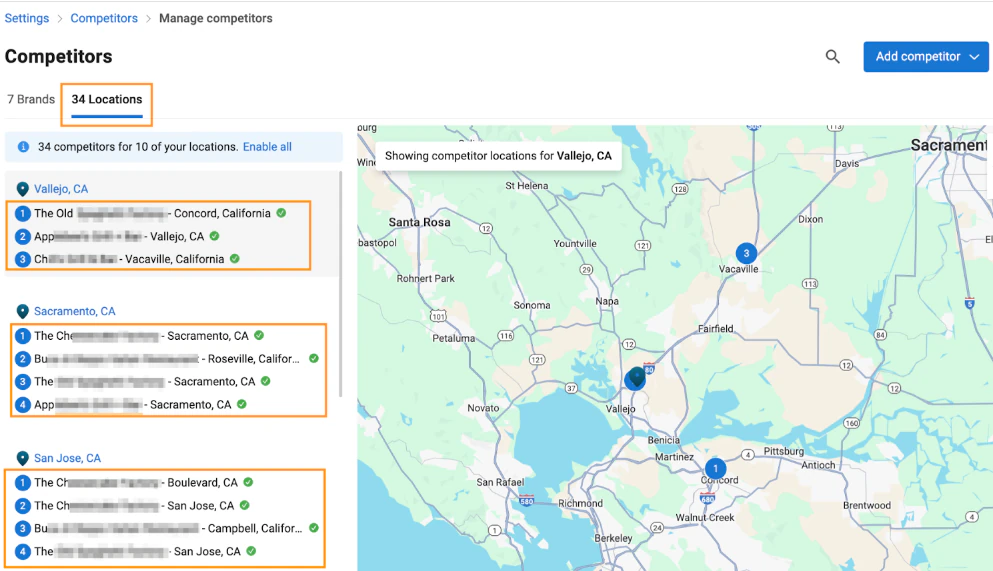
Birdeye offers "Competitors AI" that tracks competitors' public review data, including volume, ratings, and sentiment.
The platform can identify local competitors and provide SWOT analysis. This competitive intelligence integrates with the broader suite, allowing businesses to benchmark their performance.
For enterprise clients who want competitor data within the same platform as other marketing tools, this provides convenience. The competitor analysis is one component of the comprehensive platform approach.
Source: Birdeye
NiceJob offers competitor insights only on its Pro plan at $125/month.
The feature provides basic competitor review and SEO insights, including tracking competitor topics. For businesses on the standard $75/month plan, no competitor analysis is available.
This limitation reflects NiceJob's focus on review generation rather than competitive intelligence. For many small service businesses, understanding competitors may be less important than simply collecting more reviews. But for businesses in competitive markets wanting to understand their positioning, the basic competitor features may fall short.
RightResponse AI treats competitor analysis as a core feature through CompetiWatch AI.
The platform applies the same advanced sentiment analysis used for your own reviews to competitor reviews. This means you can compare sentiment scores on identical topics, not just overall ratings, understanding exactly where competitors excel or struggle relative to your business.
Beyond review analysis, RightResponse AI includes dedicated Google Maps rank tracking. While Birdeye offers local SEO rank reports within its Listings AI, and NiceJob lacks this feature entirely, RightResponse AI makes map ranking a core focus.
The Map Rank Tracker creates a grid of search points around business locations to show exactly where a business appears in Google Maps results for specific keywords. The "Rewind" feature allows users to replay how rankings have changed over time, visualizing the impact of reputation management efforts.
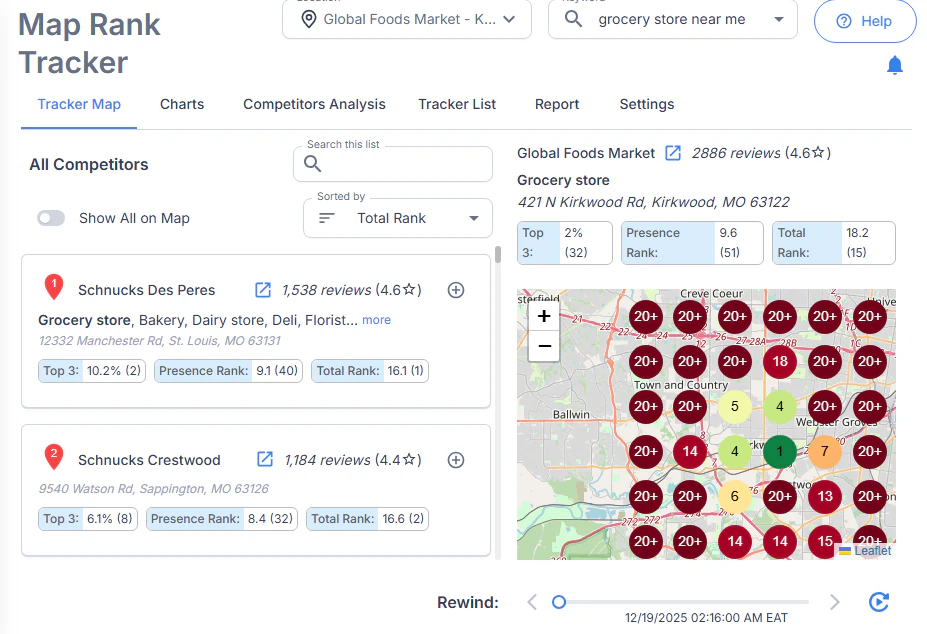
For local businesses where Google Maps visibility directly impacts customer acquisition, this tracking capability connects reputation work to local visibility outcomes. Users can see not just their ranking, but exactly which competitors outrank them at specific geographic points, enabling targeted improvement strategies.
Pricing transparency varies dramatically
How each platform prices its services reveals much about their target market and values.
Birdeye uses quote-based pricing, requiring businesses to contact sales for specific costs.
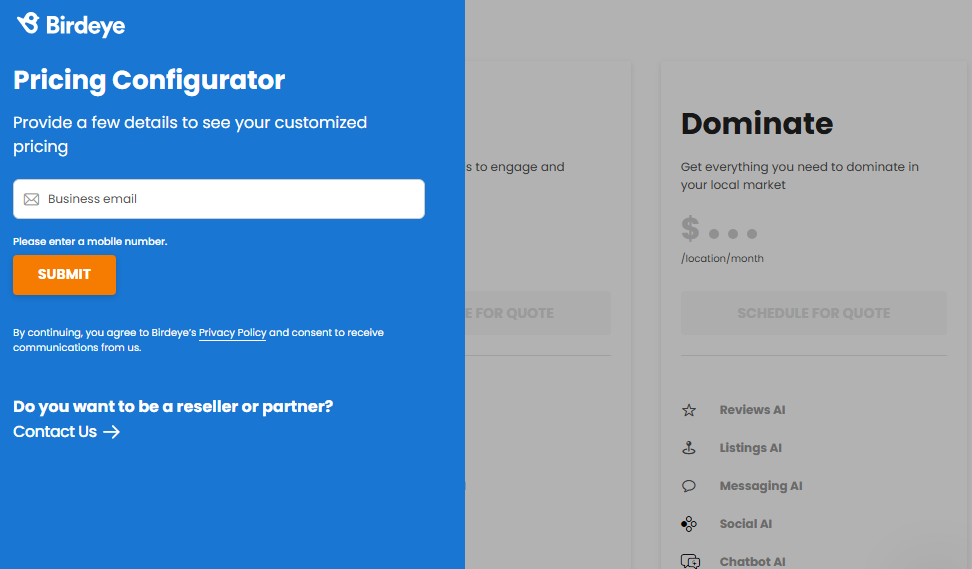
The platform offers three tiers (Starter, Growth, and Dominate) with progressively more features, but actual prices aren't publicly disclosed. The per-location pricing model means costs can scale quickly for multi-location businesses, regardless of actual review volume at each location.
More concerning are persistent reports about contract rigidity. Multiple users have described difficulty canceling Birdeye subscriptions, with complaints about auto-renewing contracts and an unresponsive billing department. For businesses valuing flexibility, these reports warrant careful contract review before committing.
Source: Birdeye
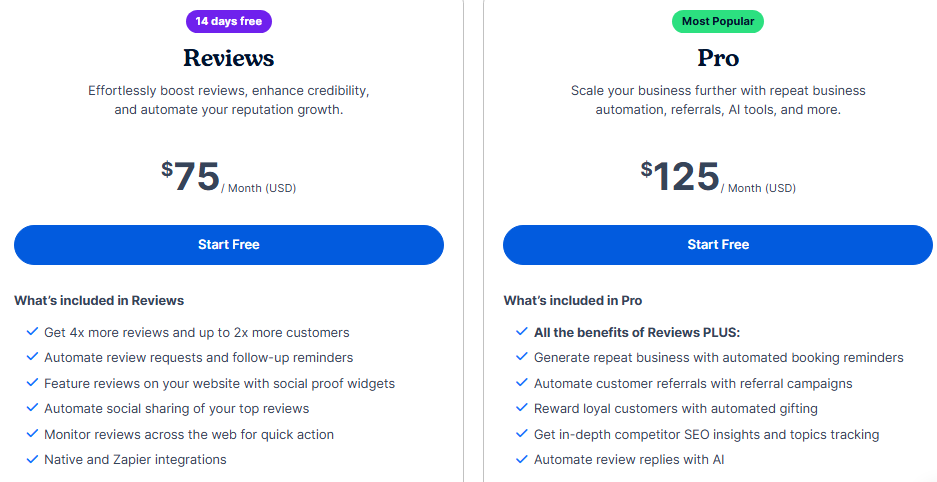
NiceJob offers more transparent pricing: $75/month for the Reviews plan or $125/month for the Pro plan with additional features like repeat customer campaigns, referrals, and competitor insights. The Sites add-on costs $99/month plus a $199 setup fee. A 14-day free trial requires no credit card, and there are no contracts.
This straightforward pricing makes budgeting easy for small businesses. However, the feature limitations at each tier mean businesses may need to upgrade or add services, increasing costs.
Users have also noted that additional landing pages and CMS functionality incur extra fees. Each location with its own Google Business Profile requires a separate license, multiplying costs for growing businesses.
Source: NiceJob
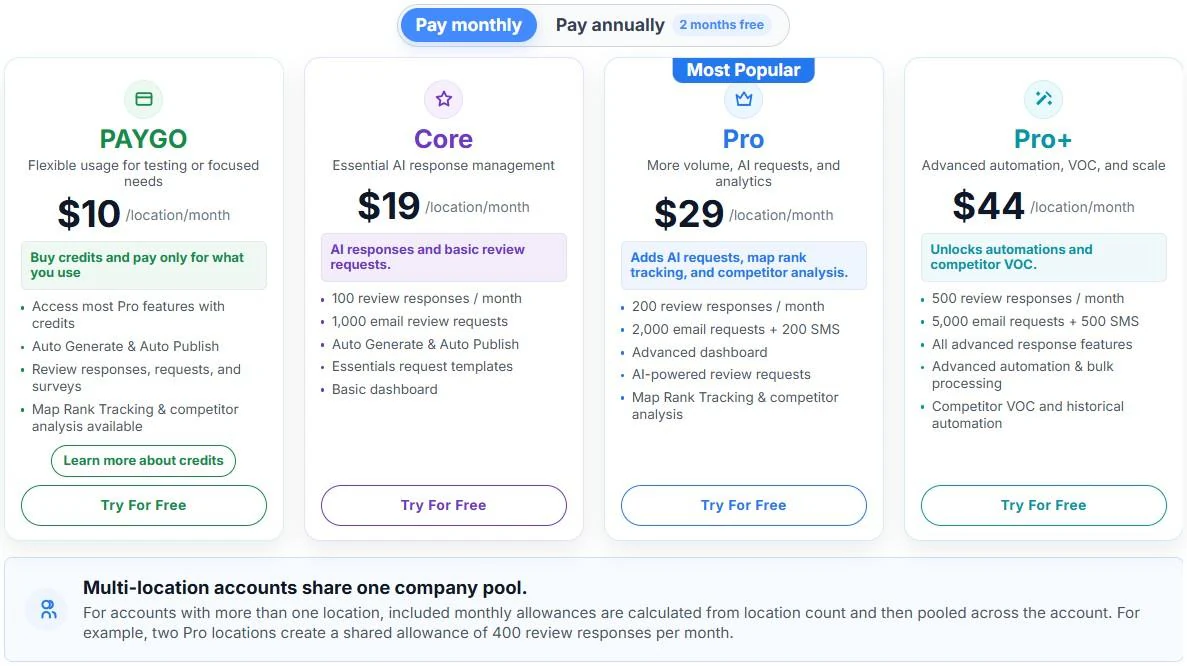
RightResponse AI takes a different approach with flexible pricing that includes both usage-based and fixed-price plans, designed around actual usage rather than arbitrary capacity.
The base cost is $10 per location per month, providing access to all features. This is the Pay As You Go (PAYGO) plan, best for businesses just starting out, running low review volume, or with narrow needs, where actual usage is charged through a credit system and you only pay for what you use. For businesses that prefer predictable monthly costs, three fixed plans build those same capabilities in with defined monthly limits:
- Core ($19/month): 100 review responses, 1,000 email review requests, and Essentials request templates. No SMS, surveys, or map rank tracking.
- Pro ($29/month, most popular): 200 review responses, 2,000 email requests plus 200 SMS, 200 surveys, AI-powered review requests, and Map Rank Tracking with competitor analysis (10 scans/month).
- Pro+ ($44/month): 500 review responses, 5,000 email requests plus 500 SMS, 500 surveys, advanced automation with bulk processing, and Competitor Voice of the Customer (25 map-rank scans/month).
- Enterprise (custom): white-label, API access, and advanced reporting for agencies and large multi-location businesses.
Credit costs are tiered: 20 credits per review response, 20 credits per sentiment analysis, 2 credits per email review request, and 1.5 credits per map rank tracker pin. The per-credit cost decreases with volume, ranging from $0.01 for small purchases to $0.006 at high volumes.
For context: sentiment analysis plus response for 10 reviews costs approximately $4, making the total monthly cost for a location with 10 reviews around $14.
This model offers several advantages. Businesses aren't forced into paying per-location for capacity they don't use; a low-volume location costs much less than a high-volume one. Agencies can scale cleanly across client accounts. The 7-day free trial includes 1,000 credits, allowing meaningful testing of all features.
And because usage directly drives costs, businesses have clear visibility into their ROI. The subscription can be canceled anytime, with the service remaining active until the end of the billing cycle.
Source: RightResponse AI
Multi-location management capabilities differ significantly
For businesses with multiple locations, management complexity becomes a critical consideration.
Birdeye was built for multi-location enterprises.
The platform offers centralized dashboards, location-level reporting, role-based access controls, and tiered approval workflows. Businesses can manage reviews, listings, and social media across hundreds of locations from a single interface. Features can be filtered by individual location.
For large franchises and corporate chains with dedicated marketing teams, Birdeye's multi-location capabilities are comprehensive. The platform understands the complexity of maintaining brand consistency while allowing local autonomy.
However, this enterprise focus means smaller multi-location businesses may find themselves paying for capabilities they don't need, and the premium pricing scales with location count.
NiceJob's multi-location management has limitations.
While businesses can add multiple locations under a single account, each location with its own Google Business Profile and social media presence requires a separate license. This means costs multiply with each location added, without the enterprise features that might justify the expense.
For single-location service businesses, this limitation doesn't matter. But businesses expanding to multiple locations may outgrow NiceJob's capabilities, requiring migration to a more robust platform at a critical growth stage.
RightResponse AI supports multi-location management with usage-based pricing designed to scale naturally.
The platform allows performance comparison across locations, sentiment analysis by location, and centralized or location-specific management as needed. Facts can be set at company, brand, or location levels, enabling consistent messaging while allowing local customization.
The pricing model scales smoothly: each location pays the base fee plus actual usage, avoiding the quantum jumps in pricing that platform tiers often require.
A business with 20 locations where some are high-volume and some are low-volume pays proportionally for actual activity rather than uniform per-location rates. Enterprise plans add brands and regions management with custom access controls for organizations needing governance features.
For businesses opening new locations, the usage-based model means a new site with few reviews costs little until it builds volume, allowing time to establish the location before costs scale.
Birdeye vs NiceJob vs RightResponse AI: Which should you choose?
The best platform depends on your business's specific needs, size, and priorities.
Choose Birdeye if:
- You operate a large multi-location enterprise with dedicated marketing resources
- You want an all-in-one platform covering reviews, listings, social, messaging, and surveys in one place
- Your budget accommodates premium pricing and annual contracts
- You have the team capacity to fully utilize a comprehensive feature set
- You prioritize consolidation and having all tools in one platform over specialized depth
Explore Birdeye's enterprise capabilities through their sales team.
Choose NiceJob if:
- You run a single-location service business seeking simplicity above all else
- Review generation is your primary concern, not response personalization or deep analysis
- You prefer straightforward monthly pricing without contracts
- Your team lacks technical expertise for complex platforms
- You need a solution that works well with minimal setup and management
Start NiceJob's 14-day free trial to test their review generation capabilities.
Choose RightResponse AI if:
- You care about review response quality and understand the impact reviews have on growth
- You want responses that actively market your business rather than just acknowledge feedback
- Voice of the Customer and competitor analysis matter to your strategy
- Transparent, usage-based pricing aligns with how your business actually operates
- Google Maps visibility is important to your customer acquisition
- You need a platform that serves location-based businesses of all sizes, from single location to enterprise
- You prefer a specialized solution that excels at reputation management rather than a broad suite
Experience RightResponse AI's AI-native approach with a 7-day free trial including 1,000 credits.
The reputation management landscape has evolved significantly. Birdeye and NiceJob represent different points on the spectrum of comprehensiveness versus simplicity, but both treat review responses as secondary to either their broader suite (Birdeye) or their collection focus (NiceJob).
RightResponse AI offers a third path: treating the review response itself as the product, with advanced AI capabilities designed to turn every response into an opportunity to win the next customer.
For businesses where quality is an objective, where reviews materially change revenue and generic responses waste an opportunity, RightResponse AI offers a modern approach built on that philosophy.
Ready to see what AI-native reputation management can do for your business? Start your free trial of RightResponse AI today.
Frequently Asked Questions
What is the main difference between Birdeye and NiceJob?
Birdeye is an enterprise-grade all-in-one customer experience platform covering reviews, listings, social media, messaging, surveys, and webchat across 200+ review sites, designed for multi-location businesses with premium quote-based pricing and annual contracts. NiceJob is a streamlined review generation tool built for small service businesses, focusing on automated review requests and social proof with transparent pricing at $75-125/month and no contracts.
When should I choose RightResponse AI over Birdeye or NiceJob?
Choose RightResponse AI if review response quality matters to your business and you want responses that actively market your business rather than just acknowledge feedback. The platform's three-pillar personalization system (Facts, Customizations, Brand Voice) produces hyper-personalized responses, while Voice of the Customer ABSA provides granular sentiment insights. With Pay As You Go at $10/month per location plus credits, plus fixed Core $19, Pro $29, and Pro+ $44 plans, it serves businesses of all sizes from single location to enterprise.
How does pricing compare between Birdeye, NiceJob, and RightResponse AI?
Birdeye uses quote-based pricing with annual contracts and three undisclosed tiers. NiceJob offers transparent pricing at $75/month (Reviews) or $125/month (Pro) with no contracts, though each location requires a separate license. RightResponse AI offers Pay As You Go at $10/month per location plus usage-based credits, with fixed Core $19, Pro $29, and Pro+ $44 plans, where Voice of the Customer plus response for 10 reviews costs approximately $4, making the total monthly cost for a low-volume PAYGO location around $14.
Does NiceJob offer Google Maps rank tracking?
No, NiceJob does not offer Google Maps rank tracking. Birdeye includes local SEO rank reports within its Listings AI feature. RightResponse AI offers dedicated grid-based Google Maps rank tracking with a Rewind feature that lets businesses replay how rankings have changed over time, connecting reputation management efforts to local visibility outcomes.
Try RightResponse AI for Free!
*No credit card required.