ReviewTrackers has been a trusted name in online reputation management since 2012, helping over 60,000 businesses monitor, analyze, and respond to customer reviews from a single dashboard. With its broad coverage of 100+ review sources and a strong focus on multi-location enterprises, it has earned a solid reputation as a comprehensive solution for managing what customers say about your brand online.
Comparison research: This article is part of the RightResponse AI review management software comparison library, which connects platform reviews, pricing analyses, alternatives, and head-to-head evaluations.
To write this ReviewTrackers review, I've analyzed the platform in detail. I believe it's the ideal choice if:
- You need centralized monitoring across 100+ review sites
- You manage a multi-location business that requires enterprise-level oversight
- You want established reputation management with proven market credibility
- You value broad integrations through Zapier and platforms like Hootsuite
- You need features like employer brand monitoring or review widgets for your website
However, ReviewTrackers might not be the best choice if:
- You want review responses that actively market your business to prospective customers, not just acknowledge the reviewer
- You need a response system built on personalization with business-specific facts, behavioral controls, and brand voice working together
- Sentiment analysis accuracy is critical to your operations
- You want transparent, publicly listed pricing without annual commitments
- You prefer usage-based billing that scales with what you actually use
In this case, you should consider RightResponse AI: a reputation management platform built with generative AI as a foundational element. RightResponse AI treats the review response itself as a conversion asset, combining a three-pillar personalization system (Facts, Customizations, and Brand Voice) with Voice of the Customer and a transparent pay-for-what-you-use pricing model. The platform also includes an advanced, AI-powered review collection system alongside its response capabilities.
Because of that, I've included a detailed look at RightResponse AI later in this ReviewTrackers review, as the best alternative for businesses that prioritize review response quality and believe that smarter replies lead to more customers. If you're eager to try it out, you can start your free trial of RightResponse AI here.
Table of contents:
- What is ReviewTrackers?
- ReviewTrackers Pros & Cons
- ReviewTrackers Review: How it Works & Key Features
- Where ReviewTrackers Falls Short
- Top ReviewTrackers Alternative: RightResponse AI
- ReviewTrackers or RightResponse AI: Comparison Summary
- Final Verdict
What is ReviewTrackers?
ReviewTrackers was founded in 2012 by Chris Campbell, who recognized how time-consuming and fragmented online review management had become for businesses.
The idea came to life when a potential franchise client discovered that one of their franchisees had written a fake review, highlighting the need for better oversight and education around this growing communication channel. The company's first customer was a retail cheese store in Seattle.
Over the years, ReviewTrackers evolved from a basic review monitoring tool into a full reputation management platform, adding review generation (2013), smart response tools (2017), text analytics (2018), competitor insights (2019), and local listings management (2020).
In June 2022, ReviewTrackers was acquired by InMoment, a leader in Experience Improvement, positioning it within a broader customer experience ecosystem.
Today, ReviewTrackers serves over 60,000 businesses across industries including restaurants, retail, healthcare, hospitality, automotive, and financial services. The platform is well suited for multi-location enterprises that need centralized oversight with location-specific insights, and for marketing agencies managing reputation across multiple clients.
ReviewTrackers Pros & Cons
Pros | Cons |
|---|---|
✅ Aggregates reviews from 100+ sources into one dashboard | ❌ No free plan available |
✅ User-friendly, intuitive interface with low learning curve | ❌ Pricing requires a sales consultation (no public pricing) |
✅ Strong multi-location management capabilities | ❌ Sentiment analysis accuracy reported as inconsistent |
✅ Well-regarded customer support team | ❌ Annual billing only with limited contract flexibility |
✅ Extensive integration options via Zapier (1,000+ apps) | ❌ Mobile app less functional than desktop version |
✅ Employer brand monitoring add-on for HR teams | ❌ Limited dashboard customization options |
✅ Review widgets for displaying social proof on websites | ❌ Key features like local SEO and listings management require add-ons |
ReviewTrackers Review: How it Works & Key Features
Review Monitoring and Aggregation: ReviewTrackers consolidates feedback from 100+ sources into a single dashboard.
The foundation of ReviewTrackers is its review monitoring capability.
The platform connects to over 100 review sites, social media platforms, and online directories, including Google, Facebook, Yelp, and TripAdvisor, pulling all customer feedback into one centralized inbox. Users receive notifications when new reviews are posted, ensuring nothing slips through the cracks.
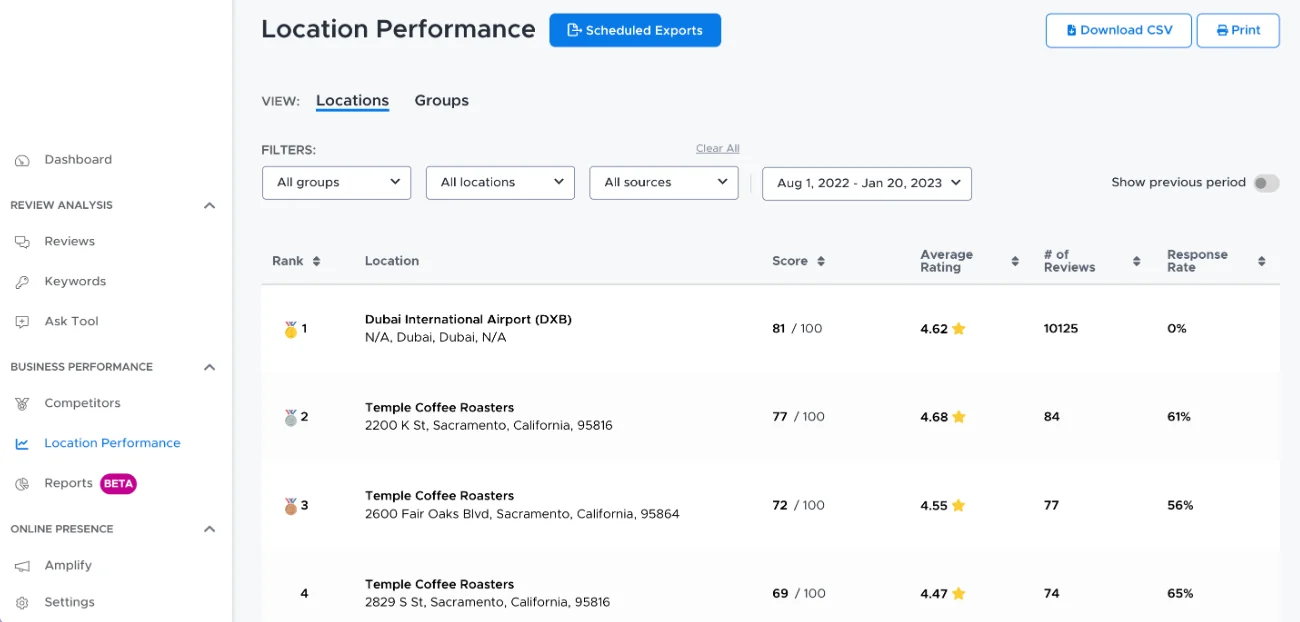
Within the dashboard, reviews can be filtered by rating, source, status (new, in progress, resolved), or custom tags. For multi-location businesses, the platform provides both a corporate-level overview and granular location-specific data, making it possible to compare performance across branches and identify location-specific issues.
Source: ReviewTrackers
The system also calculates a performance score for each business location, providing a quick snapshot of local brand health.
Review Response: Respond to feedback directly from the platform with AI suggestions and templates.
ReviewTrackers allows businesses to respond to reviews on Google and Facebook directly from the dashboard, eliminating the need to log into each platform separately.
For the other 100+ monitored sites, the platform provides a link to the original review for quick navigation.
The response workflow includes AI-powered suggestions that analyze review sentiment and generate a starting point for replies. Customizable templates help maintain brand consistency while speeding up the process. An auto-response feature can automatically post pre-approved templates to Google and Facebook reviews shortly after receipt.

Source: ReviewTrackers
Team collaboration tools allow users to assign reviews to specific team members, add internal notes (invisible to the public), and coordinate response workflows before responses are published. This is particularly useful for organizations where multiple people share responsibility for reputation management.
Review Generation (Ask Tool): Proactively solicit customer feedback through email, SMS, and in-person touchpoints.
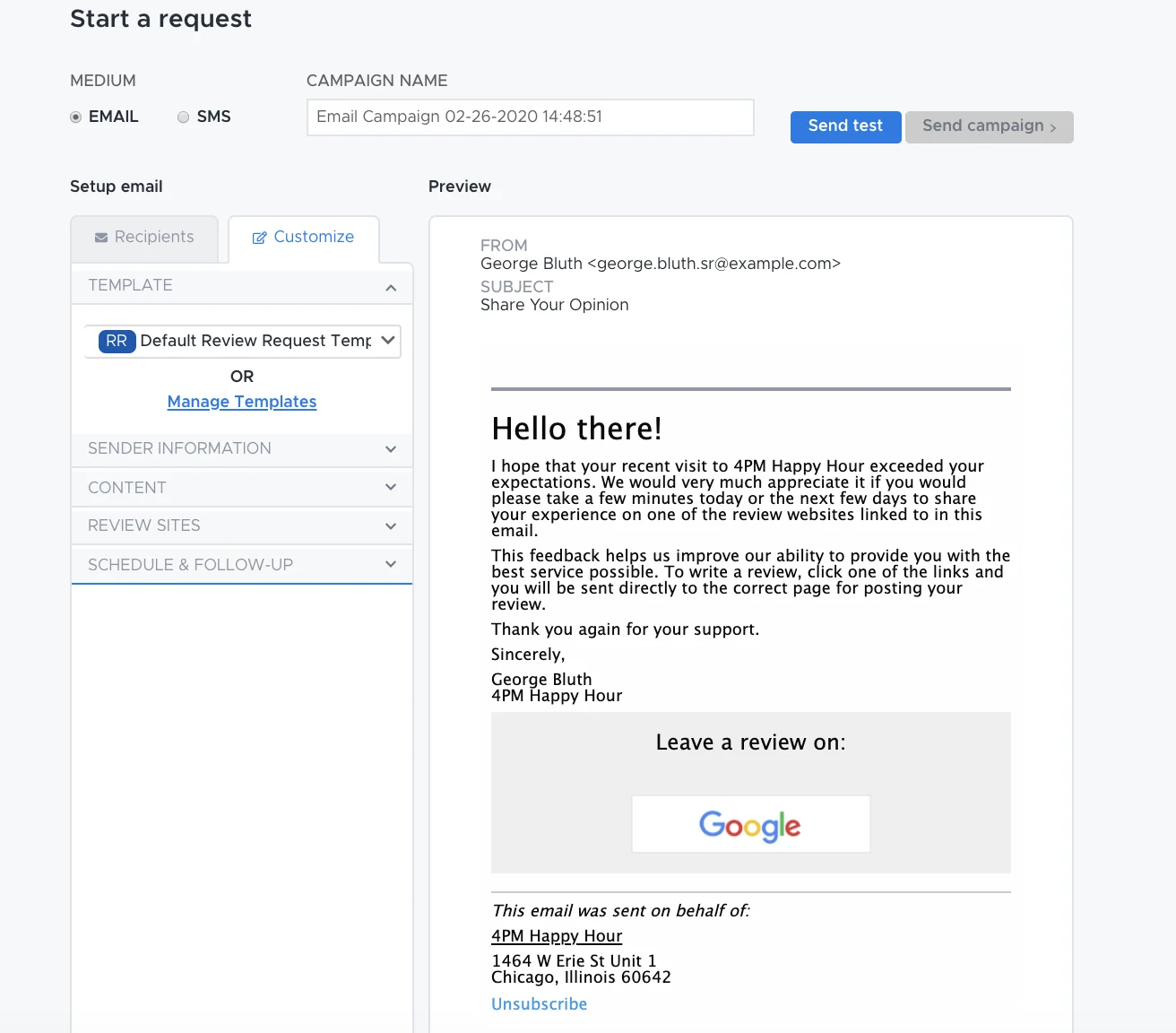
ReviewTrackers’ Ask Tool enables businesses to request reviews through email and SMS campaigns with customizable templates.
Source: ReviewTrackers
Merge tags allow for basic personalization (customer name, business name, location) without requiring technical knowledge, and a live preview shows how the message will appear before sending.
A few features stand out in this area.
Microsurveys allow businesses to add up to five custom questions alongside a standard star rating or NPS question, gathering more structured feedback than a simple review request. Kiosk Mode captures initial feedback in-person using a tablet, then sends a follow-up request for the customer to leave a public review later on their own device. QR code generation creates scannable codes that link directly to review platforms or feedback landing pages.
Automated Drip Campaigns send reminder emails to customers who haven't responded to the initial request, and integrations through Zapier allow review requests to be triggered by specific CRM events like a completed purchase or closed service ticket.
Reporting, Analytics, and Competitive Benchmarking: Track trends, sentiment, and competitor performance.
ReviewTrackers’ analytics suite processes review data to surface trends in volume, ratings, and sentiment over time.
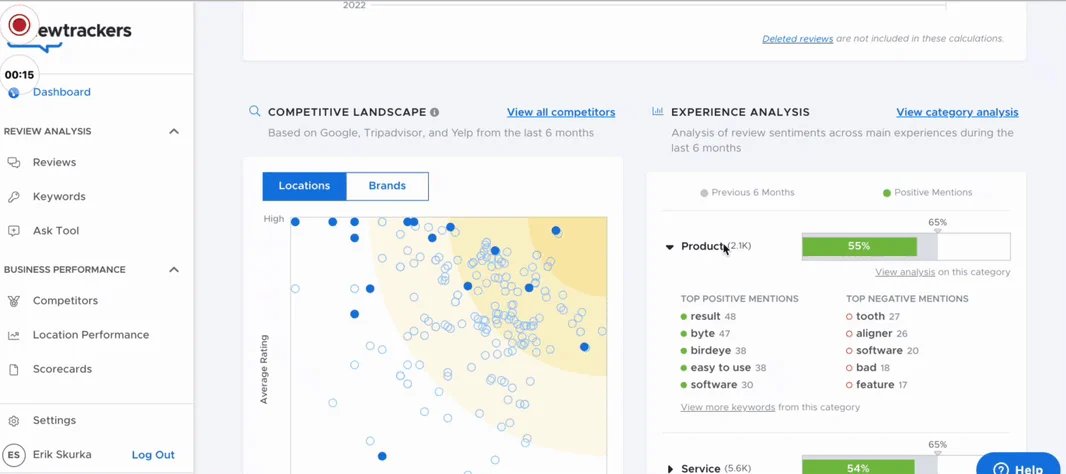
A keyword dashboard tracks specific terms at local, regional, and brand-wide levels, helping businesses identify what customers are repeatedly mentioning in positive or negative contexts. For example, a restaurant chain might discover that "wait time" is a frequently recurring negative keyword across certain locations.
Source: ReviewTrackers
Sentiment analysis, powered by natural language processing, categorizes reviews as positive, negative, or neutral and links sentiment to specific keywords. Customizable reports can be scheduled for daily, weekly, or monthly delivery, covering metrics like average rating and total reviews, while the in-platform dashboard tracks additional metrics such as response rate and response time.
The competitive benchmarking feature allows businesses to track competitors' review performance, including average ratings and review volume. This side-by-side comparison helps identify areas where competitors are outperforming and where opportunities exist.
Local SEO and Listings Management: Manage online presence to improve local search visibility.
Available as an add-on, ReviewTrackers’ Local SEO suite includes business listing synchronization across high-authority directories to ensure consistent name, address, and phone number (NAP) data.
Local search rank tracking monitors keyword performance in local search results, helping businesses understand their visibility in their target areas.
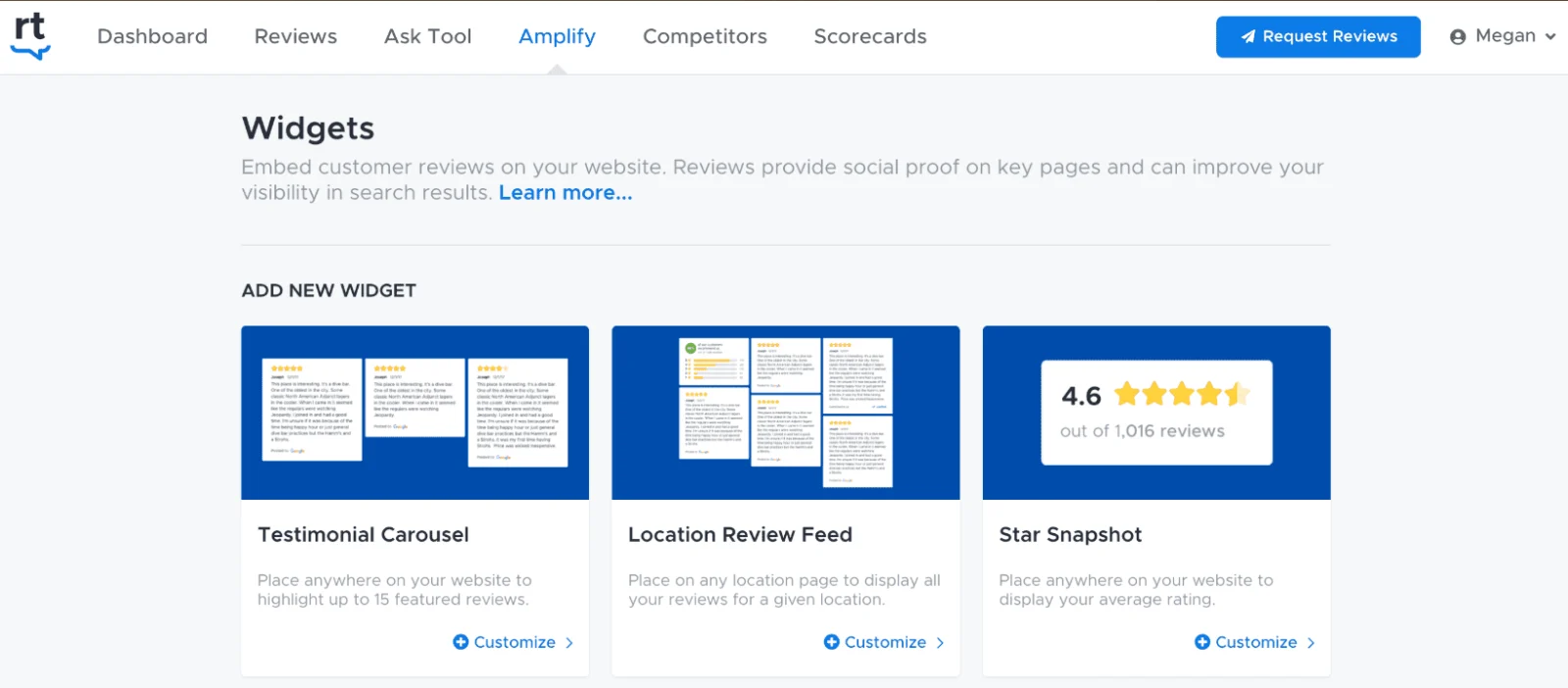
The Amplify widget suite lets businesses embed customer reviews on their website through customizable carousels and feeds, adding social proof to support conversions and local SEO efforts. Businesses can hand-pick featured reviews or display a dynamic feed of recent feedback.
Source: ReviewTrackers
Where ReviewTrackers Falls Short
While ReviewTrackers provides a well-rounded reputation management platform, several limitations become apparent with regular use.
These reflect the natural trade-offs of a platform that has evolved incrementally over more than a decade.
Sentiment Analysis Inconsistencies: Users have reported that the accuracy of ReviewTrackers' sentiment analysis can be inconsistent. For a platform where understanding customer feedback is central to its value proposition, unreliable sentiment categorization can lead to misinterpreted data and misguided business decisions.
This becomes too problematic when businesses are using sentiment data to benchmark against competitors or identify operational issues.
Pricing Opacity and Rigid Contracts: ReviewTrackers does not publish its pricing and requires a sales consultation to receive a quote. Plans are paid annually, and there is no free plan available. For businesses that want clear, upfront pricing, or for smaller operations that prefer monthly billing flexibility, this creates a significant barrier to entry.
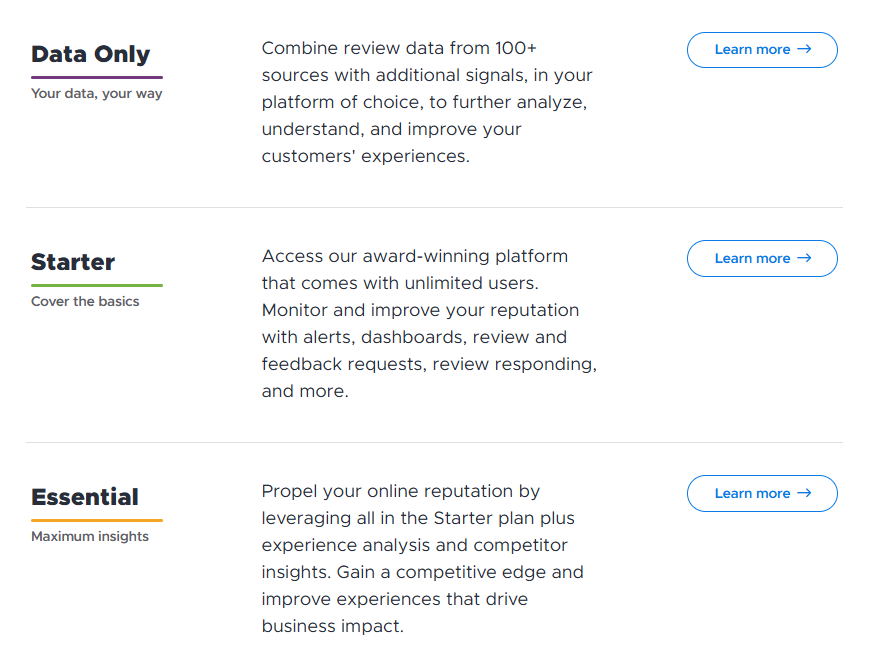
The flat per-location pricing model also means businesses pay the same rate regardless of their actual review volume; a cost structure that can be difficult to justify for locations with lower review activity.
AI Response Limitations: While ReviewTrackers offers AI-powered response suggestions and customizable templates, the responses appear to have limited capability for infusing replies with specific business facts, unique selling points, or contextually relevant information.
This matters because prospective customers reading reviews will typically skip generic responses. A reply that simply thanks the reviewer without adding substance represents a missed opportunity to differentiate the business and influence the next customer's decision. Newer AI-native platforms have pushed further in turning every response into a meaningful touchpoint.
Add-on Dependency for Core Features: Several features that many businesses would consider essential, including local listings management and local search rank tracking, are available only as paid add-ons, while competitor insights is restricted to higher-tier plans. This modular structure can make the total cost of a fully featured setup difficult to predict.
These limitations don't diminish ReviewTrackers' strengths in review aggregation, multi-location management, and enterprise-scale operations. But they do highlight areas where alternatives designed around more advanced AI and more transparent pricing from the beginning may better serve certain businesses.
Top ReviewTrackers Alternative: RightResponse AI
RightResponse AI was launched in 2024 by George Swetlitz, Shiv Pujan Singh, and Sabrina Hu. Swetlitz, a former CEO of a healthcare clinic network with over 200 locations, experienced firsthand the challenges of managing reviews at scale and saw an opportunity with generative AI to build a more intelligent solution.

The platform was designed with AI as a foundational element built to deliver higher response quality and better personalization in every aspect of reputation management.
RightResponse AI serves location-based businesses of all sizes, from single-location operations to enterprise, across industries where reviews materially influence revenue: healthcare, home services, hospitality, restaurants, automotive, dental, and professional services. The platform also serves agencies managing multiple local-business clients who need consistent, high-quality review responses at scale.
Review Response Quality: RightResponse AI turns every reply into a conversion asset through a three-pillar personalization system.
The core philosophy behind RightResponse AI is that the review response is the only part of the review a business controls, yet most businesses waste it.
Prospective customers read reviews when comparison-shopping, and while most responses today are generic enough to get skipped, a substantive response that markets the business and addresses the customer's specific experience can influence the next customer's decision.
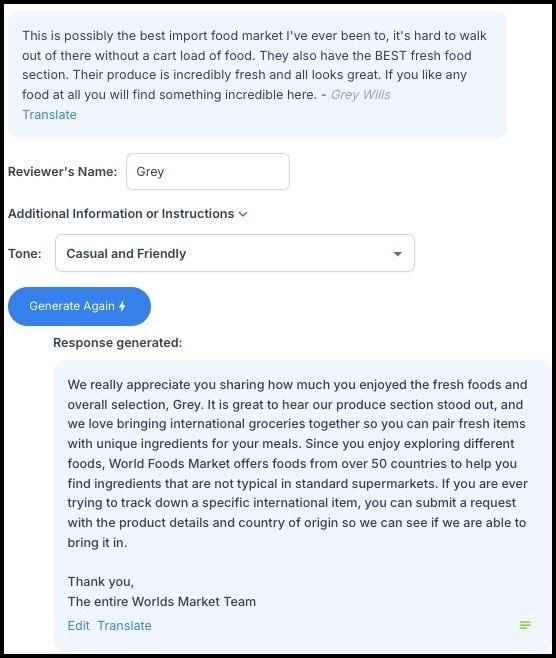
The platform's Intelligent Review Responder achieves this through a three-pillar personalization system:
- Facts (what to say): Users create a library of business-specific messaging, including unique selling points, operational details, promotions, and brand values. During onboarding, the platform reads existing reviews, responses, and the business website to help generate an initial set of facts, identifying the most important themes in reviews and mapping relevant facts to each one.
When a review comes in, the AI matches it against the relevant theme and selects which facts apply. Users can see exactly which facts were used and which weren't, making it easy to adjust messaging over time.
- Customizations (how to behave): Behavioral rules and controls that govern how responses are constructed, including how reviewer and employee names are handled, greeting and closing variations, contact information inclusion, and rating-specific response logic. Users can configure whether responses are auto-published or held for manual review based on star rating.
- Brand Voice (how to sound): Tone and style settings that ensure every response sounds like the business, not like a chatbot. Combined with Facts and Customizations, this produces responses with endless variation that never lose brand alignment.
The result is a response that does more than acknowledge the reviewer. It actively markets the business to everyone else reading.
For example, if someone complains about price at a restaurant, the response might acknowledge their experience while mentioning that the restaurant uses organic, locally sourced ingredients, turning a negative review into an informative touchpoint for the next prospective customer.
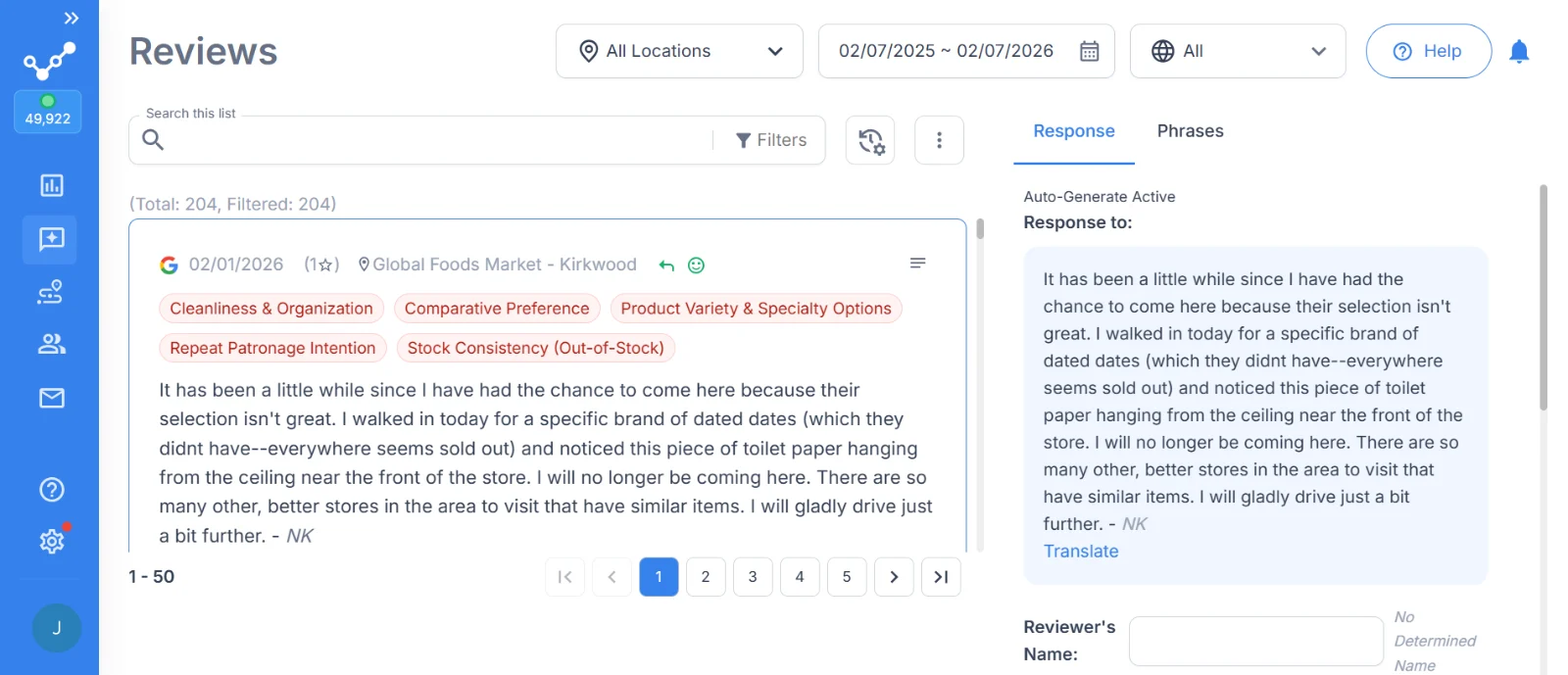
Under the hood, the platform uses a multi-step AI process that analyzes the review before the writing engine generates the response.
This agentic approach handles edge cases: it detects review updates with change tracking, identifies rating-text mismatches, examines reviewer names to determine if they appear real, correctly formats employee names mentioned in reviews, and detects the language of the review to respond appropriately.
For healthcare businesses, a PHI detection feature scans reviews for protected health information to help maintain HIPAA compliance. By separating the analytical and writing functions, the platform reduces the risk of AI generating inappropriate responses while increasing relevance.
Voice of the Customer: Aspect-based analysis that aligns with how your business operates.
RightResponse AI uses a customized version of Aspect-Based Sentiment Analysis (ABSA) powered by machine learning.
Rather than a generic positive/negative/neutral classification, the platform breaks down each review to identify specific aspects of the business the customer is discussing and assigns sentiment to each one individually.
What sets this apart is the customization. Businesses define their own topics and categories, ensuring the analysis aligns with how they think about their operations. A restaurant might track "food quality," "service speed," and "ambiance" separately, while a healthcare practice might monitor "bedside manner," "wait times," and "billing."
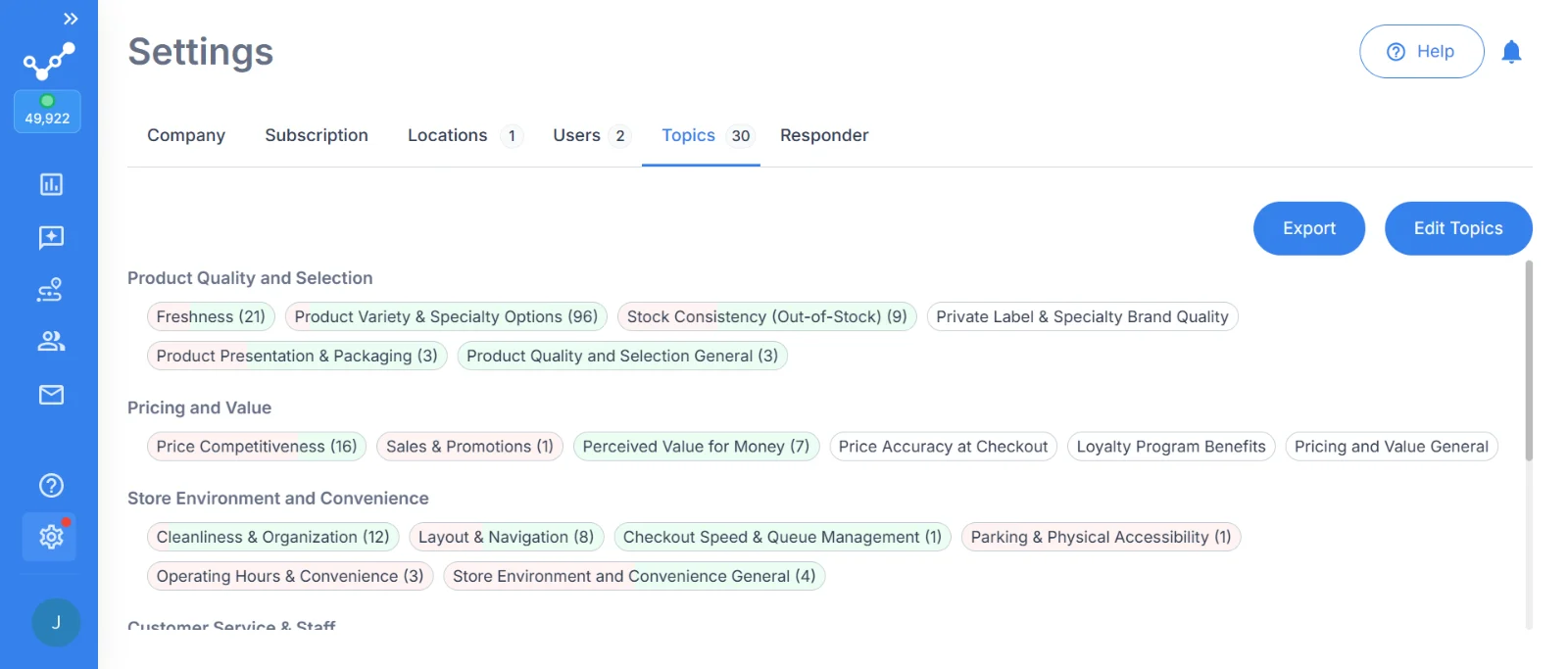
The system filters out irrelevant or vague content to focus on actual experience-based feedback.
Users can drill down to see the exact phrases from reviews mapped to each topic and sentiment, providing full context rather than just aggregated scores. Trend identification tracks shifts in sentiment over time, and the same analytical framework can be applied to competitors' reviews for a direct, apples-to-apples comparison.
Google Maps Rank Tracking with Rewind: Monitor local visibility with a unique historical playback feature.
RightResponse AI’s Map Rank Tracker creates a customizable grid of search points around a business location, simulating user searches from each point to show exactly where the business ranks on Google Maps for specific keywords. Users can configure grid size, distance between points, and scan frequency.
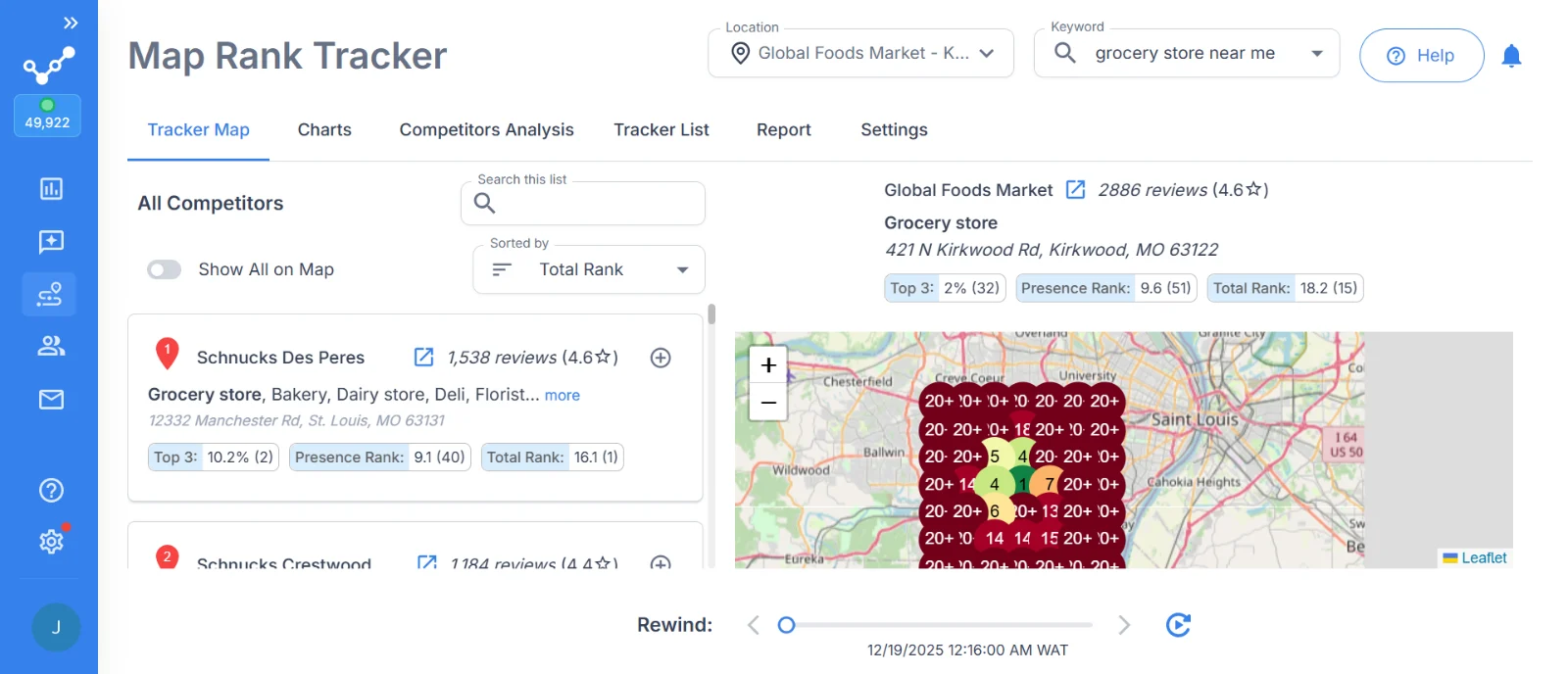
A standout feature is "Rewind," which saves every scan and allows users to visually replay how their rankings (and their competitors' rankings) have shifted over time across the entire grid. Instead of static historical charts, users watch a time-lapse of their local visibility evolving.
Key metrics include Top 3% (how often the business appears in the top three local results), Presence Rank (visibility within top 20 across the grid), and Total Rank (average ranking across all points).
Competitor analysis is integrated directly: users can click on any grid point to see which businesses rank at that location, access competitors' review metrics (volume, ratings, response rates), and even run sentiment analysis on competitors' reviews.
Review Collection: AI-personalized requests with employee attribution and unlimited follow-ups.
RightResponse AI's review request system ranges from simple template-based automation to fully AI-powered personalization.
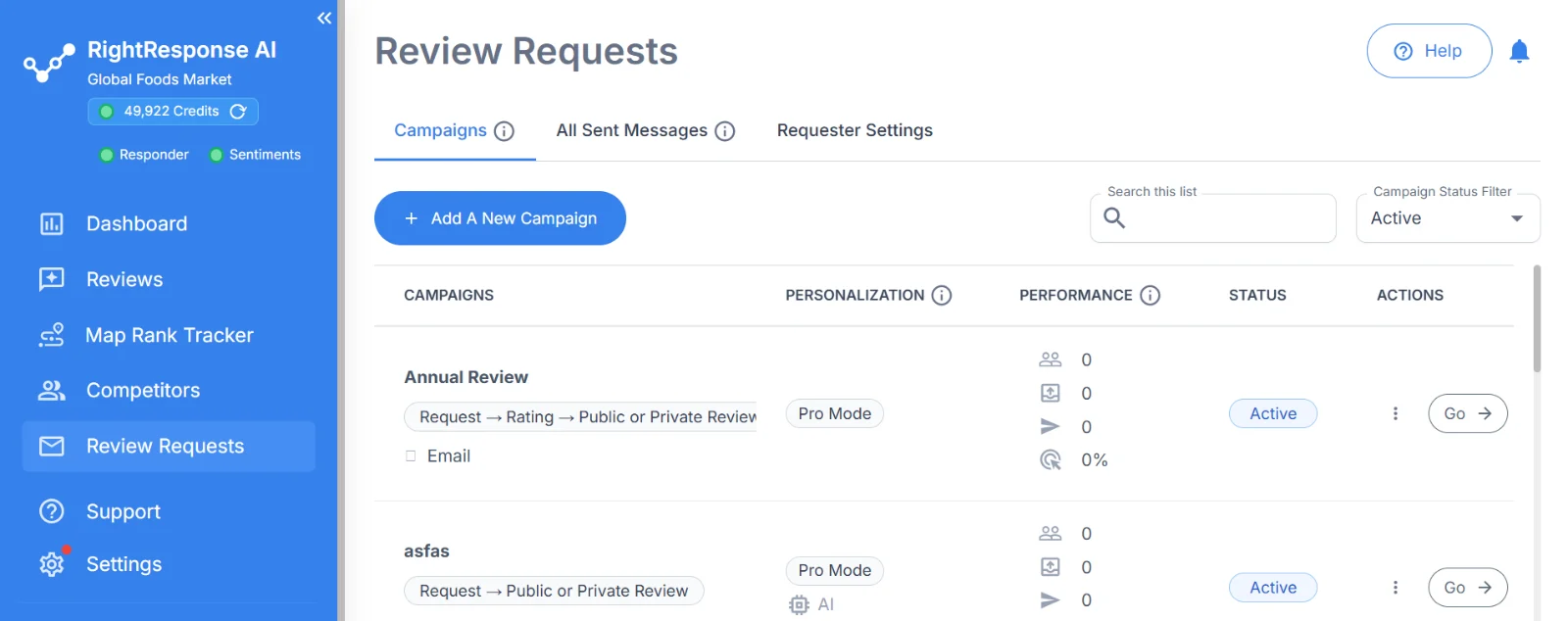
At its most advanced, the AI generates personalized invitations that reference specific details of the customer's interaction; the product purchased, the service received, the date of the visit, even the staff member who helped them. Businesses can attach a photo (like a completed project) to email requests as a visual reminder, which is more effective in home services and real estate.
Requests can include guiding questions that give reviewers inspiration about what to write, naturally encouraging mentions of SEO-relevant keywords. These questions rotate so that reviews contain varied content over time.
Multi-channel delivery covers email and SMS. Contact information can be sourced through direct entry, file uploads, remote Google Sheets, Zapier integrations, or custom-developed APIs.
The platform supports unlimited automated follow-ups. Users can configure as many as their business needs, unlike some competing systems that cap follow-up requests. A private feedback option routes negative experiences to an internal channel before they become public reviews.
A notable differentiator is employee-level attribution: each staff member can receive their own personalized QR code, enabling the business to track which employees are driving review volume and conversion. This opens the door to incentive programs tied directly to review generation performance.
Transparent, Flexible Pricing: Self-serve plans plus Pay As You Go.
RightResponse AI charges $10 per location per month on its Pay As You Go (PAYGO) plan, billed with usage-based credits. PAYGO suits businesses that are just starting out or have low, variable review volume across locations.
For those that prefer predictable monthly billing, RightResponse AI also offers three fixed plans, each priced per location:
Core ($19/month): 100 review responses, 1,000 email review requests, and Essentials request templates on a basic dashboard (no SMS, surveys, or map rank tracking).
Pro ($29/month, most popular): 200 review responses, 2,000 email requests plus 200 SMS, 200 surveys, AI-powered review requests, and Map Rank Tracking with competitor analysis (10 scans per month) on an advanced dashboard.
Pro+ ($44/month): 500 review responses, 5,000 email requests plus 500 SMS, 500 surveys, advanced automation with bulk processing, Competitor Voice of the Customer, and 25 map-rank and competitor scans per month.
For agencies and large multi-location businesses, custom Enterprise plans add white-label options, API access, and advanced reporting.

Usage is then billed through a credit system with tiered pricing that decreases per credit as volume increases. Credit costs are 20 credits per review response, 20 credits per sentiment analysis, 2 credits per email review request, and 1.5 credits per map rank tracker pin. As a reference point, sentiment analysis plus AI response generation costs approximately 20 credits per review, which at the entry tier ($0.01/credit) works out to about $0.20 per review.
This usage-based model means businesses aren't paying flat per-location fees for capacity they don't use. A location receiving 10 reviews per month pays significantly less than one receiving 100. This structure is fair for businesses with variable review volume across locations, and one that allows agencies to scale cleanly across client accounts.
A 7-day free trial includes 1,000 usage credits and access to most Pro features, with no credit card required. Monthly and annual billing options are both available, and plans can be canceled at any time.
Prefer a hands-off option? Our Done-For-You team can manage review requests, monitoring, responses, reporting and reputation insights for you. See current Done-For-You pricing.
ReviewTrackers or RightResponse AI: Comparison Summary
ReviewTrackers | RightResponse AI | |
|---|---|---|
Founded | 2012 (acquired by InMoment 2022) | 2024 |
Review Sources | 100+ sites | |
AI Response Quality | AI suggestions + customizable templates | Three-pillar system: Facts, Customizations, and Brand Voice for hyper-personalized responses |
Sentiment Analysis | ⭐⭐⭐ NLP-based, some reported inconsistencies | ⭐⭐⭐⭐⭐ Customized Voice of the Customer (VOC) with user-defined topics and direct phrase extraction |
Review Collection | Email, SMS, Kiosk, QR codes, Microsurveys | AI-personalized requests via email and SMS with photos, guiding questions, employee attribution, and unlimited follow-ups |
Local Search Tracking | Keyword-based rank tracking (add-on) | Grid-based Map Rank Tracker with "Rewind" historical playback |
Competitor Analysis | Review metrics and benchmarking | Review metrics, sentiment analysis, and map rank comparison |
Pricing Transparency | No public pricing; sales consultation required | From $10/location/month PAYGO + credits; fixed plans Core $19, Pro $29, Pro+ $44/month; Enterprise custom (public pricing) |
Free Trial | Available (details require contacting sales) | 7-day trial with 1,000 free credits |
Contract Flexibility | Annual billing | Monthly or annual billing; cancel anytime |
Multi-Location Support | ⭐⭐⭐⭐⭐ Enterprise-grade with 60,000+ businesses served | ⭐⭐⭐⭐ Scalable from single location to enterprise |
Done-For-You Service | Not publicly listed | |
Customer Support | Well-regarded support team | Email, chat, knowledge base, and Done-For-You service |
Best For | Established enterprises needing broad integrations and proven market credibility | Businesses that prioritize review response quality and want every reply to actively market their business |
Final Verdict
The choice between ReviewTrackers and RightResponse AI comes down to what matters most to your business today.
Choose ReviewTrackers if you need a well-established reputation management platform with broad review source coverage and a proven track record serving multi-location enterprises.
Its integration with InMoment's Experience Improvement ecosystem, extensive Zapier connections, and features like employer brand monitoring and review widgets make it a solid choice for organizations that value breadth of functionality and established market credibility. ReviewTrackers is the platform for teams that want a familiar, comprehensive system backed by over a decade of development.
Get started with ReviewTrackers here.
Choose RightResponse AI if you believe the quality of your review responses directly impacts whether the next customer chooses your business. Its three-pillar personalization system (Facts, Customizations, and Brand Voice) turns every response into a conversion asset that actively markets your business, not a generic "thanks for your review" that prospective customers skip over.
With Voice of the Customer, grid-based map rank tracking, advanced AI-powered review collection, and transparent usage-based pricing, RightResponse AI is built for location-based businesses of all sizes, from single-location operations to enterprise, that want smarter AI and fairer economics from their reputation management platform.
Start your free trial of RightResponse AI here.
Both platforms serve the same key need: helping businesses manage and grow their online reputation.
ReviewTrackers brings the stability and breadth of a mature platform with enterprise-grade multi-location management. RightResponse AI brings the response quality and personalization depth of a platform purpose-built for the AI era, treating every review reply as an opportunity to win the next customer. Your choice depends on which of those qualities will move the needle most for your business.
Frequently Asked Questions
When should I choose ReviewTrackers for my business?
Choose ReviewTrackers if you need a well-established reputation management platform with broad review source coverage and a proven track record serving multi-location enterprises. Its integration with InMoment's Experience Improvement ecosystem, extensive Zapier connections, and features like employer brand monitoring and review widgets make it a solid choice for organizations that value breadth of functionality and established market credibility.
When is RightResponse AI a better choice than ReviewTrackers?
Choose RightResponse AI if you believe the quality of your review responses directly impacts whether the next customer chooses your business. Its three-pillar personalization system (Facts, Customizations, and Brand Voice) turns every response into a conversion asset that actively markets your business. With Voice of the Customer, grid-based map rank tracking, sophisticated AI-powered review collection, and transparent usage-based pricing, RightResponse AI is built for location-based businesses of all sizes that want smarter AI and fairer economics from their reputation management platform.
What are the main differences between ReviewTrackers and RightResponse AI?
The main differences include: AI response quality (ReviewTrackers uses AI suggestions and templates vs RightResponse AI's three-pillar personalization system with Facts, Customizations, and Brand Voice), sentiment analysis (ReviewTrackers uses basic NLP with reported inconsistencies vs RightResponse AI's customized aspect-based analysis with user-defined topics), pricing transparency (ReviewTrackers requires sales consultation with annual billing vs RightResponse AI's publicly listed usage-based pricing), and review collection (ReviewTrackers offers email, SMS, kiosk, and QR codes vs RightResponse AI's AI-personalized requests with employee attribution and unlimited follow-ups).
How much does RightResponse AI cost compared to ReviewTrackers?
RightResponse AI offers Pay As You Go (PAYGO) at $10 per location per month plus usage-based credits (approximately $0.20 per review for Voice of the Customer and AI response), along with fixed monthly plans: Core ($19), Pro ($29), and Pro+ ($44), plus custom Enterprise plans (which add API access). A 7-day free trial includes 1,000 credits. ReviewTrackers does not publish its pricing and requires a sales consultation, with annual billing only and no free plan available. Key features like local SEO and listings management are available only as paid add-ons.
Try RightResponse AI for Free!
*No credit card required.