Choosing between Moz Local vs Yext for managing your local online presence often comes down to these five critical questions:
Comparison research: This article is part of the RightResponse AI review management software comparison library, which connects platform reviews, pricing analyses, alternatives, and head-to-head evaluations.
- Do you need a simple, affordable tool for listing management, or a full-scale enterprise digital presence platform?
- Is managing and responding to customer reviews a top priority, or are you primarily focused on listing accuracy?
- How important is it that your review responses are genuinely personalized and aligned with your brand's voice and messaging?
- Do you need deep, AI-powered Voice of the Customer analysis that tells you exactly why customers feel the way they do?
- Are you a small business watching every dollar, or an enterprise with a dedicated digital marketing budget?
In short, here's what we recommend:
👉 Moz Local is a solid all-in-one local SEO tool for small to medium-sized businesses in the US, Canada, and the UK. It offers automated listing management across 90+ directories, centralized review monitoring, social media posting, and hyper-local rank tracking through its GeoRank feature. Moz Local benefits from the strong brand reputation of its parent company, Moz, and its user-friendly interface makes it accessible to users without deep technical expertise. However, its geographic availability is limited to three countries, its AI-powered review response tools are available only as add-ons on higher-tier plans, and the ongoing SEO value of mass directory submissions continues to be debated within the industry.
👉 Yext is a powerful enterprise-grade digital presence platform built for multi-location brands. Its Knowledge Graph technology creates a structured, AI-ready single source of truth for business information, which is then syndicated across 200+ publishers through direct API integrations. Yext also offers review management with generative AI response capabilities, AI-powered search for websites, and landing page creation. While Yext's technology and publisher network are impressive, its custom pricing model can be expensive and opaque, its interface has drawn criticism for complexity, and some users have reported inconsistent customer support experiences.
Both platforms offer valuable tools for managing your local online presence. However, neither was designed around the idea that how a business engages with customer feedback can be a growth engine in its own right. Managing listings is important, but in 2026, the quality of your review engagement is becoming one of the most important factors separating thriving local businesses from the rest.
👉 RightResponse AI is an AI-powered reputation management platform designed to help location-based businesses, regardless of size, from single-location operations to enterprise, attract new customers through intelligent review engagement. Its response personalization system combines three distinct pillars: a Facts library (business-specific messaging mapped to review themes), Customizations (behavioral rules and controls), and Brand Voice (tone and style settings), enabling hyper-personalized, brand-aligned responses with endless variation without losing control. Its Voice of the Customer Aspect-Based Sentiment Analysis (ABSA) reveals exactly what drives customer satisfaction and dissatisfaction, while its Google Maps rank tracker and competitor insights tools connect reputation management directly to local search visibility. The platform also includes an advanced, AI-powered review collection system. With flexible pricing that starts at $10 per location per month on Pay As You Go (PAYGO), plus fixed Core, Pro, and Pro+ plans, RightResponse AI delivers advanced AI capabilities with commercial flexibility that avoids rigid per-location lock-in.
If turning your customer reviews into a competitive advantage sounds like what your business needs, start your free 7-day trial of RightResponse AI.
Table of contents:
- Moz Local vs Yext vs RightResponse AI at a glance
- The real battleground has shifted from listings to reviews
- Moz Local covers the basics, Yext goes enterprise-wide
- Review response quality separates good from great
- Voice of the Customer: Surface-level vs surgical precision
- Google Maps rank tracking and competitor intelligence
- Pricing reveals who each platform is really built for
- Integration and scalability for growing businesses
- Moz Local vs Yext vs RightResponse AI: Which should you choose?
Moz Local vs Yext vs RightResponse AI at a glance
Here's the fundamental difference: While all three platforms help businesses manage their local online presence, they approach the challenge from distinctly different angles.
- Moz Local is an accessible, all-in-one local SEO tool for SMBs that combines listing management, review monitoring, and social media posting.
- Yext is a comprehensive enterprise platform that uses its Knowledge Graph to power listings, reviews, web pages, and on-site search at scale.
- RightResponse AI is a purpose-built reputation management platform that uses advanced generative AI to transform customer reviews into a growth engine, with built-in review collection, Voice of the Customer, and local rank tracking.
Moz Local | Yext | RightResponse AI | |
|---|---|---|---|
Primary focus | All-in-one local SEO for SMBs | Enterprise digital presence management | AI-powered reputation management |
Listing management | ⭐⭐⭐⭐ | ⭐⭐⭐⭐⭐ 200+ publishers via direct APIs | Not a primary focus |
Review collection | ⭐⭐⭐ Basic review monitoring | ⭐⭐⭐ Review monitoring across publisher network | ⭐⭐⭐⭐ AI-personalized requests via email and SMS |
Review response quality | ⭐⭐⭐ AI add-on available, templates | ⭐⭐⭐⭐ Generative AI responses with customizable guidelines | ⭐⭐⭐⭐⭐ Facts, Customizations & Brand Voice system |
Voice of the Customer | ⭐⭐⭐ Basic sentiment scoring | ⭐⭐⭐ Keyword-level NLP sentiment | ⭐⭐⭐⭐⭐ Customized Aspect-Based Sentiment Analysis |
Google Maps rank tracking | ⭐⭐⭐⭐ GeoRank heat maps | ⭐⭐⭐ Search Tracker for competitive intelligence | ⭐⭐⭐⭐⭐ Grid-based tracking with "Rewind" feature |
Competitor analysis | ⭐⭐⭐ Basic benchmarking | ⭐⭐⭐⭐ Competitive intelligence add-on | ⭐⭐⭐⭐ Deep review and sentiment analysis of competitors |
Ease of use | ⭐⭐⭐⭐⭐ Intuitive, gentle learning curve | ⭐⭐⭐ Complex, steeper learning curve | ⭐⭐⭐⭐ Straightforward, quick setup |
Starting price | $20/month per location | Custom pricing (contact sales) | PAYGO $10/mo + credits; fixed Core $19 / Pro $29 / Pro+ $44 per location; custom Enterprise |
Best for | SMBs in the US, Canada, UK | Multi-location enterprises | Location-based businesses of any size focused on reputation growth |
The real battleground has shifted from listings to reviews
For years, the local SEO conversation centered on listings: making sure your business name, address, and phone number were consistent across every directory on the internet. And that work still matters. Inconsistent NAP data confuses both search engines and customers, and 52% of consumers have reported leaving a negative review after encountering incorrect business information online.
But here's the reality in 2026: listing accuracy is increasingly table stakes, and the competitive edge is shifting. What increasingly separates businesses that dominate local search from those that don't is how they engage with customer reviews.
Google's own algorithms increasingly weight review signals, including review volume, recency, rating, and how (and whether) a business responds. Reviews themselves help businesses rank higher in local search, that's the value of the review.
The value of the response is different: it's about winning the next customer. When a prospect is comparing two businesses with similar ratings and review counts, the one with richer, more engaging responses has an edge. Generic "thanks for your review" replies waste that opportunity.
The challenge is that most people currently skip reading responses because they're generic and uninformative. Quality responses represent the untapped opportunity; when responses contain genuine substance, they give prospective customers a reason to stop and read. That's a competitive advantage most businesses haven't captured yet.
This is where the three platforms diverge most significantly. Moz Local and Yext started as listing management tools and added review features over time. RightResponse AI was designed around making review engagement a strategic advantage.
Moz Local covers the basics, Yext goes enterprise-wide
When it comes to managing business listings, both Moz Local and Yext are proven solutions, though they serve different audiences.
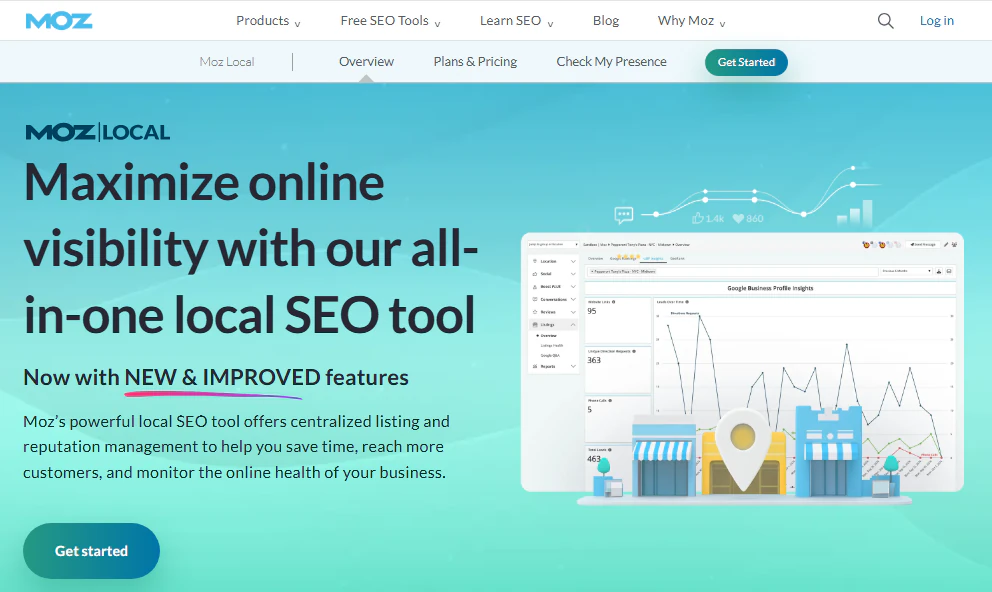
Moz Local distributes business information across 90+ directories, including major platforms like Google, Facebook, and Apple Maps, as well as key data aggregators like Data Axle and Neustar Localeze.
The submission to data aggregators is particularly valuable because these aggregators feed information to thousands of additional directories, creating a cascading effect of data consistency. New location data typically takes around four weeks to process and publish across the network, with updates to existing locations taking two to three weeks.
The platform's listing health dashboard provides a clear overview of profile completeness and data consistency. A separate duplicate detection and suppression tool helps consolidate a business's online identity into a single, authoritative source.
Yext operates on a different level of scale.
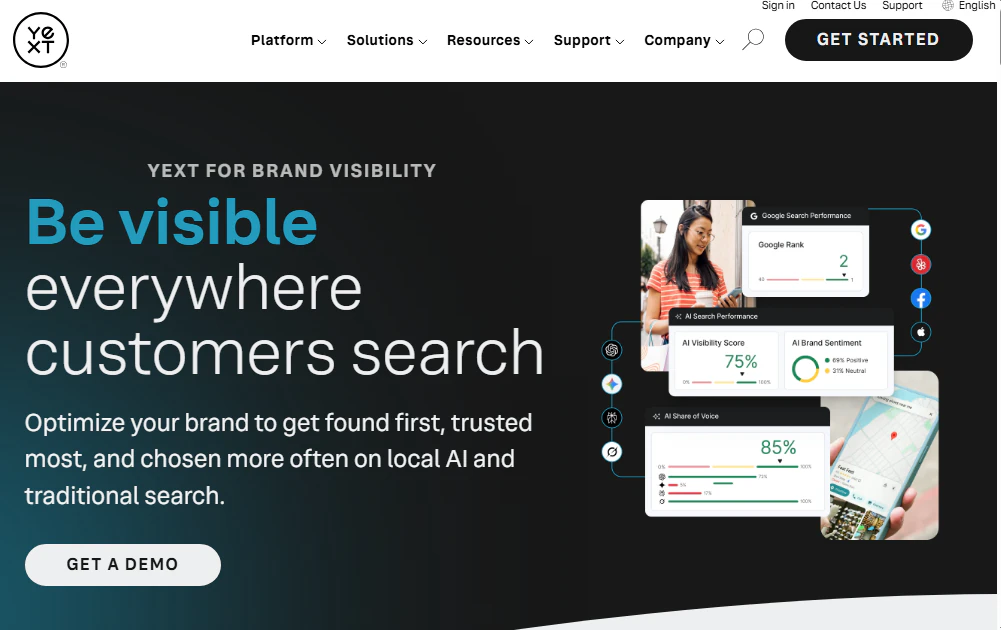
Its Knowledge Graph structures a brand's information into interconnected entities and relationships, creating what the company calls an "AI-ready" dataset. This structured data is then syndicated to over 200 publishers through direct API integrations, which is a significant technical advantage. Direct API connections mean that updates propagate in near real-time, compared to the weeks that aggregator-based distribution can require.
Yext's publisher network is broader and includes major search engines, mapping services, voice assistants like Amazon Alexa and Siri, social media platforms, and industry-specific directories including those for healthcare.
For a hospital system or restaurant chain with hundreds of locations, this breadth is essential. The platform also offers landing page creation through Yext Pages and on-site search through Yext Search, making it a comprehensive digital presence solution.
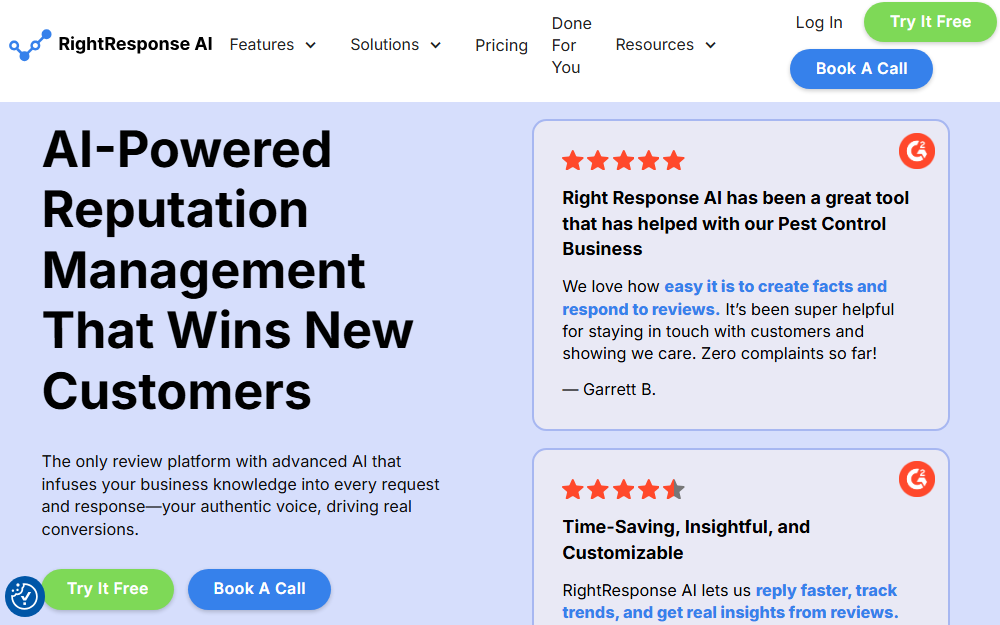
RightResponse AI takes a different approach, focusing its platform on the intelligence layer it adds on top of your review ecosystem rather than directory-level listing distribution. The platform's core strength lies in AI-powered review engagement, Voice of the Customer, review collection, and local rank tracking.
Review response quality separates good from great
This is where the comparison gets interesting, because the quality gap in review response capabilities across these three platforms is notable.
Moz Local offers centralized review monitoring across multiple platforms and the ability to respond to reviews directly from the dashboard for Google and Facebook.
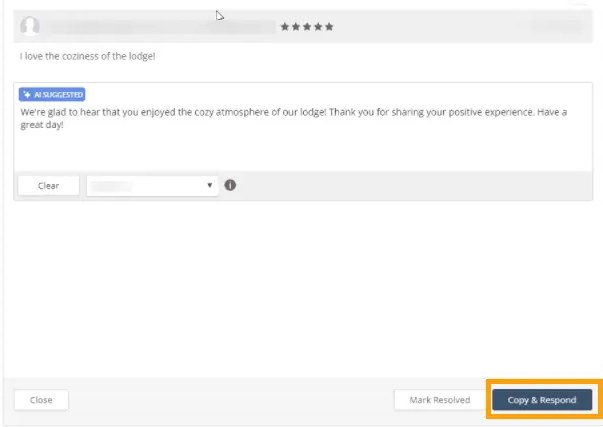
The platform provides review response templates and, through its Reviews AI add-on (available on Preferred and Elite plans), can generate AI-suggested responses with customizable GPT directives that allow users to shape the tone and content of replies. These are functional tools, but the AI capabilities are positioned as paid add-ons rather than core features, and the depth of business-specific personalization differs from platforms designed around AI response generation as their foundation.
Source: Moz
Yext provides review monitoring across its publisher network and offers Generative Review Response, an LLM-powered feature that generates individualized responses with customizable guidelines for language, tone, length, and compliance.
The platform includes a Generative Response Playground for testing prompts before going live, along with pre-defined templates and automated workflow rules that can route reviews to specific team members based on criteria like star rating or location. For enterprises managing reviews across hundreds of locations, these workflow tools are genuinely useful.
However, Yext's response customization operates through guidelines and templates rather than a structured system that maps specific business messaging to the topics customers mention in their reviews.
RightResponse AI takes a fundamentally different approach to review responses through a three-pillar personalization system.
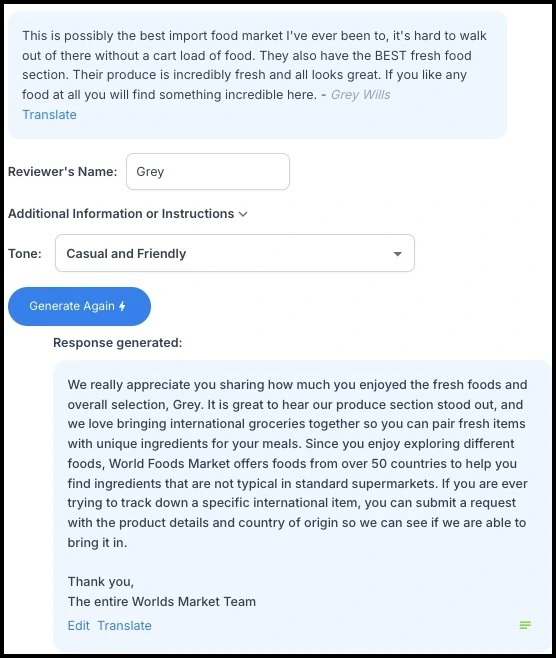
The first pillar, the "Facts" library, allows businesses to input specific selling points, operational details, promotions, and brand values. When a customer leaves a review, the AI analyzes its content, identifies the relevant theme, and selects which facts apply, weaving them naturally into the response. A review mentioning great service might trigger a response that also highlights the team's training philosophy or an upcoming loyalty program.
The second pillar, Customizations, provides behavioral rules and controls; how the response should handle greetings, names, edge cases, and sensitive topics. The third pillar, Brand Voice, ensures every response matches the business's tone and style. All three work together to produce responses with endless variation without losing control.
Under the hood, the platform uses a multi-step AI process that separates analytical functions from writing functions. The system analyzes the review before generating a response, detecting context, handling edge cases like review updates and rating/text mismatches, and for medical use cases, avoiding Protected Health Information (PHI) in responses. This separation reduces the risk of inappropriate output while increasing relevance.
The result is review responses that contain genuine substance, not generic filler. Each response actively markets the business, giving prospective customers real reasons to choose that business when they're scanning reviews during their decision-making process.
Voice of the Customer: Surface-level vs surgical precision
Understanding what customers are saying in their reviews is only valuable if you can translate that understanding into action. The depth of sentiment analysis varies significantly across these platforms.
Moz Local provides a sentiment view within its review dashboard that categorizes reviews as positive, neutral, or negative.
Users can filter by date and review network, and the dashboard provides an overview of sentiment trends over time. It's useful for tracking overall patterns, but it doesn't tell you much about the specific reasons behind customer sentiment.
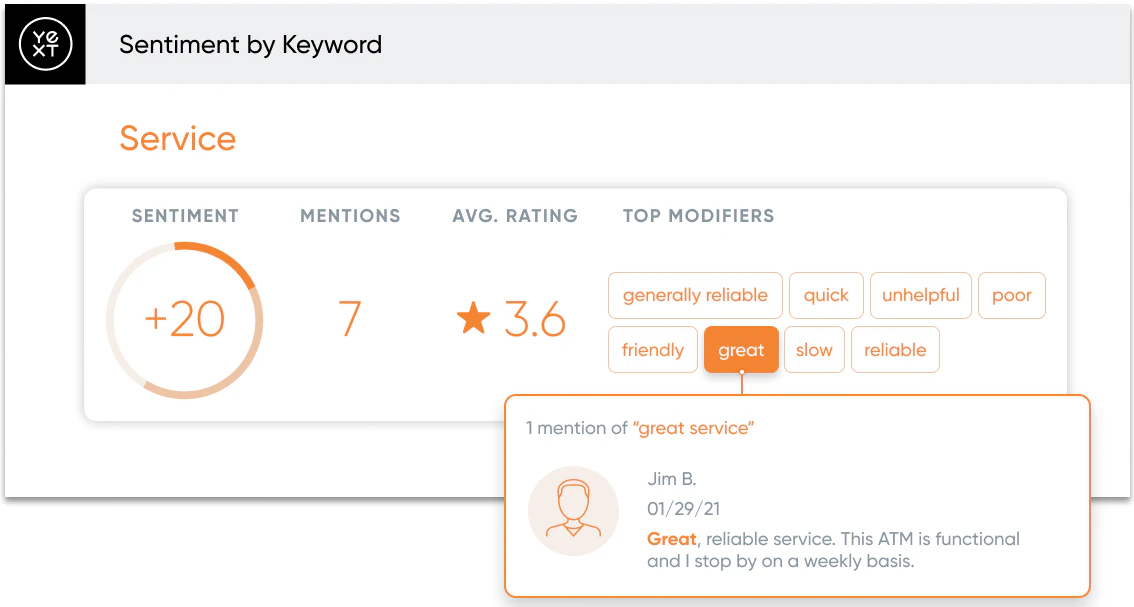
Yext offers sentiment analysis that uses Natural Language Processing to identify keywords and themes within reviews, assigning sentiment scores between -90 and +90 based on context and modifiers.
Source: Yext
The platform can highlight recurring topics, surface top modifiers used to describe those keywords, and allows administrators to create custom keyword collections for grouped analysis. This is a meaningful step up from basic positive/negative scoring, though the analysis operates primarily at the keyword level rather than providing deep contextual understanding of full review narratives.
RightResponse AI operates at a different level with its Voice of the Customer Aspect-Based Sentiment Analysis (ABSA).
Instead of simply tagging a review as "positive" or "negative," the platform breaks down each review into sentence fragments, assigns each to a specific category and topic relevant to that business, and gauges sentiment direction and intensity for each aspect independently.
Here's what makes this practical: a restaurant review might say, "The pasta was incredible but we waited 45 minutes for a table." Basic sentiment analysis might categorize this as mixed or neutral.
RightResponse AI's ABSA identifies two distinct aspects, food quality (positive) and wait times (negative), and tracks each independently. Over hundreds of reviews, this creates a precise map of exactly where a business excels and where it needs improvement.
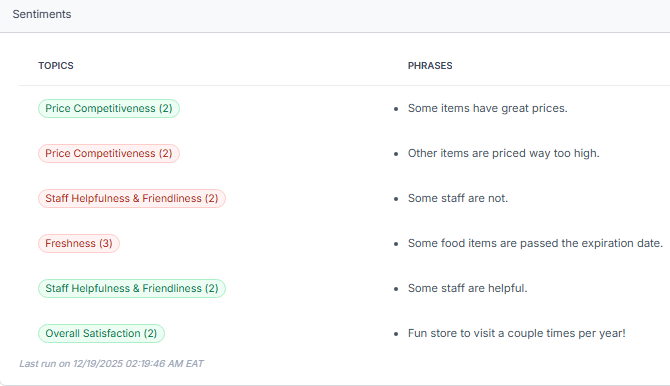
The platform also lets businesses define and customize the categories and topics being analyzed, so the analysis aligns with how the business actually thinks about its operations. The AI filters out vague or irrelevant content to focus on genuine, experience-based feedback. Users can drill down to see the exact phrases from reviews that map to each topic and sentiment, providing full context behind every data point.
This same analytical framework can be applied to competitors' reviews, creating a side-by-side comparison of strengths and weaknesses on specific operational topics.
Google Maps rank tracking and competitor intelligence
For location-based businesses, visibility on Google Maps can directly translate to foot traffic and phone calls. All three platforms offer some form of local rank tracking, but the depth and actionability of the insights differ.
Moz Local offers its GeoRank feature, which displays local search rankings on an interactive heat map.
Users can track their business's ranking for target keywords at various geographic points, providing a hyper-local perspective on map pack visibility. GeoRank is a capable tool that's available on all Moz Local plans, including the entry-level Lite tier.

Source: Moz
Yext approaches competitive intelligence differently, offering a Search Tracker that monitors rankings for specific keywords and compares them against competitors.
The Competitive Intelligence add-on allows tracking up to five competitors on metrics like search performance and review ratings, with automatic detection of competitors appearing in local pack results. However, this feature is a paid add-on rather than a core inclusion, and the focus is more on aggregate competitive positioning than granular geographic rank tracking.
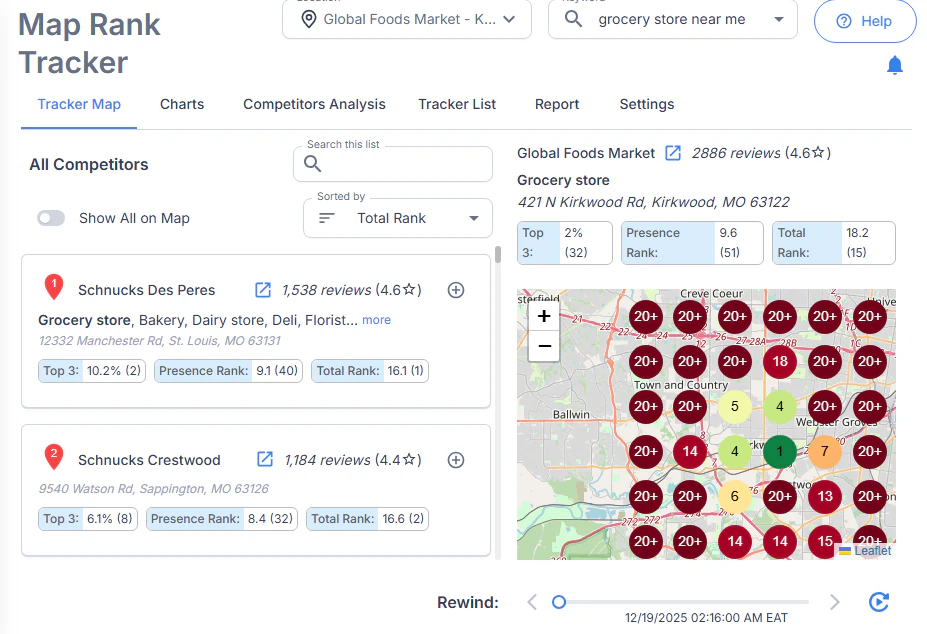
RightResponse AI provides a Google Maps rank tracker that creates a customizable grid around a business's location, simulating searches from each grid point to show exactly where the business ranks. Users can choose grid sizes, set the distance between points, and schedule scans at whatever frequency they need.
What sets RightResponse AI's tracker apart is the "Rewind" feature, which saves every scan and allows users to visually replay how rankings have evolved over time. Instead of comparing static snapshots, users can watch their position shift across the grid with each historical scan, providing an intuitive understanding of ranking dynamics.
The platform tracks three key metrics: Top 3% (how often the business appears in the top three local results), Presence Rank (visibility within the top 20 results across all grid points), and Total Rank (average ranking across the entire grid). Users can also click on any grid point to see which specific competitors rank there.
The deeper layer is how RightResponse AI connects rank tracking to its reputation analysis.
Users can dive into competitors' review metrics, including volume, ratings, and response rates over 60 and 180-day periods, and run the same ABSA sentiment analysis on competitor reviews. This creates a more complete picture: not just who outranks you, but what their customers are saying and where their operational weaknesses might be.
Pricing reveals who each platform is really built for
The pricing structures of these platforms tell you a lot about their intended customers.
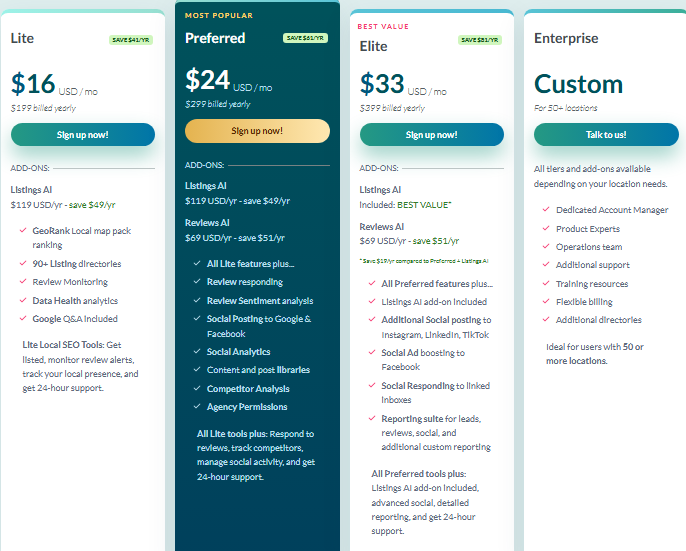
Moz Local offers three transparent tiers, all priced per location:
- Lite: $20/month ($16/month billed yearly) — Listing management, GeoRank, review monitoring, and 24-hour support.
- Preferred: $30/month ($24/month billed yearly) — Adds review responding for Google and Facebook, review sentiment analysis, social posting for Google and Facebook, competitor analysis, and agency permissions.
- Elite: $40/month ($33/month billed yearly) — Adds Listings AI, expanded social media posting (Instagram, LinkedIn, TikTok), Facebook ad boosting, social responding, and a full reporting suite.
AI add-ons carry additional costs: Listings AI is $14/month on Lite and Preferred plans, and Reviews AI is $10/month on Preferred and Elite plans. Moz Local offers a free trial for new users.
Source: Moz
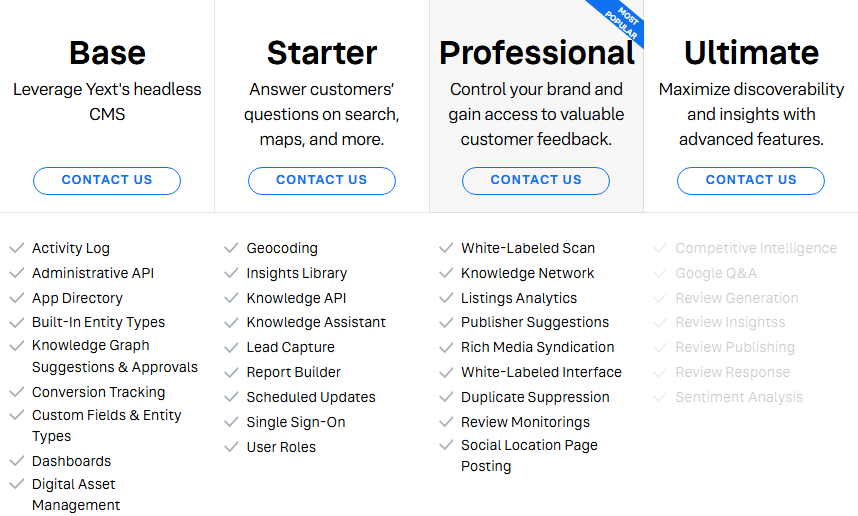
Yext uses a custom, quote-based pricing model with core enterprise pricing not listed publicly.
Prospective customers must contact sales for a demo and pricing for most products. Enterprise packages are built from modular products (Listings, Reviews, Pages, Search), each adding to the total cost. Competitive Intelligence, additional users beyond 50, and Yelp integrations are all add-ons. There is no free trial for the core Listings product.
Industry estimates and user reports suggest Yext's pricing is significantly higher than Moz Local's, reflecting its enterprise positioning. For businesses with dozens or hundreds of locations, the per-location costs and implementation fees can represent a substantial investment.
Source: Yext
RightResponse AI takes a different approach with transparent pricing built around commercial flexibility, offering a Pay As You Go (PAYGO) option alongside fixed monthly plans; Core at $19, Pro at $29, and Pro+ at $44 per month, plus custom Enterprise pricing:
- PAYGO: $10/month per location — billed per location plus usage credits, with all features available on demand. Best for starting out, low volume, or narrow needs; you pay only for what you use (roughly 20 credits per review response, 2 per email request, 1.5 per map rank pin).
- Core — $19/month: 100 review responses, 1,000 email review requests, Essentials request templates, and a basic dashboard — no SMS, surveys, or map rank tracking.
- Pro — $29/month (Most Popular): 200 review responses, 2,000 email requests plus 200 SMS, 200 surveys, AI-powered review requests, and Map Rank Tracking with competitor analysis (10 scans/month).
- Pro+ — $44/month: 500 review responses, 5,000 email requests plus 500 SMS, 500 surveys, advanced automation and bulk processing, Competitor Voice of the Customer, and 25 map-rank and competitor scans per month.
- Enterprise: custom plans for agencies and multi-location brands, with white-label, API access, and advanced reporting.
A 7-day free trial is available with 1,000 usage credits and access to most Pro features, with no credit card required.

Source: RightResponse AI
The usage-based model means businesses aren't forced into paying per-location for capacity they don't use. The fixed Core, Pro, and Pro+ plans give predictable monthly costs with clear limits on responses, requests, SMS, surveys, and map-rank scans, while PAYGO stays flexible for low-volume or variable needs and bills only for what a location actually uses.
For agencies managing multiple clients, this model scales cleanly across accounts without the pricing rigidity common in flat-rate per-location platforms.
Integration and scalability for growing businesses
How each platform fits into your existing tech stack and scales with your growth matters.
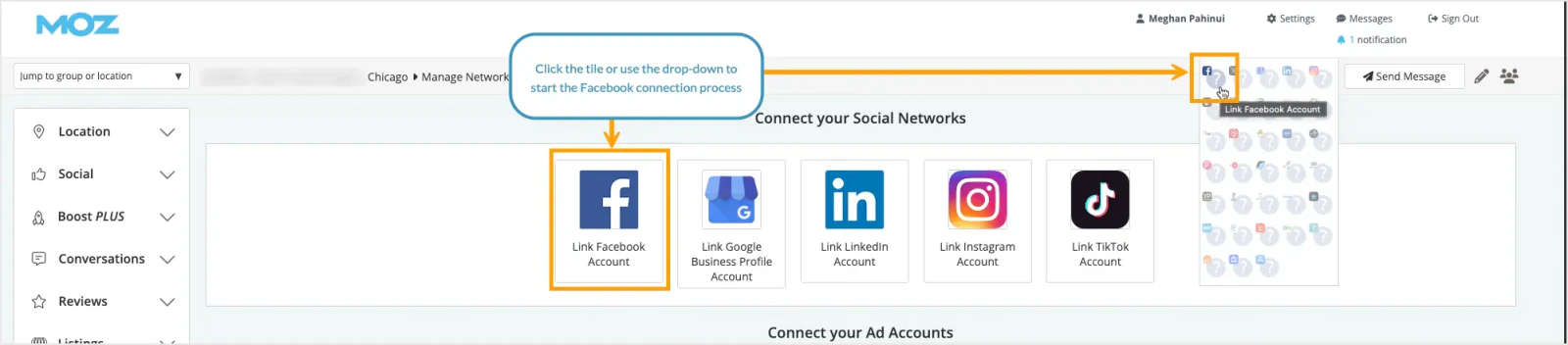
Moz Local integrates directly with Google Business Profile, Facebook, Instagram, TikTok, and LinkedIn.
Source: Moz
Beyond these direct integrations, it syndicates data to a wide network of directories and data aggregators including Apple Maps, Yelp, and Bing. The platform is designed to be scalable, with a centralized dashboard for managing multiple locations and a bulk purchase option for adding numerous locations at once. However, it's limited to businesses in the US, Canada, and the UK.
Yext has the most extensive integration ecosystem of the three.
Its App Directory features over 150 pre-built integrations with platforms like Salesforce, HubSpot, Zendesk, Tableau, and WordPress. Its publisher network spans 200+ direct API connections. Yext also offers robust APIs and webhook capabilities for custom integrations. The platform is built for enterprise scale, with features like JIT provisioning through SAML, granular role-based access controls, and SOC 2 certification.
RightResponse AI integrates natively with Google and sources reviews from 125+ review platforms.
For review collection, the platform supports multiple delivery channels, email and SMS, with contact data sourced via direct entry, file uploads, Zapier integrations, and custom APIs. The Review Requester offers both standard template-based requests and AI-powered personalized requests that can incorporate customer data like name, service history, and tenure.
API access is available through the Enterprise plan for custom integrations and workflows. The platform is designed to scale from single-location businesses to large multi-location operations, with enterprise plans including customized reporting and white-label agency services.
For businesses deeply embedded in a complex enterprise tech stack, Yext's integration breadth is hard to match. For businesses primarily focused on reputation management and local SEO, RightResponse AI's integration approach covers the most critical touchpoints without unnecessary complexity.
Moz Local vs Yext vs RightResponse AI: Which should you choose?
The right platform depends on where your biggest opportunities and pain points lie.
Choose Moz Local if:
- You're a small to medium-sized business in the US, Canada, or the UK
- Listing accuracy across directories is your primary concern
- You want an affordable, easy-to-use all-in-one local SEO tool
- Basic review monitoring and social media posting meet your needs
- You value a gentle learning curve and the trusted Moz brand
Get started with Moz Local to manage your local listings and monitor your online presence.
Choose Yext if:
- You're a multi-location enterprise with dozens or hundreds of locations
- You need a comprehensive digital presence platform beyond just listings and reviews
- Direct API integrations with 200+ publishers are essential for your business
- You require enterprise-grade governance, SSO, and compliance features
- Budget is less of a concern than having maximum control and scale
Explore Yext's enterprise digital presence platform with a demo.
Choose RightResponse AI if:
- You want review responses that actively market your business through Facts, Customizations, and Brand Voice
- Understanding exactly what drives customer sentiment is important to your operations
- You need both review collection and review response handled with AI-powered personalization
- You want a Google Maps rank tracker with deep competitor intelligence
- You're a location-based business of any size, from a single location to enterprise, that sees review engagement as a growth lever
- You want flexible pricing, whether fixed Core, Pro, and Pro+ plans with clear limits or Pay As You Go that scales with your actual usage
The local SEO landscape has matured to a point where listing management, while still essential, is no longer enough on its own to set your business apart.
Reviews help businesses rank higher in local search. But the response, the only part of the review a business controls, is where the next customer is won or lost. Most responses today are generic and easily skipped. The businesses gaining an edge are the ones making their responses worth reading: specific, substantive, and aligned with their brand. That's the opportunity RightResponse AI was designed to capture.
Frequently Asked Questions
When should I choose Moz Local over Yext?
Choose Moz Local if you're a small to medium-sized business in the US, Canada, or the UK that needs an affordable, easy-to-use all-in-one local SEO tool. Moz Local starts at $20/month per location and offers listing management across 90+ directories, review monitoring, social posting, and GeoRank local rank tracking. It's ideal if listing accuracy is your primary concern and you value a gentle learning curve.
When is Yext a better choice than Moz Local?
Choose Yext if you're a multi-location enterprise with dozens or hundreds of locations that needs a comprehensive digital presence platform. Yext's Knowledge Graph and direct API integrations with 200+ publishers provide near real-time listing updates, and its enterprise features include SSO, granular access controls, and SOC 2 certification. However, pricing is custom and typically significantly higher than Moz Local.
How does RightResponse AI differ from Moz Local and Yext?
RightResponse AI is purpose-built for reputation management rather than listing distribution. Its three-pillar personalization system (Facts, Customizations, and Brand Voice) generates review responses that actively market your business. It also offers Voice of the Customer using Aspect-Based Sentiment Analysis (ABSA) that breaks reviews into individual aspects with independent sentiment scores, a Google Maps rank tracker with a unique Rewind feature, and AI-powered review collection. Pricing is Pay As You Go at $10/month per location plus usage-based credits, with fixed Core $19, Pro $29, and Pro+ $44 monthly plans.
What is the pricing comparison between Moz Local, Yext, and RightResponse AI?
Moz Local offers three transparent tiers at $20, $30, and $40 per month per location, with AI features as paid add-ons. Yext uses custom, quote-based pricing that is generally significantly higher, reflecting its enterprise positioning. RightResponse AI offers Pay As You Go at a $10/month base fee per location plus usage-based credits starting at $0.01 per credit, alongside fixed Core $19, Pro $29, and Pro+ $44 monthly plans, with a 7-day free trial including 1,000 credits.
Try RightResponse AI for Free!
*No credit card required.