The 7 best NiceJob alternatives in 2026 are RightResponse AI for business-informed AI replies, customer-feedback analysis and Google Maps tracking; Birdeye for coordinating location reviews and assigned customer follow-up; Podium for customer texting, inquiries and connected booking; GatherUp for public and private feedback programs and agencies; LocalClarity for controlled replies and core listing corrections; SocialPilot Reviews for a low-cost review operation; and Reviewly.ai for point-of-service Google review collection.
NiceJob connects completed work to review requests, website proof and, on Pro, referrals and repeat-service reminders. Replacing that whole customer-growth program is different from adding a responder or a rank tracker. This guide serves businesses with local customers, multi-location teams and agencies; the right choice depends on which of those jobs needs improving.
This guide compares the daily work, limits, prices and replacement scope of the alternatives. It uses company research, product documentation and attributed pricing evidence; current checks were made October 21, 2026. Older reported prices retain their original dates and offer scope.
Quick Verdict: Which NiceJob Alternative Fits Your Business?
Choose by the work that must continue after a switch. The three groups below answer different buying needs:
- Best for replies, feedback evidence and geographic visibility: RightResponse AI combines those review jobs on eligible plans. Pro is $29/location/month and Pro+ is $44 on monthly billing; Core is $19 with a narrower Google-review/basic-dashboard scope and no Maps or competitor tools. PAYGO starts at $10 plus purchased usage. These are not prices for a managed website, referral program or general customer inbox.
- Best for a larger customer or location operation: Birdeye combines reviews with configured approvals, tickets and separately scoped products; CostBench reports about $299–$449/location/month, with the actual package quoted. Podium fits texting, lead follow-up and supported booking; Pabau reports about $399 Core/$599 Pro monthly on annual contracts. Both figures are attributed benchmarks, not a universal current quote.
- Best for collection, client delivery or a narrower operating job: GatherUp joins requests with private feedback and agency programs (monthly $124 for one location or $75/location for 2–10; annual equivalents $99/$60). LocalClarity emphasizes replies and listing corrections while leaving request delivery elsewhere ($16/location/month monthly or $12 billed yearly). SocialPilot Reviews has a free one-location plan; Reviewly.ai standard single-location plans are $99 or $139/month, with devices and other offers scoped separately.
RightResponse AI publishes this guide and is one of the products compared. The methodology explains the documentation-based research; the company source summary supports the claims below.
How We Evaluate NiceJob Alternatives
The order reflects qualitative fit for the stated jobs, rather than a weighted score or a controlled test of finished AI replies. A product with more modules is useful only when those modules replace work the buyer actually does.
- Replacement scope: requests, replies and customer feedback versus a website, local listings, product-catalog proof, sales conversations or payments.
- Information and release controls: what guides a reply, what staff can inspect or edit, how approval works, and what happens when a review changes.
- Collection and evidence: the customer event that starts a request, location or product mapping, reminder stopping, and the comments behind a reported theme.
- Team administration: client or location permissions, ownership of customer follow-up, integrations and remaining human work.
- Total cost: the same locations, stores or domains, plan features, usage, billing period, onboarding, retained tools and renewal terms.
NiceJob Alternatives at a Glance
Compare the same job and billing basis. Reported estimates help set a budget; the vendor’s proposal establishes what will actually be delivered. Prices were checked October 21, 2026 or retain the dated source stated below.
| Platform | Best for | Price and scope | Commitment and what to verify |
|---|---|---|---|
| RightResponse AI | AI replies, feedback investigation and Maps tracking | USD/location/month: Core $19; Pro $29; Pro+ $44. PAYGO $10 base plus credits. Core excludes Maps/competitor work. | Monthly or annual; trial seven days/1,000 credits. Confirm combined map/competitor allowances, request/SMS usage and retained growth tools. |
| Birdeye | Central/local review work and owned customer follow-up | CostBench reported Starter $299, Growth $349, Dominate $449/location/month (verified Aug. 26, 2026); actual package quoted. | Typically annual agreements. Demonstrate review release, ticket ownership, included modules and setup. |
| Podium | Texting, lead follow-up and connected booking | Pabau reports Core ~$399/Pro ~$599 per month on annual contracts (Sept. 22, 2026). Current industry quote required. | Do not assume a per-location unit from that report. Confirm AI, phones, usage, payment fees and exact scheduler. |
| GatherUp | Review requests, surveys and branded client programs | Monthly: $124 one location; $75/location for 2–10. Annual equivalents: $99/$60. Agency quote; listings extra. | 14-day trial; compare billing, survey/reply controls, branding and request intake. |
| LocalClarity | Controlled replies and core listing corrections | Professional USD $16/location/month monthly or $12/month billed yearly; Enterprise/Agency custom. | Request emails/texts require another system. Confirm approvals, source coverage, branding and service scope. |
| SocialPilot Reviews | Low-cost review collection and management | Starter free: one brand/location, 100 emails/month. Pro USD $30/month or $25.50 monthly equivalent billed annually; three locations/5,000 emails. | Additional location $10/month; 1,000 extra emails $10. Twilio/Meta transport and separate Social Media subscriptions are additional scope. |
| Reviewly.ai | Point-of-service Google reviews and SMS follow-up | Single Location USD $99/month or $999/year; Premium Location $139/month or $1,329/year, still one location. Retained limited Basic offer $39/month for 100 requests. | Core plans include 500/3,000 monthly requests respectively. Confirm offer eligibility, regional SMS, devices, AI and account-level limits. |
Why Do Businesses Look for NiceJob Alternatives?
Common reasons are more inspectable reply information, a managed approval queue, deeper analysis of particular experiences, coordinated listings, a branded agency operation or a broader inquiry-to-payment workflow. These are differences in operating scope. NiceJob already has AI replies, topic analysis, competitor themes and private NPS; none should be described as an absent capability merely to justify another product.
- Reply governance: a team may need to inspect the facts selected for a reply, hold exceptions, assign an approver or investigate changed reviews.
- Customer feedback: the question may be which experience is deteriorating, with a route to the underlying comments, rather than just how many requests converted.
- Customer operations: an inbox, phone workflow, dispatch or payment link is a wider purchase than automated review follow-up.
- Agency delivery and local presence: client access, branding, location records and listing corrections require controls beyond a standard single-business campaign.
When NiceJob May Still Be the Right Choice
NiceJob remains relevant when the priority is turning completed jobs into reviews and then maintaining customer relationships. Its editable campaign steps let staff change content, delays, media and the sequence. A connected job system supplies the event; staff still own accurate contact mapping. Customer Matching uses reviewer/contact names to stop reminders, so a different public name can require manual attention.
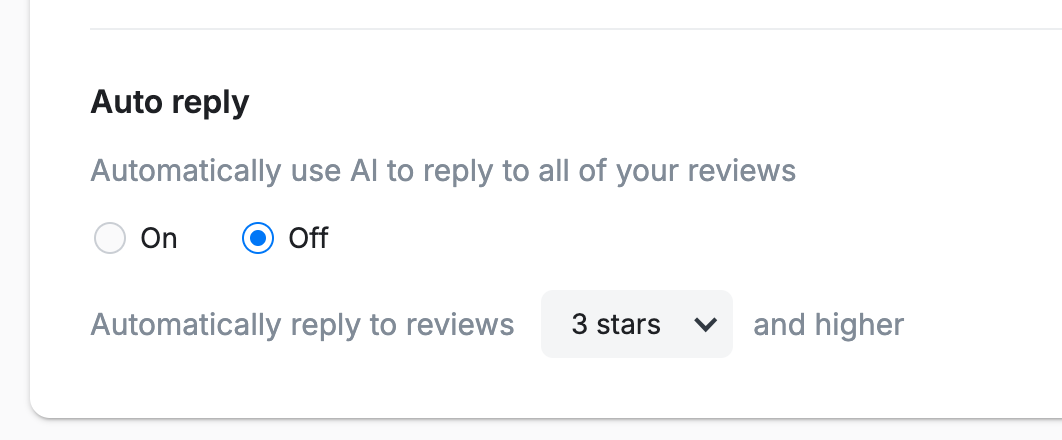
Pro includes AI Replies, Repeats, Referrals, NPS Surveys and Competitive Intel. AI Replies supports editable drafts and tone, voice and length settings; enabled automatic Google replies run daily on eligible recent reviews, need write authorization and do not backfill old review history. Competitor Insights includes review topics as well as ratings and activity for three selected public-address competitors. A geographic rank grid and an editable shared topic framework are separate questions to demonstrate.
Its NPS campaign offers a rating-only route or a predefined service questionnaire, with location comparisons. Website widgets, review-derived stories, referral and repeat-work campaigns can be useful parts of the same program. An alternative that only writes replies does not replace that collection and reuse loop.
NiceJob pricing: the current official offer is USD $75/month Starter or $125/month Pro. Starter includes automated SMS/email requests and follow-ups; AI Replies and the additional growth tools are Pro features. A 14-day trial and no contracts are advertised. Sites is a separate $99/month managed website service with $199 setup; retained pricing also lists extra pages at $145 setup plus $15/month and a CMS at $245 setup plus $15/month. Confirm current website extras and the actual multi-location arrangement. Earlier “Reviews” entry-plan labels are historical, not a separate current plan. AI Leads remains marked coming soon on the checked pricing page.
1. RightResponse AI: Best for AI Review Responses, Feedback Analysis, and Google Maps Tracking
RightResponse AI fits businesses seeking a focused review workflow alongside existing communication or operational tools. It combines review responses and requests with customer-feedback analysis, competitor investigation, and Google Maps rank tracking on eligible plans. Its distinction is inspectable use of approved business information alongside feedback and local-visibility tools, with published per-location pricing.
Context-Aware Replies Using Approved Business Messages
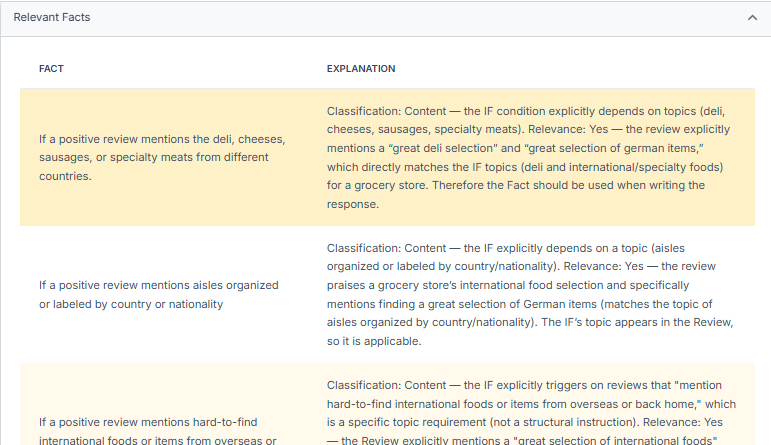
The AI review responder uses approved company, brand, and location Messages. It analyzes the review, determines whether relevant business knowledge would help, plans the response, writes it, and checks the result against configured rules. Staff can see the relevant candidate Messages and those selected for the reply and can correct the business information or edit the finished reply. A useful Message is omitted when it does not belong.
A relevant business detail can make a reply more useful to prospective customers. Suppose a repair-shop reviewer praises a clear explanation of the work, and the shop has approved a Message stating that estimates include digital inspection photos. An illustrative reply could say: “We’re glad the explanation helped. We include digital inspection photos with estimates so customers can see what needs attention before deciding on repairs.” The added detail explains the shop’s process. The same Message would not answer an unrelated billing complaint and should be omitted there.
View full-size image (opens in a new tab)
Response handling is also part of the purchase. Teams can configure star-rating and text-based publication rules, delays, and active hours, and hold or edit responses. On plans that include updated-review tracking, the system compares the changed review with the original review and response before planning a new reply. Direct response publishing is supported for Google. Monitoring other review sources does not establish direct publishing to each one.
Customer Feedback, Competitor Topics, and Local Rank Visibility
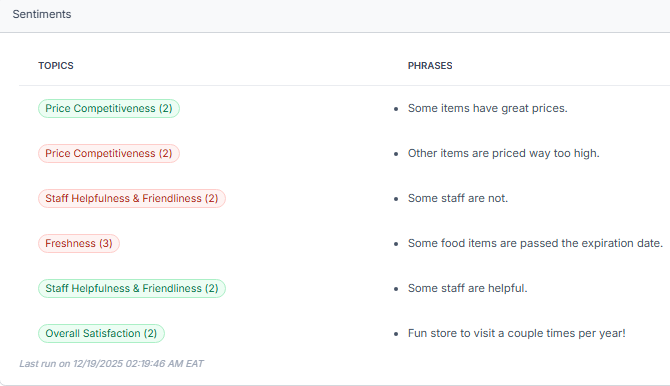
Customer-feedback analysis separates comments about particular experiences. A review can praise a technician and criticize a long wait; a single overall star rating would not preserve that distinction. Teams can modify or supply the topics used, inspect the phrases and underlying reviews, compare locations or periods, and investigate a negative topic even when the overall rating is positive. Plan eligibility matters: Core provides a basic dashboard, while teams requiring advanced topic and analysis controls need to compare the eligible plans.
View full-size image (opens in a new tab)
Pro includes competitor comparisons; Pro+ adds competitor customer-feedback analysis. That distinction matters when the question changes from “How many reviews does the nearby shop have?” to “What do its customers praise or criticize about communication, waiting, or value?” Claims about those experiences should remain traceable to the comments behind a summary.
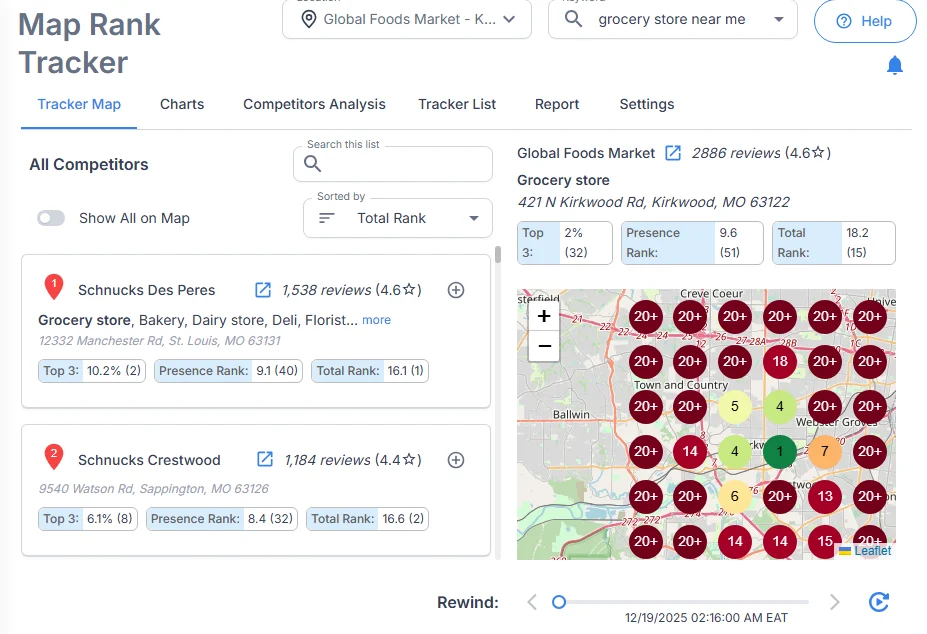
The Map Rank Tracker shows rankings at points around a location for a chosen search and retains earlier scans. Staff can investigate the businesses detected at those points and compare consistent areas over time. It measures geographic visibility; it does not establish that a particular reply caused a visit, a ranking change, or a sale.
View full-size image (opens in a new tab)
Requests, Reminders, and Daily Administration
Review requests can use customer or job information supplied through supported inputs such as a connected Sheet, Zapier, or manual entry. Eligible plans support AI-written wording, photos, guiding questions, and reminders. Templates remain useful when a business needs a simpler invitation. Location mapping and sending schedules must reflect the customer’s actual experience.
Reminder limits vary by plan: Core includes two follow-ups per campaign, Pro four, and Pro+ ten. Employee QR and request-link activity can help a team investigate outreach, but a click or scan alone does not prove that a review was posted or identify a causal effect on revenue. Confirm the current attribution and integration behavior in the required plan.
Pricing, Monthly Allowances, and Plan Boundaries
| Plan | Monthly price per location | Included reply/request capacity | Maps and competitor work | Buyer fit |
|---|---|---|---|---|
| Core | $19 | 100 responses; 1,000 email requests; basic dashboard and request templates | Maps and competitor analysis excluded | Google-review replies, template email requests, and a basic dashboard; Maps, competitor analysis, and advanced topic tools are excluded. |
| Pro | $29 | 200 responses; 2,000 email requests; 200 SMS segments; eligible AI request features | 10 combined map scans or competitor analyses per location/month | Review work with feedback, Maps visibility, and competitor comparisons. |
| Pro+ | $44 | 500 responses; 5,000 email requests; 500 SMS segments; higher automation and follow-up limits | 25 combined scans/analyses; competitor customer-feedback analysis | Higher volume, automation, and topic-based competitor investigation. |
| PAYGO | $10 base plus purchased credits | Eligible usage consumes credits; access to most Pro features | Eligible map/competitor usage consumes credits | Variable usage where the business budgets for both subscription and activity. |
The published pricing and feature table should be checked for the exact source coverage, analysis tools, request controls, and add-ons required. Monthly allowances pool across account locations. Pro’s ten and Pro+’s twenty-five cover map scans and competitor analyses together, not a separate allowance for each. Additional usage packs and SMS delivery can affect the total. The published US/Canada SMS table lists a one-time $25 registration fee and monthly phone-number fees of $4 toll-free or $3 for 10DLC; confirm any additional campaign or carrier charges. Annual subscriptions and custom enterprise arrangements have their own scope.
The tradeoff: The focused subscription suits teams that need business-informed replies, customer-feedback investigation and local rank visibility. It does not replace NiceJob’s managed Sites service or establish equivalent referrals, gifts and repeat-customer campaigns. Keep those workflows if they are doing useful work.
What to verify: use the same mixed review, changed review, and approved business facts in each demonstration. Inspect what was selected, what can publish, and how an exception reaches a person. Then compare the actual review sources, feedback tools, locations, map scans, and extra usage in the proposed plan.
2. Birdeye: Best for Coordinating Reviews and Customer Work Across Locations
Birdeye fits organizations that need central and local teams to coordinate reviews, customer follow-up, listings, and marketing. Its useful distinction is the control over how work moves between people and automated steps. The required products and setup determine how much of that wider platform a buyer actually receives.
The Review Response Agent guide describes a workflow triggered by a new or updated review. Triage checks for spam or irrelevant content; a branch can send an internal alert instead of continuing to write a reply. Review analysis identifies topics, sentiment, severity, language, staff mentions, and other information that can guide generation.
Business category, services, products, and description supply additional context. Teams can configure separate template, autonomous, suggested-reply, or human-approval approaches. Run test exposes the inputs and outputs of the configured steps, including response reasoning. That lets a manager investigate why a reply was produced and change the configuration.
The workflow can extend beyond writing a public reply. Birdeye documents creating a service ticket from a review, assigning it to a team member, and changing its status. A review about a repeated billing problem can therefore become owned follow-up work rather than ending when a response is posted.
This breadth is most useful when several locations and departments share responsibility. It also creates administration: someone must maintain business context, configure the routes, and decide who approves or resolves the work. Listings, social, messaging, and other products should be scoped individually instead of assumed to be included in a Reviews purchase.

View full-size image (opens in a new tab)
Pricing, Tradeoffs, and What to Verify
Pricing: For budgeting, CostBench reports Starter around $299, Growth $349 and Dominate $449 per location/month (last verified August 26, 2026; checked October 21). Birdeye provides a custom quote by products, locations, and contract. Its pricing explanation says agreements are typically annual, although payment schedules vary. Include approvals, ticketing, messaging, integrations, implementation, and any retained tools in the comparison.
The tradeoff: Coordinated workflows can reduce separate handoffs, but a wider suite adds configuration and module decisions. The value depends on using those connected operations, not simply having access to more features.
What to verify: Run a mixed review and an updated review through the proposed configuration. Inspect the selected branch, business context, generated reply, required approval, and final public result. Then assign the underlying issue as a ticket and show who owns its resolution.
3. Podium: Best for Texting, Lead Follow-Up, and Booking
Podium fits a business whose main problem is moving customer inquiries toward appointments and paid work. Texting, calls, website leads, reviews, and payments sit within a broader customer-conversation operation. The right comparison is the purchased industry workflow and the systems it connects, rather than a generic promise that an AI can book everything.
Its reviews product describes automated textable invitations and reminders, customer-linked review information, and an AI Reputation Specialist that generates invitations and replies. Those capabilities can keep review work connected to the same customer journey. Buyers should have the review-specific information inputs, editing, and release settings demonstrated separately from the AI Employee's sales-conversation controls.
For the wider lead workflow, Podium's AI Studio explanation describes configuring instructions and playbooks, simulating conversations, and using feedback to revise behavior. A team can test a routine question and a request that needs staff attention before enabling the workflow.
The current home-service FSM offers a concrete booking route for HVAC, plumbing, and electrical businesses: customer and job history connect to scheduling, dispatch, estimates, and payments, with Larry booking onto Podium's dispatch board using technician availability. A business keeping a different scheduler needs that integration demonstrated; native dispatch-board functionality does not prove the same behavior in every external system.
Podium Payments can place an invoice link in a text conversation, support recurring payments, and accept in-person payments through readers or phone tap-to-pay. This can matter when the same staff answer the inquiry, arrange the work, and chase payment. The current home-service offer also identifies Membership AI separately, so it should not be assumed to come with every package.
View full-size image (opens in a new tab)
Pricing, Tradeoffs, and What to Verify
Pricing: Request a current industry quote. For budgeting, Pabau’s September 22, 2026 guide reports Core at about $399/month and Pro at $599/month on annual contracts, with Signature quoted separately. These are third-party benchmarks for the general local-business platform, not a confirmed current rate for an industry product or your deployment. Include AI products, phones, messaging limits, integrations, setup, and payment fees. Podium's terms default to a 12-month term and equal renewals with at least 30 days' written non-renewal notice, unless the Subscription Documentation states otherwise.
The tradeoff: Podium is a larger operational purchase when communications and booking drive the decision. If the existing phone, CRM, and payment systems already work, replacing or connecting those functions adds cost and implementation work beyond review management.
What to verify: Follow an after-hours inquiry into the exact scheduler and payment workflow. Show staff escalation, a changed appointment, and whether booking is direct or staff-approved. Obtain written limits, overages, cancellation terms, and any trial arrangement for the specific offer.
4. GatherUp: Best for Review Requests, Private Feedback, and Agency Programs
GatherUp fits businesses and agencies that want a repeatable review and customer-feedback program. It combines requests, first-party surveys, public-review monitoring, response tools and website review displays, with agency branding and multi-location options. Its published plans include monitoring across more than 100 sites, but monitoring a site does not mean a reply can be published directly to it.
The distinction between public reviews and private feedback matters. A business can collect feedback through email, SMS or a kiosk and analyze those comments alongside public reviews. The first-party feedback update describes email notifications containing suggested replies. Authorized Google and Facebook connections allow approval from that email; other connections require copying the suggestion and following the publisher link.
Its response tools should be compared as separate methods. SmartReply generates draft text, while custom prompts let an account supply brand guidance. The optional Auto Reply Templates method selects from up to 50 complete, prewritten responses for positive Google and Facebook reviews. Rating thresholds control eligibility, and this template method sends nothing if no templates have been uploaded.
Smart Insights also draws on public reviews and first-party feedback to summarize themes and sentiment. This is useful when a client needs to compare comments from customers who completed a survey with those who chose to publish a review. A meaningful demonstration should open the comments behind a theme, rather than stop at a summary chart. Agency branding and website review widgets then help an agency deliver and present the program for clients.
View full-size image (opens in a new tab)
Pricing, Tradeoffs, and What to Verify
Pricing: The current pricing selector lists one location at $124/month on monthly billing or a $99 monthly equivalent with annual billing. For 2–10 locations, the corresponding figures are $75 or $60 per location/month. It lists up to 300 SMS and 3,000 email credits per location/month and a 14-day trial. Agency pricing is quoted; Listings Hub is a separate $40/location/month add-on. Confirm currency and any extra delivery or branding costs.
The tradeoff: GatherUp is attractive when public reviews and private feedback belong in the same ongoing program. Rebuilding that program still requires customer intake, request rules, review-source connections and staff ownership; it should not be evaluated as a replacement for unrelated phone or scheduling work merely because the review subscription costs less.
What to verify: Trigger a request from the actual customer system, inspect both feedback types, and compare a generated reply with template automation. Check publisher authorization, the review drill-down behind Smart Insights, client/location access, billing cadence and any white-label fees.
What About Grade.us?
The original shortlist treated Grade.us as a separate agency purchase. Its current new-buyer trial page introduces a GatherUp-powered offer and links to a GatherUp trial, so it is not ranked separately here. Its retained classic agency pricing remains useful context: $400/month for ten seats, $40 for an additional seat and $440/year for premium dashboard branding, with an inclusion described at 100 seats (recorded September 16, 2026). Those classic terms are not automatically the price or entitlement of the new GatherUp offer. Existing customers should confirm the named platform, migration and contract rather than discard their legacy terms.
5. LocalClarity: Best for Controlled Replies and Core Listing Operations
LocalClarity fits agencies and multi-location teams whose main work is controlling review replies and keeping core local listings accurate. Its useful distinction is the combination of a working review inbox, configurable release controls, business-informed AI replies, and detailed listing correction. A business keeping an existing request system can evaluate these operations separately from a full feedback-program replacement.
Custom AI Agents accept brand background, business history, value proposition, star-specific writing instructions, language preferences, and response variability. Staff can maintain different agents for different response tasks. The internal agent description is for identification; the business background supplies information to the writing prompt. This gives the team concrete inputs to maintain and test when a generic tone setting would not describe how the business operates.
The Review Settings can send a reply to an Outbox or require approval by a selected editor. A configurable delay leaves time to edit a response before it posts. For a regional director responsible for local replies, the difference is practical: prepared wording can wait for a person with authority to release it. Confirmation prompts, source connections, and the handling of automatic campaigns should be configured deliberately rather than assumed from a general automation label.
RealityCheck compares the business's authorized records with public Google and Apple values. An operator can inspect an hours, phone, category, or other discrepancy and choose whether to preserve the authorized record or accept the suggested change. The same workflow supports filtered bulk corrections. This is useful when customer complaints originate from inaccurate location information: the team can correct the underlying listing instead of only replying to the resulting review.
The review platform also retains review and response history and supports templates and generated replies. Source permissions govern whether a reply can publish directly or needs work on the originating platform. A monitored source and a directly writable source remain different requirements.

View full-size image (opens in a new tab)
Pricing, Tradeoffs, and What to Verify
Pricing: The current visible Professional offer is USD $16/location/month on monthly billing, or $12/month billed yearly. Enterprise and agency arrangements are quoted by volume and functionality. Confirm white-label domains, required integrations, custom roles, onboarding, and any managed service separately; the software subscription and a staffed service have different scope.
The tradeoff: LocalClarity's help explicitly says it does not send review-request emails or texts. A NiceJob buyer relying on invitation campaigns must retain or separately replace that work. Listing and reply controls are therefore the reason to shortlist it, rather than an assumption of complete campaign replacement.
What to verify: Run a mixed review through an agent, editor approval, delay, and the actual publishing destination. Then resolve an hours conflict on Google and Apple, inspect the public result and history, and test which users can change or release it. Price the retained request system alongside the proposed subscription.
6. SocialPilot Reviews: Best for a Low-Cost Review Operation
SocialPilot Reviews fits a business or small agency that wants a defined entry price for collecting, monitoring and answering reviews. The free tier can support a limited one-location workflow, while Pro adds location capacity and team/client management. Its useful buying distinction is the plan boundary and transport setup, not an assertion that free means every feature or message is included.
Its review-response automation accepts saved business description/contact information, tone and language. A rule selects the location, rating or recommendation and whether a review has text, then uses generated or custom wording. Release can be immediate, delayed from 15 minutes to 3 days, or After Confirmation by a user. A business could hold low-rated text reviews for confirmation while treating star-only reviews differently. A delay alone does not mean anyone approved the reply. Private feedback forms also support answer-dependent sections; staff configure and preview the paths rather than use a single rating funnel for every customer.
SMS setup uses a connected Twilio account, and WhatsApp has separate Meta account and template requirements. A software plan is not a universal all-inclusive messaging rate. Staff must maintain sender authorization, credits, consent and the sending configuration.
Social media publishing, inbox and approval features belong to the separately priced SocialPilot Social Media offer. A screenshot of its social-post queue cannot establish that the Reviews subscription includes that complete workflow. For a customer already using the social product, the relationship can still be useful; the proposal needs to identify both subscriptions.

Pricing, Tradeoffs, and What to Verify
Pricing: The official Reviews pricing reference, dated July 2026 and reopened October 21, lists Starter free for one brand/location with 100 email credits/month. Pro is USD $30/month monthly or $25.50/month equivalent billed annually, including three locations and 5,000 emails; extra locations are $10/month and 1,000 additional emails $10. The same source gives monthly/annual-equivalent Pro prices of EUR 29/24.65, GBP 25/21.25, AUD 47/39.95 and INR 1,000/850; these are regional offers, not currency conversions. Twilio/Meta usage and the separate Social Media product can add cost. Confirm the selected region, support and user entitlement where public help differs.
The tradeoff: A low software entry price still requires campaign, sender and client administration. The free tier’s limited volume and absence of team/client management can become the constraint before the number of reviews does.
What to verify: Run a request through the actual sender, inspect the credit charge and reminder stop, then generate and hold a reply. Demonstrate the required client access and identify exactly which product supplies any social publishing or approval feature.
7. Reviewly.ai: Best for Point-of-Service Google Review Collection
Reviewly.ai fits a business that wants staff to introduce a Google review request during or after an in-person interaction. Its QR/NFC devices and SMS workflows are different collection paths: a physical device directs the customer to the review destination, while the software follows configured contacts and requests. A scan should not be counted as a completed review.
The core offer combines Google monitoring, feedback requests, alerts and AI-assisted drafts. A location can use a kiosk, CRM/API connection or Zapier to supply the customer information. Staff still need an appropriate event, correct phone number and a way to stop unnecessary reminders. The customer remains responsible for the experience and words in their public review; an AI suggestion is not evidence that an actual customer wrote or posted it.
The owner SMS responder is a useful reason to consider the product when staff prefer text messages to another dashboard. In the detailed documented flow, a new Google review triggers an alert: the owner first replies Y/Yes to request an AI draft, then reads it and replies Y/Yes again to publish, or N/No to decline. Some simplified pages show a draft arriving immediately, so demonstrate the actual configured route. Confirming a draft is not itself proof the reply reached Google. Dashboard editing is a separate route; this business-reply workflow is distinct from AI assistance offered to a customer writing their review.
Multi-location, traditional white-label and ZeroTech agency packages are distinct offers. The agency page separates the agency-supplied Twilio route from a preconfigured path. The latter describes five locations and 2,500 monthly requests across the entire account. Those units should not be substituted for the standard single-location plans or multiplied into a promised per-client allowance.


Pricing, Tradeoffs, and What to Verify
Pricing: The standard plans are USD $99/month or $999/year for Single Location with 500 monthly feedback requests, and $139/month or $1,329/year for Premium Location with 3,000; Premium is still one location and includes Advanced AI plus a monthly ReviewSnapshot. A limited public Basic offer recorded September 16, 2026 lists $39/month for 100 requests; a separate March 2024 customer report described $39.99. These are scoped offers/experiences, not evidence that the standard plans cost $39. A retained multi-location configuration starts at $199/month for two locations; the traditional agency configuration starts at $199 for ten, while ZeroTech is $199 for five with preconfigured transport. Confirm the current route, shared request limit, AI eligibility and SMS costs. Device-only purchases and the separate Snapshot/ReviewStudio subscriptions do not come from the core price.
The tradeoff: The collection workflow is useful when staff can introduce it consistently, but physical access or a generated draft does not guarantee a review. Agency delivery adds sender compliance, client support and offer-specific allowances.
What to verify: Use the actual device and a real permitted test contact. Distinguish the scan, request delivery, draft, submitted review and posted business reply; inspect each state separately. Confirm currency, supported countries, location count, annual total and the proposed agency transport costs.
Free Option: Google Business Profile
Google Business Profile lets an authorized business manage its Google reviews and share a review link or QR code. It can be enough when the volume is small and staff can ask and reply manually. It does not replace NiceJob’s CRM-triggered campaigns, referrals, repeat-service follow-up, website proof or a consolidated multi-source team workflow. SocialPilot Reviews offers a separate free software tier with stated limits; the free response generator is a drafting utility rather than an automated collection program.
RightResponse AI vs. NiceJob: What Are You Replacing?
Both products document AI replies and review-request workflows. The useful decision is which information, follow-up and evidence the business needs, and which growth tools it would otherwise retain.
| Job | RightResponse AI | NiceJob |
|---|---|---|
| Main buying fit | Business-informed public replies, customer-feedback investigation and geographic Maps tracking on eligible plans. | Completed-job requests, website proof and customer-growth campaigns; Pro adds referrals and Repeats. |
| Reply information and release | Approved business Messages, inspectable selection and configured reply rules; direct Google publishing. | Tone, voice and length settings, editable drafts and daily eligible Google auto replies on Pro; no automatic historical backfill. |
| Feedback and competitors | Custom topics and source phrases; Pro competitor metrics, Pro+ competitor customer-feedback analysis; geographic rank grids. | Topic Insights, selected-rival topics and review activity; Pro NPS/private feedback. Confirm any geography or custom-taxonomy requirement. |
| Starting software price | Core $19/location/month with narrower scope; Pro $29/Pro+ $44; PAYGO $10 plus credits. | Starter USD $75/month; Pro $125/month; Sites and multi-location arrangements separate. |
| Work to retain | Referrals, gifts, repeat-service campaigns, managed website and general communications where required. | Any additional fact-selection, feedback-control or geographic rank workflow required after the demonstration. |
Which NiceJob Alternative Fits the Main Buying Job?
| Main need | Relevant shortlist | Why |
|---|---|---|
| Business-informed replies and local investigation | RightResponse AI | Approved facts, inspectable topic evidence and Maps analysis on eligible plans. |
| Central review approvals and customer issue ownership | Birdeye | Configurable routes and ticket follow-through. |
| Text inquiries, booking and payment | Podium | Customer-conversation and industry operating scope. |
| Public/private feedback and agency delivery | GatherUp | Requests, surveys, client administration and review displays. |
| Replies plus listing correction while retaining requests | LocalClarity | Approval/outbox and core local-data operations. |
| A small defined review budget | SocialPilot Reviews | Free/Pro boundaries and explicit extra usage. |
| Physical review capture | Reviewly.ai | Device/QR paths and SMS follow-up; validate the actual offer. |
Try the Software Before You Switch
Give each shortlisted vendor the same examples and compare the resulting work. These are proposed buyer tests; the research for this guide did not run a matched product trial.
- Use a positive review, a mixed review and a changed review. Supply the same approved facts and inspect the draft, publication rule, correction path and final result.
- Trigger a request from the real customer system. Check consent, timing, source or product mapping, reminders and what happens after a review is posted.
- Open the reviews behind a mixed topic and compare a real competitor question. Keep ratings, themes and geographic rank measurements distinct.
- For an agency, log in as a client and show the branding, data separation, report and support process included in the purchased offer.
- Price the tested configuration with the same usage and staff assumptions. Ask for a written list of excluded features, add-ons, implementation and renewal terms.
Compare RightResponse AI plans and start a trial with its advertised seven-day trial, 1,000 credits and most Pro features, with no card required. Free use ends if the credits run out; compare the actual trial allowance with the work being tested.
Questions to Ask Before Switching from NiceJob
- Who owns the business profiles, customer records, review history and embedded content, and what can be exported?
- Which contract requires notice, when does the current term end, and what happens to prepaid fees?
- Which requests or replies are already queued, and how will duplicate outreach or publication be prevented?
- Who will maintain integrations, permissions, business information, automation rules and customer escalations?
How to Switch from NiceJob
1. Inventory the work to retain
List current campaigns, connected profiles or stores, embeds, people, integrations and renewal dates.
2. Export and check the available history
Keep the source, location or product mapping, timestamps, consent and media permissions that the new system can actually use.
3. Configure a limited pilot
Connect one business location or store where applicable, map the actual events and validate permissions without enabling duplicate campaigns.
4. Check the public result
Inspect replies, links, widgets, mobile rendering and the relevant staff handoff before expanding.
5. Cut over deliberately
Pause the old sending or publication rules, account for queued work, then enable the replacement and inspect early exceptions.
6. Train the people who own the work
Explain the approval path, source corrections, reports, request failures and escalation decisions.
7. Confirm retirement and renewal
Remove obsolete embeds or credentials only after the new workflow is working, and obtain cancellation or renewal confirmation.
Further Research on NiceJob and Review Management
The comparison library connects platform reviews, pricing analyses and head-to-head guides. Use the product and help links in Sources by Company to verify the specific offer and controls rather than rely on an older screenshot.
How We Compared the Products
RightResponse AI publishes this guide and evaluated the platforms against the same operational, pricing and workflow criteria. The research reopened existing company dossiers and the shared pricing evidence register, then checked material product and commercial details against public documentation. Useful third-party, customer and historical prices are attributed and separated from current official offers.
This is a documentation-based comparison. No controlled test established a winner for writing quality, accuracy, conversion, revenue or ranking impact. The screenshots are retained vendor-interface illustrations with unestablished original capture dates; they do not certify every current control or price. Plan and regional differences are identified where they change the buying decision.
Final Verdict: Choosing the Right NiceJob Competitor
RightResponse AI fits a review-centered purchase that needs approved business information in replies, investigable feedback and Google Maps visibility on eligible plans. Birdeye fits coordinated location review and customer work; Podium fits a wider communication and booking operation. GatherUp serves public/private feedback and client programs, LocalClarity serves controlled replies and core listings, SocialPilot Reviews offers a defined low-cost entry and Reviewly.ai focuses on point-of-service collection. NiceJob remains a valid choice when its job-triggered requests, proof, referrals and repeat-service workflows already fit. Compare the demonstrated scope and the full bill before replacing it.
Frequently Asked Questions
What is the best NiceJob alternative for AI review responses?
RightResponse AI is a candidate when approved business information, inspectable selection and feedback analysis are central. Birdeye and LocalClarity offer different response controls. NiceJob Pro also has AI replies and Google auto replies; compare the same reviews and release requirements rather than assume a writing-quality winner.
Is there a free NiceJob alternative?
Google Business Profile supports manual Google review work and review links. SocialPilot Reviews advertises a free one-brand, one-location plan with 100 email credits/month. Neither automatically replaces NiceJob’s complete customer-growth program; sender transport and other tools can still cost extra.
What does NiceJob cost?
The checked official offer is USD $75/month Starter or $125/month Pro. AI Replies, NPS, referrals and Repeats are Pro features. Sites is separate at $99/month plus $199 setup; confirm website extras and any multi-location arrangement.
Can NiceJob analyze topics and competitors?
Yes. Topic Insights and Competitor Insights include review themes; the competitor guide describes three selected public-address rivals. A geographic rank grid, editable shared taxonomy and case-management workflow are separate requirements to demonstrate.
How much should a business budget for Birdeye or Podium?
Birdeye is quoted, with CostBench reporting Starter/Growth/Dominate around $299/$349/$449 per location/month, last verified August 26, 2026. Pabau’s September 22, 2026 guide reports Podium Core around $399 and Pro $599 per month on annual contracts. These are reported benchmarks, with different product and unit assumptions; obtain the actual deployment quote.
Why is Grade.us not ranked separately?
Its current new-buyer trial introduces a GatherUp-powered offer and sends buyers to GatherUp. Classic Grade.us agency pricing remains useful historical context, but does not establish a separate current purchase or transfer every legacy entitlement into the new offer.
Can a business use NiceJob alongside another review tool?
Yes, when the jobs are deliberately separated and the required connections exist. Keep one owner for each request sequence and public reply, and prevent duplicate outreach or posting. Do not assume a native integration between two named products without confirming it.
Does Reviewly.ai Premium include multiple locations?
The standard Premium Location offer describes one location at USD $139/month or $1,329/year with 3,000 monthly requests. Separate multi-location and agency offers have their own locations, transport and shared-request terms; do not infer five locations from the Premium label.
Sources by Company
RightResponse AI: AI review responder; Pricing and feature limits; Customer-feedback analysis; Maps and competitors; Review requests.
Birdeye: Review Response Agent; Ticket creation; Pricing and commitment; CostBench reported benchmarks, Aug. 26, 2026.
Podium: Pricing; Home-service workflow; Payments; Contract terms; Pabau reported prices, Sept. 22, 2026.
GatherUp: Pricing and billing selector; SmartReply; Auto Reply Templates; First-party feedback updates.
Google Business Profile: Reviews, replies, and review links.
NiceJob: Current pricing; Editable campaigns; Customer matching; AI replies; NPS; Competitor themes.
LocalClarity: Pricing; AI business context; Approval/outbox settings; RealityCheck; Request-delivery boundary.
Grade.us historical context: New-buyer transition; Retained classic pricing.
SocialPilot Reviews: Reviews product; July 2026 pricing reference; Twilio setup; Business context and release rules.
Reviewly.ai: Core current plans; Owner SMS response workflow; Multi-location offer; Agency offers; Retained limited Basic offer recorded Sept. 16, 2026; Historical customer report.