Choosing between NiceJob vs Yext for your reputation management needs often comes down to these five critical questions:
Comparison research: This article is part of the RightResponse AI review management software comparison library, which connects platform reviews, pricing analyses, alternatives, and head-to-head evaluations.
- Are you a single-location service business or a multi-location enterprise with complex digital presence needs?
- Do you need a simple, automated review collection tool or a full-scale digital presence management platform?
- Is your primary goal getting more reviews, or do you need to turn every review response into a chance to win the next customer?
- How important is it to understand your competitive landscape and local search rankings?
- Do you want a tool that collects reviews, or one that makes the response itself a conversion asset?
In short, here's what we recommend:
👉 NiceJob leans heavily toward small to medium-sized service businesses that want to automate the process of collecting customer reviews. Its "set-and-forget" approach to review invitations, automated follow-ups, and social proof widgets makes it easy for busy business owners to build their online reputation without much hands-on effort. NiceJob excels at generating a high volume of reviews and has expanded its platform with features like topic insights, employee leaderboards, and competitor analysis on the Pro plan. NiceJob also supports multi-location management, though some users of larger deployments have reported a less polished experience compared to enterprise-focused tools.
👉 Yext serves as a comprehensive digital presence platform weighted toward multi-location enterprises that need to manage listings, reviews, pages, and search across hundreds of channels. Its Knowledge Graph technology provides a centralized source of truth for business information, and its publisher network of over 200 integrations ensures brand consistency across the web. However, Yext's enterprise focus comes with custom pricing that can be prohibitive, a steep learning curve, and review management that is just one module in a much larger (and more expensive) platform.
Both platforms have added analytics and AI capabilities over time, but their architectures reflect their origins: NiceJob was built to automate review collection, and Yext was built to manage enterprise-scale digital presence. Neither was designed around the premise that the review response itself is the product, that every reply is a chance to market the business, strengthen positioning, and win the next customer. That's where RightResponse AI comes in.
👉 RightResponse AI is built around a different philosophy: that reviews are the conversion gate, and the response is the only part a business controls. Instead of treating responses as an afterthought, the platform uses a three-pillar personalization system, Facts (what to say), Customizations (behavioral rules), and Brand Voice (tone and style), to generate responses that actively market the business to the prospective customers reading them. RightResponse AI also includes AI-powered review collection, Voice of the Customer Aspect-Based Sentiment Analysis, Google Maps rank tracking, and competitor insights. With transparent pricing that starts at $10 per location per month, it delivers response quality and reputation intelligence that traditional platforms don't match, for businesses of any size, from a single location to enterprise.
If you're ready to turn every review response into a conversion asset, see how RightResponse AI can transform your reputation management with a 7-day free trial.
Table of contents:
- NiceJob vs Yext vs RightResponse AI at a glance
- The fundamental divide: Review collection vs digital presence vs response quality
- NiceJob automates review collection for service businesses
- Yext manages digital presence for multi-location enterprises
- RightResponse AI turns every response into a conversion asset
- AI capabilities reveal the real differentiation
- Pricing models reflect very different target markets
- Competitor insights separate monitoring from strategy
- NiceJob vs Yext vs RightResponse AI: Which should you choose?
NiceJob vs Yext vs RightResponse AI at a glance
Here's the fundamental difference: While all three platforms help businesses manage their online reputation, they approach the challenge from distinctly different angles.
- NiceJob automates review collection and social proof for small service businesses.
- Yext centralizes digital presence management for multi-location enterprises.
- RightResponse AI treats the review response as the product, making every reply a conversion asset through AI-powered personalization.
NiceJob | Yext | RightResponse AI | |
|---|---|---|---|
Primary focus | Automated review collection & social proof | Digital presence management & listings | AI-driven review response quality & reputation intelligence |
Ideal business size | ⭐⭐⭐⭐ Heavily weighted toward small to mid-size service businesses | ⭐⭐⭐⭐ Primarily mid-market to large enterprises | ⭐⭐⭐⭐⭐ Single locations to large enterprises |
Review generation | ⭐⭐⭐⭐⭐ Automated invitations & follow-ups | ⭐⭐⭐ Available as add-on module | ⭐⭐⭐⭐⭐ AI-personalized requests with employee QR codes |
Review response | ⭐⭐⭐ AI replies available on Pro plan | ⭐⭐⭐⭐ AI-powered with templates | ⭐⭐⭐⭐⭐ Three-pillar personalization: Facts, Customizations & Brand Voice |
Voice of the Customer | ⭐⭐ Basic topic tracking | ⭐⭐⭐ NLP-based sentiment | ⭐⭐⭐⭐⭐ Voice of the Customer Aspect-Based Sentiment Analysis |
Competitor insights | ⭐⭐ Pro plan only, limited metrics | ⭐⭐⭐ Available as add-on | ⭐⭐⭐⭐⭐ Deep competitor review & sentiment analysis |
Local SEO / Map tracking | ⭐ Not available | ⭐⭐⭐ Through listings network | ⭐⭐⭐⭐⭐ Grid-based Google Maps rank tracker |
Pricing transparency | ⭐⭐⭐⭐ Published pricing | ⭐⭐ Custom quotes only | ⭐⭐⭐⭐⭐ Transparent, usage-based pricing |
Starting price | $75/month | Custom (contact sales) | $10/month per location (PAYGO); fixed plans $19-$44/month |
The fundamental divide: Review collection vs digital presence vs response quality
Understanding each platform's core philosophy is essential because it shapes everything from their feature sets to their pricing models.
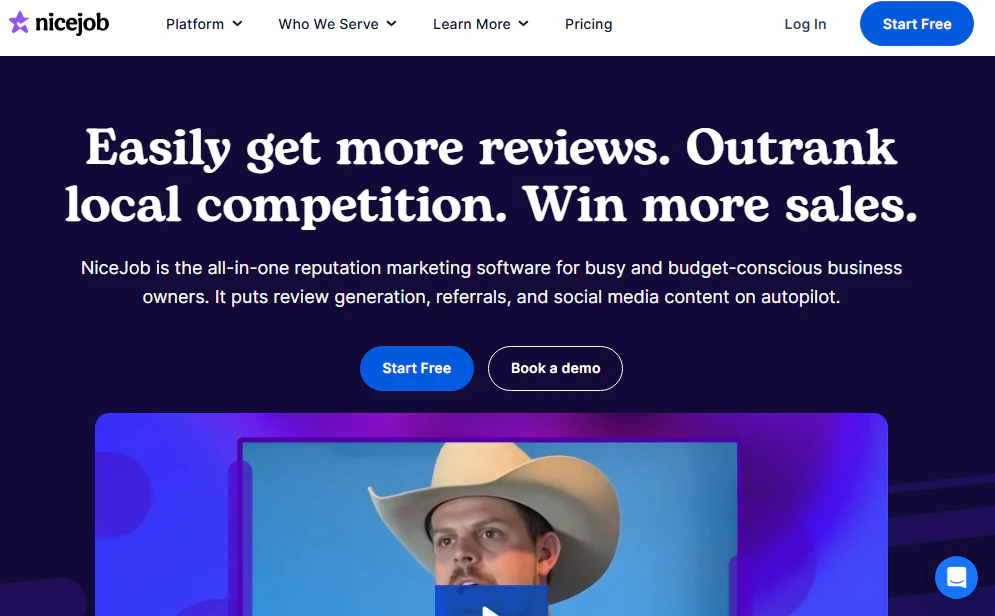
NiceJob's core premise is that small service businesses providing excellent customer experiences deserve more reviews.
The platform automates the awkward task of asking customers for feedback, sending review invitations via email and SMS at just the right moment, then following up automatically if a customer hasn't responded. It's a focused tool built around doing one thing effectively.
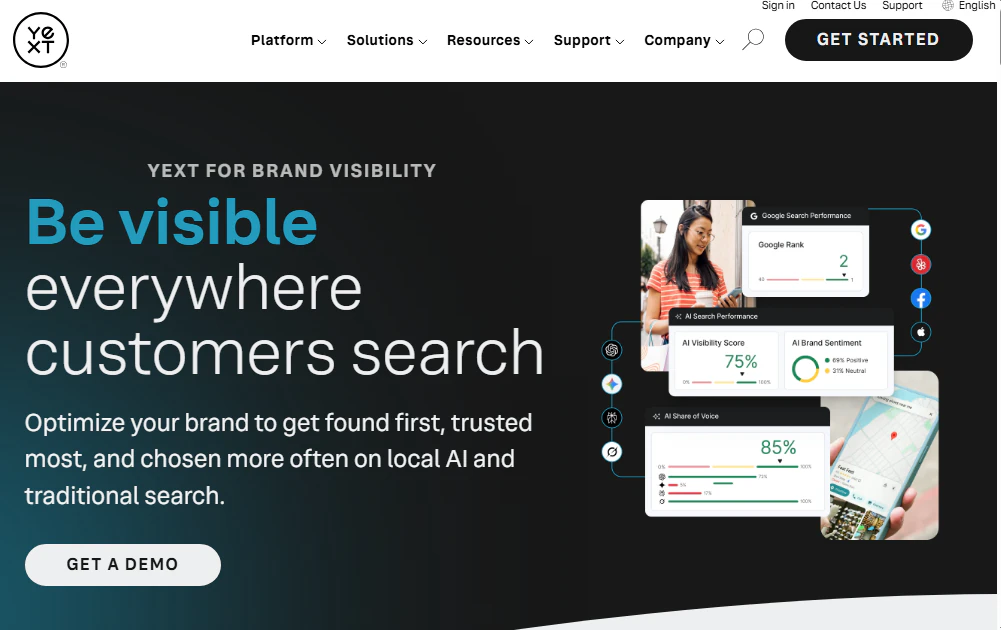
Yext approaches reputation from a much broader angle.
The company's foundation is its Knowledge Graph, a centralized database that stores and syndicates a brand's information across over 200 publishers. Reviews are just one module in a comprehensive digital presence platform that also includes listings management, website pages, and on-site search. For Yext, reviews are part of the bigger picture of brand visibility.
RightResponse AI was born from a different insight entirely.
Its co-founder, George Swetlitz, ran a healthcare clinic network with over 200 locations and recognized something most businesses overlook: people read reviews more than they read a business's website, yet nearly every business wastes the response, the only part they actually control, with generic filler like "Thanks for your review!"
That generic response doesn't just fail to add value; it takes up space that could be working for the business. RightResponse AI was built with generative AI at its core around the premise that every response should actively market the business to the prospective customers reading reviews, turning what most treat as a chore into a competitive advantage.
The practical implications of these philosophies become clear when you consider what happens after a review is collected.
NiceJob helps you get the review and share it on social media. Yext helps you monitor and respond to it as part of a broader digital footprint. RightResponse AI analyzes the specific topics mentioned, selects relevant facts from a business-specific messaging database, and generates a response through its three-pillar personalization system, producing replies that are substantive, brand-aligned, and useful to prospective customers rather than generic space-fillers.
NiceJob automates review collection for service businesses
NiceJob has earned its reputation by making one of the most uncomfortable parts of business (asking for reviews) completely hands-off. The platform integrates with popular business management tools like Jobber, Housecall Pro, and QuickBooks, and automatically sends review requests when a job is completed or an invoice is paid.
The automation goes deeper than a single request. NiceJob's system sends up to three follow-up emails over a 14-day period, and its "Customer Matching" technology automatically removes customers from the campaign once they leave a review. This persistent but respectful approach is why NiceJob claims businesses can get up to four times more reviews with their platform.
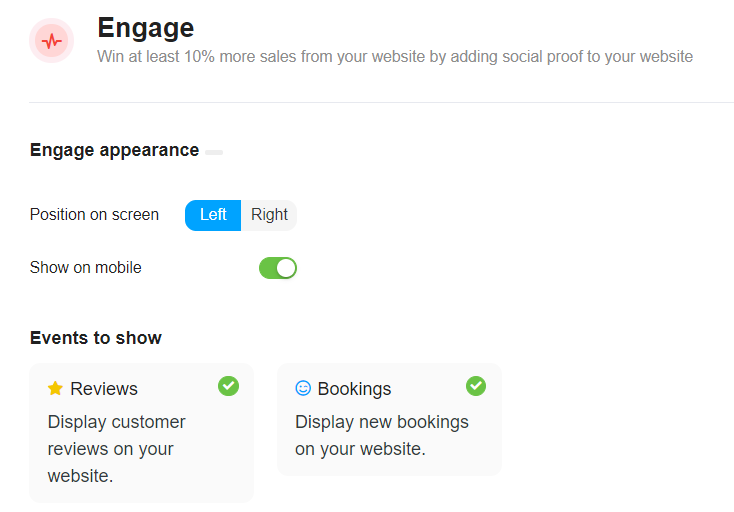
Beyond collection, NiceJob offers a "Stories" feature that transforms reviews (especially those with photos) into visual marketing content that can be shared on social media and displayed on a business's website through embeddable widgets. The "Engage" widget creates real-time pop-up notifications on a website showing recent customer activity, adding a layer of social proof that can boost conversion rates.
Source: NiceJob
NiceJob's Pro plan ($125/month) adds referral campaigns, repeat booking reminders, and competitor insights. The referral feature is particularly clever: it automatically enrolls customers who leave positive reviews into a referral campaign, capitalizing on the moment when satisfaction is highest.
Where NiceJob is more limited is in the depth of its analytics and the quality of its review responses.
The platform offers topic tracking through machine learning and a team leaderboard, but it doesn't provide the kind of aspect-level sentiment analysis that helps businesses understand the specific drivers behind their ratings with full granularity. The competitor insights available on the Pro plan track metrics like review volume, star ratings, and topic mentions, though they don't offer the depth of sentiment-level competitive comparisons found in more specialized platforms.
AI review replies are available on the Pro plan with tone and rules customization, but they follow the standard pattern of generating a polite response based on the review text alone, without business-specific messaging, behavioral controls, or brand voice systems that prevent generic output. And while NiceJob supports multi-location management, some users of larger deployments have reported a less polished experience when managing three or more locations.
Yext manages digital presence for multi-location enterprises
Yext operates on a fundamentally different scale.
The platform's Knowledge Graph serves as a centralized hub for all of a brand's public-facing information, organizing data into structured entities, fields, and relationships. A change made once in the Knowledge Graph automatically propagates to over 200 connected publishers, from Google and Apple Maps to Yelp and Facebook.
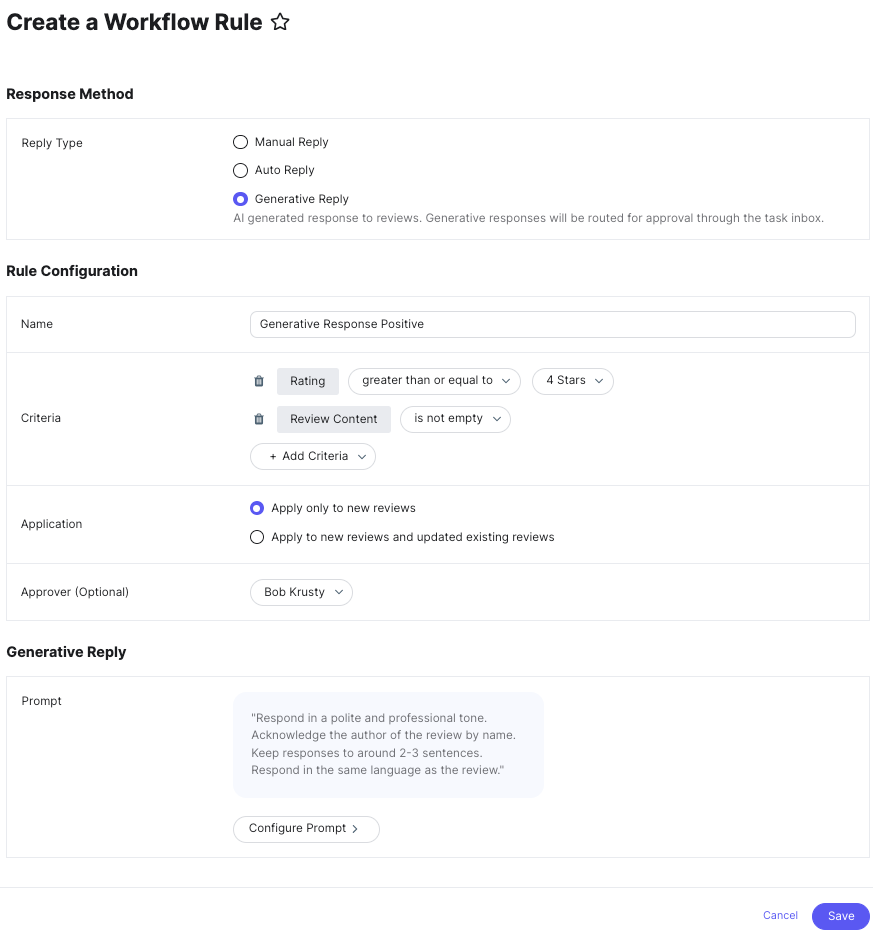
For review management specifically, Yext offers Review Monitoring, Review Response, and Review Generation as distinct capabilities. Review Monitoring aggregates feedback from over 80 sites into a single dashboard. Review Response includes AI-powered tools for crafting replies, along with template-based responses and workflow automation for routing reviews to the right team members.
Source: Yext
Review Generation automates request campaigns through email, SMS, and QR codes, with a "smart balancing algorithm" that directs customers to the review platforms where feedback will have the most impact.
Yext also provides sentiment analysis using Natural Language Processing to identify positive, negative, and neutral sentiment, along with recurring keywords and themes. The platform can push star ratings into Google Ads and display review widgets on a business's website.
The challenge with Yext is that its review management capabilities are one piece of a much larger (and more expensive) enterprise platform.
For its core reputation and listings products, the company uses custom, quote-based pricing, which means you typically need to go through a sales process to learn what it costs. Users have reported that the platform can be complex to navigate, with a steep learning curve, and some have raised concerns about customer support responsiveness.
Pricing rigidity and contract lock-in are common friction points with enterprise platforms like Yext. For a business that primarily needs reputation management, investing in Yext's full digital presence suite may be more than what's needed.
RightResponse AI turns every response into a conversion asset
This is where the comparison gets interesting.
While NiceJob focuses on generating reviews and Yext focuses on managing a broad digital presence, RightResponse AI was purpose-built around a simple principle: reviews are the conversion gate, and the quality of every response determines whether a prospective customer chooses you or a competitor.
Think about how people actually use reviews.
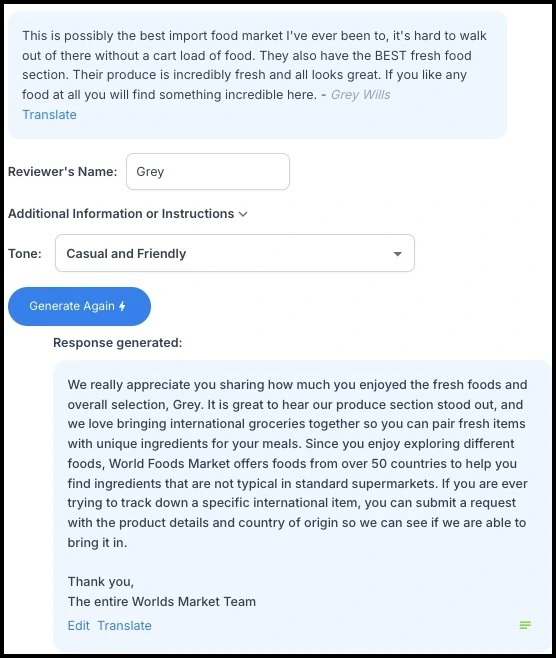
A prospect comparing two businesses with similar ratings and review volume will read the reviews, and if they glance at the responses, a generic "Thank you for your kind words!" tells them nothing. But a response that says, "Glad you enjoyed the steaks, next time, don't miss our mezcal bar; we have the largest selection in San Francisco" shows the business genuinely engages with customers and gives the prospect a reason to visit.
That's the difference between a response that fills space and one that wins business.
Response quality through three pillars of personalization
RightResponse AI's "Intelligent Review Response" generator achieves this through a three-pillar personalization system:
- Facts (what to say): During onboarding, the platform reads existing reviews, past responses, and the business website to build a messaging database of "facts" about the business. It identifies the most important themes in reviews and maps relevant facts to each theme. When generating a response, the system finds the relevant theme and selects which facts apply. If a customer complains about price, the response can mention that the restaurant uses organic, non-GMO ingredients sourced fresh from the market daily. Users can see which facts were used and swap in alternatives as needed.
- Customizations (behavioral rules): These are the controls that govern how responses behave: length preferences, do-not-say lists, how to handle specific scenarios, and rules for greeting and closing styles.
- Brand Voice (tone and style): Users define how responses should sound, formal, conversational, warm, professional, with rotation capabilities that keep responses varied and natural-sounding rather than repetitive.
Together, these three pillars produce hyper-personalized, brand-aligned responses with endless variation without losing control, something no tone slider or basic rules configuration can replicate.
An agentic pipeline built for trust
RightResponse AI doesn't hand the entire task to a single AI prompt. It uses an intentionally agentic approach that separates analytical functions from writing functions: the system analyzes the review first, identifying sentiment, topics, edge cases, and relevant facts, then passes that analysis to a writing engine that focuses only on crafting the response.
This reduces the risk of AI generating inappropriate content.
The pipeline handles edge cases that simpler AI tools miss: it examines reviewer names to determine suitability for greetings, identifies and correctly formats employee names mentioned in reviews, detects when a review has been updated by a customer for more informed follow-up, and for medical practices, identifies Protected Health Information (PHI) to maintain HIPAA compliance.
Review collection with AI sophistication
RightResponse AI doesn't just respond to reviews, it also helps generate them. The platform's review request system includes two modes:
- Essentials Mode: A template-based, set-and-forget system with pre-built templates for businesses that want simplicity.
- Pro Mode: AI-powered requests that incorporate customer data, name, service history, tenure, recent transactions, to craft messages that feel personal rather than automated. Requests can include photos (particularly effective for home services and real estate), and businesses can add guiding questions that give reviewers inspiration about what to write, with questions rotating to produce varied review content.

Requests can be sent via email and SMS. The system allows unlimited follow-ups; businesses can configure as many as they need, unlike competitors that cap the number of follow-ups. Contact data can be sourced via direct entry, file uploads, remote Google Sheets, or Zapier integrations.
A standout feature is employee-level QR codes: instead of a single business-level code, each technician, server, or employee gets their own QR code on a card they can present to customers. The system tracks scans and credits completed reviews to individual employees, enabling incentive programs that drive review volume from the front lines.
For multi-location businesses, the review grouping feature allows established locations to funnel reviewers into new locations, helping them build review volume quickly, a technically complex capability that very few competitors offer.
Reputation intelligence: sentiment, rankings, and competitors
RightResponse AI's Voice of the Customer Aspect-Based Sentiment Analysis (ABSA) goes beyond simple positive/negative scoring.
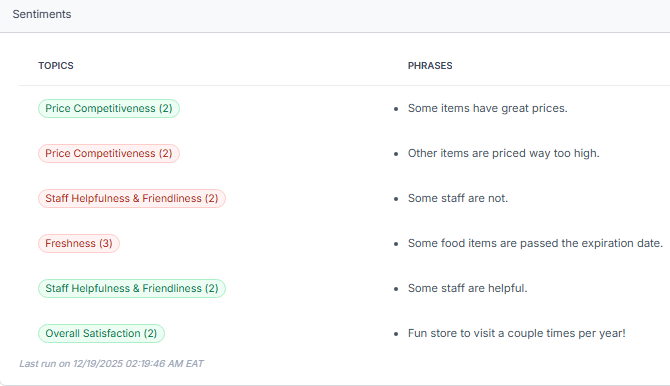
Businesses define their own topics and categories, and the AI analyzes reviews to understand sentiment for each specific aspect. A restaurant might track "food quality," "wait times," and "staff friendliness" separately, seeing exactly which areas are driving satisfaction or dissatisfaction. The platform extracts the specific phrases from reviews that correspond to each topic, providing full context behind every insight.
The Google Maps Rank Tracker creates a customizable grid around a business's location and simulates searches from each point, providing a street-level view of visibility for specific keywords. The "Rewind" feature lets users visually replay how rankings have changed over time.
The platform sources reviews from 125+ review platforms with native Google integration, and also offers a Done-For-You service for businesses that want fully managed monitoring, responding, and review disputes, as well as a free AI review response generator anyone can use to experience the quality difference firsthand.
AI capabilities reveal the real differentiation
All three platforms use some form of AI, but the depth and what they optimize for vary significantly.
NiceJob uses AI primarily for review replies (available on the Pro plan at $125/month).
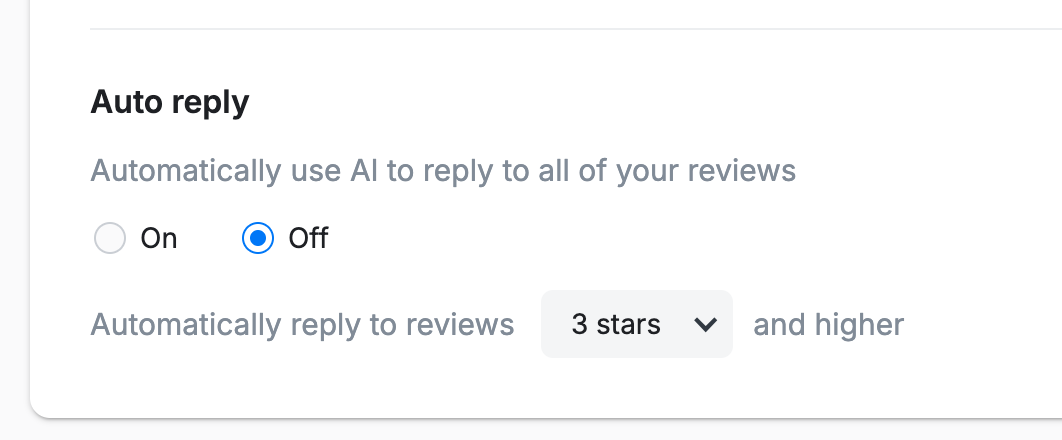
The AI Replies feature scans for new reviews daily and generates reply suggestions. Users can approve, edit, or set the feature to auto-publish responses. The replies can be customized for tone and length. While useful for saving time, the responses are generated from the review text alone; there's no mechanism to incorporate business-specific messaging or prevent repetitive, generic output across dozens of responses.
Source: NiceJob
Yext employs AI across its broader platform, including Natural Language Understanding for its search product and NLP-based sentiment analysis for reviews.
The AI can generate personalized review responses and identify recurring themes in feedback. However, AI capabilities for reviews are part of the larger enterprise offering, and some advanced features may require additional investment.
RightResponse AI was built with AI as its architectural foundation rather than as an add-on.
The platform's agentic pipeline analyzes each review before writing, then generates responses through the three-pillar system (Facts, Customizations, Brand Voice) that ensures every reply is substantive, brand-aligned, and varied. Key capabilities include:
- Fact-infused response generation that weaves business-specific messaging into every reply based on review topics
- Voice of the Customer ABSA that maps feedback to user-defined business categories
- Irrelevant content filtering that removes vague or off-topic content from analysis
- Edge case handling including PHI detection, review update detection, and reviewer/employee name analysis
The practical difference is this: NiceJob's AI helps you respond faster. Yext's AI helps you identify themes across a large portfolio. RightResponse AI makes the response itself the product; every reply substantive enough that a prospective customer reading it gains useful information about the business rather than scrolling past generic filler.
Currently, most people skip review responses because they contain nothing worth reading. Quality responses represent the untapped opportunity to capture that attention.
Pricing models reflect very different target markets
The pricing structures tell you everything about who each platform was built for.
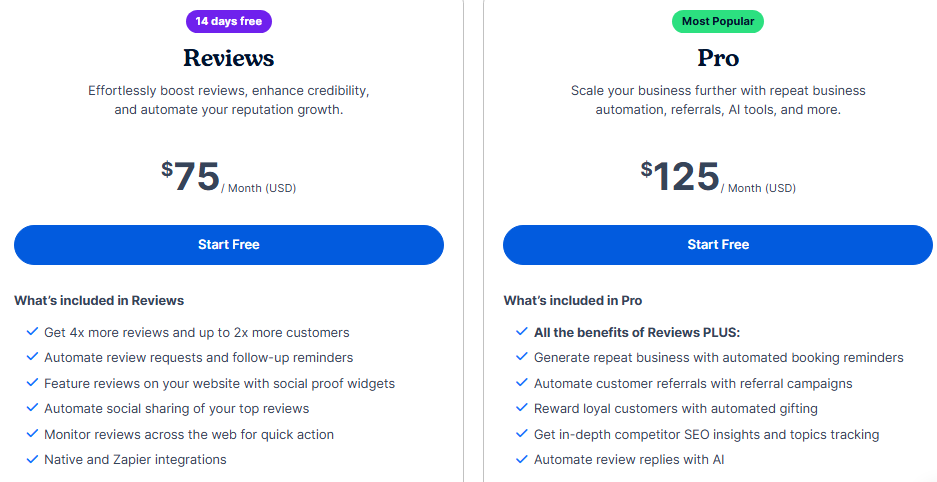
NiceJob offers straightforward, published pricing:
- Reviews Plan: $75/month for automated review collection, social proof widgets, and basic insights
- Pro Plan: $125/month adds repeat booking reminders, referral campaigns, competitor insights, AI review replies, and gifting automation
- Sites Add-on: $99/month plus a $199 setup fee for a custom-built, conversion-optimized website
- A 14-day free trial is available with no credit card required
Source: NiceJob
Yext uses custom, quote-based pricing with no published rates.
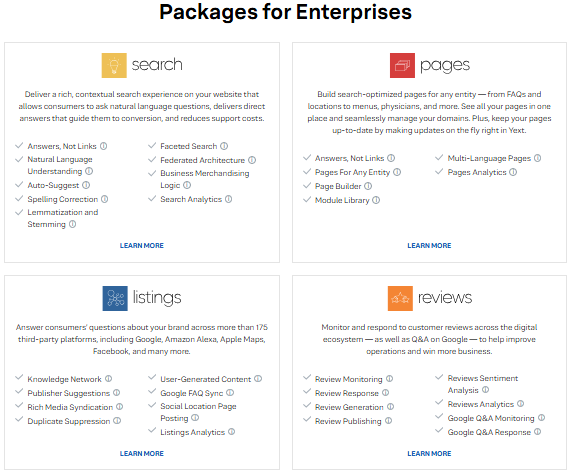
Prospective customers must contact sales or request a demo to learn the cost. The platform is structured around enterprise packages (Listings, Reviews, Pages, Search), each of which requires contacting Yext for pricing. Add-ons like Competitive Intelligence and Yelp Knowledge carry additional costs.
Industry sources and user feedback suggest that Yext's pricing typically runs into the thousands per month for meaningful implementations, and contract rigidity is a common buyer friction point.
Source: Yext
RightResponse AI takes a transparent, usage-based approach:
- Base fee: $10/month per location on Pay As You Go (PAYGO), a usage-based option best for starting out, low review volume, or narrow needs.
- Core ($19/month): 100 review responses, 1,000 email review requests, Essentials request templates, and a basic dashboard (no SMS, surveys, or map rank tracking).
- Pro ($29/month, Most Popular): 200 review responses, 2,000 email requests plus 200 SMS, 200 surveys, AI-powered Pro-mode review requests, and Map Rank Tracking with competitor analysis (10 scans/month).
- Pro+ ($44/month): 500 review responses, 5,000 email requests plus 500 SMS, 500 surveys, advanced automation with bulk processing, Competitor Voice of the Customer, and 25 map-rank/competitor scans per month.
- Enterprise (custom): plans for agencies and large multi-location businesses, adding white-label, API access, and advanced reporting.
- Usage credits: Purchased as needed, starting at $0.01 per credit for the first 3,000 credits, with decreasing costs at higher volumes
- PAYGO feature costs are clearly defined: 20 credits per review response, 20 credits per Voice of the Customer analysis, 2 credits per email review request, and 1.5 credits per map rank tracker pin
- A 7-day free trial includes 1,000 usage credits and access to most Pro features, with no credit card required
The PAYGO model means businesses pay only for what they actually use rather than being locked into flat per-location fees for capacity they may not need, while the fixed plans offer predictable pricing with generous built-in limits. For a single-location business generating 50 reviews per month and wanting response generation plus Voice of the Customer analysis, the estimated PAYGO cost would be approximately $30 to $40.

Source: RightResponse AI
But it's important to note that RightResponse AI isn't positioning itself as the budget option; there are cheaper tools that use basic AI and produce generic responses. The platform is competitively priced at the entry level thanks to its usage-based economics, but the value is in the quality of what it delivers.
NiceJob's $75 to $125/month plans offer solid value for the review collection automation they provide. Yext's undisclosed pricing is geared toward organizations with larger budgets and multi-location digital presence needs.
Competitor insights separate monitoring from strategy
Understanding your competitive landscape is essential for improving your market position, but the depth of competitor analysis varies significantly across these platforms.
NiceJob offers competitor insights on its Pro plan ($125/month).
These insights cover metrics like competitors' total reviews, average star ratings, and customer sentiment trends. While useful for a general understanding of how you stack up, the analysis doesn't go deep enough to reveal what specifically competitors are doing better or worse in the eyes of their customers.
Yext provides Competitive Intelligence as an optional add-on.
The feature includes a Search Tracker that monitors keyword rankings against competitors and Reviews Competitive Intelligence that compares average review ratings. It's a solid benchmarking tool, but it's an extra cost on top of an already premium platform, and the review analysis stays at the ratings level rather than diving into sentiment by topic.
RightResponse AI's CompetiWatch AI takes competitor analysis further.
The platform doesn't just track competitors' review volume and ratings; it applies the same Voice of the Customer ABSA to competitor reviews that it uses for your own. This means you can see exactly how customers rate a competitor's "customer service," "pricing," or "product quality" compared to yours, at the topic level, not just as an aggregate star rating.
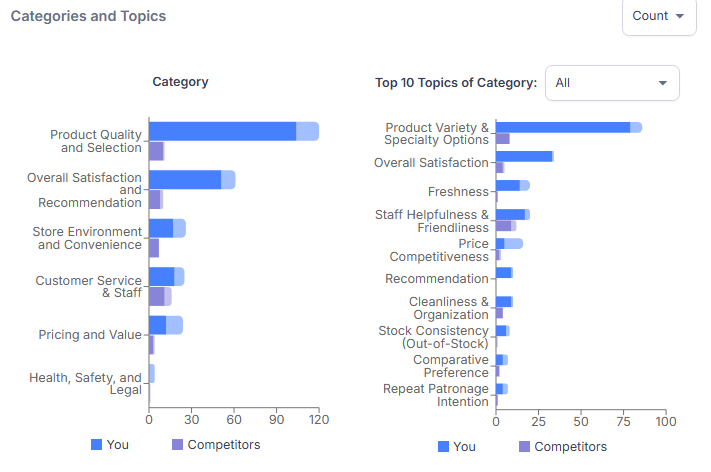
The Google Maps Rank Tracker adds a geographic dimension to competitive analysis. Each point on the tracking grid shows which businesses rank in that specific area, giving you a spatial understanding of where you're winning and where competitors dominate. The "Rewind" feature lets you watch how your ranking position relative to competitors has changed over time.
You can also access competitors' actual reviews, analyze their response rates, and compare sentiment on the same topics you track for your own business.
This depth of competitor intelligence transforms reputation management from a defensive activity (responding to reviews) into a strategic one (understanding where to improve and how to differentiate).
NiceJob vs Yext vs RightResponse AI: Which should you choose?
The best platform depends on your business size, your primary goals, and how much value you want to extract from customer feedback.
Choose NiceJob if:
- You're a small to mid-size service business that needs more online reviews
- Your primary goal is automating the review collection process
- You want an easy, "set-and-forget" tool with minimal learning curve
- Social proof widgets and social media sharing are important to you
- You value repeat booking reminders and referral campaigns
- A budget of $75-$125/month fits your needs
Get started with NiceJob's 14-day free trial.
Choose Yext if:
- You're a mid-market to large enterprise with many locations
- You need centralized management of business listings across 200+ publishers
- Accurate, consistent business information across all digital channels is your top priority
- You have the budget for an enterprise digital presence platform
- Your review management needs are part of a broader digital strategy
- You require enterprise-grade governance, workflows, and compliance features
Contact Yext for a customized demo and pricing.
Choose RightResponse AI if:
- You believe the quality of your review responses directly impacts whether prospective customers choose you
- You want every response to actively market your business, not just say "thanks"
- AI-powered, fact-infused responses with full brand voice control matter to you
- You also need sophisticated review collection with AI personalization, employee QR codes, and unlimited follow-ups
- Deep Voice of the Customer analysis by customizable business topics and competitor benchmarking are important
- You need Google Maps rank tracking with competitor visibility
- Transparent, usage-based pricing that scales with actual usage matters, regardless of whether you have one location or hundreds
Start your 7-day free trial of RightResponse AI with 1,000 free credits.
The reputation management landscape has evolved significantly. NiceJob has established itself as a strong player in automated review collection for service businesses, and it remains excellent at that job. Yext built a powerful infrastructure for managing enterprise-scale digital presence.
But the future of reputation management isn't just about collecting more reviews or syndicating more data, it's about what happens with the review response itself.
Most businesses treat responses as a box to check. The result is that prospective customers skip over them entirely because they contain nothing worth reading.
RightResponse AI was built to change that: to make every response substantive, brand-aligned, and useful enough that it works as a conversion asset for the business. Combined with AI-powered review collection, aspect-based sentiment analysis, map rank tracking, and competitor intelligence, it offers a quality-first approach to reputation management with the pricing transparency and usage-based economics that businesses of any size can embrace.
When customer feedback is increasingly the deciding factor in purchase decisions, having the tools to not just manage reviews but make every response count isn't optional, it's where the competitive edge lives.
Frequently Asked Questions
What is the main difference between NiceJob and Yext?
NiceJob is primarily an automated review collection and social proof platform designed for small to mid-size service businesses, starting at $75/month. Yext is a comprehensive digital presence management platform built for multi-location enterprises, with custom pricing and features including listings management across 200+ publishers, Knowledge Graph technology, and review management as one module in a larger suite. NiceJob focuses on getting more reviews through automated invitations and follow-ups, while Yext focuses on centralized brand consistency and digital presence at scale.
How much does NiceJob cost compared to Yext?
NiceJob offers published pricing with a Reviews Plan at $75/month and a Pro Plan at $125/month, with a 14-day free trial available. Yext uses custom, quote-based pricing with no published rates — prospective customers must contact sales for pricing. Industry sources suggest Yext implementations typically run into the thousands per month. RightResponse AI offers transparent pricing: Pay As You Go at $10/month per location plus credits, with fixed Core $19, Pro $29, and Pro+ $44 monthly plans.
Which platform is best for a small service business?
For small service businesses focused primarily on getting more reviews, NiceJob is a strong choice with its automated review invitations, follow-ups, and social proof widgets at $75/month. However, if the quality of review responses and turning them into conversion assets matters, RightResponse AI offers a more sophisticated approach with AI-powered responses that actively market the business, starting at just $10/month per location plus credits under Pay As You Go, with fixed Core $19, Pro $29, and Pro+ $44 monthly plans.
Does RightResponse AI offer review collection like NiceJob?
Yes, RightResponse AI offers AI-powered review collection with two modes: Essentials Mode (template-based, set-and-forget) and Pro Mode (AI-personalized requests using customer data). It also features employee-level QR codes, unlimited follow-ups, review grouping for multi-location businesses, and integration options via direct entry, file uploads, remote Google Sheets, or Zapier. These capabilities complement its core strength in AI-powered review response generation.
Try RightResponse AI for Free!
*No credit card required.