Choosing between Synup vs Vendasta for your reputation and local marketing needs often comes down to these five critical questions:
Comparison research: This article is part of the RightResponse AI review management software comparison library, which connects platform reviews, pricing analyses, alternatives, and head-to-head evaluations.
- Are you a marketing agency looking for a white-label platform, or a business that needs to manage its own online reputation?
- Do you need a broad suite of marketing tools, or would you benefit more from advanced, AI-powered review intelligence?
- Is your priority managing listings across hundreds of directories, or understanding what your customers are actually saying in their reviews?
- Are you willing to pay enterprise-level prices for an all-in-one platform, or do you prefer transparent, usage-based pricing?
- Do you need generic review response automation, or AI that can infuse real business knowledge, behavioral controls, and brand voice into every reply?
In short, here's what we recommend:
👉 Synup is a comprehensive local marketing platform whose focus leans heavily toward agencies managing multiple clients. It offers listing management across 75+ directories, review monitoring, social media management, and a full agency operating system with sales tools and white-labeled reporting.
Synup is designed for centralizing local marketing workflows, particularly for agencies that need to manage dozens or hundreds of client locations. Its review response AI can analyze context and adapt to brand tone, though it may not offer the same depth of personalization as purpose-built tools. Sentiment analysis is available as a premium add-on, and its pricing can add up with numerous add-ons layered on top of base plans.
👉 Vendasta serves as an extensive B2B marketplace and platform for channel partners who resell digital solutions to small businesses. With over 250 resellable products, AI-powered CRM, marketing automation, and project management, it positions itself as a complete operating system for agencies and resellers.
Vendasta's breadth is impressive, and its AI Reputation Specialist offers capable automated review response with customizable rules and multi-language support. However, many users report a steep learning curve, some have experienced inconsistent fulfillment quality for outsourced services, and its pricing model can escalate quickly with additional seats, products, and add-ons.
Both platforms provide comprehensive agency-focused solutions with white-label capabilities. Their broad approach means that reputation management is one well-developed module among many rather than the singular focus of the platform.
For businesses that understand reviews are where customers make buying decisions; the conversion gate where all other marketing efforts lead, a purpose-built solution offers distinct advantages.
👉 RightResponse AI takes a different approach by focusing exclusively on turning customer reviews into a competitive advantage. Built from the ground up with generative AI at its core, its response personalization system rests on three pillars including Facts (business-specific messaging mapped to review themes), Customizations (behavioral rules and controls), and Brand Voice (tone and style). This makes each reply a marketing asset rather than a generic acknowledgment.
Combined with Voice of the Customer Aspect-Based Sentiment Analysis that reveals the specific drivers behind your ratings, Google Maps rank tracking with a unique "Rewind" feature, and AI-personalized review requests with SEO-guiding questions, RightResponse AI delivers broad reputation intelligence for location-based businesses of all sizes, from single-location to enterprise, with transparent, usage-based pricing starting at $10 per location per month.
If you want to see how AI-powered review responses can transform your online reputation into a customer acquisition engine, start your 7-day free trial of RightResponse AI with 1,000 free credits.
Table of contents:
- Synup vs Vendasta vs RightResponse AI at a glance
- The fundamental difference: Agency operating systems vs reputation intelligence
- Review response quality separates good from exceptional
- Voice of the Customer depth determines actionable insights
- Google Maps rank tracking approaches vary dramatically
- Pricing transparency reveals each platform's priorities
- Review generation strategies show different philosophies
- White-labeling and multi-location management compared
- Synup vs Vendasta vs RightResponse AI: Which should you choose?
Synup vs Vendasta vs RightResponse AI at a glance
Synup | Vendasta | RightResponse AI | |
|---|---|---|---|
Primary focus | Agency local marketing OS | B2B marketplace & agency platform | AI-powered reputation intelligence |
Review response AI | ⭐⭐⭐ Context-aware AI responses | ⭐⭐⭐ AI Reputation Specialist | ⭐⭐⭐⭐⭐ Three-pillar personalization (Facts, Customizations, Brand Voice) |
Sentiment analysis | ⭐⭐⭐ Sentiment tracking (add-on) | ⭐⭐⭐ Sentiment detection | ⭐⭐⭐⭐⭐ Voice of the Customer ABSA |
Google Maps rank tracking | ⭐⭐⭐⭐ Grid Ranker tool | ⭐⭐⭐ Local Search Grid (limited keywords) | ⭐⭐⭐⭐⭐ Grid tracking with "Rewind" feature |
Review generation | ⭐⭐⭐ Email/SMS campaigns | ⭐⭐⭐⭐ Multi-channel with automation | ⭐⭐⭐⭐⭐ AI-personalized requests with SEO-guiding questions & photo attachment |
Pricing transparency | ⭐⭐⭐ Base plan + add-ons | ⭐⭐ Complex minimum-spend model | ⭐⭐⭐⭐⭐ Fixed plans plus Pay As You Go credits |
Starting cost | |||
White-labeling | ⭐⭐⭐⭐⭐ Extensive | ⭐⭐⭐⭐⭐ Extensive | ⭐⭐⭐⭐ Available for agencies |
Best for | Agencies managing multiple client locations | Channel partners reselling digital solutions | Location-based businesses of all sizes focused on review-driven growth |
The fundamental difference: Agency operating systems vs reputation intelligence
Synup and Vendasta both evolved from the belief that agencies need a single platform to manage everything for their local business clients: listings, reviews, social media, sales pipelines, invoicing, and more.
This all-in-one approach has benefits for agencies juggling dozens of tools, and both platforms have developed capable reputation management modules within their broader suites. But the breadth of features naturally means each individual module competes for development resources with every other module on the platform.
Synup's recent evolution into "Synup OS" makes this explicit.
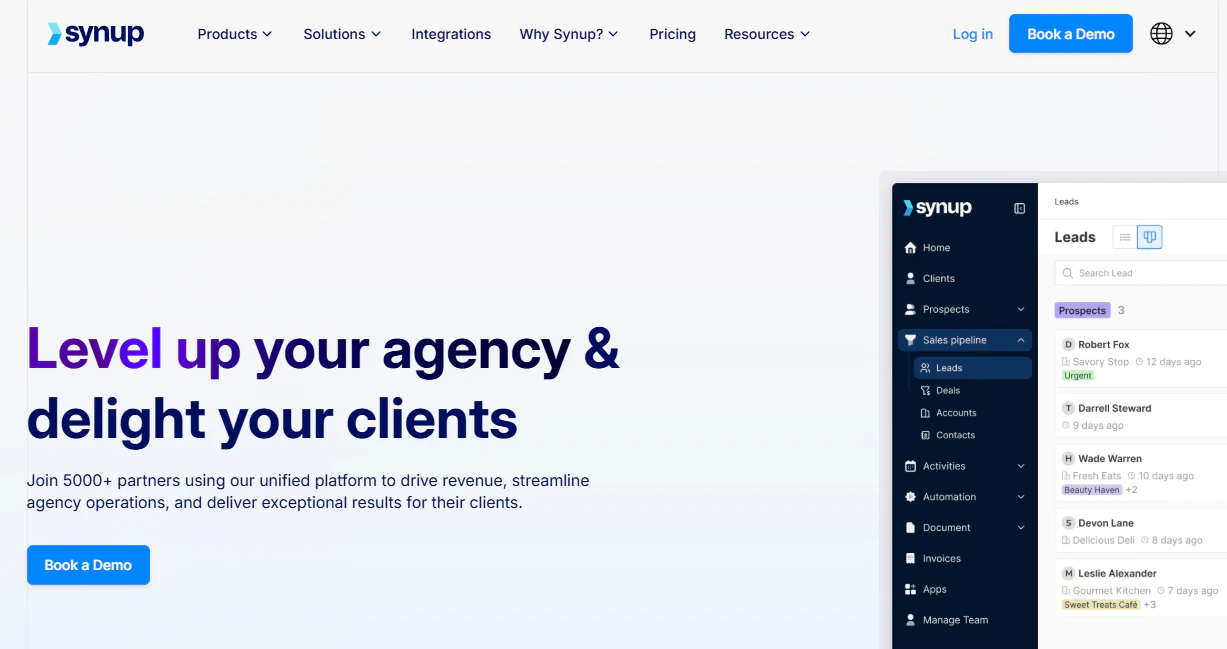
The platform now includes lead generation tools, sales pipeline management, invoicing with e-signatures, and even email sequences for prospecting. These are valuable agency tools, but they illustrate how the platform's investment is distributed across many operational areas beyond reputation management.
Vendasta takes the breadth even further with its marketplace of over 250 resellable products.
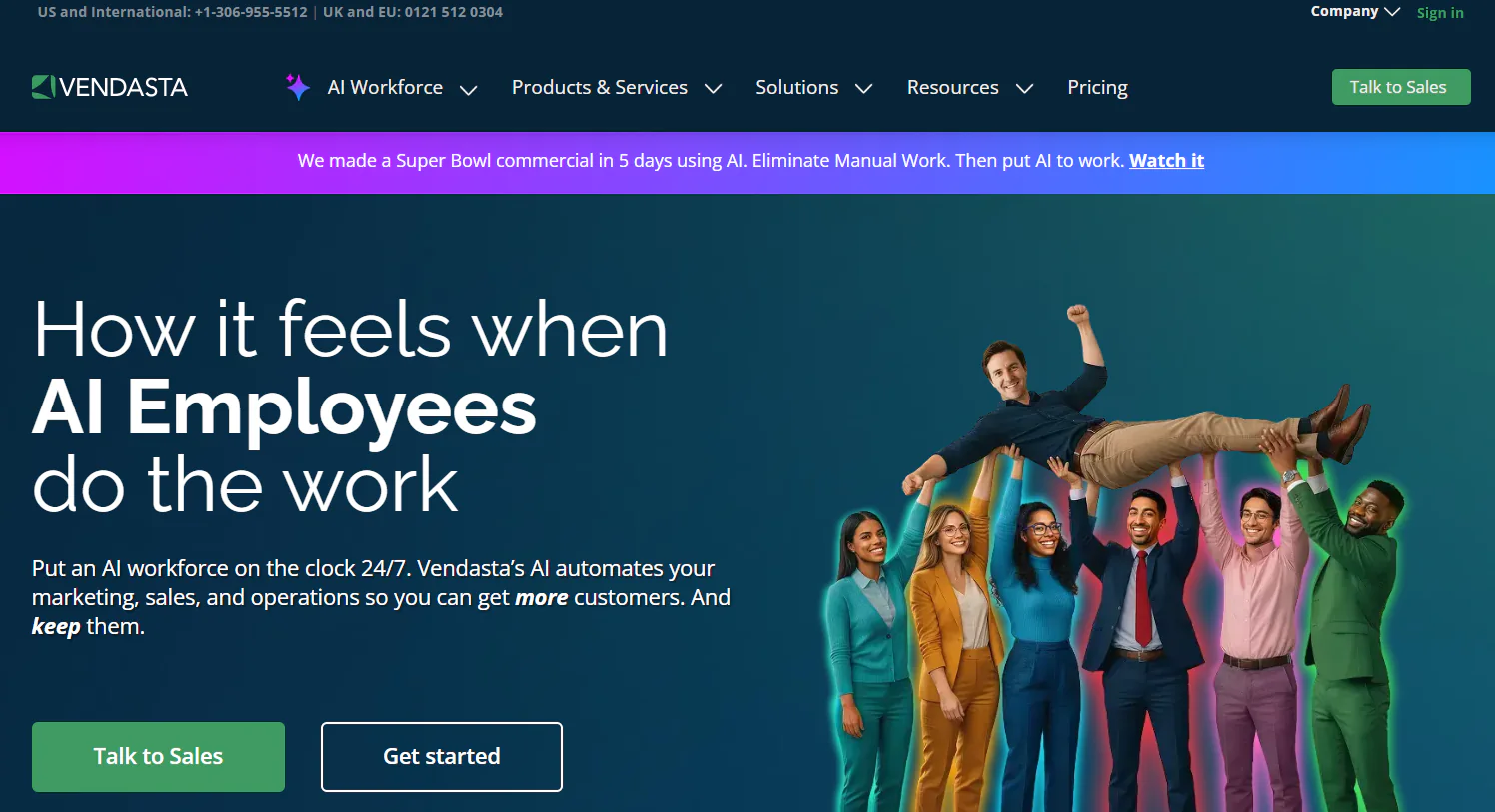
Their "AI Workforce" concept introduces AI employees for various functions, from receptionists to salespeople. Reputation management is one product category in a catalog that also includes website builders, advertising tools, and productivity software.
RightResponse AI chose a different path entirely.
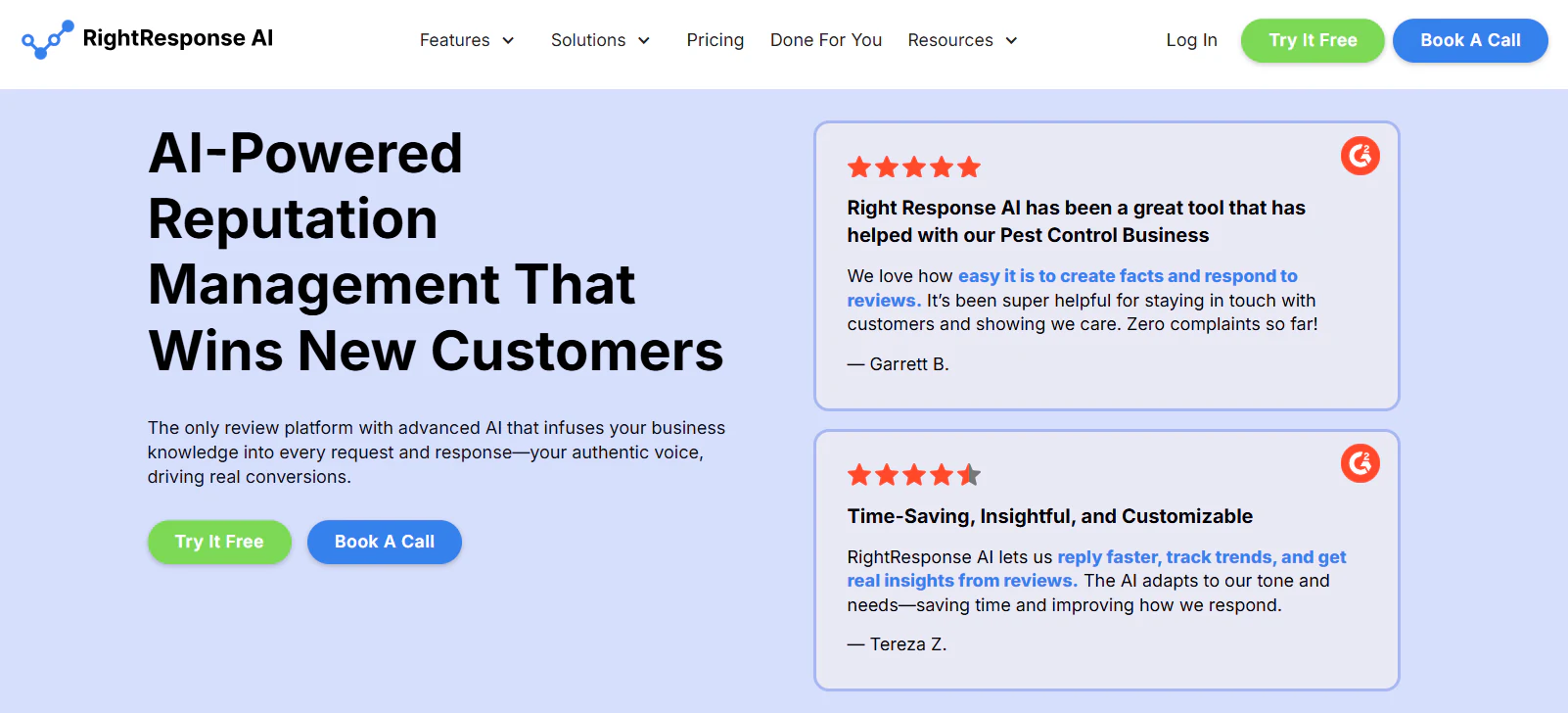
Rather than building an agency operating system, they built a reputation intelligence platform. Every feature, from the review response generator powered by Facts, Customizations, and Brand Voice to the Voice of the Customer Aspect-Based Sentiment Analysis, is designed with a single purpose: helping businesses understand, leverage, and grow through their customer reviews.
This focus matters because all the marketing spend in the world; SEO, ads, a polished website, ultimately leads prospective customers to one place: the reviews.
Reviews are the conversion gate. People read reviews more than they read a business's website, and the response is the only part the business controls. The difference between a generic "Thank you for your review!" and a response that weaves in relevant business facts, follows clear behavioral rules, and matches the brand's voice is the difference between wasted space and a good conversion opportunity.
Review response quality separates good from exceptional
Synup's review response AI provides context-aware, AI-generated responses that detect emotional cues, identify keywords, and adapt to a business's brand style.
The platform aggregates reviews from various sources and allows users to respond from a central dashboard using templates or AI suggestions. For agencies managing dozens of clients, this centralized workflow saves significant time.

Source: Synup
The AI can fully automate responses based on rating, sentiment, and location, which is useful at scale, though the system works from general AI capabilities rather than a structured business-knowledge framework.
Vendasta's "AI Reputation Specialist" is a capable tool that can be configured with customizable rules, purpose, and knowledge.
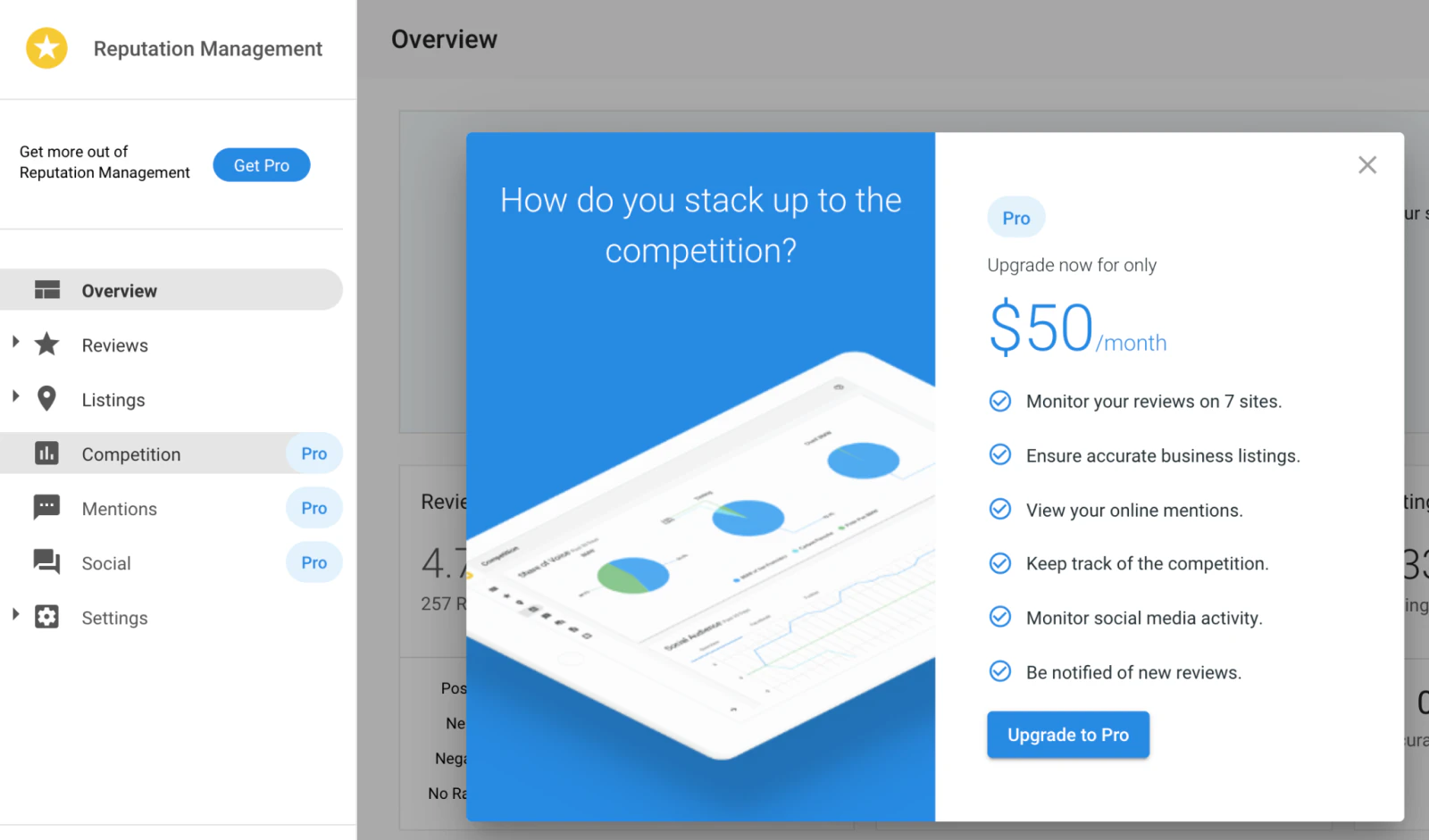
Source: Vendasta
It automatically posts responses on Google and Facebook and provides AI-suggested responses for 100+ additional sources. The AI can detect the language of a review and respond accordingly, and its conversational AI insights feature transforms review data into actionable intelligence through a chat interface. It's a well-built tool within a broader platform ecosystem.
RightResponse AI's "Intelligent Review Response" generator represents a different approach built on three distinct personalization pillars.
Facts define what to say — business-specific messaging mapped to review themes so the AI knows which information to surface when a customer mentions a specific topic.
Customizations define how the response should behave — greeting preferences, contact information rules, "do-not-say" lists, and response closing formats.
Brand Voice defines how it should sound — whether formal, casual, warm, or high-energy. All three work together to produce hyper-personalized, brand-aligned responses with endless variation without losing control.
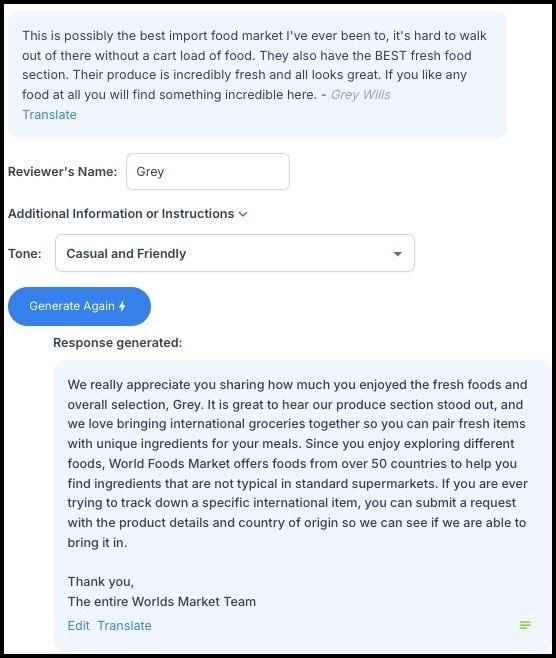
The system uses an intentionally agentic pipeline that separates analysis from writing.
It first analyzes the review, detecting context, sentiment, names, updates, and sensitive information, then determines which Facts and Review/Response Pairs are relevant, and only then generates the response. This multi-step process reduces the risk of AI producing inappropriate output while increasing relevance.
For medical practices, the system flags potentially sensitive health information to help maintain HIPAA compliance.
What does this look like in practice? When a customer praises a restaurant's food, instead of a generic "Thanks for your kind words!", the response might naturally incorporate: "We're glad you enjoyed the steaks. Did you know we also have the best mezcal bar in San Francisco? We'd love to welcome you back."
This turns the response into a marketing moment. Prospective customers scanning reviews don't just see that the business responds; they discover something new that might bring them through the door.
Currently, most people read reviews but skip responses because most responses are generic and unhelpful. Quality responses represent the untapped opportunity to capture attention when prospective customers do glance at them, and the richer, more engaging those responses are, the more likely they are to be read and to influence a buying decision.
RightResponse AI also includes reviewer name analysis that determines whether a name appears genuine before including it in a greeting, and employee name recognition to ensure proper formatting when staff are mentioned in reviews. These details create responses that feel thoughtful rather than machine-generated.
Voice of the Customer depth determines actionable insights
Synup offers sentiment analysis as part of its review management module.
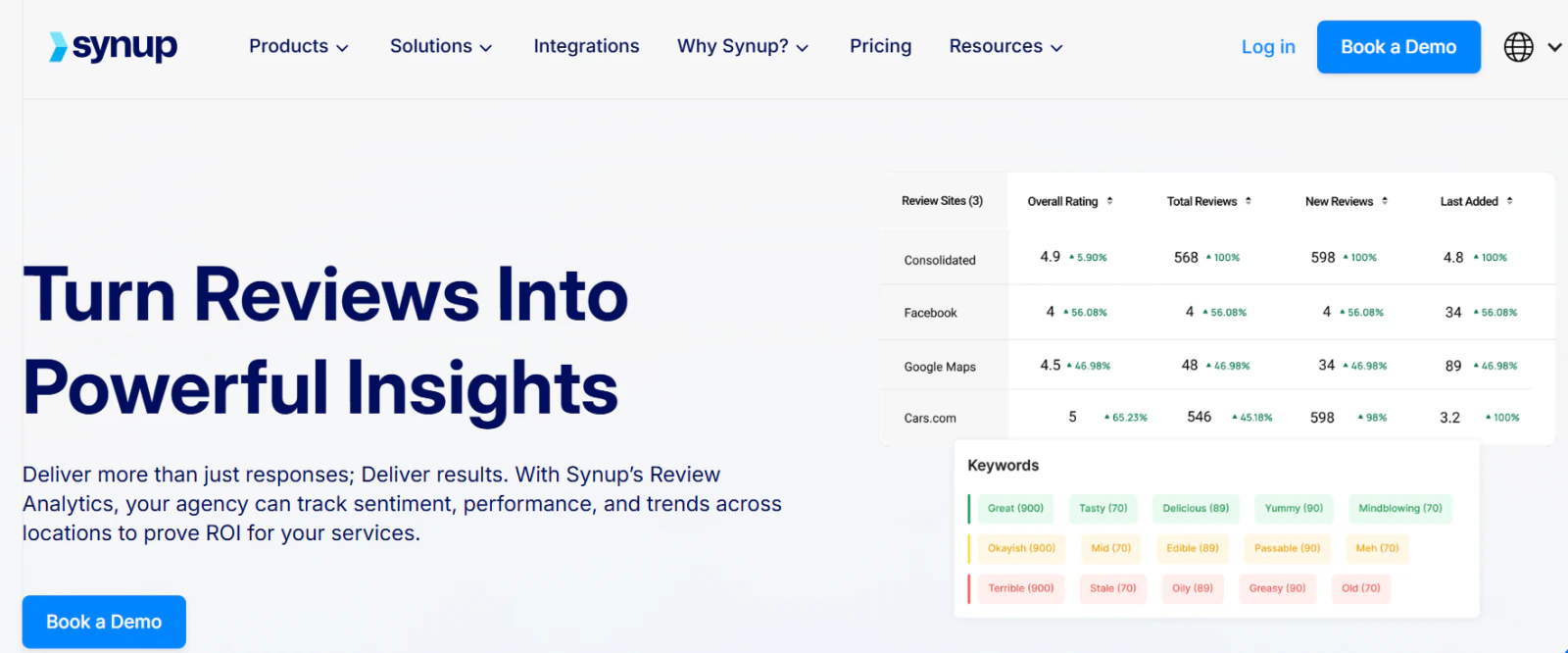
The platform can categorize reviews as positive, negative, or neutral and identify recurring themes. The Reviews Gold add-on at $50 per location per month includes sentiment analysis alongside automated review generation and CRM integration. While functional, the sentiment capability sits behind a premium add-on rather than being a core part of the platform.
Vendasta's reputation management includes sentiment analysis that can detect shifts in customer sentiment and identify recurring issues.
The conversational AI insights feature lets users ask follow-up questions and uncover trends through a chat interface, which is a thoughtful approach to making data accessible. As one component of a platform with hundreds of products, the analysis is designed for general monitoring and trend detection.

Source: Vendasta
RightResponse AI built its sentiment analysis from the ground up using a customized version of Voice of the Customer Aspect-Based Sentiment Analysis (ABSA).
This isn't typical positive/negative scoring. The system breaks down each review to identify the specific aspects of a business that customers are reacting to, then assigns sentiment to each aspect individually.
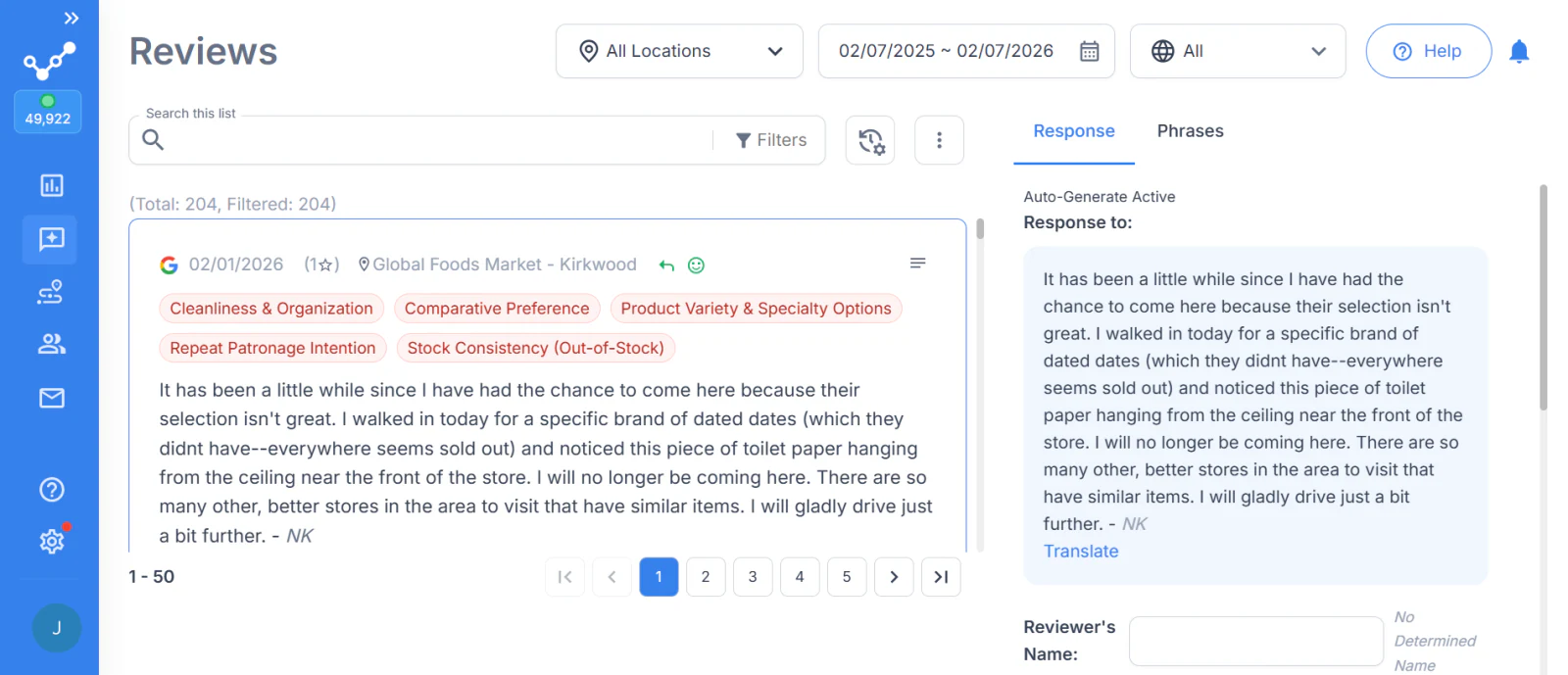
What makes this powerful is the customization. Businesses can define their own topics and categories that align with how they actually think about their operations. A hotel might track "check-in experience," "room cleanliness," "amenities," and "staff friendliness" as distinct categories. The AI then maps every relevant phrase from every review to these custom categories, revealing precise patterns.
The platform filters out irrelevant content automatically, focusing the analysis on genuine, experience-based feedback.
Users can drill down to see the exact phrases customers used for each topic, providing full context behind every insight. And the same analytical framework can be applied to competitors' reviews, offering a direct side-by-side comparison of strengths and weaknesses on specific operational topics.
For a restaurant chain trying to understand why one location consistently outperforms another, the difference between "67% positive sentiment" and "customers at Location A praise the 'attentive service' and 'quick seating' while Location B receives complaints about 'long wait times' and 'inattentive staff'" is the difference between data and insight.
Google Maps rank tracking approaches vary dramatically
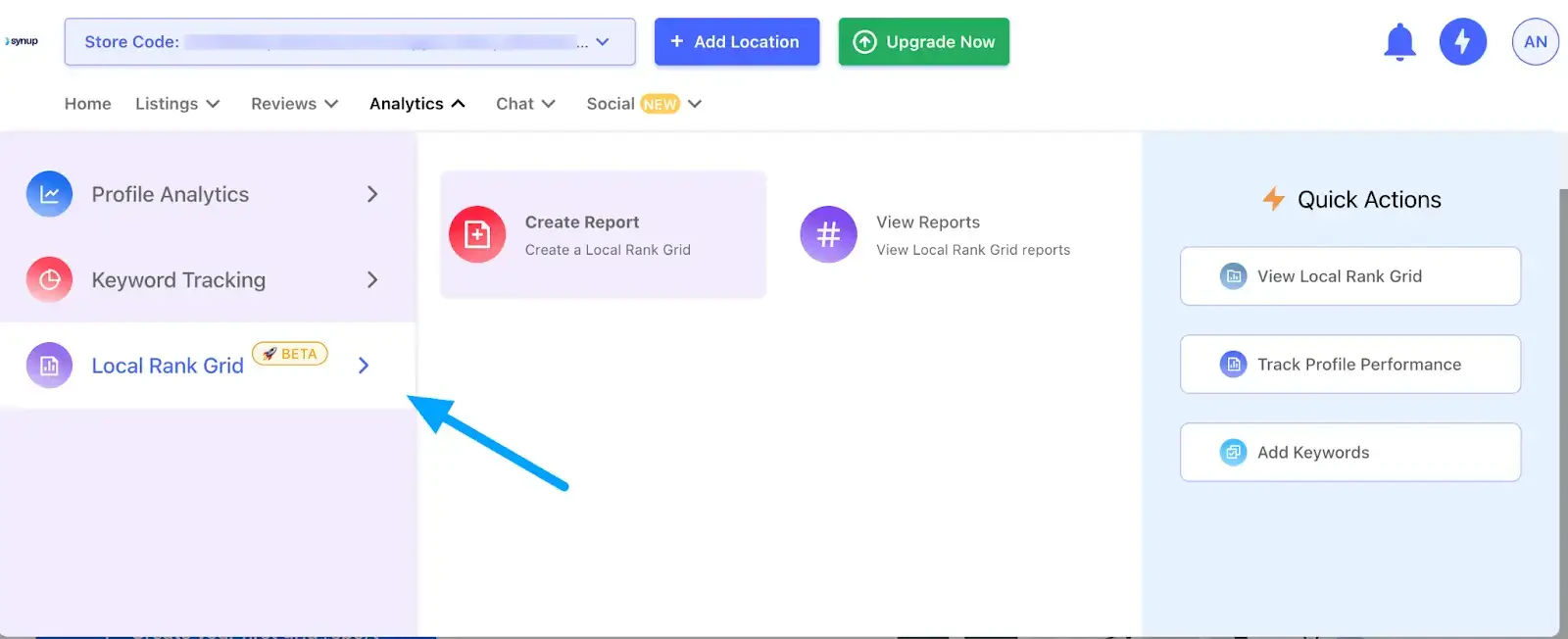
Synup offers a "Grid Ranker" tool that provides a visual representation of local search rankings across a defined geographic area.
Source: Synup
Monthly grid rank tracking credits are included in the base plans (50, 100, and 150 credits for the three tiers respectively), with an SEO Pro add-on available at $5 per location per month for weekly tracking and additional reports.
The Grid Ranker is a solid tool for agencies tracking client visibility, though the credit limitations in the base plans may require agencies to purchase add-ons for comprehensive tracking.
Vendasta includes a Local Search Grid within its Local SEO product that tracks Google Maps positions on a map-based view.
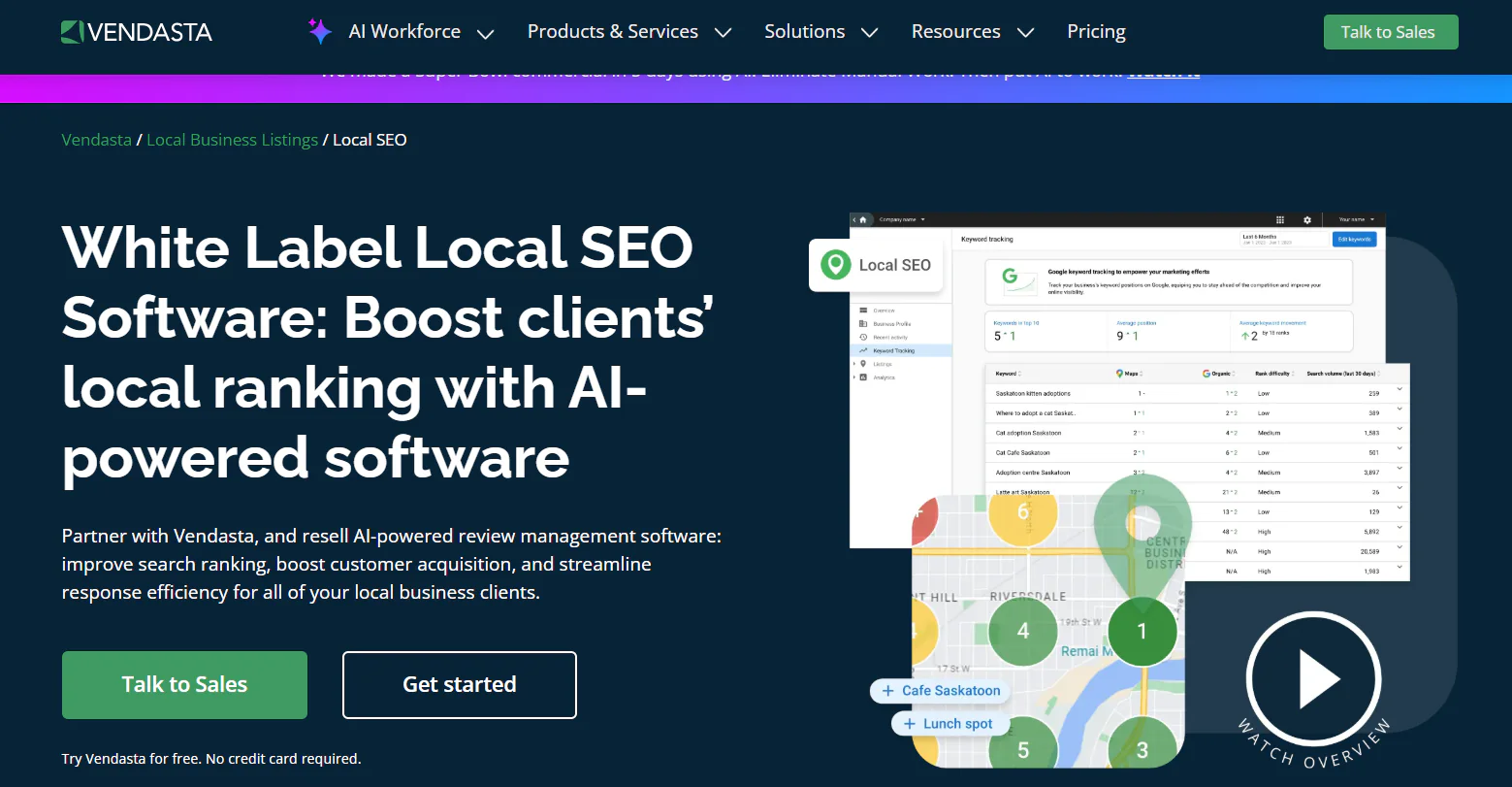
The Standard plan tracks up to 3 keywords, while the Pro plan supports up to 15 keywords. While this provides useful visibility data, the keyword limits may feel restrictive for businesses targeting a broader range of search terms.
RightResponse AI offers a fully-featured map rank tracker with several distinctive capabilities.
Users can customize grid sizes and distances between points to match their specific market area. The system simulates searches from each grid point for chosen keywords, then presents results as a color-coded heatmap showing exactly where the business ranks.
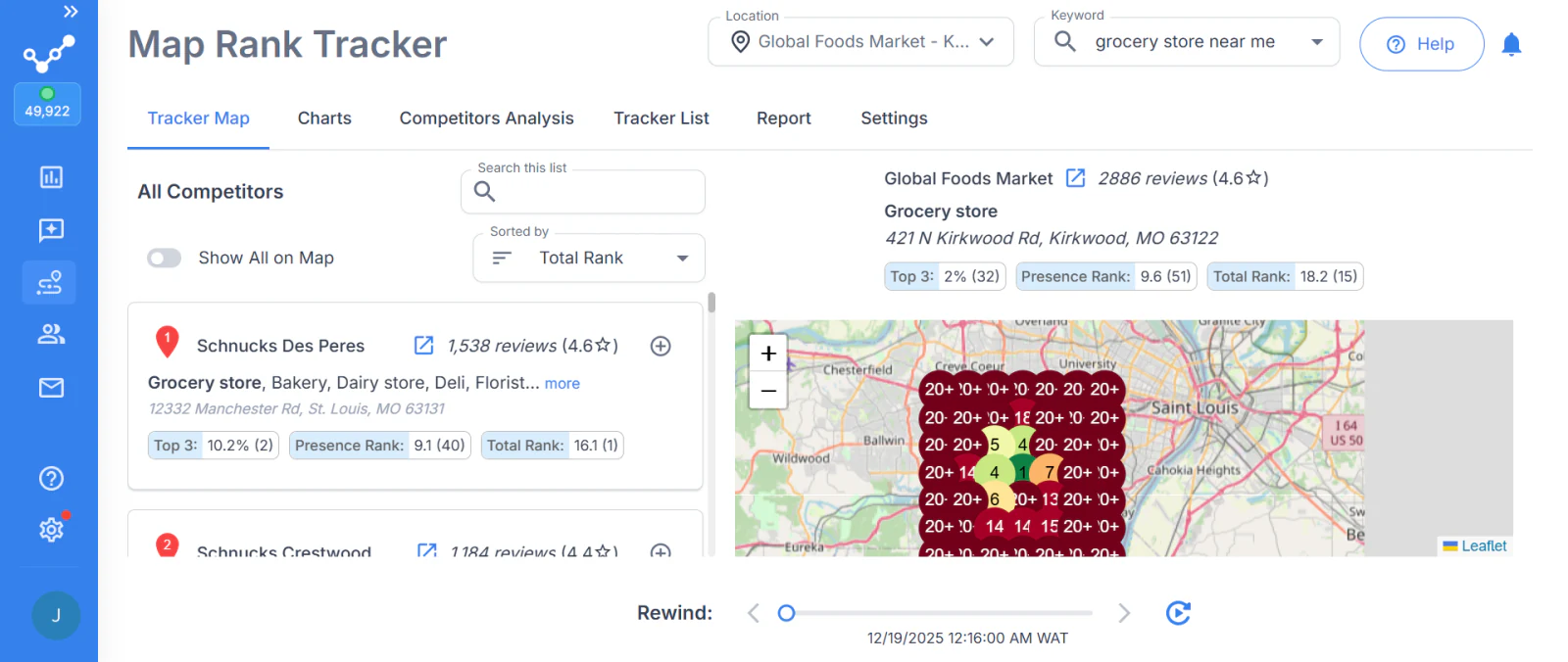
The standout feature is the "Rewind" capability. Every scan is saved, and users can visually replay how rankings have evolved over time by using a slider to step through historical data. Rather than just seeing static charts of ranking changes, businesses can watch their positions shift across the map grid over weeks and months, providing an intuitive understanding of ranking dynamics.
The competitor analysis within the map rank tracker allows users to click on any grid point to see which businesses rank there, then dive into detailed competitor analysis including review volume, average ratings, response rates over 60 and 180-day periods, and even apply the same Voice of the Customer ABSA to competitors' reviews. This creates a competitive intelligence picture tied directly to local search visibility.
At 1.5 credits per pin per scan, the usage-based pricing means businesses pay only for the tracking they need, whether that's a focused 5x5 grid around a single location or comprehensive scans across an entire metro area.
Pricing transparency reveals each platform's priorities
Synup uses a tiered subscription model with three plans: Startup at $79/month (annual billing), Agency at $199/month, and Scale at $799/month.
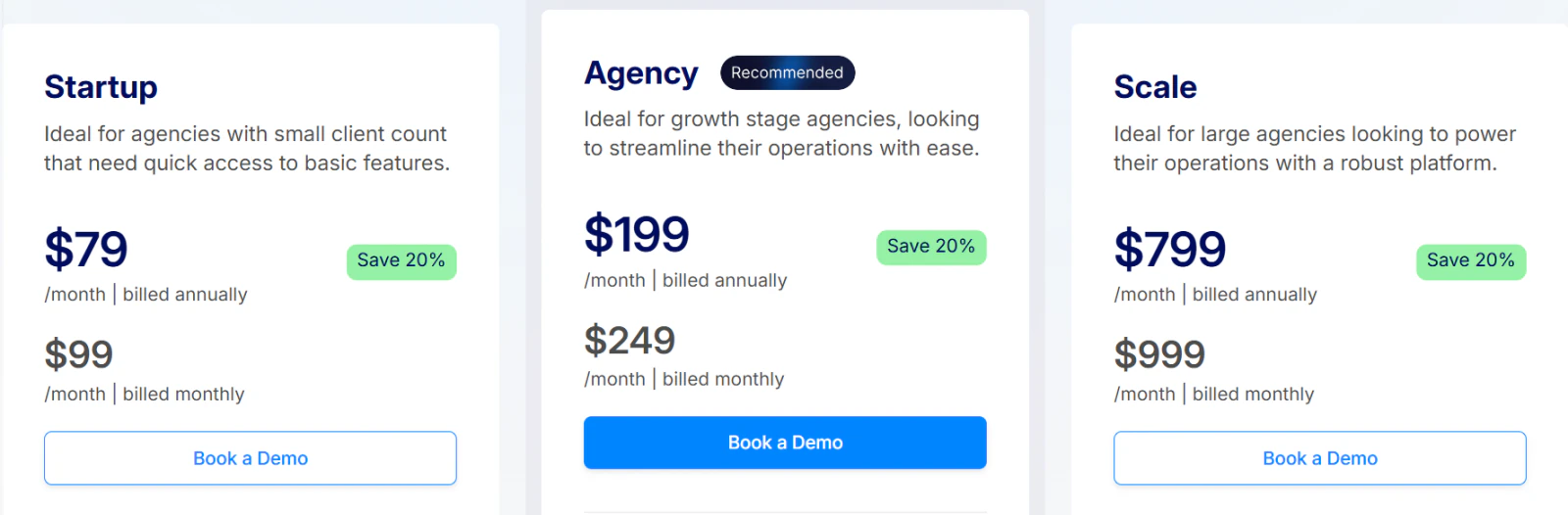
These base plans include a set number of team members, client accounts, and locations for basic listings and review management. However, the costs emerge with add-ons. Listings Pro costs $35 per location per month.
Reviews Pro runs $20 per location per month, while Reviews Gold (which includes sentiment analysis) costs $50 per location per month. Social Pro adds $6 per connection per month, and SEO Pro is $5 per location per month.
For an agency managing 50 client locations with full-featured reputation management, the costs add up significantly beyond the base subscription based on published add-on pricing.
Vendasta operates on a minimum-spend model starting at $99/month for the Starter plan ($79/month with annual billing), $499/month for Professional, and $999/month for Premium.
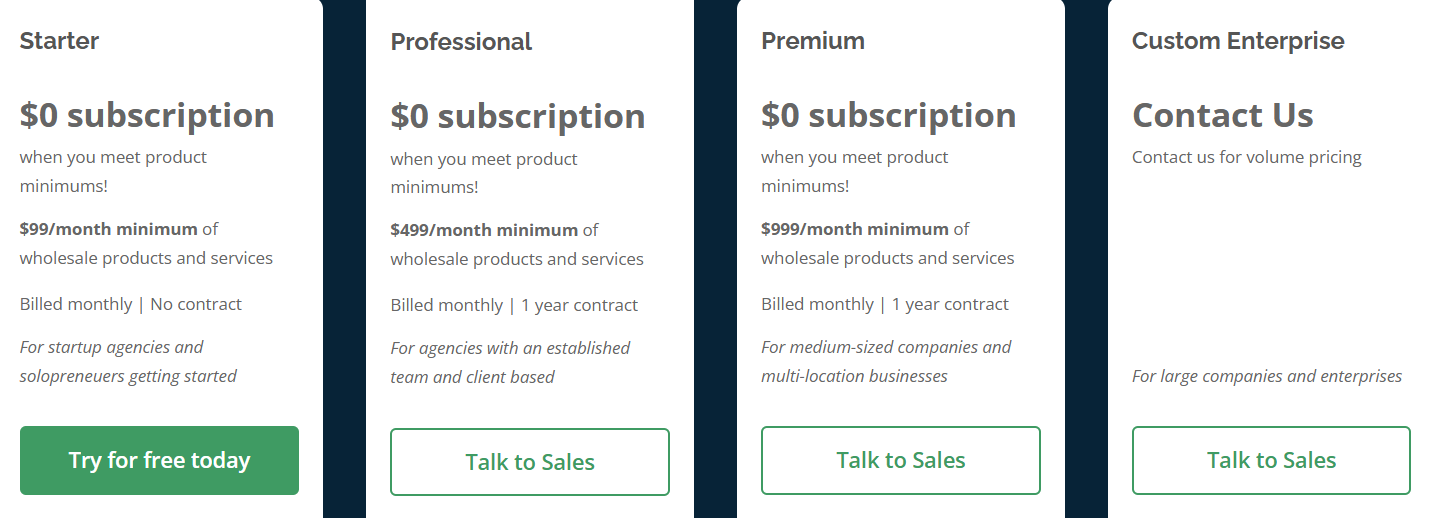
Spending on qualifying Vendasta products counts toward the monthly minimum. In practice, the costs compound: additional team seats range from $30 to $65 per month depending on the plan, Snapshot Reports beyond the included allotment cost $2 each, and marketplace products are additional costs on top of the subscription.
Professional and Premium monthly plans also require 12-month contracts, plus mandatory onboarding fees ranging from $500 to $2,500.
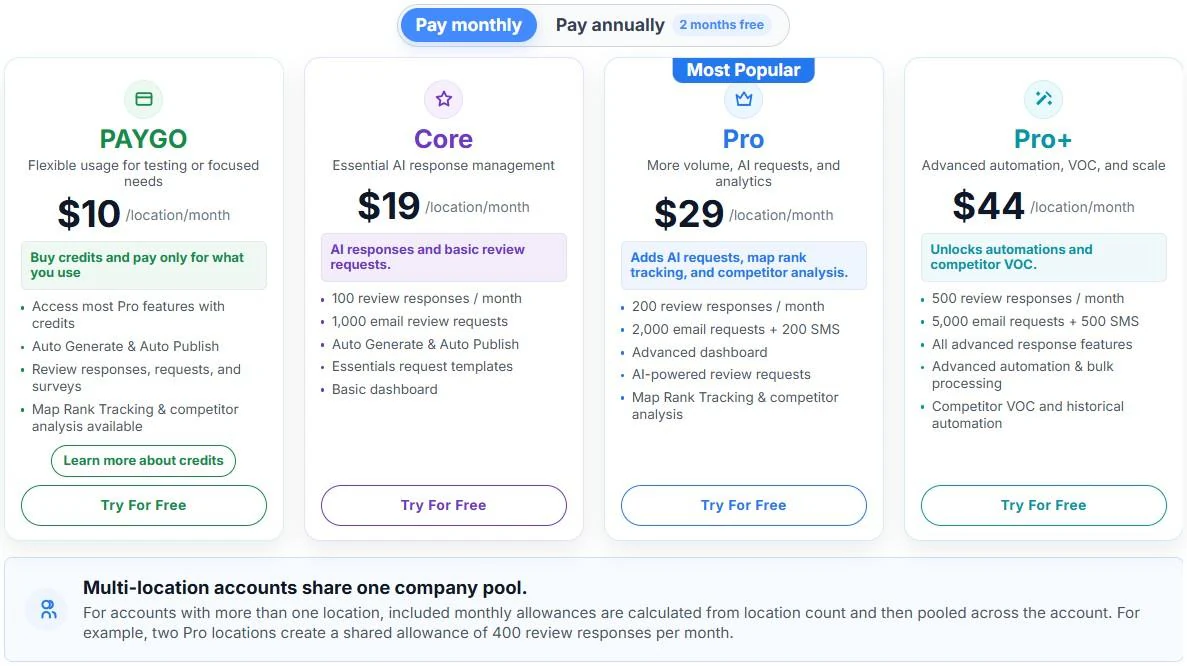
RightResponse AI takes a straightforward approach: Pay As You Go starts at $10 per location per month for PAYGO access, or $100 per location billed annually ($8.33/month equivalent; two months free), then bills only for the credits you use—a good fit for low-volume or narrow needs. Most businesses instead pick one of its fixed monthly plans (below) for predictable allowances.
On Pay As You Go, usage is managed through a credit system where credits cost $0.01 each at the base tier and as little as $0.006 each at higher volumes. A review response costs 20 credits ($0.20 at the base rate). Sentiment analysis costs 20 credits per text review. A map rank scan costs 1.5 credits per pin. An email review request costs 2 credits.
Source: RightResponse AI
Beyond Pay As You Go, RightResponse AI offers simple fixed-price plans, each with clear monthly allowances per location so you know exactly what you get:
- Core ($19/mo): 100 review responses, 1,000 email review requests, Essentials request templates, and a basic dashboard (no SMS, surveys, or map rank tracking).
- Pro ($29/mo, most popular): 200 review responses, 2,000 email requests plus 200 SMS, 200 surveys, AI-personalized (Pro-mode) review requests, Map Rank Tracking with competitor analysis (10 scans/mo), and an advanced dashboard.
- Pro+ ($44/mo): 500 review responses, 5,000 email requests plus 500 SMS, 500 surveys, advanced automation with bulk processing, Competitor Voice of the Customer, and 25 map-rank/competitor scans/mo.
- Enterprise: custom plans for agencies and multi-location brands, adding white-label, API access, and advanced reporting.
There are no confusing add-on modules, and a 7-day free trial includes 1,000 usage credits and access to most Pro features, with no credit card required.
This usage-based model means businesses aren't forced into paying per-location for capacity they don't use, and agencies can scale cleanly across accounts. It's competitively priced at the low end for businesses with moderate review volume, though the focus is quality over cost. Businesses choosing purely on price aren't likely to value what differentiates the platform.
For those who understand that a generic "thanks for your review" response wastes space and blocks readers from actual content, the investment in quality responses pays for itself through improved conversion.
To put this in perspective: a single-location business using RightResponse AI for comprehensive reputation management (responding to reviews, running sentiment analysis, and tracking map rankings) might spend $30-50 per month total, depending on usage volume.
The same level of functionality through Synup could cost $79 plus $50 per location for Reviews Gold plus $5 for SEO Pro, totaling $134 per month. Through Vendasta, the base subscription alone starts at $99 (or $79 annually), before adding any reputation management products.
Review generation strategies show different philosophies
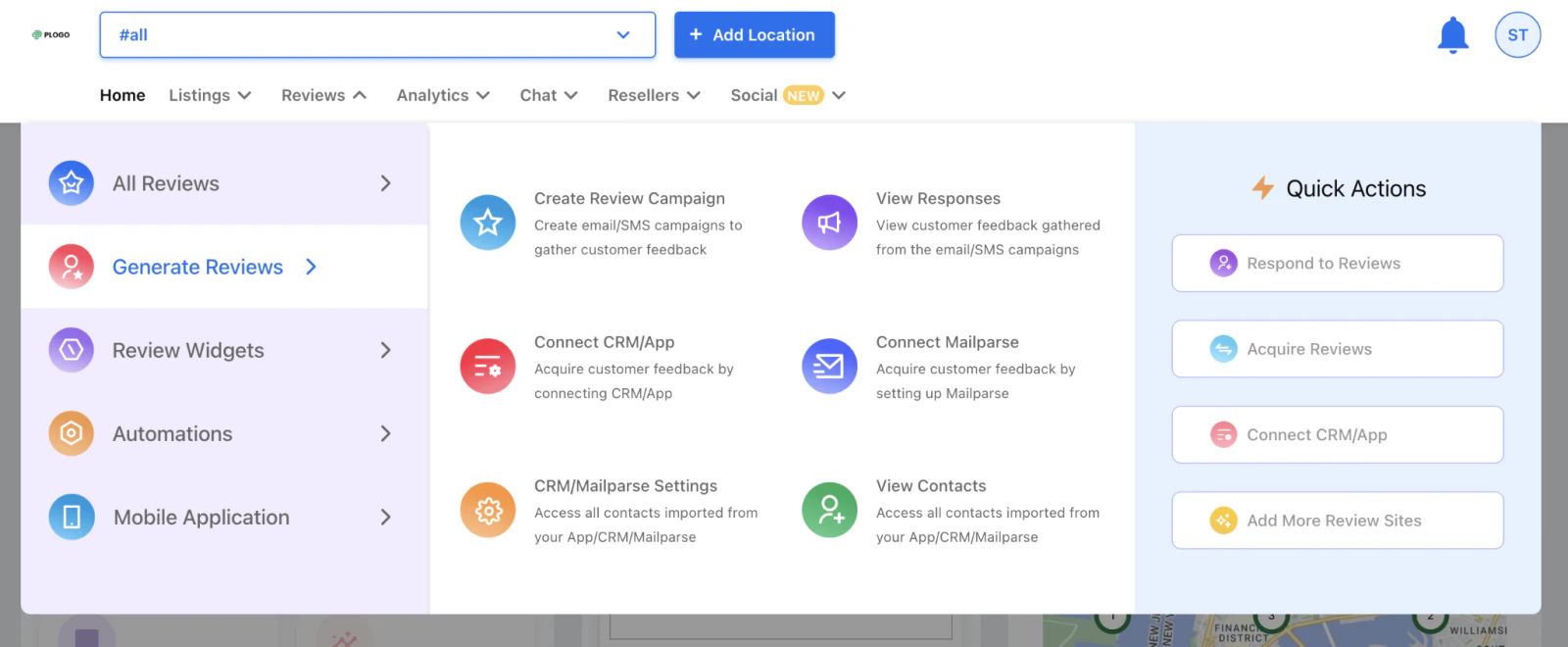
Synup includes basic review generation in its platform with email and SMS campaigns.
Source: Synup
The base plans include a limited number of review invite emails per month (25 for Startup, 50 for Agency). The Reviews Gold add-on expands this significantly with 1,000 email credits and 50 text credits monthly, plus CRM integration for automated review generation and review surveys. It's a functional system, particularly for agencies that can integrate it with their clients' existing customer data.
Vendasta's review generation capabilities, marketed under the "Customer Voice" brand, offer multi-channel review requests via email and SMS with customizable templates.
The platform can be integrated with CRMs and point-of-sale systems to automate review requests after customer transactions. Multiple request methods are supported, including kiosk mode and email signatures. A website review widget can showcase positive reviews. The automation and integration options make it a solid choice for agencies handling review generation at scale.
RightResponse AI approaches review generation with the same AI-first philosophy it applies to responses.
Instead of generic "How was your experience?" templates, the platform creates AI-personalized review requests that can reference specific details of the customer's interaction such as the product purchased, service received, or date of visit.
Users can create unlimited "Profiles" (frameworks for personalization) and attach photos to email requests, such as an image of a completed project, to reinforce the positive experience and give customers something they can upload to their own review.
A distinctive capability is the inclusion of structured SEO-guiding questions that give reviewers inspiration about what to write, with questions that can rotate so that reviews contain varied content. Questions like "What type of massage did you get?" or "Which treatment did you visit us for?" gently prompt customers to include keywords relevant to the business's local SEO strategy.
This means the generated reviews aren't just more numerous but are also more valuable for search visibility.
The platform supports email and SMS delivery, with contact data sourced via direct entry, file uploads, remote Google Sheets, Zapier integrations, or custom APIs. Unlimited follow-up reminders can be configured; seven follow-ups for a roofer, fewer for a lawyer, to match each industry's dynamics.
Employee-level personalized QR codes allow businesses to tie reviews back to the individual who requested them, tracking which staff members drive review volume and conversion.
The private feedback option allows businesses to route potentially negative feedback to a private channel, addressing customer concerns directly before they become public reviews. Higher conversion rates through personalization, photos, and guiding questions are valuable for lower-volume businesses that need to maximize every review opportunity.
White-labeling and multi-location management compared
Synup excels at white-labeling.
The platform offers fully branded client portals, white-labeled emails, and customizable dashboard experiences. Higher-tier plans offer additional custom app branding and embedded tools. With SOC 2 compliance and role-based access control, Synup provides the security and governance features that agencies need.

Source: Synup
The platform supports bulk listing updates via CSV, real-time synchronization across its publisher network, and duplicate listing suppression. For agencies that need a complete white-label solution with better listing management, Synup is strong.
Vendasta provides perhaps the most extensive white-labeling in the market.
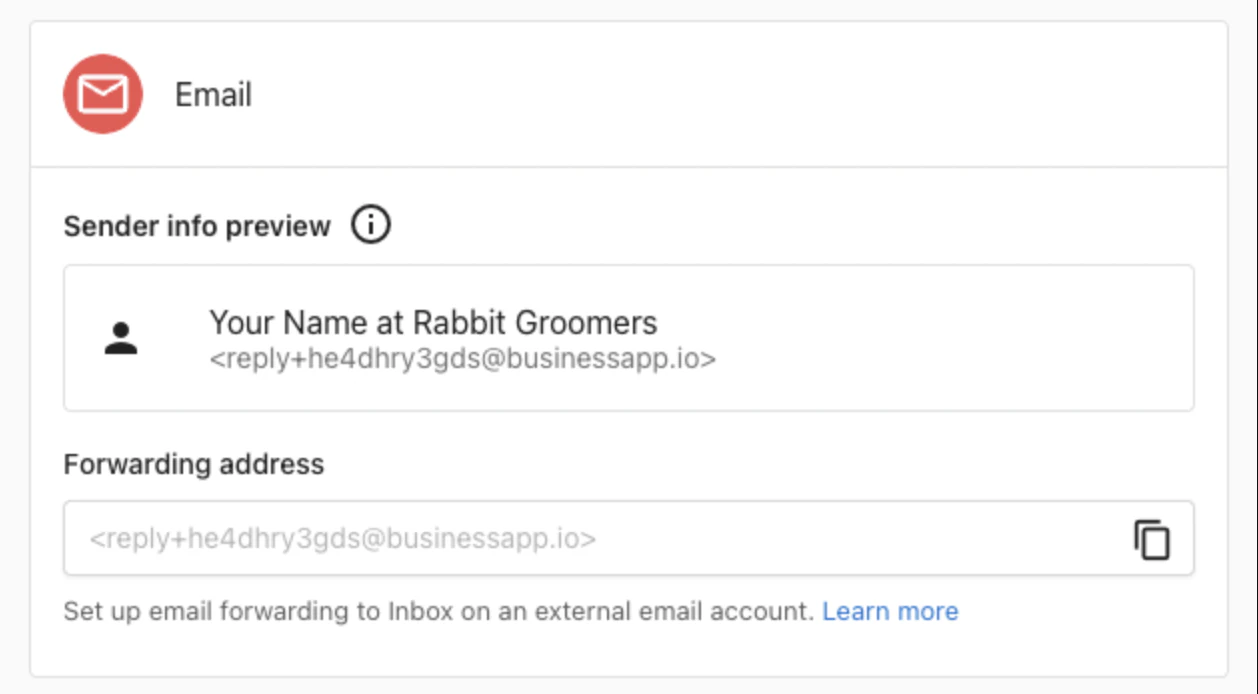
The entire client-facing experience, including the "Business App" portal, can be fully branded with custom logos, colors, and domains. Partners can set their own pricing and markups on products, and even the email communications can be sent from the partner's domain.
Source: Vendasta
The marketplace of 250+ resellable products can all be presented under the partner's brand. For channel partners who want to build an entire business on top of a white-label platform, Vendasta offers unmatched breadth.
RightResponse AI offers white-label reputation management services for agencies, along with advanced multi-location management features including brands and regions management, API access, customized reporting, and custom AI workflows.
The platform's multi-location features are built around reputation intelligence: businesses can set Facts at the company, brand, or individual location level, ensuring response quality and messaging consistency across the organization while allowing location-specific detail. Sentiment analysis can be compared across locations, and the map rank tracker can monitor visibility for each location independently.
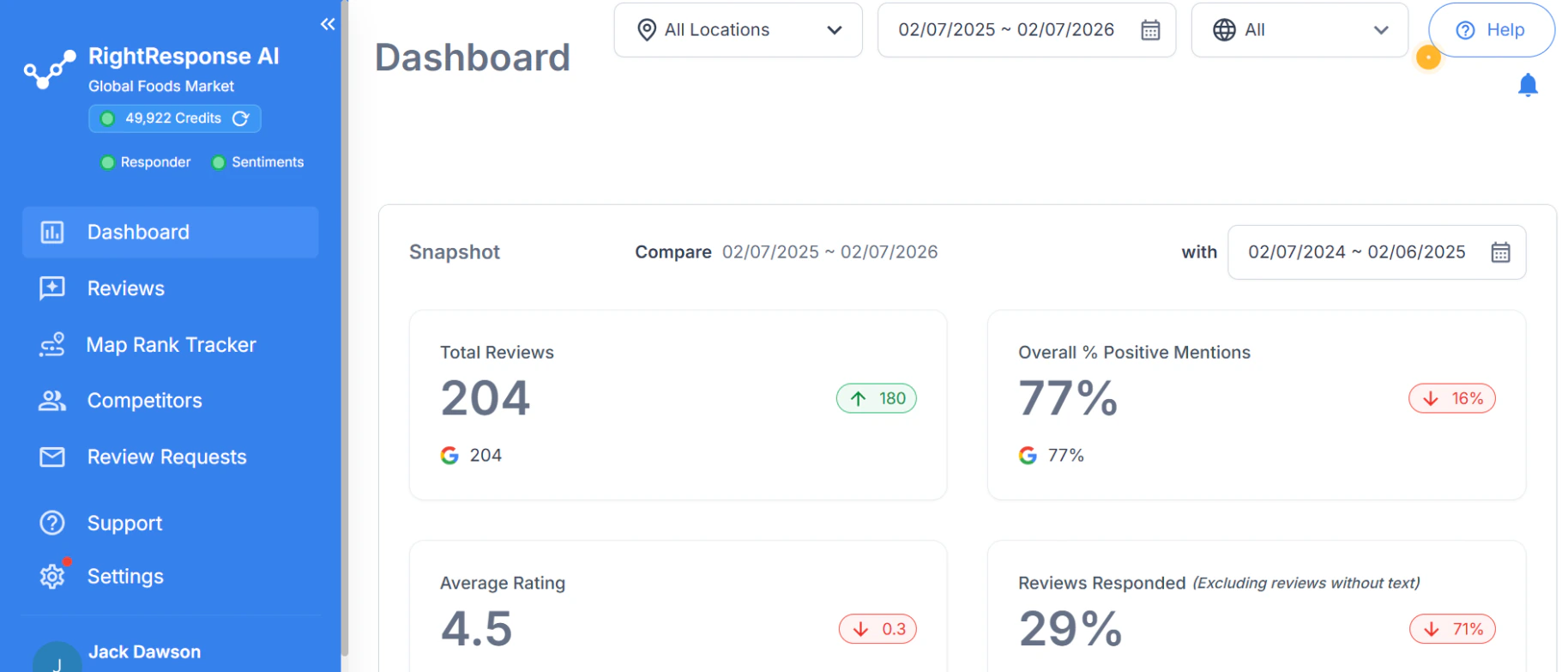
For corporate executives and regional managers who need to monitor brand reputation and identify performance risks across their organization, the platform provides operational depth focused specifically on reputation intelligence.
The key distinction is that RightResponse AI's multi-location features are oriented around understanding how each location performs in the eyes of its customers and what specific actions can drive improvement, rather than managing listings and social media posts across a broad marketing stack.
Synup vs Vendasta vs RightResponse AI: Which should you choose?
Choose Synup if:
- You're a marketing agency that needs a complete operating system for managing client local marketing
- Listing management across 75+ directories is a core requirement
- You need white-labeled sales tools, invoicing, and client management alongside reputation management
- Your clients need social media management as part of a bundled service
- You're comfortable with add-on pricing to access advanced reputation features
Explore Synup's agency operating system with a demo.
Choose Vendasta if:
- You're a channel partner that wants to resell a broad marketplace of digital products
- You need a white-label platform to build your entire business around
- Marketing automation, CRM, and project management are as important as reputation management
- You're prepared to invest time in learning a feature-rich platform
- You want the option to outsource fulfillment to a white-label team
See Vendasta's marketplace and platform capabilities with a free account.
Choose RightResponse AI if:
- You're a location-based business of any size, from single-location to enterprise, that wants reviews to drive growth
- You want AI-powered review responses built on three personalization pillars (Facts, Customizations, Brand Voice) rather than generic templates
- Understanding the specific drivers behind your customer ratings matters more than managing listings
- Google Maps rank tracking with competitor intelligence is a priority
- You prefer transparent, usage-based pricing without complex tiers and add-ons
- You want every review response to actively market your business to prospective customers
- You're a multi-location brand or agency that needs consistent, high-quality responses at scale
The reputation management landscape has no shortage of platforms that include review monitoring as one well-developed module among many. Synup and Vendasta both offer comprehensive agency solutions with real capabilities.
RightResponse AI offers something different: the intelligence to turn every customer review into a growth opportunity through responses that actively market your business, Voice of the Customer that reveals precisely what drives your ratings, and competitive intelligence tied directly to local search visibility.
In a market where 93% of consumers say online reviews impact their purchasing decisions, the question isn't whether you need reputation management. It's whether your reputation management tool treats the review response as a conversion asset, or just a box to check.
Frequently Asked Questions
When should I choose Synup for reputation management?
Choose Synup if you're a marketing agency that needs a complete operating system for managing client local marketing. It's ideal when listing management across 75+ directories is a core requirement, you need white-labeled sales tools, invoicing, and client management alongside reputation management, and your clients need social media management as part of a bundled service. Be prepared for add-on pricing to access advanced reputation features like sentiment analysis.
When should I choose Vendasta for reputation management?
Choose Vendasta if you're a channel partner that wants to resell a broad marketplace of digital products under your own brand. It's best when you need a white-label platform to build your entire business around, marketing automation, CRM, and project management are as important as reputation management, and you want the option to outsource fulfillment to a white-label team. Be prepared to invest time in learning a feature-rich platform.
When should I choose RightResponse AI for reputation management?
Choose RightResponse AI if you're a location-based business of any size—from single-location to enterprise—that wants reviews to drive growth. It's ideal when you want AI-powered review responses built on three personalization pillars (Facts, Customizations, Brand Voice), understanding the specific drivers behind your customer ratings matters more than managing listings, and you prefer flexible pricing—Pay As You Go at $10 per location per month plus usage-based credits, or simple fixed plans (Core $19, Pro $29, Pro+ $44) and custom Enterprise pricing.
How does pricing compare between Synup, Vendasta, and RightResponse AI?
Synup starts at $79/month (annual billing) with add-ons like Reviews Gold at $50/location/month and SEO Pro at $5/location/month. Vendasta starts at $99/month ($79 annual) with a minimum-spend model plus additional costs for seats and marketplace products. RightResponse AI offers Pay As You Go at $10/location/month plus usage-based credits at $0.01 each, or fixed plans—Core $19, Pro $29, Pro+ $44—and custom Enterprise pricing; a single-location business might spend $30-50/month total for comprehensive reputation management.
What is the main difference between these three platforms?
Synup is an agency operating system where reputation management is one well-developed module among broader local marketing tools. Vendasta is a B2B marketplace platform with 250+ resellable products where reputation management is one product category. RightResponse AI is a purpose-built reputation intelligence platform where every feature—from AI review responses to aspect-based sentiment analysis to map rank tracking—is designed to maximize the value of customer reviews.
Try RightResponse AI for Free!
*No credit card required.