Choosing between Uberall vs Yext for managing your multi-location online presence often comes down to these five critical questions:
Comparison research: This article is part of the RightResponse AI review management software comparison library, which connects platform reviews, pricing analyses, alternatives, and head-to-head evaluations.
- Do you need a platform primarily for listings management, or do you also need deep review intelligence and AI-powered insights from customer feedback?
- Is your priority managing data consistency across directories, or turning customer reviews into actionable business improvements?
- Are you willing to pay enterprise-level pricing for a comprehensive suite, or would you prefer transparent, usage-based pricing that scales with your actual needs?
- Do you need advanced AI that simply generates review responses, or AI that infuses your business's unique selling points into every reply?
- Is local search visibility your main concern, or do you also need granular competitor analysis and Voice of the Customer to outperform your rivals?
In short, here's what we recommend:
👉 Uberall is a comprehensive multi-location marketing platform that excels at managing listings across 125+ directories, local social media, and store locator pages. Its AI agent UB-I can automate review responses and social posting at scale, and its "Location Performance Optimization" framework ties online activity to offline revenue. Uberall also includes review generation through email, SMS, and QR codes. However, Uberall's quote-based pricing makes it difficult to evaluate costs upfront, and its review management capabilities, while solid, are integrated into a broader platform rather than serving as a dedicated specialization.
👉 Yext is the established brand visibility platform built around its Knowledge Graph, a structured database that acts as a single source of truth for business information across 200+ publishers. Yext offers strong data consistency and enterprise-grade governance, with robust tools for listings, pages, and search. It publishes per-location annual pricing starting at $199/year for its base tier, though multi-location enterprise pricing remains custom-quoted. Yet Yext has faced criticism for its complexity, steep learning curve, and mixed customer support experiences, which can make it challenging for teams without dedicated technical resources.
Both platforms are powerful enterprise solutions for managing multi-location digital presence. They were built as comprehensive digital presence platforms with listings and data management at their core, and review management as one component of a broader suite. For businesses that see customer reviews as their primary growth driver and want AI that goes beyond generic responses, there's a more focused alternative.
👉 RightResponse AI is a generative-AI-first platform purpose-built to turn customer reviews into a competitive advantage. Its response personalization system is built on three pillars, Facts (business-specific messaging mapped to review themes), Customizations (behavioral rules and controls), and Brand Voice (tone and style), enabling hyper-personalized, brand-aligned responses with endless variation without losing control. Combined with Voice of the Customer using customized Aspect-Based Sentiment Analysis (ABSA), Google Maps rank tracking with a visual "Rewind" feature, AI-powered competitor insights, and a sophisticated review collection system, RightResponse AI delivers a depth of review intelligence that broader platforms aren't designed to match, and it serves businesses of all sizes, from single-location operations to enterprise, with transparent pricing starting at $10/month per location plus usage-based credits, alongside fixed monthly plans.
If turning your customer reviews into a measurable growth engine sounds like what your business needs, start your free 7-day trial of RightResponse AI with 1,000 free credits.
Table of contents:
- Uberall vs Yext vs RightResponse AI at a glance
- The fundamental divide: Data management platforms vs review intelligence
- Uberall dominates multi-location marketing breadth
- Yext leads in structured data and publisher reach
- RightResponse AI turns reviews into revenue
- AI capabilities reveal very different philosophies
- Pricing transparency varies dramatically
- Competitor analysis and local SEO tracking compared
- Uberall vs Yext vs RightResponse AI: Which should you choose?
Uberall vs Yext vs RightResponse AI at a glance
Here's the fundamental difference: While all three platforms help businesses manage their online reputation, they approach the challenge from distinctly different directions.
- Uberall is a multi-location marketing platform that covers listings, reviews, social, and local pages under one roof.
- Yext is a brand visibility platform built on a structured Knowledge Graph for enterprise-grade data consistency.
- RightResponse AI is an AI-powered review intelligence platform purpose-built to extract maximum value from customer feedback.
Uberall | Yext | RightResponse AI | |
|---|---|---|---|
Primary focus | Multi-location marketing suite | Brand visibility & data management | AI-powered review intelligence |
Review response AI | ⭐⭐⭐⭐ AI-suggested and bulk replies | ⭐⭐⭐ Instruction-based AI generation | ⭐⭐⭐⭐⭐ Fact-infused, personalized responses via Facts, Customizations & Brand Voice |
Listings management | ⭐⭐⭐⭐⭐ 125+ directories | ⭐⭐⭐⭐⭐ 200+ publishers | N/A (intentionally not a listings platform) |
Review collection | ⭐⭐⭐⭐ Email, SMS, QR codes | ⭐⭐⭐⭐ Email, SMS, QR codes with smart balancing | ⭐⭐⭐⭐⭐ AI-personalized requests with guiding questions & follow-ups |
Sentiment analysis | ⭐⭐⭐⭐ Sentiment scoring with topic grouping | ⭐⭐⭐ Keyword and theme analysis | ⭐⭐⭐⭐⭐ Customized ABSA with phrase extraction |
Competitor analysis | ⭐⭐⭐ Available as add-on | ⭐⭐⭐ Competitive intelligence add-on | ⭐⭐⭐⭐⭐ Deep review-based competitor insights |
Google Maps rank tracking | ⭐⭐ Not a core feature | ⭐⭐ Limited | ⭐⭐⭐⭐⭐ Grid-based tracking with "Rewind" |
Pricing transparency | ⭐⭐ Quote-based, tiered | ⭐⭐⭐ Published base tiers; enterprise is custom | ⭐⭐⭐⭐⭐ PAYGO $10/location + credits, plus plans from $19/mo |
Ease of setup | ⭐⭐⭐ Moderate learning curve | ⭐⭐ Steep learning curve | ⭐⭐⭐⭐⭐ Intuitive, quick onboarding |
Best for | Multi-location enterprises needing full marketing suite | Enterprises prioritizing data consistency at scale | Location-based businesses of any size focused on review-driven growth |
The fundamental divide: Data management platforms vs review intelligence
Most businesses comparing Uberall and Yext are really asking a deeper question: Do I need a platform that manages my data across the web, or one that helps me grow my business through customer feedback?
Uberall and Yext both primarily address the same core problem: businesses with multiple locations need their information to be accurate and consistent everywhere online. Both platforms solve this effectively. Uberall syncs data across 125+ directories, while Yext's Knowledge Graph pushes structured data to 200+ publishers. For large enterprises with hundreds of locations, this data consistency is foundational.
But here's what many businesses discover after investing in these platforms: accurate listings are table stakes, not a growth strategy.
Having the right address and phone number everywhere is necessary, but it doesn't tell you why customers are choosing your competitors, what specific aspects of your service drive satisfaction, or how to turn a three-star review into a five-star relationship.
Consider where prospective customers end up after all the money a business spends on SEO, ads, and website optimization: they land on reviews.
Reviews are the conversion gate; people read them more than they read a business's website. And at that gate, the response is the only part the business controls. Yet most responses today are generic filler that readers skip entirely, because there's nothing worth reading. That's an untapped opportunity: when a response has real substance, specific, helpful, and relevant information, it has the chance to capture the attention of prospective customers who are actively deciding where to spend their money.
RightResponse AI approaches the problem from this angle.
Instead of starting with data management and adding reviews as a feature, it starts with customer feedback and builds an intelligence layer on top of it. The platform was co-founded by George Swetlitz, a former CEO of a private-equity-backed healthcare clinic network with over 200 locations, who experienced firsthand the gap between managing listings and actually leveraging reviews for growth.
This philosophical difference shapes everything about how each platform operates.
Uberall dominates multi-location marketing breadth
Uberall's strength is its comprehensive approach to local marketing. The platform covers listings management, review management, local social media, store locator pages, and analytics, all in one integrated suite. For multi-location businesses that want a single platform to manage their entire local digital presence, Uberall delivers.
The listings management capability is robust, with syncing across 125+ directories and features like duplicate suppression and profile protection. The local social feature allows brands to create and schedule location-specific social media content, complete with AI-powered content generation and approval workflows for brand consistency. The store locator and local pages feature creates SEO-optimized landing pages for each location.

Source: Uberall
Uberall's AI agent, UB-I, is positioned as an "agentic AI" that can operate autonomously, monitoring performance, making decisions, and executing tasks like updating listings and responding to reviews without requiring prompts for every action. The platform also includes AI-Bulk Replies for generating unique responses to multiple reviews at once and automated responses for star-only reviews.
On the review collection side, Uberall offers review generation through email, SMS, and QR codes, allowing businesses to automate the process of requesting customer feedback after interactions. Customizable templates and in-store QR codes make it straightforward to build review volume across locations.
Where Uberall is less specialized is in the depth of its review intelligence.
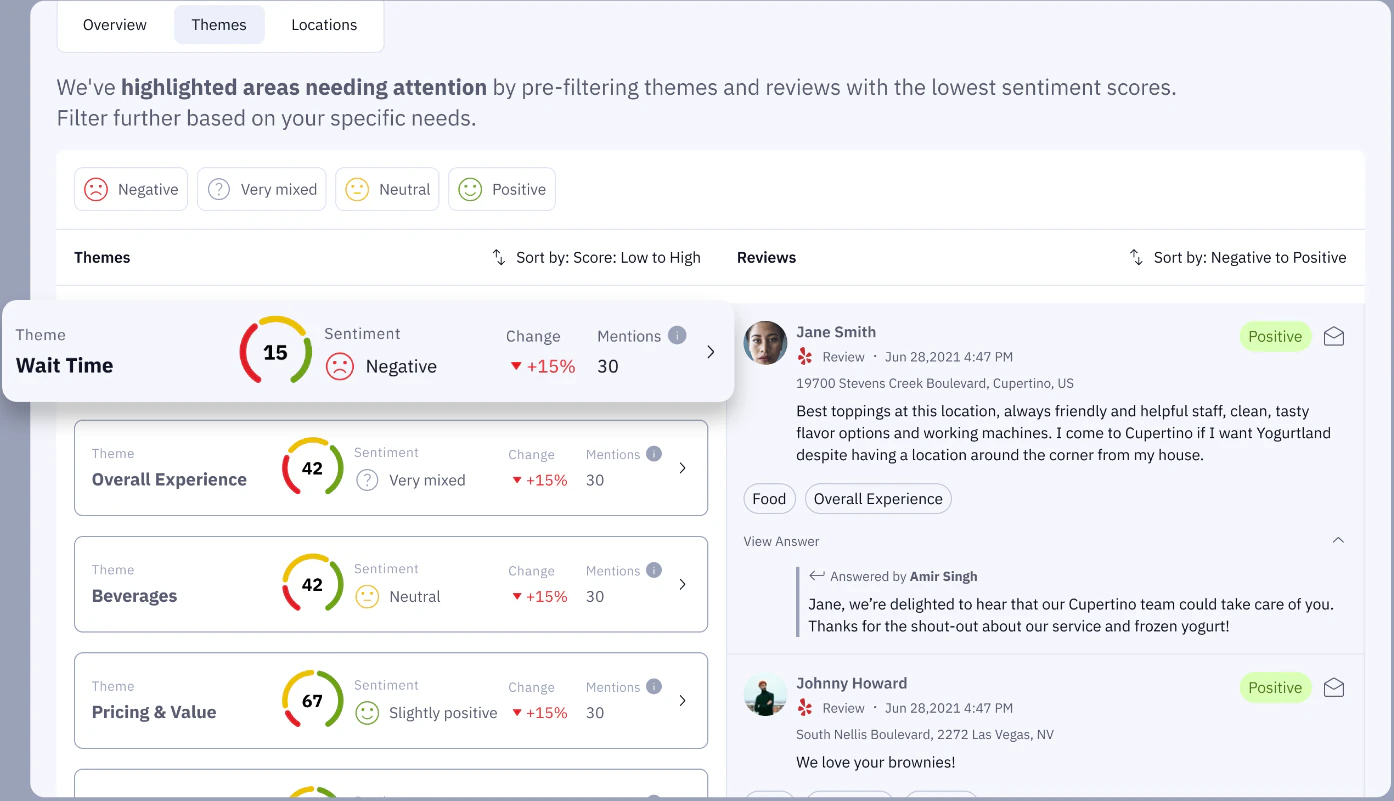
The platform offers sentiment analysis with a 0-to-100 scoring system and can identify themes in feedback through its Sentiment Themes feature, which groups industry-specific topics with individual sentiment scores. However, it does not offer the same level of customizable, aspect-based analysis that lets businesses define their own topics and extract the exact phrases driving each score.
Source: Uberall
Additionally, Uberall's review response AI generates replies based on contextual parameters, sentiment, star rating, business name and category, reviewer name, and language, and can be configured for brand voice consistency. However, based on available documentation, there is no mechanism for injecting custom business facts or unique selling points into individual responses the way a topic-mapped facts system would.
Uberall's pricing is quote-based across three tiers (Show Up, Stand Out, and Connect), with additional costs for add-ons like enhanced analytics, reviews tools, and collaboration features. This makes it difficult to evaluate the true cost without engaging in a sales process.
Yext leads in structured data and publisher reach
Yext's core innovation is its Knowledge Graph, a centralized database that structures a business's information into entities, fields, and relationships.
This isn't just a contact database; it's an advanced system that models how different aspects of a business connect to each other. For example, a healthcare professional entity can link to a facility entity, which links to a department entity, creating the kind of structured data that search engines and AI models need to deliver accurate answers.
This structured approach gives Yext a significant advantage in data consistency. With direct API integrations across 200+ publishers, changes made in the Knowledge Graph propagate almost instantly to search engines, maps, social media, and voice assistants. For enterprises that need absolute control over their brand information at scale, this level of data governance is compelling.
Yext's Pages product is another standout, allowing businesses to create SEO-optimized landing pages at scale using templates that pull dynamic content from the Knowledge Graph. The Search product powers on-site search experiences that deliver direct answers rather than just links, using natural language understanding and a multi-algorithm approach.

Source: Yext
The Reviews product covers monitoring, response, and generation. Yext can aggregate reviews from over 80 sites and offers generative AI review responses where users provide the LLM with instructions including tone of voice, language, sentence length, and contact information. For review collection, Yext supports email, SMS, and QR code requests with a smart balancing algorithm that directs review requests to the platforms where they'll have the most impact. The sentiment analysis identifies keywords and themes across review content.
However, Yext has faced persistent criticism in several areas.
User reviews frequently mention a steep learning curve, with some describing the platform as "confusing" to navigate. Customer support experiences are polarized, with some users praising responsiveness while others report difficulty getting help after contracts are signed.
And while Yext's review management is comprehensive, it functions as one module among many within a broader platform, with its AI response system operating through general guidelines rather than topic-mapped business messaging.
RightResponse AI turns reviews into revenue
This is where the comparison gets interesting. While Uberall and Yext treat reviews as one component of a broader digital presence strategy, RightResponse AI is built around a single premise: the review response is the most underutilized marketing asset a business has.
The logic is straightforward. Reviews are where prospective customers make buying decisions; they read reviews more than they read the business's own website. The response is the only element at that decision point that the business controls.
Yet most businesses waste that space with generic replies like "Thanks for your 5-star review!" that readers skip entirely. RightResponse AI's goal is to make every response worth reading by filling it with substance that actively markets the business.
The platform achieves this through a response personalization system built on three distinct pillars:
- Facts (what to say): During onboarding, the platform reads existing reviews, responses, and the business website to build a Fact Library of business-specific messaging: unique selling points, operational details, services, and promotions. It identifies the most important themes in the business's reviews and maps relevant facts to each theme. When a customer leaves a review, the AI identifies which theme applies and selects the right facts to incorporate naturally into the response.
- Customizations (how to behave): Rules and behavioral controls that govern how responses are generated: approval workflows, do-not-say lists, greeting preferences, and contact rules. Businesses can auto-publish low-risk positive responses while queuing edge cases for one-click human approval.
- Brand Voice (how to sound): Tone and style settings that ensure every response sounds like it came from the brand, whether that's formal, casual, warm, or professional. The AI can rotate between multiple tones to keep responses sounding natural rather than robotic.
The practical result is that a customer who mentions enjoying the food at a restaurant might receive a response that naturally incorporates information about the restaurant's locally sourced ingredients or upcoming seasonal menu. A prospective customer reading reviews doesn't just see a polite reply; they discover concrete reasons to visit. The system also shows businesses which facts were used and which weren't, so they can refine their messaging over time.
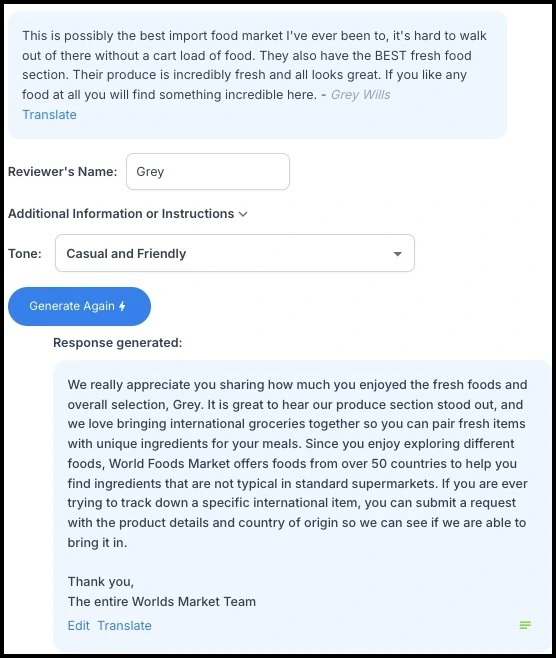
Beyond response intelligence, the AI performs advanced contextual analysis: examining the reviewer's name to determine if it's appropriate for a personalized greeting, identifying and correctly formatting employee names mentioned in reviews, detecting review updates, and flagging Protected Health Information (PHI) for medical businesses to help maintain HIPAA compliance.
This reflects the platform's deliberate multi-step architecture; the system analyzes the review before generating a response, separating the analytical function from the writing function to reduce the risk of the AI generating inappropriate content while increasing relevance.
Review collection: Not just response, but the full cycle
RightResponse AI also includes a full-featured review collection system, an important distinction, since the platform's core differentiation is response quality, but it handles the complete review lifecycle.
The AI-powered review requester generates personalized invitations that reference customer names, service details, and specific transaction history, making each request feel individually crafted rather than mass-produced. Businesses can add guiding questions that give reviewers inspiration about what to write; questions that rotate so reviews contain varied, keyword-rich content.
The platform supports email and SMS delivery, automated follow-ups for customers who haven't yet responded, and employee-level personalized QR codes that tie reviews back to the individual who requested them, enabling incentive programs that reward staff for generating feedback.

Voice of the Customer and rank tracking
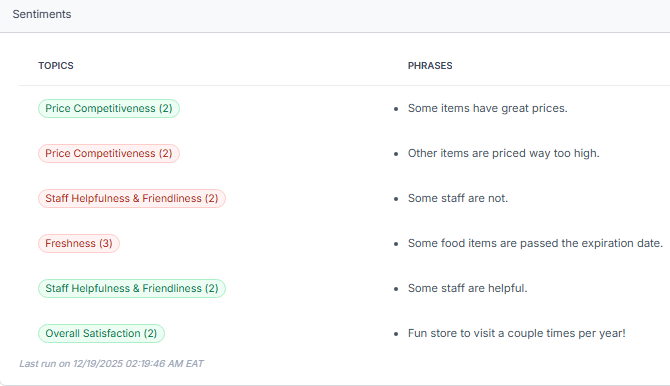
RightResponse AI's sentiment analysis uses customized Aspect-Based Sentiment Analysis (ABSA), which offers a different approach from what Uberall or Yext provide.
While Uberall groups feedback into industry-specific themes and Yext identifies keywords with sentiment scores, ABSA breaks down each review to identify specific aspects of the business that customers are commenting on and assigns sentiment to each one. Businesses can customize the topics being analyzed to match how they think about their own operations, and the platform extracts the exact phrases from reviews that correspond to each topic.
This means a restaurant doesn't just know that "food" sentiment is 85% positive; they can see the specific comments driving that score and track how it changes over time.
The Google Maps rank tracking feature provides a grid-based view of local search visibility, showing exactly where a business ranks from different geographic points around their location. The Rewind feature allows users to visually replay how rankings have evolved over time, providing an intuitive understanding of ranking dynamics that static charts can't match.
CompetiWatch AI, the platform's competitive intelligence tool, applies the same deep analysis to competitor reviews. Businesses can compare their sentiment scores and review volume against competitors on the exact same topics, providing a direct, apples-to-apples view of competitive strengths and weaknesses.
AI capabilities reveal very different philosophies
The way each platform deploys AI tells you a lot about their priorities.
Uberall's AI is broad and autonomous.
The UB-I agent monitors listings, social media, and reviews across all locations, identifying issues and executing fixes without constant human input. The AI-Bulk Replies feature can generate unique responses for multiple reviews simultaneously. The AI-Social Writer creates social media posts and can learn from top-performing content.
This breadth-first approach makes sense for a platform designed to be an all-in-one marketing suite; the AI helps teams manage workload across a wide set of tasks.
Yext's AI is structured and governance-focused.
The Knowledge Graph provides the AI-ready data foundation, with content generation capabilities that can produce business descriptions, biographies, and FAQs from structured data. The platform's Retrieval Augmented Generation (RAG) approach grounds AI responses in verified business data to reduce hallucinations.
For reviews, the generative response feature works through user-defined instructions, tone, language, length, and contact details that guide the LLM. This approach prioritizes accuracy and consistency across large organizations.

Source: Yext
RightResponse AI's AI is deep and insight-focused.
Built using Large Language Models as a core foundation, the platform uses a multi-step agentic pipeline that separates analytical functions from writing functions. The system first analyzes the review, detecting sentiment, identifying the relevant theme, checking for edge cases like review updates, rating-text mismatches, or PHI, before the writing engine generates the response using the three-pillar personalization system (Facts, Customizations, Brand Voice).
This architecture means the writing engine doesn't have to think about analysis; it focuses entirely on producing a high-quality, brand-aligned response. The same analytical depth powers the customized ABSA sentiment analysis and competitor sentiment comparison.
The practical difference is this: Uberall and Yext users get AI that helps manage workload efficiently across a broad set of marketing and data management tasks. RightResponse AI users get AI purpose-built to maximize the quality and strategic value of every review interaction, making each response work harder as a conversion asset.
Pricing transparency varies dramatically
Pricing is where the differences between these platforms become most stark, and most frustrating for buyers.
Uberall uses a tiered, quote-based model with three packages: Show Up (listings), Stand Out (listings + reviews), and Connect (listings + reviews + social).
Additional capabilities like enhanced analytics, advanced review tools, and collaboration features are available as add-ons. No prices are listed publicly; businesses must book a demo and go through a sales process to get pricing. This approach is common among enterprise platforms but makes it difficult for growing businesses to evaluate whether Uberall fits their budget.

Source: Uberall
Yext offers published per-location pricing for its base packages: Emerging ($199/year), Essential ($449/year), Complete ($499/year), and Premium ($999/year).
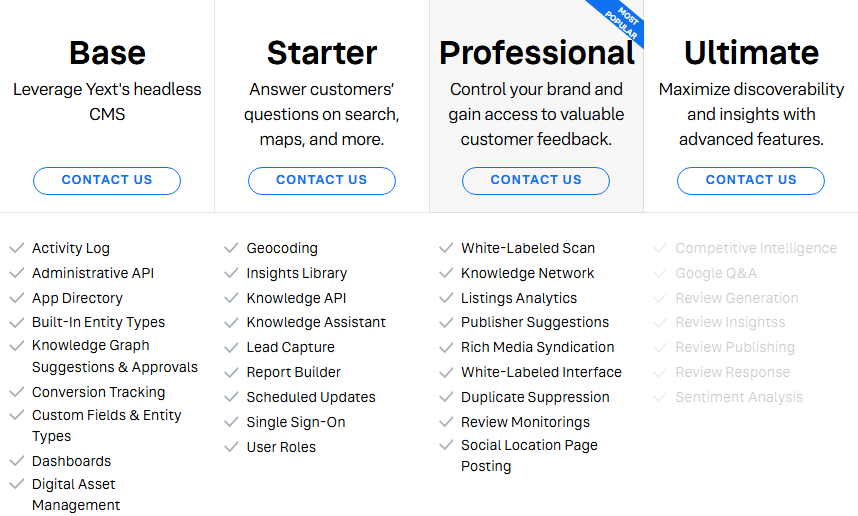
These packages bundle different combinations of Yext's core products (Search, Pages, Listings, Reviews), all powered by the Knowledge Graph platform. Reseller partner packages come in four tiers (Base, Starter, Professional, Ultimate), though prices are not published for those. Add-ons for competitive intelligence, Yelp integration, and additional users add further cost.
For multi-location enterprise deployments, pricing typically moves to custom quotes. Some user reviews mention feeling that Yext is expensive, particularly for smaller businesses.
Source: Yext
RightResponse AI takes a different approach with transparent, usage-based pricing.
RightResponse AI offers several transparent ways to buy.
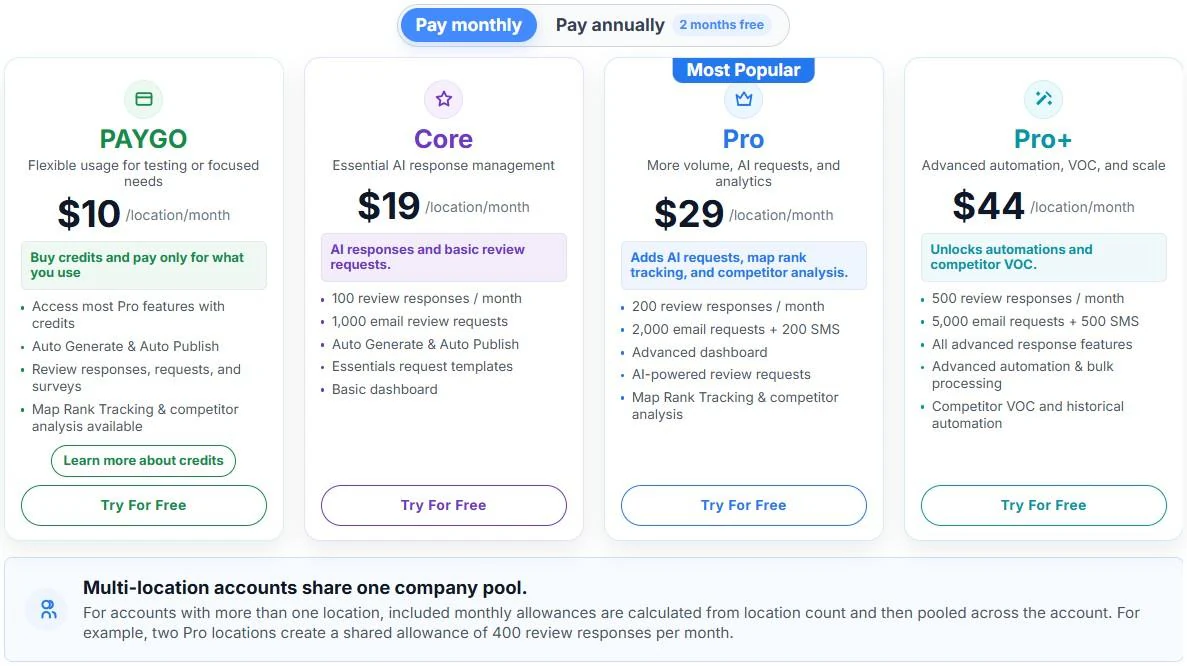
With Pay As You Go (PAYGO), the base cost is $10 per month per location plus usage-based credits that start at $0.01 each and decrease in price with volume: 20 credits per review response, 20 credits per sentiment analysis, 2 credits per email review request, and 1.5 credits per map rank tracker pin.
For businesses that prefer predictable monthly billing, fixed plans include:
- Core at $19/month (100 review responses, 1,000 email review requests, and Essentials request templates; no SMS or surveys),
- Pro at $29/month (200 review responses, 2,000 email requests plus 200 SMS, 200 surveys, AI-powered review requests, and Map Rank Tracking with competitor analysis),
- and Pro+ at $44/month (500 review responses, 5,000 email requests plus 500 SMS, 500 surveys, advanced automation with bulk processing, and Competitor Voice of the Customer).
- Enterprise plans are custom-quoted for agencies and large multi-location businesses, adding white-label access, API access and integrations, and advanced reporting.
Prefer a hands-off option? Our Done-For-You team can manage review requests, monitoring, responses, reporting and reputation insights for you. See current Done-For-You pricing.
With PAYGO, businesses aren't paying per-location for capacity they don't use; a location with 5 reviews per month costs far less than one with 50, and agencies can scale cleanly across accounts without rigid per-location commitments.
A 7-day free trial includes 1,000 usage credits and access to most Pro features, with no credit card required. Uberall does not offer a publicly available free trial, while Yext offers free trials for some specific products like its search integrations, though not necessarily for its full enterprise suite.
Source: RightResponse AI
For a business with 10 locations processing 100 reviews per month with sentiment analysis and weekly map rank tracking, RightResponse AI's costs are predictable and transparent. With Uberall's enterprise packages, that same business would need to go through a sales process; with Yext, they could estimate based on published tiers but would likely need a custom quote for the full multi-location setup.
Competitor analysis and local SEO tracking compared
Understanding your competitive landscape is critical for local businesses, and the three platforms take markedly different approaches.
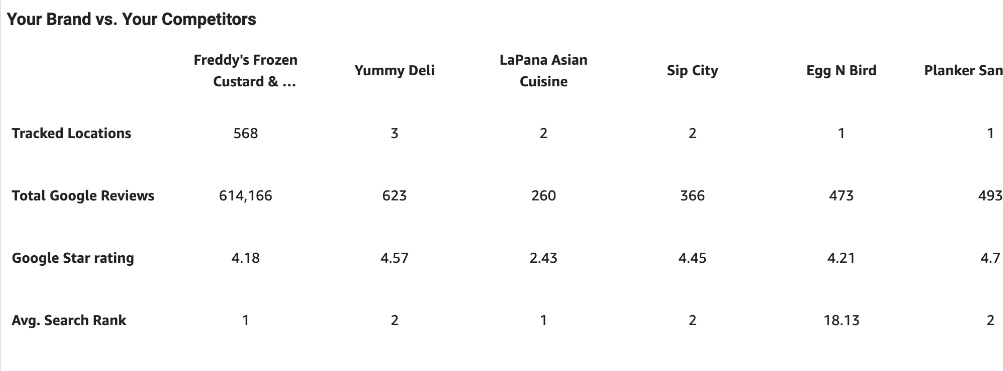
Uberall offers competitive intelligence as an add-on to its Analytics Plus package.
This includes side-by-side comparisons of visibility, keyword rankings, and review ratings against competitors. The platform can also identify competitor strengths and weaknesses and provide personalized recommendations through its Actionable Insights Panel. However, the competitive analysis primarily compares high-level metrics rather than diving deep into what customers are saying in competitor reviews.
Source: Uberall
Yext provides competitive intelligence through its Search Tracker and Reviews Competitive Intelligence features, available as add-ons for most packages (though included in the Ultimate tier).
Businesses can track keyword rankings against up to five competitors and compare average review ratings. The analytics are comprehensive from a visibility perspective, but the competitor analysis focuses more on search positioning than on analyzing what customers actually think about competitors.
RightResponse AI's CompetiWatch AI takes a fundamentally different approach by analyzing competitors through the lens of their customer reviews.
Businesses can track competitors' review volume, average ratings, and activity over 60- and 180-day periods. More importantly, the platform applies the same customized ABSA sentiment analysis to competitor reviews, allowing for direct topic-by-topic comparison of customer sentiment. Users can read competitors' actual reviews, see which aspects of their service customers praise or criticize, and identify gaps where they can differentiate.
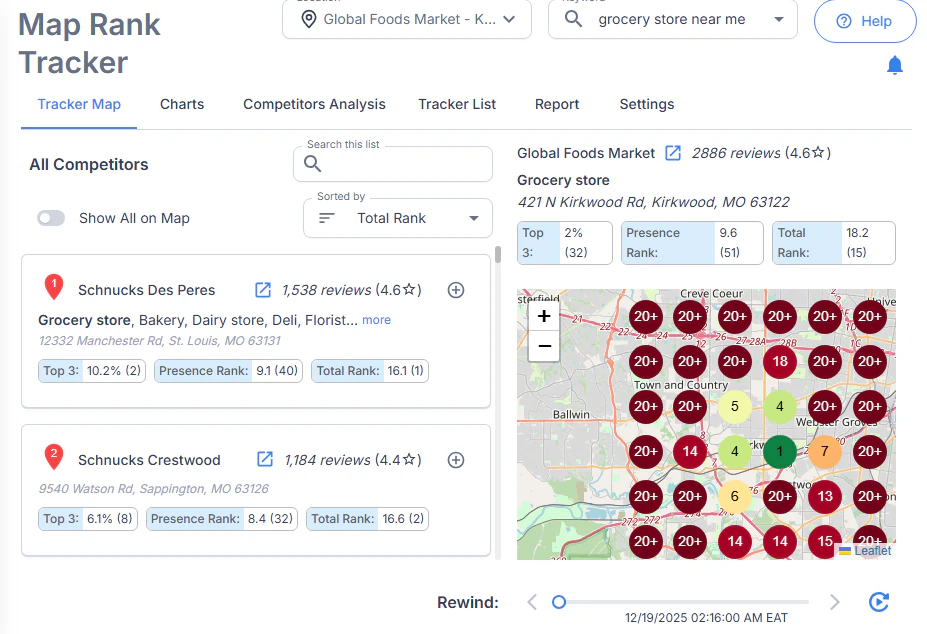
For Google Maps rank tracking, RightResponse AI stands out with its dedicated grid-based tracker. Businesses define a geographic grid around their location, choose their target keywords, and the platform simulates searches from each grid point to show exactly where they rank.
The Rewind feature allows users to play back historical scans and watch how rankings have shifted over time. Key metrics include Top 3% (how often the business appears in the top three local results), Presence Rank (visibility across the grid), and Total Rank (average position). Neither Uberall nor Yext offers a comparable grid-based Google Maps rank tracking tool as part of their core platform.
Uberall vs Yext vs RightResponse AI: Which should you choose?
The right platform depends on what your business needs most right now.
Choose Uberall if:
- You need an all-in-one platform for listings, reviews, social media, and local pages
- Managing local social media content across many locations is a priority
- You want an AI agent that can autonomously handle routine marketing tasks
- You have a dedicated marketing team that can leverage a comprehensive suite
- Your budget can accommodate enterprise-level, quote-based pricing
Choose Yext if:
- Data consistency across 200+ publishers is your primary concern
- You need enterprise-grade governance with granular user permissions and approval workflows
- You're building AI-ready structured data for search and voice assistants
- You need scalable, SEO-optimized landing pages for hundreds of locations
- Your organization has the technical resources to manage a feature-rich platform
Choose RightResponse AI if:
- You want to turn customer reviews into a conversion asset, not just manage them
- You need AI responses built on business-specific messaging (Facts), behavioral controls (Customizations), and consistent tone (Brand Voice), not generic templates
- Deep, customizable sentiment analysis at the aspect level matters for operational improvement
- You want to understand exactly how you compare to competitors through the lens of customer feedback
- Google Maps rank tracking with historical analysis is critical to your local SEO strategy
- Transparent, usage-based pricing that scales with actual volume matters to your budget, whether you have 1 location or 500
The bottom line:
Listings accuracy and review intelligence serve different strategic purposes. Accurate listings ensure customers can find you. Review intelligence ensures they choose you over the competition.
For businesses that already have their listings managed, whether through Uberall, Yext, or another provider, adding RightResponse AI provides the depth of review intelligence, competitor analysis, and response quality that broader platforms aren't built to prioritize.
For businesses starting from scratch, RightResponse AI's combination of AI-powered review response, review collection, Voice of the Customer, competitor analysis, and Google Maps rank tracking provides the tools that most directly impact customer acquisition and retention, all with pricing that scales to the business's actual usage. The platform deliberately stays focused on review intelligence rather than competing in listings, social media, or general CX capabilities, and that focus is what enables the depth.
Ready to see how AI-powered review intelligence can transform your customer acquisition? Start your free 7-day trial of RightResponse AI with 1,000 free credits and experience the difference between managing reviews and leveraging them.
Frequently Asked Questions
When should I choose Uberall over Yext?
Choose Uberall if you need an all-in-one platform for listings, reviews, social media, and local pages. Uberall is ideal if managing local social media content across many locations is a priority, you want an AI agent (UB-I) that can autonomously handle routine marketing tasks, and you have a dedicated marketing team that can leverage a comprehensive suite. Uberall syncs data across 125+ directories and includes review generation through email, SMS, and QR codes.
When should I choose Yext over Uberall?
Choose Yext if data consistency across 200+ publishers is your primary concern and you need enterprise-grade governance with granular user permissions and approval workflows. Yext is also the better choice if you're building AI-ready structured data for search and voice assistants, need scalable SEO-optimized landing pages for hundreds of locations, and your organization has the technical resources to manage a feature-rich platform. Yext publishes per-location pricing starting at $199/year.
When is RightResponse AI a better choice than Uberall or Yext?
Choose RightResponse AI if you want to turn customer reviews into a conversion asset rather than just manage them. It's ideal if you need AI responses built on business-specific messaging (Facts), behavioral controls (Customizations), and consistent tone (Brand Voice). The platform excels at deep customizable Voice of the Customer at the aspect level, competitor analysis through customer feedback, and Google Maps rank tracking with historical analysis. With Pay As You Go (PAYGO) at $10/month per location plus usage-based credits, or fixed plans from $19/month (Core, Pro, Pro+) and custom Enterprise pricing, it offers transparent pricing for businesses of any size.
What are the main differences between Uberall, Yext, and RightResponse AI?
The main differences are in focus and approach. Uberall is a comprehensive multi-location marketing suite covering listings (125+ directories), reviews, social media, and local pages. Yext is a brand visibility platform built on a structured Knowledge Graph for data consistency across 200+ publishers. RightResponse AI is an AI-powered review intelligence platform purpose-built to extract maximum value from customer feedback through personalized responses, Voice of the Customer using aspect-based sentiment analysis, and competitor insights. Pricing also differs significantly: Uberall is quote-based, Yext starts at $199/year per location, and RightResponse AI offers Pay As You Go from $10/month per location plus usage-based credits, with fixed plans from $19/month.
Can I use RightResponse AI alongside Uberall or Yext?
Yes. RightResponse AI deliberately focuses on review intelligence rather than competing in listings, social media, or general CX capabilities. For businesses that already have their listings managed through Uberall, Yext, or another provider, adding RightResponse AI provides the depth of review intelligence, competitor analysis, and response quality that broader platforms aren't built to prioritize.
Try RightResponse AI for Free!
*No credit card required.