
Choosing between Grade.us vs Reputation.com for your online reputation management often comes down to these five critical questions:
Comparison research: This article is part of the RightResponse AI review management software comparison library, which connects platform reviews, pricing analyses, alternatives, and head-to-head evaluations.
- Are you a marketing agency looking to white-label a review platform, or a multi-location business managing your own reputation?
- Do you need a focused review management tool, or a comprehensive customer experience platform that covers social media, listings, and surveys?
- Is AI-powered analysis of customer sentiment a priority, or are you primarily looking to generate and monitor reviews?
- How important is it that your review responses go beyond generic templates and actively market your business to prospective customers through personalized messaging, behavioral controls, and a consistent brand voice?
- Are you comfortable with enterprise-level pricing, or do you need a usage-based model that scales with your actual review volume?
In short, here's what we recommend:
👉 Grade.us is the go-to choice for marketing agencies and SEO professionals who want to offer review management as a branded service to their clients. Its extensive white-labeling capabilities, automated review funnels, and agency-centric features make it easy to generate, monitor, and market reviews across more than 100 sites. While Grade.us also offers Solo and Professional plans for individual businesses and marketers, its deepest capabilities are agency-oriented. The platform provides basic sentiment analysis and word clouds but lacks advanced AI-powered sentiment analysis, dedicated competitor intelligence dashboards, and local search rank tracking. Its pricing, starting at $110/month for a single seat, can also be steep for smaller operations.
👉 Reputation.com serves as a comprehensive reputation experience management platform optimized for mid-to-large enterprises with multiple locations. It combines review management with social media publishing, business listing syndication, customer surveys, and AI-powered analytics, all unified under a proprietary Reputation Score. The platform has made substantial AI investments, including an AI Reputation Manager and conversational AI engine. While powerful and feature-rich, Reputation.com's enterprise optimization means higher costs, a steeper learning curve, and more complexity than many businesses actually need.
Both platforms are established players in the reputation management space. However, Grade.us focuses heavily on agencies and review generation, while Reputation.com casts a wide net across the entire customer experience. For businesses that want specialized, high-quality AI-driven review management, deep Voice of the Customer, and competitor intelligence without enterprise complexity or agency-only features, there's a smarter option.
👉 RightResponse AI takes a fundamentally different approach by putting generative AI and review response quality at the center of reputation management. Instead of generic templates, its AI generates personalized, brand-aligned review responses powered by three distinct pillars: Facts (business-specific messaging mapped to review themes), Customizations (behavioral rules and controls), and Brand Voice (tone and style). This system turns every response into a conversion asset that actively markets the business to prospective customers reading reviews. The platform also includes Voice of the Customer that reveals specific topics driving customer satisfaction, a Google Maps Rank Tracker with competitor comparison, and an advanced AI-powered review request system. With flexible pricing that starts at just $10/location/month plus usage credits on Pay As You Go (PAYGO), alongside fixed monthly plans, RightResponse AI delivers advanced review intelligence at a competitive price point, though the real differentiator is quality, not cost.
If AI-powered reputation management with transparent pricing sounds like the right fit, start your free 7-day trial of RightResponse AI.
Table of contents:
- Grade.us vs Reputation.com vs RightResponse AI at a glance
- The fundamental divide: Agency tool vs enterprise platform vs AI-native solution
- Grade.us excels at white-label review management for agencies
- Reputation.com offers comprehensive customer experience management
- RightResponse AI turns reviews into actionable intelligence
- AI capabilities reveal the real differentiation
- Pricing models reflect very different philosophies
- Competitor intelligence separates monitoring from strategy
- Grade.us vs Reputation.com vs RightResponse AI: Which should you choose?
Grade.us vs Reputation.com vs RightResponse AI at a glance
Here's the fundamental difference: While all three platforms help you manage online reviews, they represent three distinct approaches to reputation management:
- Grade.us is a white-label review generation and monitoring platform whose focus leans heavily toward marketing agencies, though it also serves individual businesses and marketers.
- Reputation.com is an all-in-one reputation experience management suite optimized for larger multi-location businesses and enterprises.
- RightResponse AI is an AI-native reputation management platform built around review response quality and business intelligence for location-based businesses of all sizes.
Grade.us | Reputation.com | RightResponse AI | |
|---|---|---|---|
Primary focus | White-label review management, heavily weighted toward agencies | Enterprise reputation experience management | AI-powered review intelligence and growth for location-based businesses |
Target audience | Marketing agencies, SEO professionals, individual businesses | Mid-to-large multi-location enterprises | Location-based businesses of all sizes, from single-location to enterprise |
AI capabilities | ⭐⭐ Basic sentiment and workflow automation | ⭐⭐⭐⭐ AI-powered analytics, response drafting, and conversational AI | ⭐⭐⭐⭐⭐ Generative AI with Facts, Customizations, Brand Voice, and Voice of the Customer |
Review generation | ⭐⭐⭐⭐⭐ Multi-channel funnels, automated campaigns | ⭐⭐⭐⭐ Review Booster with email, SMS, kiosks | ⭐⭐⭐⭐ AI-personalized requests via email and SMS with guiding questions and employee-level QR codes |
Sentiment analysis | ⭐⭐ Basic sentiment analysis and word clouds | ⭐⭐⭐⭐ AI-powered theme identification and key driver analysis | ⭐⭐⭐⭐⭐ Customized Aspect-Based Sentiment Analysis (ABSA) |
Competitor analysis | ⭐⭐ Limited (Prospect Report benchmarking) | ⭐⭐⭐⭐ Competitive benchmarking with Reputation Score and SWOT analysis | ⭐⭐⭐⭐⭐ Deep competitor review analysis, ABSA on competitor reviews, and map rank comparison |
Local rank tracking | ⭐ Not available | ⭐⭐⭐ Local benchmarking tools | ⭐⭐⭐⭐⭐ Google Maps grid-based rank tracker with "Rewind" |
White-labeling | ⭐⭐⭐⭐⭐ Extensive, agency-grade | ⭐⭐⭐ Enterprise customization | ⭐⭐⭐ Agency white-label services available |
Starting price | Custom/quote-based; published tiers start at $80/location/month | ||
Free trial | 14 days, no credit card required | Limited free trial (Social Suite only) | 7 days with 1,000 free credits |
The fundamental divide: Agency tool vs enterprise platform vs AI-native solution
The comparison between Grade.us and Reputation.com is a bit like comparing a specialty shop to a department store. They serve fundamentally different customers with fundamentally different needs.
Grade.us's focus leans heavily toward marketing agencies.
The platform's core strengths, from its white-label dashboard to its prospect reports and reseller tiers, are built to help agencies offer reputation management as a profitable service. It also serves individual businesses through its Solo and Professional plans; the Solo plan is explicitly designed for single-location business owners, while the Professional plan targets individual marketers and small agencies.
That said, Grade.us's deepest capabilities and competitive advantages are agency-oriented. If you're an agency looking to add a revenue stream, Grade.us speaks your language.
Reputation.com, on the other hand, is optimized for larger multi-location businesses.
It goes far beyond review management to encompass social media publishing, business listing syndication, customer surveys, and a proprietary Reputation Score that quantifies your entire online presence in a single number. While the platform serves businesses of various sizes, its pricing, onboarding, and feature depth skew toward organizations with multiple locations: hospital chains, automotive groups, nationwide retailers, and similar operations where enterprise-grade breadth is a genuine need.
RightResponse AI represents a newer approach entirely, founded in 2024.
Instead of optimizing for agency resale or enterprise breadth, it focuses on using generative AI to maximize the value of every customer review. The platform was founded by a former CEO of a 200+ location healthcare network who understood firsthand that most businesses weren't getting real insights from their reviews, just dashboards full of stars and percentages. The platform serves location-based businesses of all sizes, from single-location operations to enterprise.
This philosophical difference matters because it shapes what you actually get from each platform day to day.
Grade.us excels at white-label review management for agencies
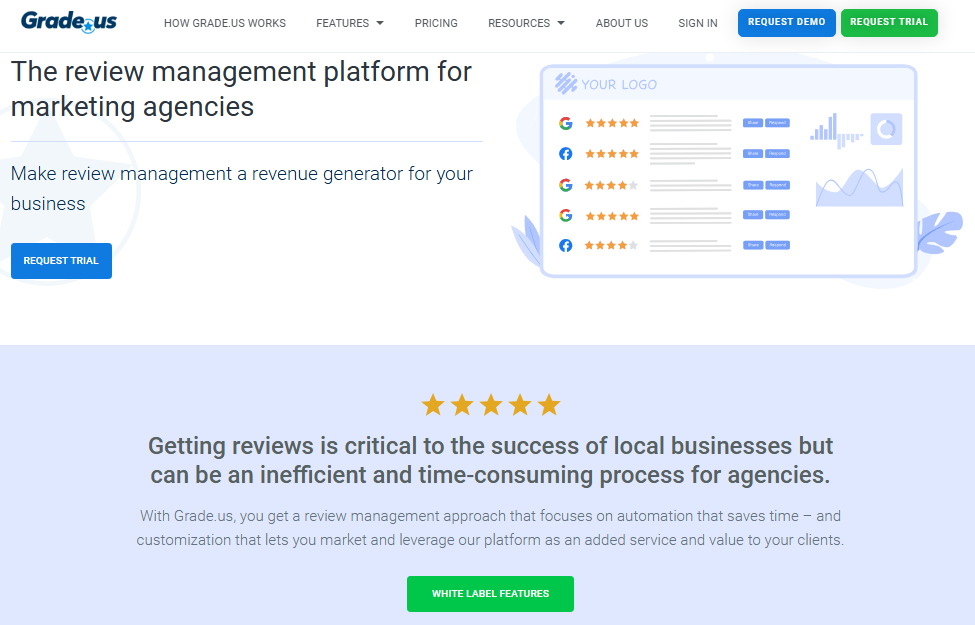
If you run a marketing agency and want to sell reputation management to your clients, Grade.us has built its business around making that easy.
The white-labeling goes deep. With the Premium White Label option, agencies can brand the entire dashboard, from the domain and logo to email notifications and reports. Clients log in to what appears to be the agency's own proprietary software. Grade.us even provides white-labeled pitch decks, marketing videos, and educational articles that agencies can use to sell the service.
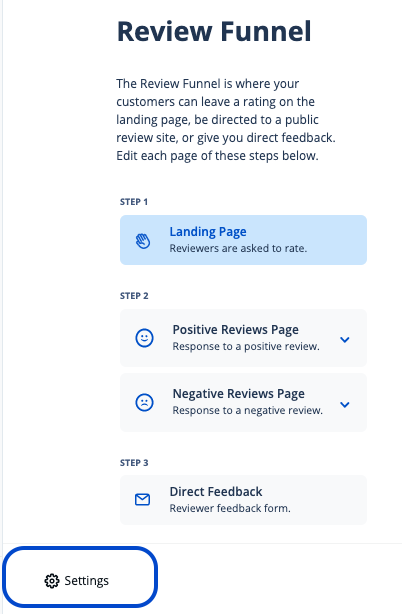
The review generation workflow is well-designed. The "review funnel" guides customers through a landing page that separates satisfied customers (who are directed to public review sites) from unhappy ones (who are directed to a private feedback form). Automated email and SMS campaigns keep the requests flowing, and the platform supports multiple request methods including QR codes, website widgets, and email signature snippets.
Source: Grade.us
For monitoring, Grade.us aggregates reviews from over 100 sites into a centralized dashboard with email alerts and filtering capabilities. The review marketing features automatically stream positive reviews to a business's website and social media, with a WordPress plugin that adds SEO-friendly schema markup.
It's worth noting that Grade.us also serves individual businesses directly. The Solo plan ($110/month) targets single-location business owners, and the Professional plan ($180/month for 3 seats) targets individual marketers and consultants. However, these plans include the same core review management toolset; the platform doesn't offer fundamentally different capabilities for non-agency users.
Where Grade.us falls short is in the depth of intelligence it provides.
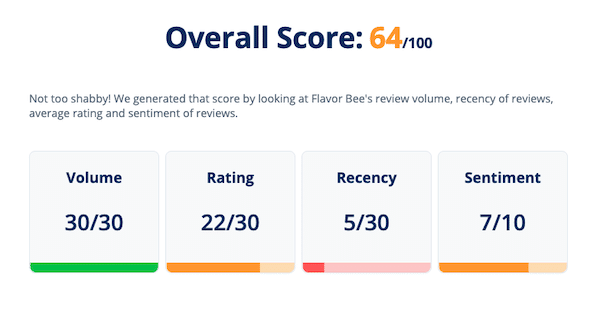
The platform includes basic sentiment analysis and word clouds but does not employ generative AI for response drafting; responses are managed manually through the centralized dashboard. There's no dedicated competitor analysis module, though agencies can use the Prospect Report tool to benchmark clients against competitors in a limited way.
Source: Grade.us
There's also no local search rank monitoring. The reporting is solid for demonstrating activity (reviews generated, average ratings, sentiment trends), but it doesn't provide the granular operational insights or competitive positioning that some businesses need.
Reputation.com offers comprehensive customer experience management
Reputation.com approaches reputation from a much broader angle. Their platform isn't just about reviews, it's about the entire customer experience across every digital touchpoint.
The review management capabilities are robust. The platform monitors over 130 review sites, aggregates everything into a unified inbox, and offers AI-assisted response drafting. The Review Booster feature supports automated review requests via email, SMS, and point-of-service kiosks, with a patented methodology for prioritizing high-impact review sites.
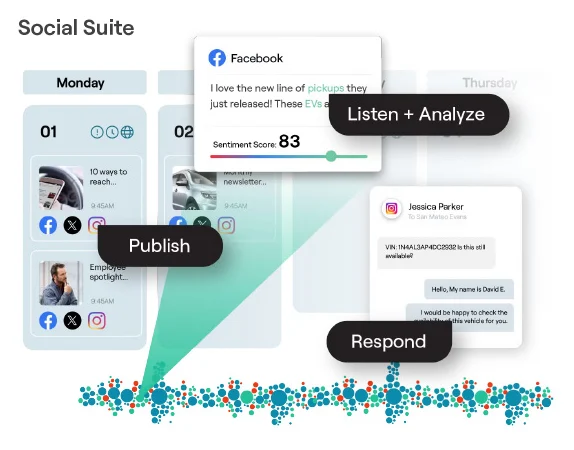
Beyond reviews, Reputation.com offers a full Social Suite for publishing, listening, and engaging across platforms like Facebook, Instagram, X, LinkedIn, and TikTok. The Listings feature manages business information across 250+ directories with automated auditing and duplicate suppression. Customer surveys, including conversational AI-powered formats, provide private feedback channels that complement public reviews.
Source: Reputation.com
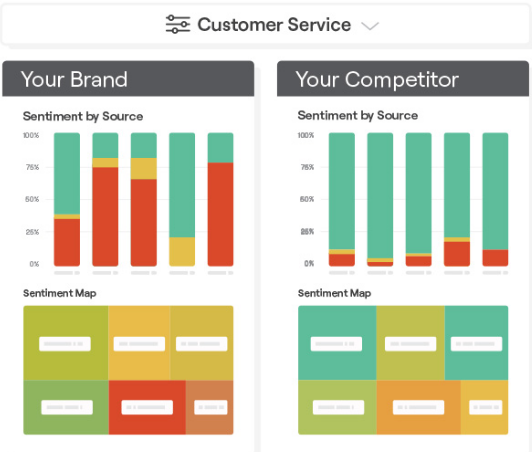
The analytics layer ties it all together with the proprietary Reputation Score, a single number from 0 to 1,000 that quantifies a business's overall online reputation by combining review sentiment, social engagement, listing accuracy, search visibility, and survey feedback. Custom dashboards, drag-and-drop report builders, and AI-powered sentiment analysis with key driver analysis provide enterprise-grade reporting capabilities.
Reputation.com has also made substantial AI investments recently. The platform now describes itself as an "AI-Native Intelligence Platform", with products including an AI Reputation Manager that tracks how brands appear in AI-driven search platforms like Google AI Overviews and ChatGPT, and a conversational AI engine called Reputation IQ that lets users ask business questions in plain English. These represent a genuine commitment to AI-powered capabilities across the product.
The challenge with Reputation.com is that all this breadth comes with complexity and cost.
The platform uses custom, quote-based pricing, with published tiers starting at $80/location/month for the most basic tier (which doesn't include surveys). Add-ons like Competitive Insights, the Social Suite, and Actions & Ticketing carry additional charges. While Reputation.com has offered a free trial for its Social Publishing product, there is no general free trial of the full platform.
Source: Reputation.com
For a multi-location business, the total cost can climb quickly. And many of those features, social publishing, listing management, surveys, while impressive in a demo, may go underutilized by teams whose primary need is managing reviews effectively.
RightResponse AI turns reviews into actionable intelligence
RightResponse AI was built on the idea that customer reviews contain business intelligence that most platforms barely scratch the surface of, and that the review response itself is an underutilized conversion asset.
Consider this: prospective customers read reviews as one of their final steps before choosing a business. The response is the only part the business controls. Yet most responses are generic, "Thanks for your review, we appreciate the five stars!", which wastes that space and blocks readers from anything useful. RightResponse AI's core philosophy is that every response should actively market the business, giving prospective customers specific reasons to choose it.
The platform's response personalization system achieves this through three distinct pillars working together.
Facts define what to say: business-specific messaging mapped to review themes, so when a customer mentions great food, the response can naturally reference the restaurant's farm-to-table sourcing or upcoming seasonal menu.
Customizations define how responses should behave: rules for greetings, escalation triggers, employee name handling, and edge cases like review updates or rating mismatches.
Brand Voice defines how responses should sound: the tone, style, and personality that stays consistent across every location. Together, these three pillars produce hyper-personalized, brand-aligned responses with endless variation without losing control.

The AI itself uses an agentic pipeline that separates analytical functions from writing functions. The system analyzes the review first, examining context, detecting edge cases, identifying relevant themes, and for medical businesses, checking for Protected Health Information to maintain HIPAA compliance, before the writing engine generates the response. This multi-step approach reduces the risk of AI producing inappropriate responses while increasing relevance.
The platform also includes an advanced review request system. AI-powered requests can incorporate customer data like name, service history, and recent transactions to create genuinely personal requests rather than generic blasts.
Requests can be delivered via email and SMS, with unlimited follow-ups, guiding questions that rotate to encourage varied review content, and employee-level QR codes that attribute reviews to individual team members for recognition and incentive programs. The platform focuses on business reviews for location-based companies.
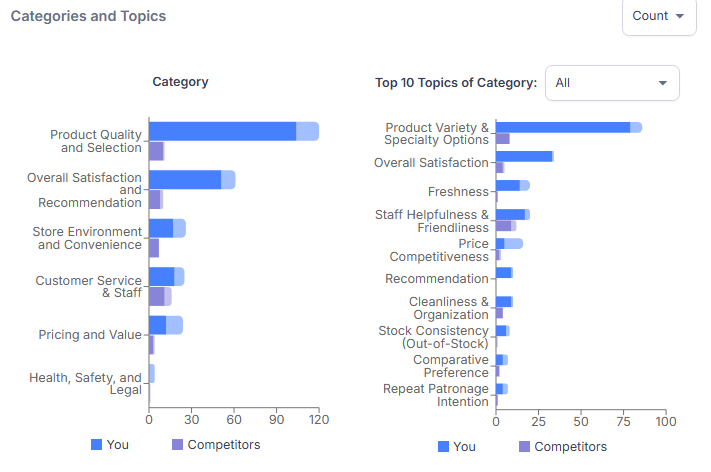
The Aspect-Based Sentiment Analysis breaks down each review phrase by phrase to identify specific topics (like "wait time," "staff friendliness," or "product quality") and assigns sentiment to each on a 1-to-5 intensity scale. Businesses can define their own custom categories and topics, filter out irrelevant content, and drill down to exact phrases customers used. This granularity turns vague impressions into concrete operational insights.
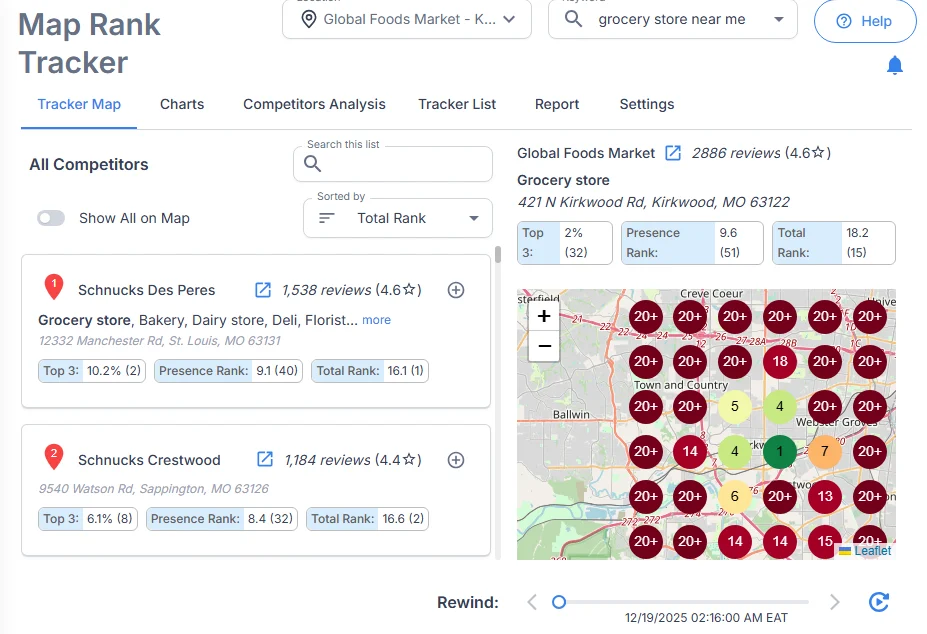
The Google Maps Rank Tracker provides a visual grid showing exactly where a business ranks in local search from different geographic points, while the "Rewind" feature lets users replay how rankings have shifted over time. The platform's competitor intelligence features extend this analysis to rivals, comparing review volume, response rates, and even applying the same sentiment analysis framework to competitor reviews for an apples-to-apples comparison.
AI capabilities reveal the real differentiation
This is where the three platforms diverge most dramatically.
Grade.us uses automation primarily for workflow efficiency: sending review requests, monitoring new reviews, and distributing positive reviews to websites and social media.
The platform includes basic sentiment analysis and word clouds but does not employ generative AI for response drafting; review responses are handled manually. Its reporting covers standard metrics like review count, average rating, campaign open rates, and sentiment trends.
Reputation.com has made significant AI investments and now positions itself as an AI-Native Intelligence Platform.
The platform uses AI for sentiment analysis, automated response suggestions, and its Reputation Score calculation. The "Tell Me More" AI in their surveys asks intelligent follow-up questions based on customer responses. More recently, the AI Reputation Manager tracks how brands appear in AI-driven search platforms, and the Reputation IQ engine lets users query customer feedback data conversationally. These represent a substantial and growing commitment to AI across the product.
RightResponse AI was designed with generative AI as its foundation, but with a specific focus: making every review response worth reading.
The three-pillar personalization system (Facts, Customizations, and Brand Voice) ensures responses are both personalized and controlled, a critical distinction from generic AI drafts that may sound polished but say nothing specific. The agentic pipeline that separates analysis from writing, the Aspect-Based Sentiment Analysis, and the ability to apply the same analytical framework to competitor reviews represent a fundamentally different approach to what AI should do with review data.
The practical impact is significant. With Grade.us, you get efficient review management with manual response workflows. With Reputation.com, you get broad reputation monitoring with AI assistance across a wide product surface. With RightResponse AI, you get a system purpose-built to understand what drives customer satisfaction, how you compare to competitors on specific operational topics, and where you rank in local search, all anchored by AI that turns every response into a conversion asset rather than generic filler.
Pricing models reflect very different philosophies
The pricing structures of these platforms tell you everything about who they're built for.
Grade.us uses a tiered, seat-based model.
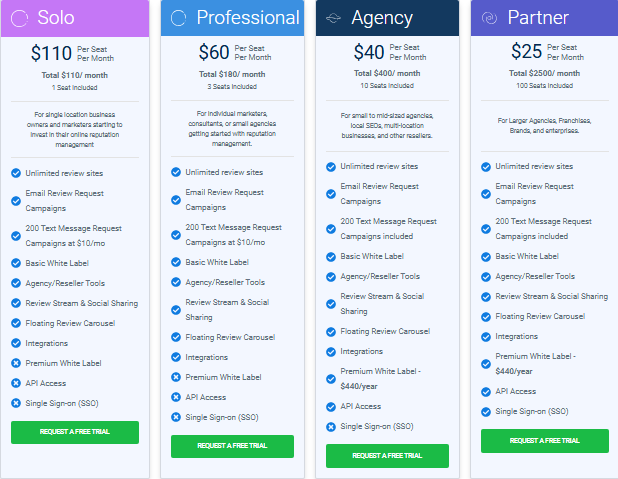
The Solo plan starts at $110/month for a single seat. The Professional plan is $180/month for 3 seats. The Agency plan costs $400/month for 10 seats, and the Partner plan is $2,500/month for 100 seats. SMS campaigns and Premium White Label are additional costs. This pricing works well for agencies who mark up the service for their clients, but for individual businesses, the per-seat cost can feel high, especially at the lower tiers.
Source: Grade.us
Reputation.com uses custom, quote-based pricing, with published tiers starting at $80/location for the Rep Core plan (reviews, listings, and insights, but no surveys).
The Rep Core + Pulse plan at $115/location adds a single survey, while the Rep Core + Surveys plan at $150/location includes six custom surveys. Add-ons like Competitive Insights, the Social Suite, and Actions & Ticketing are priced separately. Actual costs vary based on number of locations and configuration; a multi-location business on the full plan with add-ons can expect significant monthly spend.

Source: Reputation.com
RightResponse AI offers both usage-based and fixed-price plans.
The base fee is $10/location/month plus usage credits, which gives access to every feature. Many businesses, though, will pick one of the fixed monthly plans, which bundle set allowances per location:
Core ($19/mo): 100 review responses, 1,000 email review requests, and Essentials request templates — no SMS, surveys, or map rank tracking.
Pro ($29/mo, most popular): 200 responses, 2,000 email requests plus 200 SMS, 200 surveys, AI-powered review requests, and Map Rank Tracking with competitor analysis.
Pro+ ($44/mo): 500 responses, 5,000 email requests plus 500 SMS, 500 surveys, advanced automation and bulk processing, and Competitor Voice of the Customer.
Enterprise (custom): white-label, API access, and advanced reporting for agencies and large multi-location businesses.
Pay As You Go suits low-volume or narrow needs: instead of a fixed plan, you pay usage credits starting at $0.01 each (20 per review response, 2 per email request, 1.5 per map rank pin), so you only pay for what you use.
This means a single-location business with moderate review volume can start at a competitive price point, while high-volume businesses and agencies scale without per-location lock-in.
For context, a single-location business using RightResponse AI to respond to 50 reviews per month, analyze sentiment on those reviews, run a weekly map rank scan on a 5x5 grid, and send 100 AI-personalized review requests would spend roughly $35-45/month. That same business would pay $110/month on Grade.us's Solo plan (without advanced sentiment analysis, competitor analysis, or rank monitoring) or $80+/month on Reputation.com's base tier (without competitive insights or the social suite).

Source: RightResponse AI
It's worth noting that cheaper alternatives do exist in the market; some charge as little as $15/month for unlimited reviews using older AI models. RightResponse AI's usage-based model makes it accessible at the low end, but the platform's value proposition is response quality, not low cost.
The three-pillar personalization system, agentic AI pipeline, and depth of analytics are what differentiate it; businesses that only need basic AI-generated responses may not need what RightResponse AI offers.
Competitor intelligence separates monitoring from strategy
Understanding your competitive landscape is increasingly essential for local businesses, and the three platforms approach this very differently.
Grade.us does not include a dedicated competitor analysis module within its core dashboard. The platform is focused on managing your own reviews.
However, agencies can leverage the Prospect Report tool to benchmark clients against local competitors on ratings, volume, and recency, providing some level of competitive insight outside the everyday monitoring workflow.
Reputation.com includes competitive benchmarking through its Reputation Score, allowing businesses to compare their score against industry averages and specific competitors.
The platform can generate AI-driven SWOT analyses based on competitor data and identify recurring themes in competitor feedback. However, the Competitive Insights feature is an add-on with additional cost, not included in the base plans.
RightResponse AI bakes competitor intelligence into the core platform.
Users can track competitors' review volume, average ratings, and response rates over 2-month and 6-month periods. More uniquely, the platform applies the same Aspect-Based Sentiment Analysis to competitor reviews, allowing businesses to see exactly how they compare on specific topics like "customer service" or "value for money."
The Google Maps Rank Tracker shows competitor positions on the same grid, and the "Rewind" feature visually replays how the competitive landscape has shifted over time. Users can even read individual competitor reviews directly within the platform.
This integrated approach to competitive intelligence means businesses using RightResponse AI can make strategic decisions based on a comprehensive understanding of their market position, not just their own review metrics.
Grade.us vs Reputation.com vs RightResponse AI: Which should you choose?
The right platform depends on your specific situation, goals, and resources.
Choose Grade.us if:
- You're a marketing agency looking to resell review management as a branded service
- White-labeling and client management are your top priorities
- You need a proven review funnel with automated multi-channel campaigns
- You have the budget for agency-tier pricing ($400+/month for 10 seats)
- Advanced competitor analysis and local rank tracking aren't core requirements
- You're an individual business that primarily needs review generation and monitoring without AI-powered response tools
Start your 14-day free trial of Grade.us to explore its agency features.
Choose Reputation.com if:
- You're a mid-to-large enterprise with multiple locations across regions
- You need a unified platform for reviews, social media, listings, and surveys
- A proprietary reputation score, AI-powered search tracking, and enterprise-grade analytics are important
- You have the budget and team to fully utilize a comprehensive platform
- You want broad coverage across every digital touchpoint, and you're prepared to add modules for competitive insights and social management as needed
Schedule a demo with Reputation.com to see their enterprise platform.
Choose RightResponse AI if:
- Review response quality matters to you; you want responses that actively market your business to prospective customers, not generic filler
- You value the control of a three-pillar system (Facts, Customizations, Brand Voice) that keeps AI responses personalized and on-brand across every location
- Deep Voice of the Customer that reveals specific operational strengths and weaknesses matters to you
- You need competitor intelligence and Google Maps rank tracking integrated into one platform
- Usage-based pricing that scales with your actual review volume appeals to you, whether you're a single location or an enterprise
- You want advanced AI-powered insights without enterprise-grade complexity
The reputation management landscape has evolved significantly. Grade.us established itself as a leading white-label review management platform whose strength lies in agency tooling and review generation. Reputation.com built a comprehensive enterprise platform spanning the entire customer experience with growing AI capabilities. RightResponse AI represents a different philosophy: that the review response itself is a conversion asset, and AI should be purpose-built to make every response worth reading.
For businesses focused on turning customer feedback into a genuine competitive advantage through response quality, operational insights, and competitive intelligence, that specialized approach can make all the difference.
Frequently Asked Questions
When should I choose Grade.us for reputation management?
Choose Grade.us if you're a marketing agency looking to resell review management as a branded service, if white-labeling and client management are your top priorities, if you need a proven review funnel with automated multi-channel campaigns, and if advanced competitor analysis and local rank tracking aren't core requirements. Grade.us also serves individual businesses through its Solo plan ($110/month) for review generation and monitoring without AI-powered response tools.
When is Reputation.com the right choice?
Choose Reputation.com if you're a mid-to-large enterprise with multiple locations across regions, you need a unified platform for reviews, social media, listings, and surveys, and enterprise-grade analytics with a proprietary Reputation Score are important. The platform is best suited for organizations with the budget and team to fully utilize a comprehensive platform, with published tiers starting at $80/location/month.
When should I choose RightResponse AI over Grade.us or Reputation.com?
Choose RightResponse AI if review response quality matters to you and you want responses that actively market your business to prospective customers rather than generic filler. The platform is ideal for businesses that value a three-pillar personalization system (Facts, Customizations, Brand Voice), deep Voice of the Customer aspect-based sentiment analysis, competitor intelligence with Google Maps rank tracking, and Pay As You Go pricing at $10/location/month plus credits, with fixed Core $19, Pro $29, and Pro+ $44 plans. It serves location-based businesses of all sizes without enterprise-grade complexity.
How do Grade.us, Reputation.com, and RightResponse AI compare on pricing?
Grade.us uses seat-based pricing starting at $110/month for 1 seat (Solo), $180/month for 3 seats (Professional), $400/month for 10 seats (Agency), and $2,500/month for 100 seats (Partner). Reputation.com uses quote-based pricing with published tiers starting at $80/location/month for reviews, listings, and insights. RightResponse AI uses Pay As You Go pricing at $10/location/month plus credits starting at $0.01 each, with fixed Core ($19), Pro ($29), and Pro+ ($44) plans, where a typical single-location business might spend $35-45/month total.
What are the key differences in AI capabilities between these three platforms?
Grade.us includes basic sentiment analysis and word clouds but does not employ generative AI for response drafting — responses are handled manually. Reputation.com has made significant AI investments including AI-powered sentiment analysis, response suggestions, AI Reputation Manager for tracking brand mentions in AI search platforms, and Reputation IQ conversational analytics. RightResponse AI was built with generative AI as its foundation, featuring a three-pillar personalization system for responses, an agentic AI pipeline separating analysis from writing, and customizable Aspect-Based Sentiment Analysis that can also be applied to competitor reviews.
Try RightResponse AI for Free!
*No credit card required.