Choosing between Synup vs Yext for your reputation management needs often comes down to these five critical questions:
Comparison research: This article is part of the RightResponse AI review management software comparison library, which connects platform reviews, pricing analyses, alternatives, and head-to-head evaluations.
- Do you need an all-in-one agency operating system, or a comprehensive enterprise digital presence platform?
- Is transparent, usage-based pricing important, or are you prepared for custom enterprise quotes?
- Are you looking for AI-powered review responses that go beyond generic templates?
- Do you need Voice of the Customer analysis to understand what's driving your ratings?
- Is Google Maps rank tracking essential for your local SEO strategy?
In short, here's what we recommend:
👉 Synup positions itself as an all-in-one local marketing platform and "agency operating system" designed for marketing agencies and multi-location businesses. It offers comprehensive tools for listings management, review monitoring, social media scheduling, and analytics, all from a centralized dashboard. The platform includes AI-powered features for review responses and content generation, along with white-labeling capabilities for agencies. However, some users report a steep learning curve due to its extensive features, and there have been mixed reviews regarding customer support responsiveness and contract flexibility.
👉 Yext is a digital presence platform built for multi-location brands, with a focus on its Knowledge Graph technology that serves as a single source of truth for business information across 200+ publisher integrations. The platform excels at enterprise-scale deployments with robust governance features, AI-powered search capabilities, and comprehensive listings syndication. While Yext offers powerful capabilities for large organizations, it comes with premium pricing, a complex interface that can overwhelm new users, and some users have reported challenges with customer support and the quality of core listings functionality.
Both platforms provide robust reputation management as part of broader marketing suites. However, their AI review response capabilities were added as features within larger platforms. For businesses that prioritize response quality, where every reply is an opportunity to market to prospective customers reading reviews, there's a more specialized approach.
👉 RightResponse AI is a purpose-built reputation management platform designed specifically to help location-based businesses of all sizes turn customer reviews into growth opportunities. The platform's response personalization system combines three pillars: Facts (business-specific messaging mapped to review themes), Customizations (rules and behavioral controls), and Brand Voice (tone and style settings), enabling hyper-personalized, brand-aligned responses with endless variation while maintaining control. Beyond response generation, RightResponse AI includes AI-powered review requests with personalization, photo attachments, and SMS delivery, plus Voice of the Customer Aspect-Based Sentiment Analysis (ABSA), Google Maps rank tracking, and competitor insights, all with transparent pricing starting at $10 per location per month, with both Pay As You Go (PAYGO) and fixed monthly plans.
If quality review responses matter to your business, and you want advanced review collection alongside response generation, see how RightResponse AI can transform your customer engagement with a 7-day free trial.
Table of contents:
- Synup vs Yext vs RightResponse AI at a glance
- The fundamental difference: Platform breadth vs response quality
- Synup excels at agency operations, but AI is one of many features
- Yext dominates enterprise digital presence, but at enterprise prices
- RightResponse AI delivers specialized reputation management
- Pricing models reveal each platform's priorities
- Review response capabilities show the quality divide
- Voice of the Customer approaches differ in granularity
- Local SEO and rank tracking capabilities vary by focus
- Synup vs Yext vs RightResponse AI: Which should you choose?
Synup vs Yext vs RightResponse AI at a glance
Here's the fundamental difference: While all three platforms help businesses manage their online reputation, they approach the challenge from distinctly different angles.
- Synup is best for marketing agencies seeking an all-in-one operating system that combines sales tools, client management, and local marketing services.
- Yext is best for large enterprises needing comprehensive digital presence management with extensive publisher network integrations, though it also offers packages for smaller businesses.
- RightResponse AI is best for location-based businesses of any size, from single locations to enterprise, that prioritize review response quality and want both advanced response generation and AI-powered review collection.
Synup | Yext | RightResponse AI | |
|---|---|---|---|
Primary focus | Agency operating system | Enterprise digital presence | Reputation management with quality focus |
Starting price | |||
Free trial | Demo available | Demo available | 7-day trial with 1,000 free credits |
Publisher network | 200+ publishers | Key review platforms (125+ sources) | |
Review collection | ⭐⭐⭐⭐ Automated campaigns | ⭐⭐⭐⭐ Request management | ⭐⭐⭐⭐⭐ |
AI review responses | ⭐⭐⭐ Template + AI features | ⭐⭐⭐ | ⭐⭐⭐⭐⭐ |
Sentiment analysis | ⭐⭐⭐ Available | ⭐⭐⭐⭐ | ⭐⭐⭐⭐⭐ |
Google Maps rank tracking | ⭐⭐⭐ Grid reports available | ⭐⭐⭐ Competitive intelligence | ⭐⭐⭐⭐⭐ |
Best for | Marketing agencies | Large enterprises | Location-based businesses (all sizes) |
Learning curve | Moderate to steep | Steep | Minimal |
The fundamental difference: Platform breadth vs response quality
The core distinction between these platforms lies in their fundamental approach to reputation management.
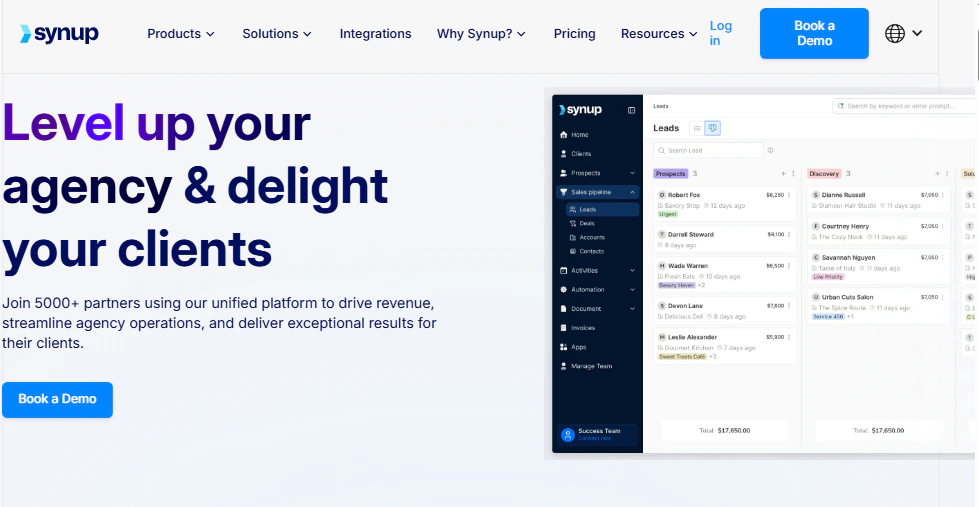
Synup and Yext both take the "all-in-one" approach, offering broad suites of tools that extend well beyond review management.
Synup has evolved into an "agency operating system" that includes sales pipeline management, invoicing, and client portals alongside its marketing tools. Yext's Knowledge Graph technology positions it as a comprehensive digital presence platform with capabilities spanning listings, pages, search, and analytics.
RightResponse AI takes a different path.
Rather than building a broad platform with AI added as one of many features, RightResponse AI focuses specifically on making every review response an opportunity to win the next customer. The platform handles both sides of reputation management: review collection through AI-personalized review requests, and review response through its three-pillar personalization system.
This difference becomes apparent in the quality of AI-generated review responses.
Where Synup and Yext offer AI-assisted responses with template and tone customization, RightResponse AI's approach separates what to say (Facts), how the response should behave (Customizations), and how it should sound (Brand Voice). The platform uses an agentic pipeline that analyzes each review before writing, handles edge cases like rating/text mismatches, and for medical use cases avoids including Protected Health Information (PHI) in responses.
The result is responses that feel genuinely personalized rather than templated; responses that can actively market the business to the prospective customers who read reviews when comparison shopping.
Synup excels at agency operations, but AI is one of many features
Synup has strategically positioned itself as the go-to platform for marketing agencies, and for good reason. The platform's evolution into "Synup OS" provides agencies with a comprehensive toolkit that extends far beyond reputation management.
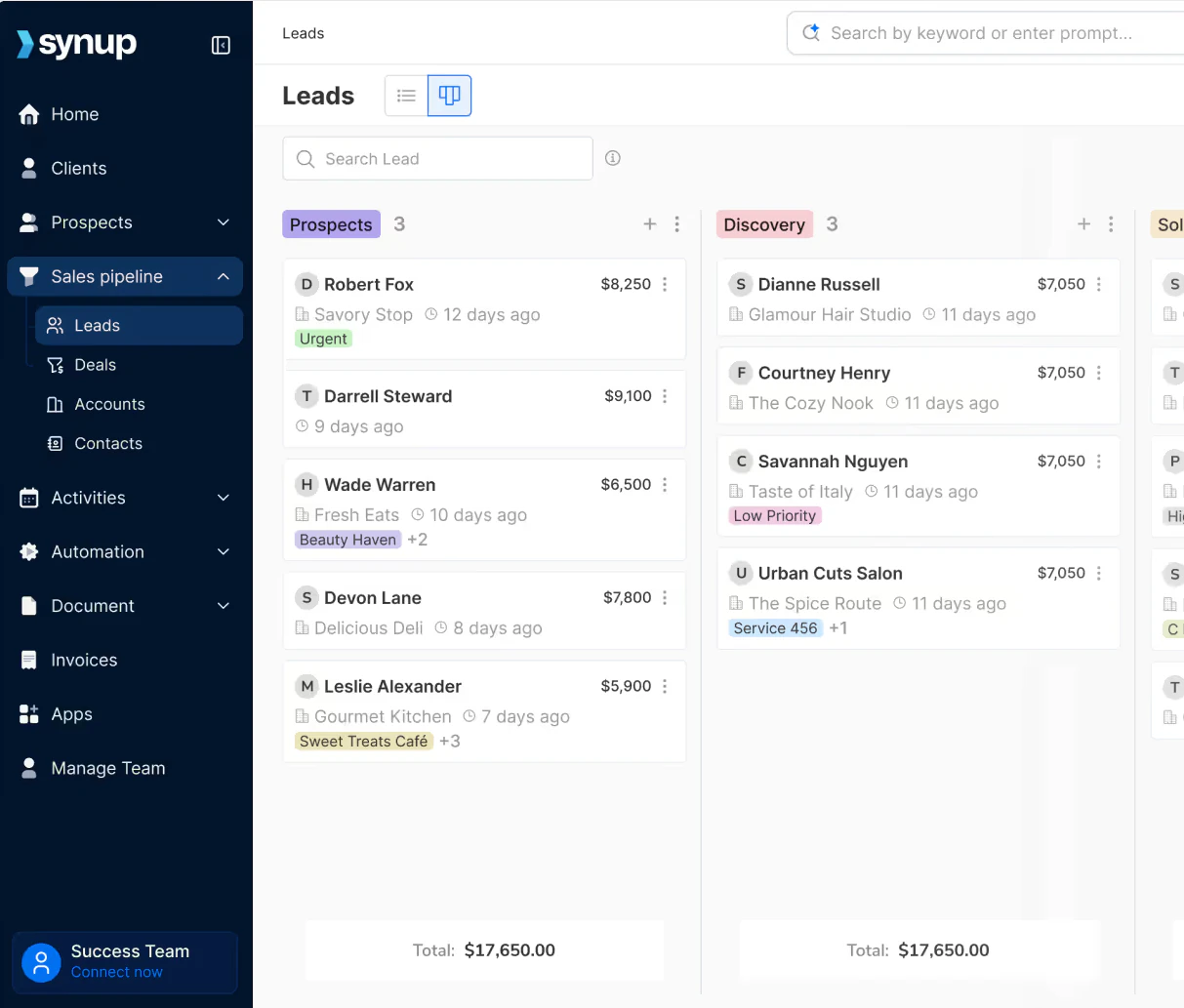
For agencies, Synup offers compelling capabilities: AI-powered lead prospecting, customizable sales pipelines, built-in invoicing with e-signature support, and extensive white-labeling that allows agencies to present the platform as their own. The ability to manage multiple clients from a single dashboard with granular access controls makes it attractive for agencies scaling their operations.
Source: Synup
The platform's listing management syncs business information across 75+ directories, with support for updates and duplicate suppression. Review management includes aggregation from multiple sources, AI-powered response suggestions, and automated review generation campaigns. The AI can generate responses based on rating, sentiment, and location, with customizable templates that use wildcards for personalization.
However, Synup's breadth comes with trade-offs.
Users frequently mention a steep learning curve, with the extensive feature set feeling overwhelming for those without dedicated marketing teams. Some users have also reported inconsistent customer support experiences and concerns about contract flexibility.
For agencies that need a unified platform for everything from prospecting to service delivery, Synup offers significant value. But businesses whose primary concern is advanced, quality-focused review responses may find themselves paying for capabilities they don't need.
Yext dominates enterprise digital presence, but at enterprise prices
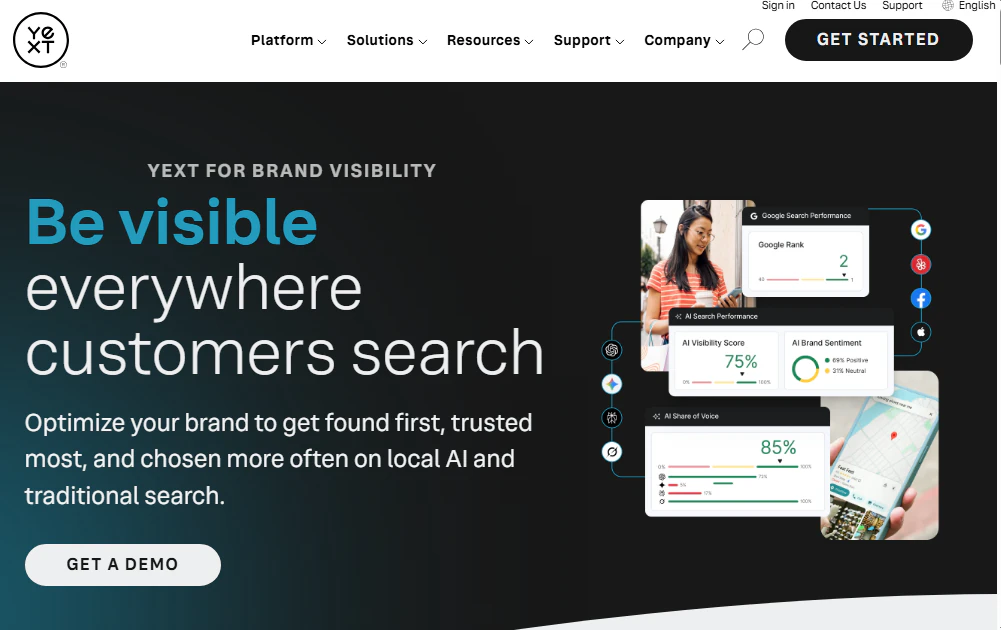
Yext is widely recognized as a leading enterprise solution for digital presence management. The platform's Knowledge Graph technology serves as a centralized repository that structures business information into entities and relationships, making data easily consumable by search engines and AI systems.
The numbers are impressive: over 200 direct API integrations with publishers, enabling real-time syndication of business information across search engines, maps, social media platforms, and voice assistants. For enterprises with hundreds or thousands of locations, this scale of distribution is valuable.
Yext's enterprise-grade features include advanced governance controls, detailed auditability features, and multi-level access permissions. The platform's AI capabilities extend beyond review responses to include AI-powered search for websites and support portals, which can deflect support tickets and improve self-service experiences. For review responses, Yext offers Generative Review Response that can be configured with guidelines for language, tone, and length.

Source: Yext
But Yext's enterprise focus comes with enterprise complexity.
The platform's pricing starts at $199 per year for basic packages but can reach $999+ per location annually for full capabilities, with custom pricing consultations required for enterprise plans. Implementation can take weeks, and the interface has been described by users as overwhelming for those new to the platform. Customer support experiences vary significantly, with some users reporting excellent service while others describe frustrating interactions.
The platform has also faced criticism regarding the accuracy of its core listings product. Some users report outdated or inaccurate listings persisting despite paying for the service. The company has also faced retention headwinds, with net retention rates below typical high-growth SaaS benchmarks.
For large enterprises with dedicated marketing teams and substantial budgets, Yext provides comprehensive capabilities. For businesses seeking focused, effective reputation management without enterprise overhead, it may be more than what's needed.
RightResponse AI delivers specialized reputation management
RightResponse AI emerged from a different starting point entirely.
Founded by George Swetlitz, the former CEO of a healthcare clinic network with over 200 locations, the platform was built to solve the specific challenge of turning customer reviews into business growth opportunities.
The key differentiator is how the platform approaches personalization. RightResponse AI's response system is built on three distinct pillars that work together:
- Facts: Business-specific messaging mapped to review themes. During onboarding, the platform reads existing reviews and the business website to create a set of "facts." When generating responses, the AI identifies which facts are relevant and incorporates them naturally, so if a customer praises fast service, the response might include a fact about the business's commitment to efficiency.
- Customizations: Rules and behavioral controls that govern how responses behave. This includes handling edge cases, formatting employee names correctly when mentioned, detecting review language, and for medical businesses, identifying potential Protected Health Information (PHI) to maintain HIPAA compliance.
- Brand Voice: Tone and style settings that ensure responses sound consistent with the business's personality. Businesses can rotate between multiple brand voices to create natural variation and avoid repetitive-sounding responses.
This three-pillar system produces responses that actively market the business.
Rather than generic "Thanks for your review" replies, responses can mention related offerings, highlight differentiators, and give prospective customers reasons to choose that business. Currently, most people read reviews but skip responses because they're generic and unhelpful; quality responses represent the opportunity to capture attention when prospects do glance at them.
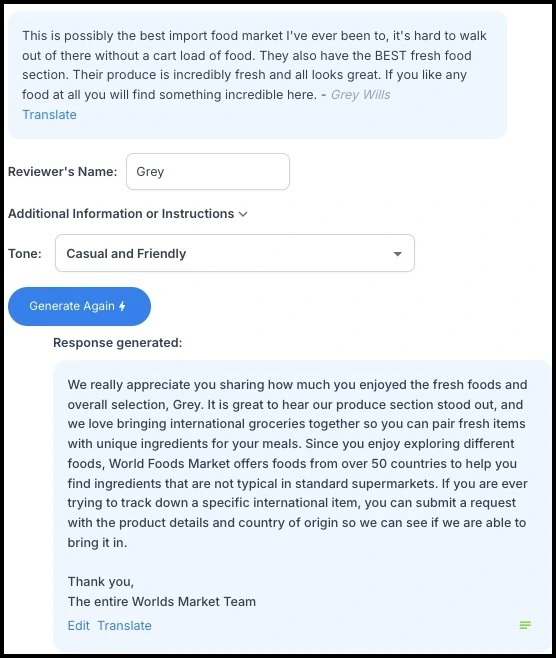
Beyond response generation, RightResponse AI includes AI-powered review requests that can reference actual customer experiences, incorporating names, service history, and even photos of completed work. Review requests can be sent via email and SMS, with unlimited follow-ups and QR codes at the individual employee level for tracking and incentive programs.
The platform also offers Voice of the Customer Aspect-Based Sentiment Analysis (ABSA), Google Maps rank tracking with a unique "Rewind" feature for visualizing ranking changes over time, and competitor review analysis.
Pricing models reveal each platform's priorities
The pricing structures of these platforms tell you everything about their target customers and value propositions.
Synup uses tiered pricing designed for agencies:
- Basic listings and review management start at $29.99/location/month
- Premium tiers at $74.99/location/month add CRM integrations, additional directory coverage, and dedicated support
- Agency OS plans range from $79-$999/month depending on team size and location count
Additional costs include add-ons like "Listings Pro" at $35/location/month and "Reviews Gold" at $50/location/month for advanced features.

Source: Synup
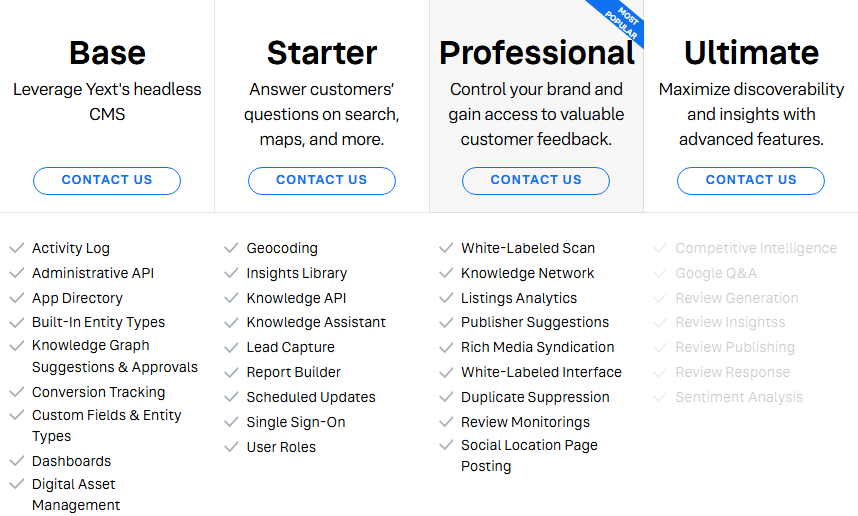
Yext uses tiered and custom pricing:
- Emerging plan starts at $199/year for basic listings across 30 directories
- Essential and Complete packages scale up to $999/year per location
- Enterprise plans require custom quotes, built from combinations of core products (Search, Pages, Listings, Reviews)
Yext is generally perceived as a premium-priced solution, with costs accumulating significantly for multi-location businesses.
Source: Yext
RightResponse AI offers flexible pricing with both usage-based and fixed-price plans:
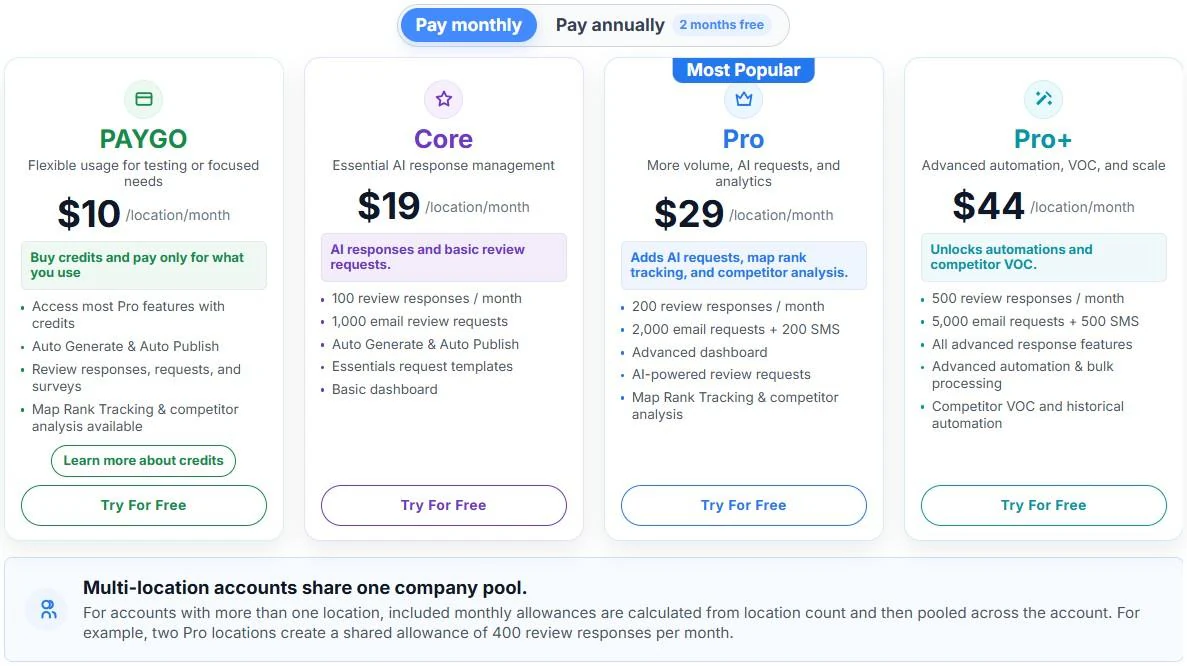
- Pay As You Go (PAYGO): $10 per location/month plus usage credits, best for getting started, lower review volumes, or narrow needs
- Core ($19/mo): 100 review responses and 1,000 email review requests with Essentials request templates (no SMS, surveys, or map rank tracking)
- Pro ($29/mo, most popular): 200 review responses, 2,000 email requests plus 200 SMS, 200 surveys, AI-powered Pro review requests, and Map Rank Tracker with competitor analysis (10 scans/month)
- Pro+ ($44/mo): 500 review responses, 5,000 email requests plus 500 SMS, 500 surveys, advanced automation and bulk processing, and Competitor Voice of the Customer (25 scans/month)
- Enterprise: custom plans for agencies and multi-location businesses, adding white-label, API access, and advanced reporting
A 7-day free trial includes 1,000 usage credits and access to most Pro features, with no credit card required.
Source: RightResponse AI
The usage-based model means businesses aren't locked into paying flat per-location fees for capacity they don't use. A business with 10 locations receiving 100 reviews per month might spend $80 on base fees plus approximately $20 in credits, totaling around $100/month for AI-powered review management with sentiment analysis. Agencies can scale cleanly across accounts without rigid per-location commitments.
Review response capabilities show the quality divide
This is where the platforms diverge most significantly in practical terms.
Synup offers AI-powered review responses as part of its broader platform.
The system can generate responses based on review content, rating, and sentiment. Users can create templates with wildcard personalization (customer name, location name, review site) and set up automations to bulk-respond across locations. The AI learns from interactions to maintain brand tone.
Yext includes Generative Review Response with configurable guidelines for language, tone, and length.
The platform supports approval workflows for managing responses at scale, with recent updates enabling bulk responses using freeform text and pre-created assets. Sentiment analysis powers templated responses, dynamically populating text based on positive or negative keywords.
RightResponse AI approaches response generation through its three-pillar system:
- Facts Integration: The platform maintains a library of business-specific facts mapped to common review themes. When generating a response, the AI identifies relevant facts and incorporates them naturally. If someone complains about price, the response can mention value differentiators (e.g., organic ingredients, specialized equipment, certified technicians). Users see which facts were used and can swap in alternatives.
- Behavioral Customizations: The agentic pipeline analyzes reviews before writing, handling edge cases like reviewer name authenticity (avoiding awkward greetings when names appear fake), employee name formatting, language detection for multilingual responses, review updates and rating/text mismatches, and PHI detection for medical businesses.
- Brand Voice Consistency: Beyond basic tone settings, businesses can create multiple brand voice profiles and rotate between them for natural variation while maintaining consistent style.
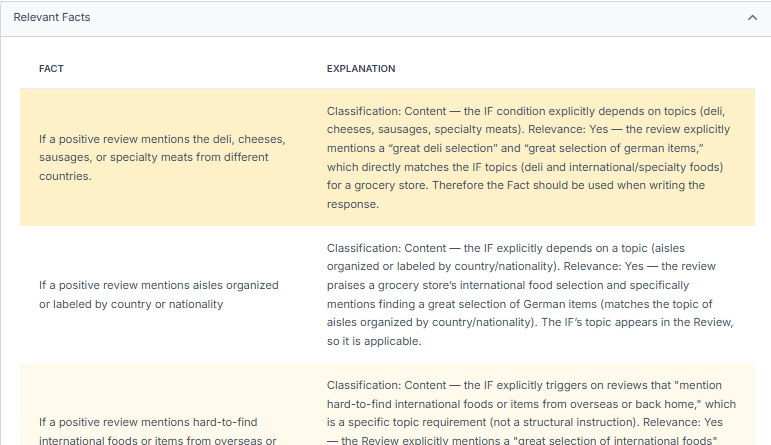
The practical difference: Synup and Yext integrate AI within broader marketing platforms, offering customizable but template-oriented responses. RightResponse AI's dedicated focus on response quality means responses can actively market the business, mentioning related services, highlighting differentiators, and giving prospective customers reading reviews a reason to choose that business.
Voice of the Customer approaches differ in granularity
Understanding what customers are actually saying, beyond simple star ratings, requires sophisticated sentiment analysis. The platforms approach this differently.
Synup includes sentiment analysis in its review management suite, allowing businesses to categorize reviews and identify trends. The analysis provides positive/negative scoring and keyword identification across locations.
Yext offers Sentiment Analysis using Natural Language Processing to identify keywords and assign sentiment scores between -90 and +90.
Users can create custom collections to group related keywords, with dashboards for tracking trends by location and time period. The system identifies top modifiers for each keyword, providing context for sentiment drivers.
RightResponse AI employs Voice of the Customer Aspect-Based Sentiment Analysis (ABSA), which takes a more granular approach:
- Topic Customization: Businesses define the specific aspects they want to track, aligned with how they think about their operations. A restaurant might track "food quality," "service speed," "ambiance," and "value," while a medical practice might track "wait times," "staff friendliness," "communication," and "treatment outcomes."
- Contextual Understanding: The AI understands synonyms and context, recognizing that "quick service" and "didn't have to wait long" both relate to speed of service.
- Direct Phrase Extraction: For each sentiment topic, users can see the exact phrases from customer reviews, providing full context rather than just aggregated scores.
- Irrelevant Content Filtering: The system automatically filters out vague or off-topic content, ensuring insights are based on genuine experience-based feedback.
- Comparative Analysis: The same analysis can be applied to competitor reviews, providing direct, side-by-side comparison on specific topics.
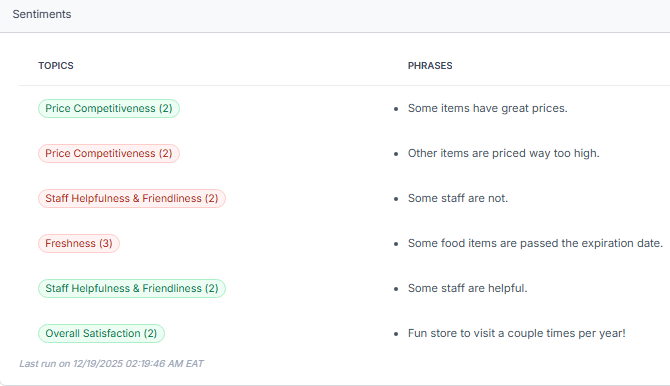
This granular approach can reveal insights that keyword-based scoring might miss. For example, a business might have a 4.2-star average but discover through ABSA that while customers love their product quality, there's consistent negative sentiment about a specific operational aspect, something aggregated keyword analysis could obscure.
Local SEO and rank tracking capabilities vary by focus
For location-based businesses, understanding and improving Google Maps rankings is essential. Each platform approaches this differently.
Synup includes grid-based rank tracking that shows where a business ranks for specific keywords across a geographic area. The platform offers monthly grid tracking credits and keyword search ranking tracking, with more advanced features available in add-on packages.
Yext provides competitive intelligence features that allow businesses to track their performance against competitors in local search.
The platform's Knowledge Graph is designed to structure data in ways that improve visibility in both traditional and AI-powered search. Yext's focus leans more toward broad digital presence than dedicated Google Maps grid tracking.
RightResponse AI offers a dedicated Map Rank Tracker with distinctive capabilities:
- Visual Grid Tracking: The platform creates a grid of search points around a business's location, simulating user searches from specific areas to show exactly where the business appears in Google Maps results.
- "Rewind" Feature: Unlike static reports, users can visually replay how their rankings and competitors' rankings have changed over time across the grid. This provides an intuitive understanding of ranking dynamics that charts alone cannot convey.
- Key Performance Metrics: The platform tracks "Top 3%" (how often the business appears in top three results), "Presence Rank" (visibility across the grid), and "Total Rank" (average ranking across all grid points).
- Deep Competitor Insights: Beyond just showing who outranks you, the platform connects rank tracking with competitor review analysis, allowing businesses to compare review volumes, ratings, response rates, and sentiment analysis on competitors' reviews.
- Scheduled Scans: Users can schedule tracking at intervals that suit their needs to monitor changes over time.
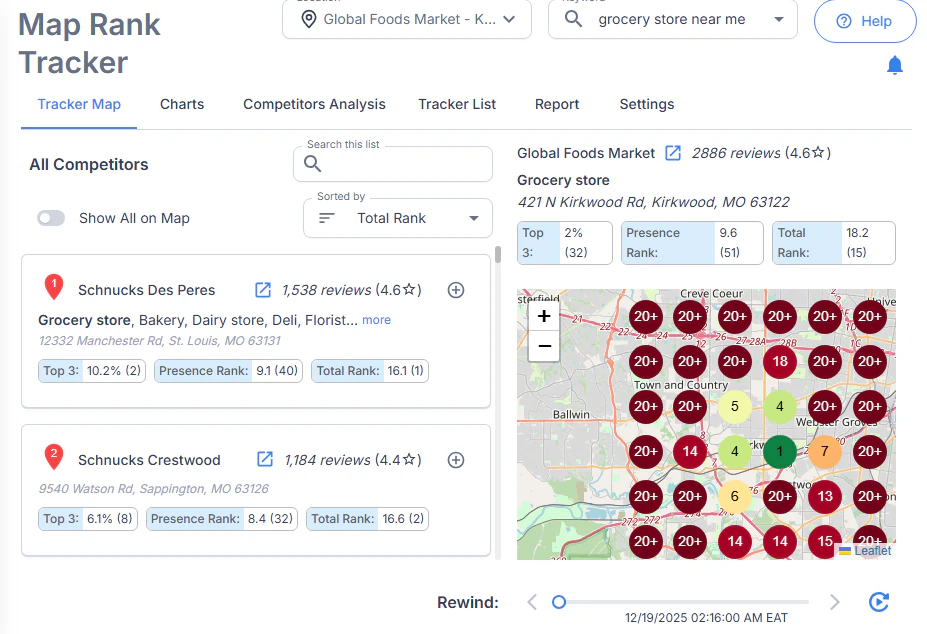
The integration between rank tracking and review management is particularly valuable. Since reviews and responses are significant factors in Google Maps rankings, understanding the connection between reputation management activities and ranking changes provides actionable insights.
Synup vs Yext vs RightResponse AI: Which should you choose?
The choice depends on your specific situation, priorities, and resources.
Choose Synup if:
- You're a marketing agency needing an all-in-one operating system for client management
- You want white-labeled solutions to present as your own brand
- You need sales tools, invoicing, and client portals alongside marketing capabilities
- You're prepared to invest time in learning the platform
- Listings management across 75+ directories is a priority
Get started with Synup by booking a demo to see the full platform.
Choose Yext if:
- You're a large enterprise with hundreds or thousands of locations
- You need extensive publisher network integrations (200+)
- Enterprise-grade governance, auditability, and access controls are essential
- You have budget for premium pricing and dedicated implementation resources
- You want AI-powered search capabilities for your website alongside reputation management
Explore Yext's enterprise capabilities by contacting their sales team.
Choose RightResponse AI if:
- Quality review responses matter; you want responses that actively market your business to prospective customers reading reviews
- You need the full three-pillar personalization system: Facts (what to say), Customizations (how responses behave), and Brand Voice (how they sound)
- You want AI-powered review collection alongside sophisticated response generation
- Transparent, usage-based pricing suits your budget better than flat per-location fees
- You want to get started quickly without a steep learning curve
- Voice of the Customer ABSA and Google Maps rank tracking with historical "rewind" capabilities support your local SEO strategy
RightResponse AI may not be ideal if:
- Your primary need is messaging, webchat, payments, or listings management; RightResponse AI stays focused on review response quality and related analytics rather than being a general customer communication platform
- You have near-zero review volume (limited ROI until review velocity increases)
- You prefer generic "set and forget" responses and don't prioritize differentiation through response quality
The reputation management landscape offers options ranging from broad platforms to specialized solutions.
Synup and Yext provide comprehensive capabilities for agencies and enterprises, respectively, with AI review responses as one component among many. RightResponse AI represents a different approach: focused specifically on making every review response an opportunity to market your business to the next customer reading it, with review collection, Voice of the Customer, and rank tracking built to support that goal.
For businesses that understand the potential of customer reviews to drive acquisition and retention, the question isn't just which platform has the most features. It's which platform makes every review response count.
Frequently Asked Questions
What is the main difference between Synup and Yext?
Synup is an all-in-one Agency Operating System designed for marketing agencies and multi-location businesses, with transparent tiered pricing starting at $29.99/location/month and features like white-labeling, sales pipeline management, and listings across 75+ directories. Yext is an enterprise digital presence platform built around Knowledge Graph technology with 200+ publisher integrations, starting at $199/year per location for basic packages up to $999+/year for full capabilities, with custom enterprise pricing for larger deployments.
How does RightResponse AI compare to Synup and Yext?
RightResponse AI is purpose-built for review response quality and review collection, rather than being a broad marketing suite. Its three-pillar personalization system (Facts, Customizations, Brand Voice) creates hyper-personalized responses that actively market the business to prospective customers. It also includes AI-powered review requests, Voice of the Customer Aspect-Based Sentiment Analysis, and Google Maps rank tracking with a unique Rewind feature, all with transparent pricing starting at $10 per location per month, with both Pay As You Go (PAYGO) and fixed monthly plans (Core, Pro, and Pro+).
How much does Synup cost compared to Yext and RightResponse AI?
Synup starts at $29.99/location/month for basic listings and reviews, with premium tiers at $74.99/location/month and Agency OS plans from $79-$999/month. Yext starts at $199/year per location for basic packages up to $999+/year for full capabilities, with custom enterprise pricing. RightResponse AI offers Pay As You Go (PAYGO) at $10/month per location plus usage credits, or fixed monthly plans: Core ($19), Pro ($29), and Pro+ ($44), with custom Enterprise pricing.
Which platform has the best AI review response quality?
RightResponse AI offers the most advanced AI review response capabilities through its three-pillar personalization system. Facts map business-specific messaging to review themes, Customizations provide behavioral rules and edge case handling (including PHI detection for healthcare), and Brand Voice maintains consistent tone with natural variation. The agentic pipeline analyzes each review before writing, producing responses that actively market the business rather than generic template-based replies.
Which platform is best for marketing agencies?
Synup is specifically designed for marketing agencies with its Agency Operating System approach, offering white-labeling, AI-powered lead prospecting, sales pipelines, built-in invoicing, and multi-client management. RightResponse AI's usage-based pricing also works well for agencies managing multiple accounts, as credits scale without rigid per-location commitments and agencies can manage quality review responses across their client portfolio.
Which platform offers the best sentiment analysis?
RightResponse AI's Voice of the Customer Aspect-Based Sentiment Analysis (ABSA) offers the most granular approach. Businesses define custom topics aligned with their operations, the AI understands synonyms and context, and users can see exact customer phrases for each sentiment topic. The same analysis can be applied to competitor reviews for direct comparison. Yext offers NLP-based keyword scoring with sentiment scores from -90 to +90. Synup includes basic sentiment categorization and keyword identification.
Try RightResponse AI for Free!
*No credit card required.