TrueReview has built a loyal following among small business owners looking for a straightforward way to generate more customer reviews. With its clean interface, automated SMS and email drip campaigns, and affordable pricing, it delivers on a simple promise: make it easy to ask customers for reviews and manage them in one place.
Comparison research: This article is part of the RightResponse AI review management software comparison library, which connects platform reviews, pricing analyses, alternatives, and head-to-head evaluations.
To write this TrueReview review, I've analyzed it extensively. I believe it's the ideal choice if:
- You want a simple, easy-to-learn platform for generating customer reviews
- You value affordability and transparent pricing
- Your primary goal is increasing review volume on Google and other sites
- You need basic automation for review requests via SMS and email
- You prefer a focused tool over a feature-heavy platform
However, TrueReview might not be the best choice if:
- You care about review response quality and want responses that actively market your business to prospective customers
- You need topic-level sentiment analysis that breaks down reviews by specific business aspects
- You want to track your Google Maps ranking across your service area
- Competitor review analysis and benchmarking are important to your strategy
- You want a response personalization system that gives you control over what gets said, how it behaves, and how it sounds
- You prefer usage-based pricing that scales with actual consumption rather than fixed tiers
In this case, you should consider RightResponse AI: a reputation management platform that treats the review response itself as a conversion asset, not a chore. It also includes advanced, AI-powered review collection, but where it stands apart is what happens after the review comes in: fact-infused AI responses built on a three-pillar personalization system (Facts, Customizations, and Brand Voice), Voice of the Customer, Google Maps rank tracking, and competitor intelligence. It serves location-based businesses regardless of size, from single-location operations to enterprise.
Because of that, I've included a detailed look at RightResponse AI later in this TrueReview review, as the best alternative for businesses that want their online reputation to actively drive revenue. If you're ready to explore a quality-focused approach to review management, you can start your free trial of RightResponse AI here.
Table of contents:
- What is TrueReview?
- TrueReview Pros & Cons
- TrueReview Review: How it Works & Key Features
- Where TrueReview Falls Short
- Top TrueReview Alternative: RightResponse AI
- TrueReview or RightResponse AI: Comparison Summary
- Final Verdict
What is TrueReview?
TrueReview is a cloud-based reputation management platform founded in 2019 by brothers Mikael and Alex Edwards.
The idea started when Alex, who has a marketing background, tried to help their father's small business generate more online reviews. They found that existing tools were either too expensive or too complex for a small business owner who wasn't particularly tech-savvy.
Mikael, who brings a background in product design and user experience, partnered with Alex to build something simpler. Their goal was to create an affordable, easy-to-use solution that would make it straightforward for businesses of any size to collect and manage customer reviews.

Today, TrueReview serves a range of local and service-based businesses, including automotive dealerships, dental practices, legal firms, property management companies, real estate agencies, and insurance providers. The platform also caters to marketing agencies managing online reputation for multiple clients.
TrueReview's value proposition remains rooted in its founding principles: simplicity, effective automation, and accessible pricing for small to medium-sized businesses that rely on online reviews to attract new customers.
TrueReview Pros & Cons
Pros | Cons |
|---|---|
✅ Intuitive, user-friendly interface designed for non-technical users | ❌ No Google Maps rank tracking |
✅ SMS and email drip campaigns for review generation | ❌ AI responses based on review content and tone selection, with no way to inject custom business facts or messaging |
✅ Transparent pricing with no hidden fees | ❌ No competitor analysis or benchmarking tools |
✅ AI-powered review response generator with four tone options | ❌ Sentiment analysis limited to high-level themes without aspect-based, topic-level detail |
✅ Embeddable review widgets and social post generator | ❌ Starter plan limited to email-only drip campaigns |
✅ Responsive and helpful customer support | ❌ Full drip campaign customization restricted to Premium plan |
✅ 14-day free trial with 250 review requests |
TrueReview Review: How it Works & Key Features
Review Requests and Drip Campaigns: TrueReview automates the process of asking customers for reviews through multi-step SMS and email sequences.
The core of TrueReview's value is its review request system. Businesses can add customer contacts manually, import them in bulk via CSV, or automate the process through Zapier or TrueReview's API by connecting a CRM or point-of-sale system. Once contacts are in the system, review requests can be sent immediately or scheduled for later.

Source: TrueReview
The platform's drip campaign feature is where the automation gets interesting.
By default, if both a phone number and email are provided, TrueReview sends an SMS first, followed by a series of three follow-up emails spaced over several days. The system monitors customer interaction throughout: if someone clicks a review link, the sequence stops automatically. If a customer indicates a negative experience, the campaign halts to allow the business to address the issue privately.
Users can customize the timing between each message, the content of both SMS and email templates, and the branding elements like logos and colors. On the Small Business plan and above, the first step of the sequence includes SMS; the Starter plan is limited to email-only follow-ups. The Premium plan unlocks fully customizable multi-step sequences where users can add, rearrange, or remove steps entirely.
For domain verification, businesses can send emails from their own domain rather than TrueReview's default address, which can improve open rates and brand recognition.
Review Management and Monitoring: A centralized dashboard for tracking and responding to reviews across multiple platforms.
TrueReview aggregates reviews from Google, Facebook, BBB, and over 20 other platforms into a single dashboard. When a new review is posted on connected sites like Google or Facebook, the system sends notifications so businesses can respond promptly.
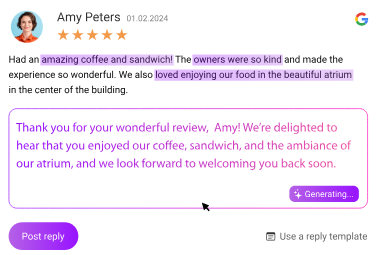
The AI Review Response Generator analyzes the customer's name, star rating, and review content to draft a personalized reply. Users can select a desired tone, professional, friendly, grateful, or direct and concise, and then review, edit, and publish the response directly from TrueReview's dashboard. Businesses can also set up automated replies for new Google reviews based on star rating brackets, with options to use AI-generated responses or pre-written templates.
Source: TrueReview
A feature called Review Mentions tracks when specific employees are named in reviews, providing a way to monitor individual performance and recognize standout team members.
The platform includes AI-powered review insights that identify recurring themes and trends in customer feedback, along with AI-generated summaries highlighting common patterns. For further analysis, businesses can export all their reviews to a CSV file.
Feedback Collection and Website Integration: Tools for private feedback, surveys, and showcasing reviews on your website and social media.
TrueReview includes a direct feedback feature that routes customers to a private form instead of a public review site.
This is particularly useful for unhappy customers, giving businesses an opportunity to resolve concerns before they become public complaints. When feedback is submitted, the business receives an email notification with the details.

Source: TrueReview
The survey tool lets businesses create rating-based surveys using star or numerical scales. A notable feature is the ability to link survey outcomes to subsequent actions: customers who give high ratings can be automatically prompted to leave a public review, while those with lower ratings are directed to the private feedback form.
For website integration, TrueReview offers embeddable review widgets that display a live feed of reviews from connected platforms. The widgets are highly customizable, with options for layout (list or column), color schemes, light or dark mode, and filtering by specific reviews. Implementation requires copying and pasting a code snippet into the website's HTML.
The Social Review Post Generator converts positive reviews into branded graphics that can be downloaded in various sizes optimized for different social media platforms. Users can customize fonts, colors, and layouts to match their brand identity.
Where TrueReview Falls Short
While TrueReview delivers on its promise of simple review generation, several limitations become apparent for businesses that need more from their reputation management efforts. These limitations reflect a platform optimized for collecting reviews rather than deeply analyzing what those reviews actually mean, or leveraging review responses as a tool for customer acquisition.
Limited Sentiment Depth: TrueReview's review insights feature identifies recurring themes and trends in customer feedback through its AI Review Summary.
But it doesn't offer aspect-based analysis that breaks sentiment down by specific business topics. A restaurant owner, for example, can't easily see that "food quality" sentiment is trending up while "wait times" sentiment is declining. Without this granularity, businesses are left to manually read through reviews to identify topic-specific patterns.

Source: TrueReview
No Local Search Visibility Tools: TrueReview doesn't include any Google Maps rank tracking.
For location-based businesses, understanding where they appear in local search results across their service area is critical to connecting reputation management with actual customer acquisition. Businesses need a separate tool to monitor this.
No Competitor Intelligence: The platform provides no way to monitor competitors' reviews, track their response rates, or benchmark performance against local rivals. Understanding the competitive landscape is a key input for reputation strategy, and its absence means businesses are managing their reputation in a vacuum.
Basic AI Response Personalization: TrueReview's AI response generator is functional, but it works from three inputs: the review content, the customer's name, and the star rating, plus a tone selection.
It doesn't provide a way to incorporate specific business facts, selling points, or operational details into responses. This means responses can be contextually appropriate to the review but miss the opportunity to speak to prospective customers who may be reading. Where a response could say something like "Glad you enjoyed the steaks! Did you know we also have the best mezcal bar in San Francisco?", a tone-based generator can only reflect what the reviewer already said.
Drip Campaign Customization Varies by Plan: While TrueReview's drip campaigns do send automated follow-up messages, the level of customization depends on your plan. Only Premium plan users can add extra steps, rearrange the sequence, or fully customize the campaign flow. Lower-tier plans are limited to a fixed sequence structure.
These limitations aren't failures. They're the natural result of a platform designed around simplicity and review generation. But they create a clear gap for businesses that want to use their online reputation as a tool for growth; where every review response is an opportunity to win the next customer, not just acknowledge the last one.
Top TrueReview Alternative: RightResponse AI
RightResponse AI addresses these gaps with a different philosophy: reviews drive search rankings, but the response is the business's chance to win the next customer.
People read reviews, and when they glance at a response, that's the one piece of the conversation the business controls. Most responses today are generic filler that readers skip. RightResponse AI is built to make responses worth reading.
Launched in 2024 by George Swetlitz, Shiv Pujan Singh, and Sabrina Hu, the platform was born from Swetlitz's experience leading a healthcare business with over 200 locations. Managing that volume of customer feedback revealed the need for tools that don't just collect reviews but turn every response into a conversion asset that actively markets the business. The platform serves location-based businesses regardless of size, from single-location operations to enterprise.
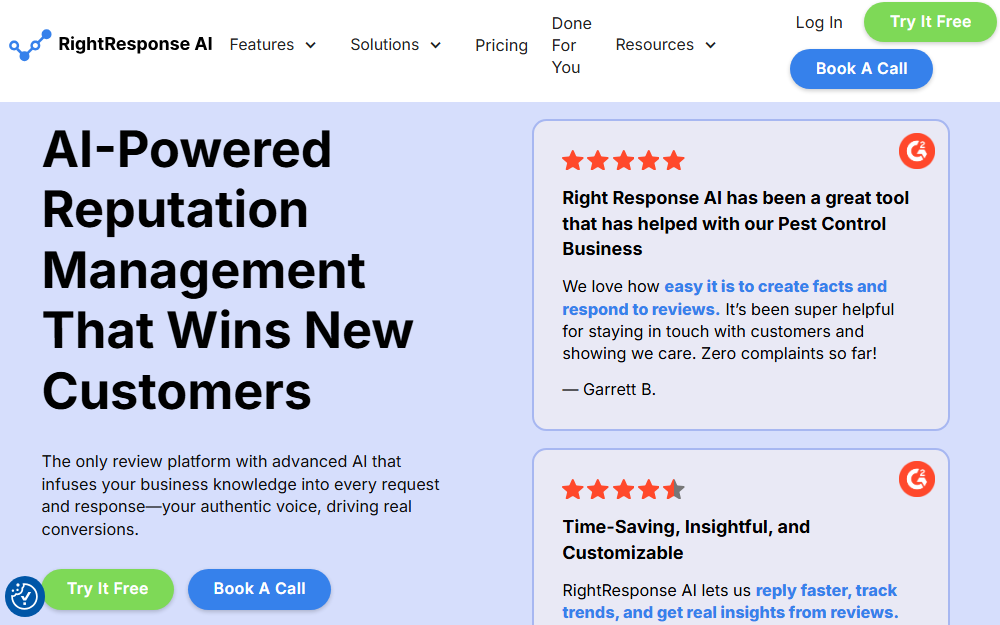
RightResponse AI also includes an advanced review request system, with both simple template-based requests and an AI-powered mode that generates highly personalized outreach incorporating customer data like name, service history, and recent transactions, delivered via email and SMS.
But where it stands apart from review-collection-centric platforms like TrueReview is what happens after the review comes in.
Fact-Infused Intelligent Review Responses: A three-pillar personalization system that turns every reply into a conversion opportunity.
RightResponse AI's response generator is built on a fundamentally different approach than standard AI reply tools. Rather than generating responses from the review text and a tone setting alone, it uses a three-pillar personalization system:
- Facts (what to say): During onboarding, the platform reads existing reviews, responses, and the business's website to create a library of business-specific "facts": unique selling points, operational details, promotions, brand values. It identifies the most important themes in reviews and maps relevant facts to each theme. When a review comes in, the AI matches it to the relevant theme and selects which facts to weave into the response naturally. The system shows users which facts were used and which weren't, so they can make adjustments, and changes roll forward immediately.
- Customizations (how it should behave): Rules and behavioral controls that govern the response, such as how to handle negative reviews, what to avoid saying, how to format greetings and closings, and how to treat edge cases. This gives businesses governance over the AI's behavior without micromanaging every response.
- Brand Voice (how it should sound): Tone and style definitions that ensure responses sound consistently like the business across all locations and over time, with custom style guidelines and "do-not-say" lists.
All three pillars work together to produce hyper-personalized, brand-aligned responses with endless variation, without losing control.
The result is the difference between a generic "Thanks for your 5-star review, we appreciate your business!" and a response that says "Glad you enjoyed the steaks! Did you know we also have the best mezcal bar in San Francisco?" One wastes space; the other actively markets the business to every prospective customer who reads it.

The system also uses a multi-step process that separates analysis from writing. Before the response is generated, the AI analyzes the review's content and sentiment, identifies relevant facts and reference examples, detects context like reviewer names and employee mentions, and handles edge cases such as review updates and rating-text mismatches.
For medical businesses, a PHI detection step flags protected health information to help maintain HIPAA compliance. By the time the writing engine takes over, all analytical work is done, reducing the risk of the AI generating something inappropriate while increasing relevance.
The auto-publishing feature can be configured by star rating, so positive reviews get responded to immediately while negative reviews are held for manual review.
Voice of the Customer: Aspect-Based Sentiment Analysis (ABSA) reveals what's driving your ratings, not just whether they're positive or negative.
RightResponse AI's sentiment analysis product, formally called Voice of the Customer Aspect-Based Sentiment Analysis (ABSA), uses machine learning to go beyond simple positive/negative categorization. The system breaks each review down to identify specific topics customers are discussing and assigns sentiment to each one individually.
Businesses define their own topics and categories. A hotel might track "room cleanliness," "front desk experience," "breakfast quality," and "parking" as separate topics. The AI then maps customer feedback to these categories, extracting the exact phrases that correspond to each topic and sentiment. A review that praises the breakfast but complains about parking would have both data points captured separately.
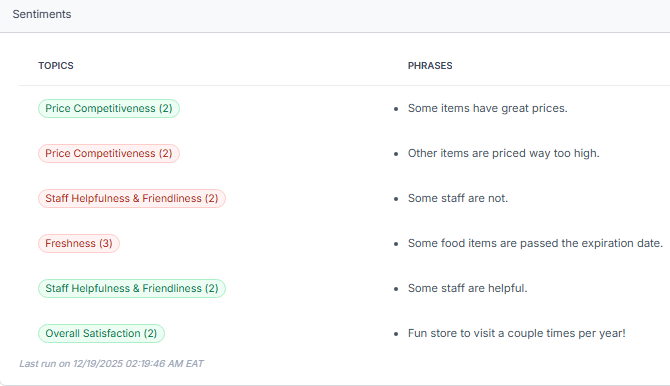
The system filters out vague or irrelevant content automatically, focusing the analysis on genuine experience-based feedback. Results are visualized in interactive dashboards where businesses can explore sentiment by topic, track changes over time, and compare performance across different locations.
A significant feature is the ability to apply this same analytical lens to competitors' reviews. Businesses can see how their sentiment on specific topics compares to local rivals, providing a direct benchmarking tool.
Google Maps Rank Tracking and Competitor Intelligence: Monitor local search visibility with grid-based tracking and deep competitor analysis.
RightResponse AI's Map Rank Tracker creates a customizable grid around a business's location, simulating searches from each point to show exactly where the business appears in Google Maps results for specific keywords. The platform provides grid-based tracking (such as a 7x7 grid) to match your service area coverage.
Key metrics include "Top 3%" (how often the business appears in the top three local results), "Presence Rank" (the percentage of grid points where the business appears in the top 20), and "Total Rank" (average ranking across all grid points). Scans can be scheduled to run automatically.
The "Rewind" feature saves every scan and lets users visually replay how rankings have changed over time across the grid. This provides an intuitive way to see the impact of local SEO efforts rather than just looking at static charts.
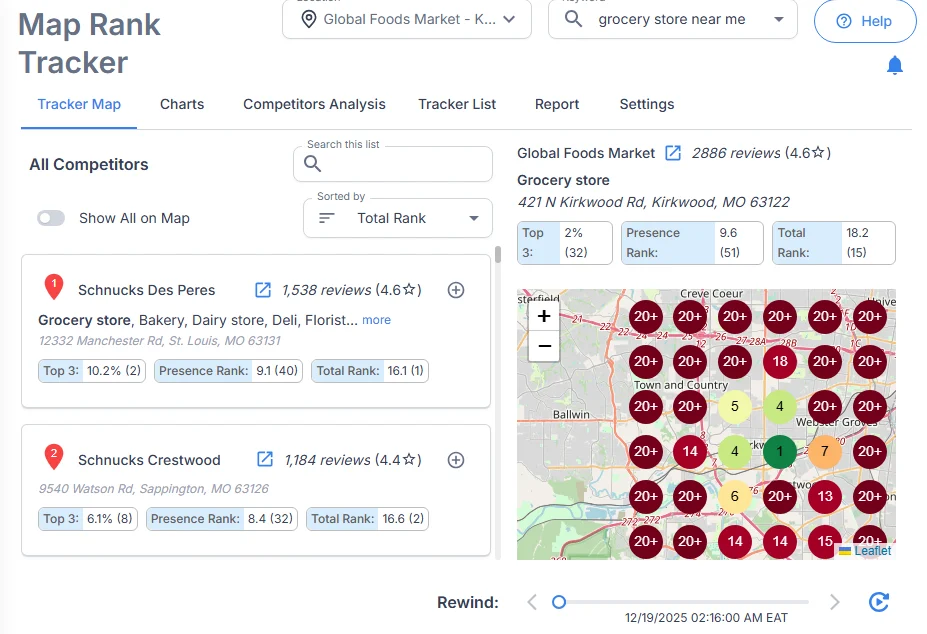
CompetiWatch AI, the competitor intelligence module, identifies businesses ranking in the same area and provides side-by-side analysis. Users can track competitors' review volume, average ratings, and response rates over 60-day and 180-day periods. The same aspect-based sentiment analysis applied to your own reviews can be applied to competitors' reviews, providing a topic-level comparison of strengths and weaknesses.
Pricing: Fixed Plans or Pay As You Go (PAYGO)
RightResponse AI uses a hybrid pricing model with fixed monthly plans, Core at $19/month, Pro at $29/month, and Pro+ at $44/month, alongside a Pay As You Go (PAYGO) option billed at $10 per location plus credits, so businesses aren't forced into paying per-location for capacity they don't use.
The three fixed plans are billed per location each month and come with set monthly allowances, so your costs stay predictable:
Core ($19): 100 review responses, 1,000 email review requests, Essentials request templates, and a basic dashboard. No SMS, surveys, or map rank tracking.
Pro ($29, the most popular tier): 200 review responses, 2,000 email requests plus 200 SMS, 200 surveys, AI-powered (Pro-mode) review requests, and Map Rank Tracking with competitor analysis (10 scans per month) on an advanced dashboard.
Pro+ ($44): 500 review responses, 5,000 email requests plus 500 SMS, 500 surveys, advanced automation and bulk processing, Competitor Voice of the Customer, and 25 map-rank and competitor scans per month.
Enterprise plans are custom-built for agencies and multi-location brands, adding white-label access, API access, and advanced reporting.
For lower-volume or narrower needs, Pay As You Go (PAYGO) is the flexible entry point: a $10 per location base fee that unlocks every feature, with usage billed through credits (for example, 20 credits per review response, 20 per Voice of the Customer analysis, 2 per email review request, and 1.5 per map rank pin).
PAYGO credits are priced by volume, from $0.01 each, and can be topped up manually or set to auto-recharge.
This model is particularly well-suited to agencies managing multiple clients and multi-location brands where review volume varies significantly across locations. Rather than paying flat per-location fees regardless of activity, businesses pay in proportion to what they actually consume.
A 7-day free trial includes 1,000 usage credits and access to most Pro features, with no credit card required. Enterprise plans with custom pricing include API access, customized reporting, and custom AI workflows.

Source: RightResponse AI
TrueReview or RightResponse AI: Comparison Summary
TrueReview | RightResponse AI | |
|---|---|---|
Primary focus | Review generation and management | AI-powered review response quality and reputation analytics |
Target audience | Small to medium local businesses | Location-based businesses, from single location to enterprise |
Ease of use | ⭐⭐⭐⭐⭐ Very simple and intuitive | ⭐⭐⭐⭐ Comprehensive but intuitive |
AI review responses | ⭐⭐⭐ Tone-based AI responses from review content | ⭐⭐⭐⭐⭐ Three-pillar system: Facts, Customizations, and Brand Voice |
Sentiment analysis | ⭐⭐ High-level theme identification | ⭐⭐⭐⭐⭐ Aspect-based (ABSA) with customizable topics |
Google Maps rank tracking | ❌ Not available | ⭐⭐⭐⭐⭐ Grid-based tracking with Rewind feature |
Competitor analysis | ❌ Not available | ⭐⭐⭐⭐⭐ Review metrics and sentiment benchmarking |
Review request automation | ⭐⭐⭐⭐ SMS and email drip campaigns | ⭐⭐⭐⭐ AI-personalized requests via email and SMS |
Website review widgets | ⭐⭐⭐⭐ Customizable embeddable widgets | Not a primary feature |
Free trial | 14 days with 250 requests | 7 days with 1,000 credits |
Starting price | $29/month (annual) for 1 location | Core $19, Pro $29, Pro+ $44/month, or from $10/location on PAYGO (Enterprise custom) |
Pricing model | Fixed subscription tiers | Fixed monthly plans or PAYGO usage credits |
Best for | Simple review generation and collection | Businesses that care about review response quality and reputation analytics |
Final Verdict
The choice between TrueReview and RightResponse AI depends on what you need from your reputation management efforts.
Choose TrueReview if you want a focused, easy-to-use platform for generating more customer reviews without a steep learning curve.
It's the right tool for small businesses that need to get more reviews on Google and other sites, want automated SMS and email follow-ups to do the heavy lifting, and prefer a straightforward interface that anyone on the team can pick up quickly. TrueReview's embeddable widgets and social post generator also make it a solid choice for businesses looking to showcase their reviews across their website and social channels.
Get started with TrueReview here.
Choose RightResponse AI if you care about review response quality and want every reply to actively market your business to the prospective customers reading it.
It's built for location-based businesses, from single-location operations to enterprise, that want to understand what specific topics drive customer satisfaction, how they compare to local competitors, and where they rank in Google Maps searches across their service area.
The three-pillar personalization system (Facts, Customizations, and Brand Voice) gives businesses control over what gets said, how it behaves, and how it sounds, producing responses that feel specific and helpful rather than generic. It also includes an AI-powered review collection, but the core differentiator is what happens after the review comes in.
Flexible pricing, from fixed monthly plans (Core, Pro, and Pro+) to Pay As You Go, lets you match spend to your review volume rather than being locked into flat per-location fees.
Get started with RightResponse AI here.
TrueReview excels at making review collections simple and accessible. RightResponse AI excels at turning every review response into a chance to win the next customer. Your choice depends on whether you need a review generation tool or a platform where response quality and reputation analytics drive growth.
Frequently Asked Questions
When should I choose TrueReview?
Choose TrueReview if you want a focused, easy-to-use platform for generating more customer reviews without a steep learning curve. It's the right tool for small businesses that need to get more reviews on Google and other sites, want automated SMS and email follow-ups to do the heavy lifting, and prefer a straightforward interface that anyone on the team can pick up quickly. TrueReview's embeddable widgets and social post generator also make it a solid choice for businesses looking to showcase their reviews across their website and social channels.
When is RightResponse AI a better choice than TrueReview?
Choose RightResponse AI if you care about review response quality and want every reply to actively market your business to the prospective customers reading it. It's built for location-based businesses — from single-location operations to enterprise — that want to understand what specific topics drive customer satisfaction, how they compare to local competitors, and where they rank in Google Maps searches across their service area. The three-pillar personalization system (Facts, Customizations, and Brand Voice) gives businesses control over what gets said, how it behaves, and how it sounds.
What are the main differences between TrueReview and RightResponse AI?
The main differences include: Primary focus (TrueReview focuses on review generation and management, while RightResponse AI focuses on AI-powered review response quality and reputation analytics), AI responses (TrueReview uses tone-based AI responses from review content, while RightResponse AI uses a three-pillar system with Facts, Customizations, and Brand Voice), analytics (TrueReview offers high-level theme identification, while RightResponse AI provides Voice of the Customer using aspect-based sentiment analysis (ABSA)), and additional features (RightResponse AI includes Google Maps rank tracking and competitor intelligence, which TrueReview does not offer).
How does pricing compare between TrueReview and RightResponse AI?
TrueReview uses fixed subscription tiers starting at $29/month (annual) for 1 location. RightResponse AI uses a hybrid pricing model with fixed monthly plans (Core at $19, Pro at $29, and Pro+ at $44 per location per month) plus a Pay As You Go (PAYGO) option at $10 per location per month with usage-based credits from $0.01 each, and custom Enterprise pricing. RightResponse AI offers a 7-day free trial with 1,000 credits, while TrueReview offers a 14-day free trial with 250 review requests.
Try RightResponse AI for Free!
*No credit card required.