Yext has built its reputation as one of the most comprehensive digital presence platforms available, serving major brands across retail, healthcare, financial services, and hospitality. With its centralized Knowledge Graph, a publisher network spanning over 200 integrations, and tools for managing everything from business listings to on-site search, it offers multi-location enterprises a single platform to control their entire online footprint.
Comparison research: This article is part of the RightResponse AI review management software comparison library, which connects platform reviews, pricing analyses, alternatives, and head-to-head evaluations.
To create this Yext review, I've analyzed the platform extensively. I believe it's the ideal choice if:
- You need centralized control over business information across hundreds of digital channels
- You operate a multi-location enterprise with 50 or more locations
- You want a unified platform covering listings, pages, search, and reviews
- You have the budget and internal resources for enterprise-grade software
- You need structured data management that's optimized for AI-powered search
However, Yext might not be the best choice if:
- Your primary need is deep, specialized review management with high-quality AI responses that actively market your business
- You want transparent, accessible pricing without a lengthy sales process
- You prefer a focused tool you can master quickly over a broad platform
- You need customized Voice of the Customer analysis that maps feedback to specific business topics
- You want both sophisticated review collection and response quality in one reputation-focused platform
In this case, you should consider RightResponse AI: a specialist reputation management platform built from the ground up with generative AI, designed for location-based businesses of all sizes, from single-location operations to enterprise. Its response personalization system combines three pillars, Facts (business-specific messaging mapped to review themes), Customizations (behavioral rules that control how responses behave), and Brand Voice (tone and style), to produce responses that don't just acknowledge reviews but actively market the business to prospective customers reading them. Alongside response quality, the platform includes AI-powered review collection, Voice of the Customer, Google Maps rank tracking, and competitor review intelligence.
Because of that, I've included a detailed look at RightResponse AI later in this Yext review, as the best alternative for businesses seeking specialized reputation management depth. If you're ready to explore a more focused approach, you can start with RightResponse AI's free trial here.
Table of contents:
- What is Yext?
- Yext Pros & Cons
- Yext Review: How it Works & Key Features
- Where Yext Falls Short
- Top Yext Alternative for Reputation Management: RightResponse AI
- Yext or RightResponse AI: Comparison Summary
- Final Verdict
What is Yext?
Yext was founded in 2006 by Howard Lerman, Brian Distelburger, and Brent Metz. The company started as a local advertising business before pivoting in 2012 to focus on digital presence management, guided by the principle that the ultimate authority on a business should be the business itself.
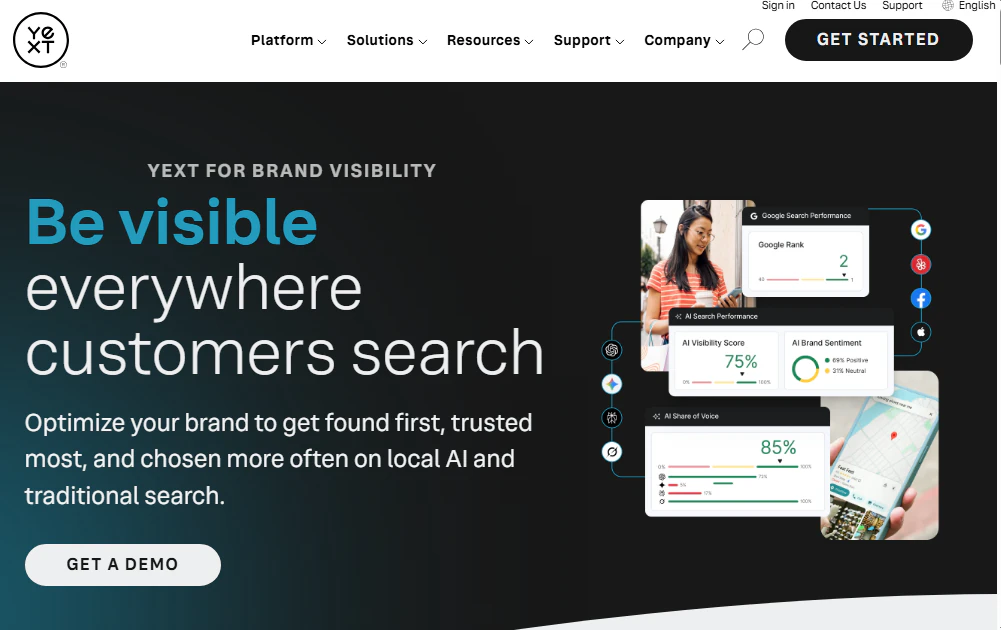
Today, Yext is a publicly traded company (NYSE: YEXT) with approximately 1,150 employees and fiscal year 2025 revenue of around $421 million. The platform is built around its Knowledge Graph, a centralized database that structures a brand's public information into entities, fields, and relationships.
This structured data feeds into the platform's core products: Listings for syncing business information across 200+ publishers, Reviews for monitoring and responding to customer feedback, Pages for creating search-optimized landing pages, and Search for powering on-site search experiences.
Yext's focus leans heavily toward mid-market to large enterprises with multiple physical locations, dedicated marketing teams, and significant digital marketing budgets, though the platform also serves smaller businesses. It operates across industries including retail, healthcare, financial services, and restaurant and hospitality.
Yext Pros & Cons
Pros | Cons |
|---|---|
✅ Extensive publisher network with 200+ direct API integrations | ❌ Limited public pricing for core packages; requires sales consultation |
✅ Centralized Knowledge Graph as a single source of truth | ❌ Steep learning curve reported by some users |
✅ Enterprise-grade scalability for multi-location brands | ❌ Mixed customer support experiences |
✅ AI-powered search and structured data management | ❌ Reviews feature is one module among many, not the core focus |
✅ Comprehensive analytics across digital channels | ❌ High cost can be prohibitive for smaller businesses |
✅ Strong security certifications (SOC 2) | ❌ Platform complexity can feel excessive for simpler needs |
Yext Review: How it Works & Key Features
Knowledge Graph: Yext structures brand information into an interconnected, AI-ready database.
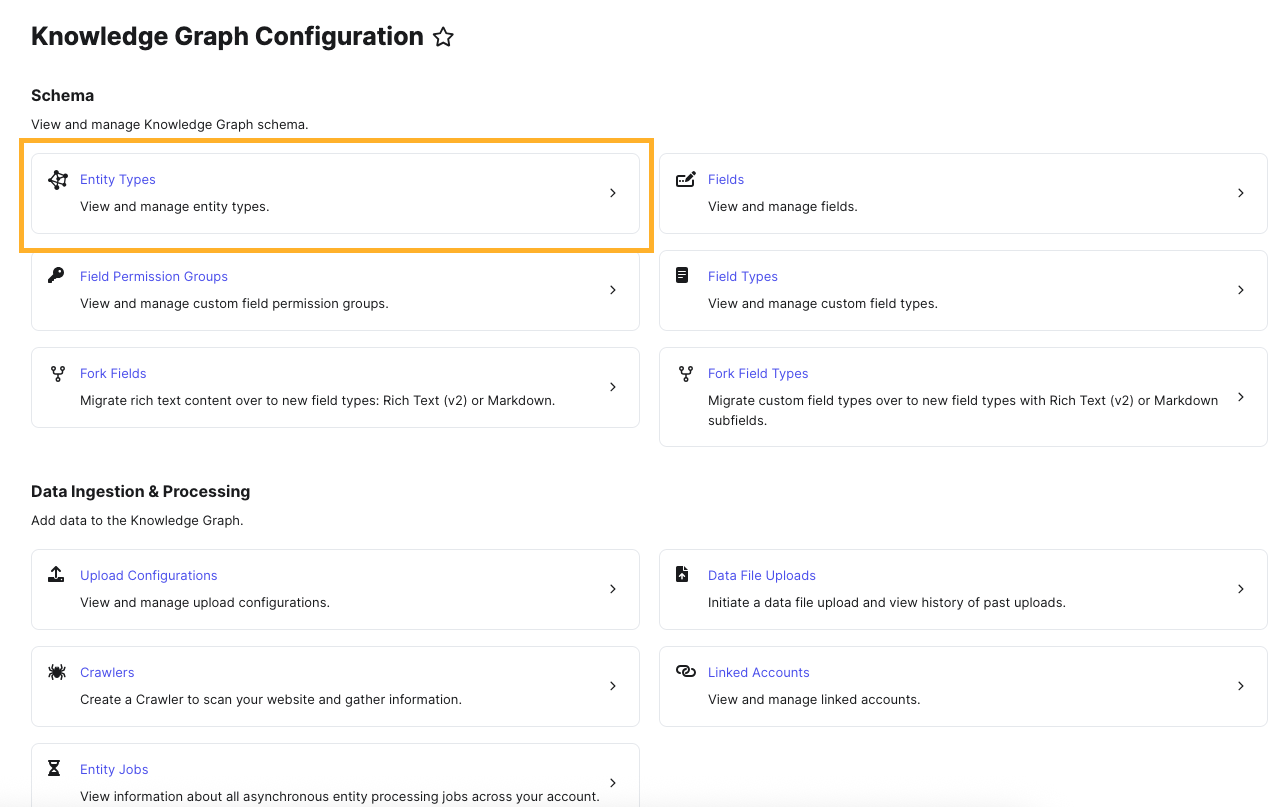
The Knowledge Graph is the foundation of everything Yext does.
It organizes a business's public-facing information into "entities" (locations, professionals, products, events) and "fields" (address, hours, specialties), then maps the relationships between them. For example, it can define that a specific doctor works at a particular hospital and specializes in a certain medical field.
Data enters the Knowledge Graph through manual entry, spreadsheet uploads, API connections, or automated website crawlers. Once structured, the information can be syndicated to Yext's publisher network, used to generate web pages, or surfaced through on-site search. A change made once in the Knowledge Graph propagates automatically across all connected endpoints.
The platform includes AI-powered content generation that can create business descriptions, professional biographies, and FAQs based on the structured data. It also offers enterprise-grade governance features: fine-grained user roles, approval workflows, and audit trails for maintaining control across teams and regions. Custom entity types and fields allow businesses to model their data in ways that reflect their specific operations.
Source: Yext
Listings: Real-time information syncing across a global network of publishers.
Yext Listings enables businesses to manage their information across over 200 publishers through direct API integrations.
This network includes major search engines (Google, Bing), mapping services (Apple Maps, Waze), social platforms (Facebook, Instagram), voice assistants (Amazon Alexa, Siri), and industry-specific directories for healthcare, restaurants, and financial services.
The key advantage is the direct API connections, which allow for near-real-time updates. When a business changes its hours in the Knowledge Graph, that update is pushed to connected publishers through direct API integrations almost immediately.
For publishers that don't support an API, Yext relies on data submissions, which may take longer. This still contrasts favorably with services that rely solely on data aggregators, where updates can take weeks to propagate.
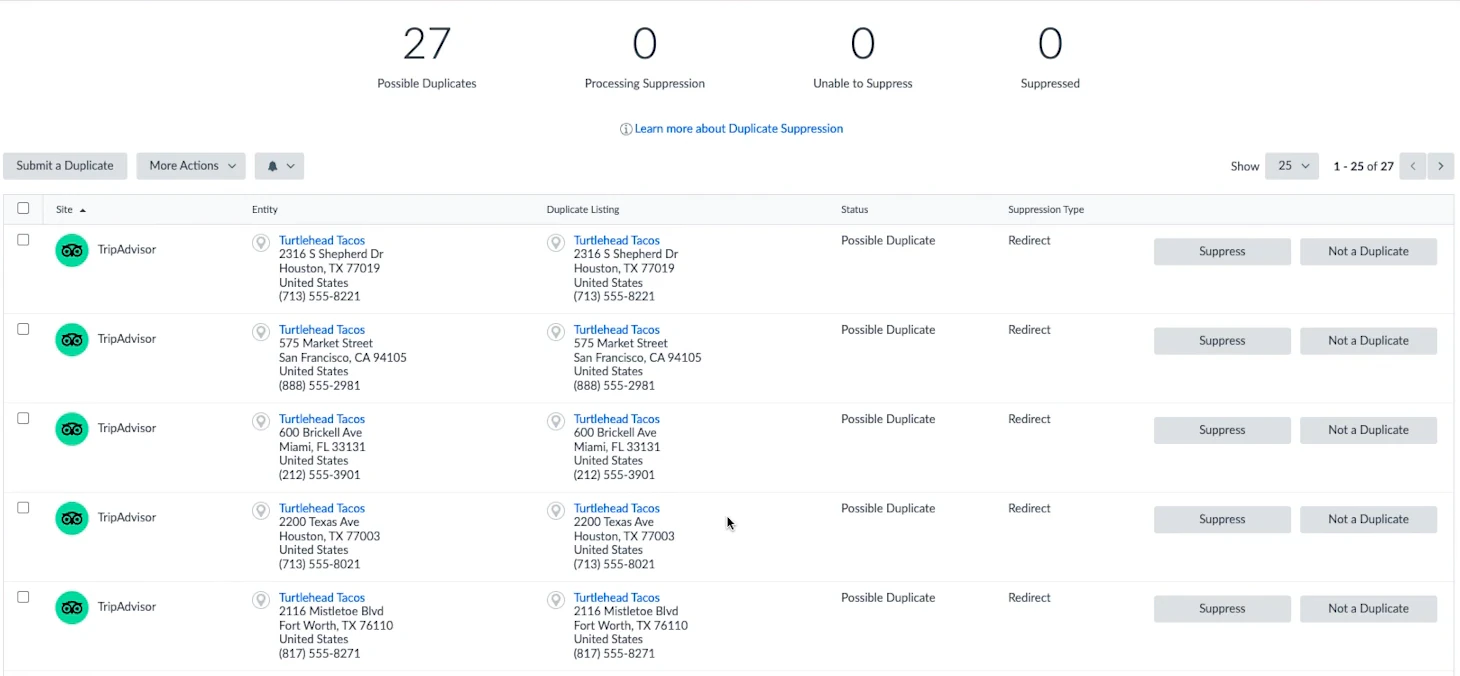
Additional capabilities include duplicate listing suppression, where Yext's system scans publishers monthly to identify incorrect duplicate listings so businesses can review and suppress them.
Source: Yext
Rich data syncing supports over 50 data fields beyond basic name, address, and phone number, including photos, menus, services offered, and publisher-specific fields. The analytics integration provides a unified dashboard tracking impressions, profile views, clicks, and search terms across the entire network.
Reviews: Monitoring, responding, and generating customer feedback at scale.
Yext's Reviews product aggregates customer reviews from numerous third-party sites into a single dashboard and supports both first-party and third-party review management. The platform is structured into distinct packages: Review Monitoring, Review Response, and Review Generation.
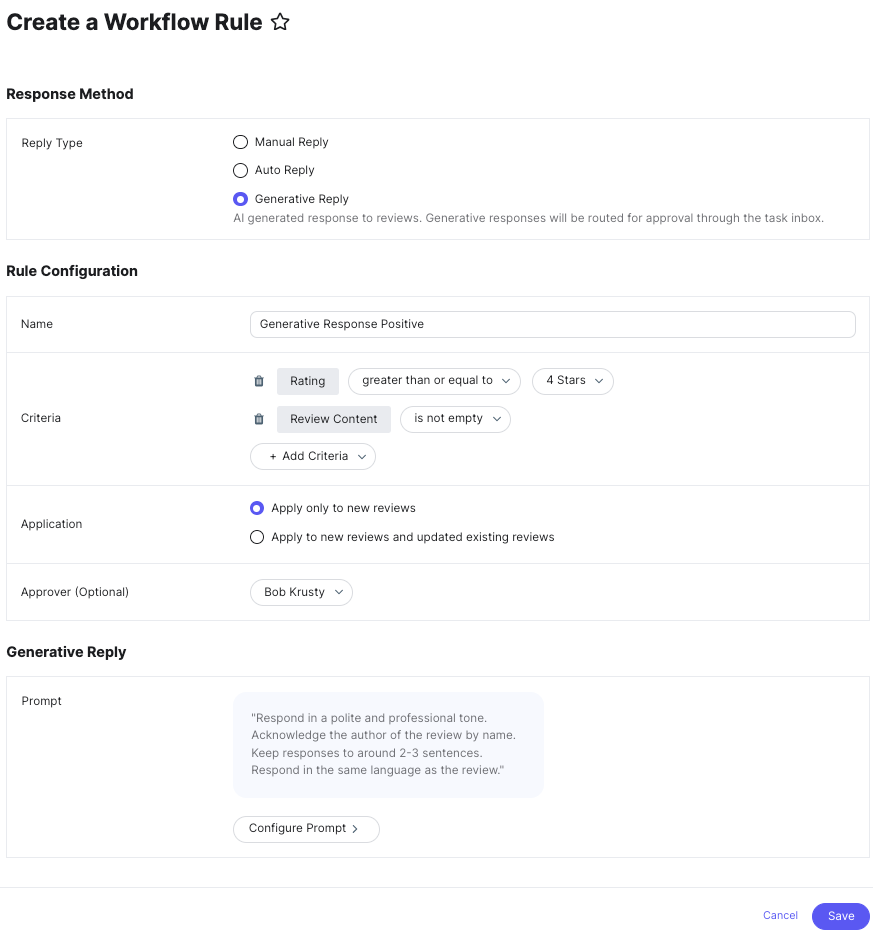
Review Monitoring pulls in reviews from across Yext's publisher network and provides filtering by star rating, date, language, and keywords. Review Response allows businesses to reply directly from the dashboard using manual responses, pre-approved templates, or AI-generated suggestions. Workflow rules can automatically assign reviews to specific team members based on criteria like star rating or location.
Source: Yext
Review Generation automates the process of requesting reviews through email, SMS, and QR codes. A "smart balancing algorithm" can direct customers to the review platforms that will have the most impact on the business's visibility. The platform also includes sentiment analysis using natural language processing to identify positive, negative, or neutral sentiment and recurring keywords.
For marketing purposes, businesses can embed review widgets on their websites.
Pages and Search: Building optimized web experiences powered by structured data.
Yext Pages enables businesses to create search-optimized landing pages at scale for locations, professionals, products, and events.
Built on a JAMstack framework, the pages pull content dynamically from the Knowledge Graph, so any update to business information is instantly reflected. A drag-and-drop Page Builder with a module library allows marketing teams to create and customize pages without developer support. Automatic schema markup, mobile optimization, and fast loading speeds are built in.
Yext Search (formerly Yext Answers) powers on-site search experiences using a multi-algorithm approach. It combines Named Entity Recognition for structured data, Semantic Text Search for semi-structured content like FAQs, and Extractive QA for pulling answers from unstructured documents.

Source: Yext
The federated architecture routes a single query across multiple data categories simultaneously, then ranks and aggregates the results. The platform also supports generative AI answers grounded in the brand's verified data from the Knowledge Graph, using a retrieval-augmented approach.
Where Yext Falls Short
While Yext excels as a comprehensive digital presence platform, several limitations become apparent for businesses whose primary focus is reputation management. These constraints reflect a platform optimized for breadth of coverage rather than depth in any single area.
Pricing Opacity and Cost Barriers: Yext does not publish pricing for its core packages on its website.
Prospective customers must go through a sales consultation to receive a quote, which creates friction in the evaluation process. While some standalone solutions (such as Search integrations) have published prices, the main listings and reviews bundles require direct engagement with sales.
For smaller businesses or those with limited budgets, the enterprise focus suggests costs that may be difficult to justify, especially when the primary need is review management rather than the full suite of listings, pages, and search tools.
Platform Complexity: Users frequently report a steep learning curve when getting started with Yext.
The platform's extensive feature set, while powerful, can feel overwhelming for teams that don't need all of its capabilities. Some users have described the interface as "confusing," and first-time users have reported spending significant time navigating the numerous settings and dashboards.
Review Management as One Module Among Many: Because Yext is built to manage an entire digital presence, its Reviews product is one piece of a larger platform rather than a dedicated focus area.
The sentiment analysis relies on NLP keyword and theme identification rather than more granular, aspect-based approaches that map feedback to custom business topics. Yext does offer Generative Review Response that leverages a business's own data and allows setting guidelines for tone and language. However, the review management experience is still designed as one component within a much larger platform, rather than being the central product focus.
This matters because reviews function as a conversion gate: prospective customers read them before making purchasing decisions, and the response is the only part a business controls. When review responses are generic, the typical "thanks for your review" reply, they waste that opportunity and give readers nothing useful.
For businesses that see every response as a chance to market themselves and win the next customer, the depth of the review management tooling matters as much as its existence.
Inconsistent Customer Support: A recurring theme in user feedback is mixed experiences with customer support. Some users praise responsive assistance, while others report unresponsiveness, frequent changes in account representatives, and difficulty resolving issues after signing a contract.
These limitations are the natural result of building a platform that covers the full spectrum of digital presence management. But for businesses whose core priority is turning customer reviews into actionable insights and growth opportunities, they highlight a gap that more focused tools are designed to fill.
Top Yext Alternative for Reputation Management: RightResponse AI
RightResponse AI addresses the depth gap in Yext's review management capabilities by focusing exclusively on AI-powered reputation management.
Launched in 2024 by George Swetlitz (former CEO of a healthcare clinic network with over 200 locations), Shiv Pujan Singh, and Sabrina Hu, the platform was built from the ground up with generative AI at its core. Swetlitz's experience managing online reputation across hundreds of locations directly informed the product's design, the central premise being that review response quality is a growth lever most businesses underutilize.
Intelligent Review Response: Three pillars of personalization that turn responses into conversion assets.
RightResponse AI's approach to review response is built on the idea that every reply is a marketing opportunity.
When a prospective customer is comparing two businesses with similar ratings and review volume, the one with richer, more specific responses wins their attention. Generic "thanks for your review" replies waste that space; responses that actually say something useful give the business a competitive edge.
The platform achieves this through three personalization pillars that work together:
Facts define what to say.
Businesses build a Fact Library containing key information: unique selling propositions, operational details, current promotions, and values. During onboarding, the platform reads existing reviews, past responses, and the business website to help create an initial set of facts, identifying the most important themes in the business's reviews and mapping relevant facts to each.
When a customer leaves a review, the AI matches the review content with relevant facts and weaves them naturally into the response. For example, if someone complains about pricing at a restaurant, the response can mention that the restaurant uses organic, locally-sourced ingredients, addressing the concern while reinforcing brand positioning.
Customizations define how responses should behave.
These are rules and behavioral controls: how to handle greetings (including whether to use a reviewer's name based on whether it appears to be a real name), how to structure closings, how to handle edge cases like review updates or mismatches between a review's star rating and its text, and what contact information to include.
For medical businesses, these rules include scanning reviews for protected health information and excluding it from responses to support HIPAA compliance.
Brand Voice defines how responses should sound.
Businesses configure the tone, style, and personality so that every response feels consistent with their brand, whether that's warm and casual for a neighborhood restaurant or professional and measured for a financial services firm.
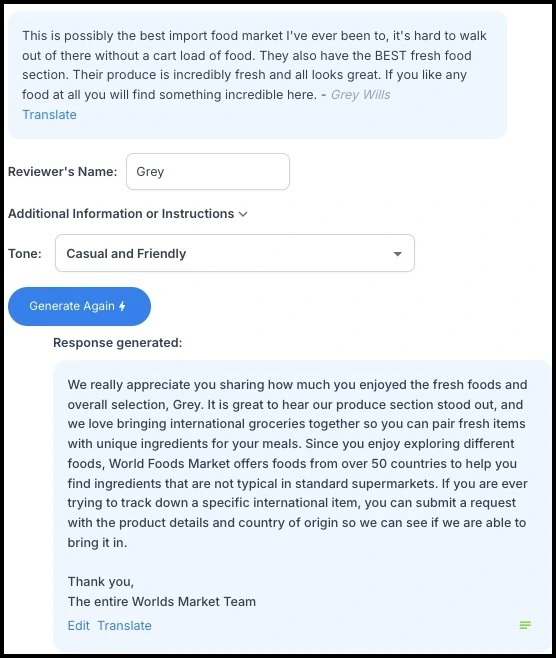
The three pillars work together to produce responses with endless variation that never lose brand alignment or control. The platform also shows users which facts were used in each response and which were available but unused, so they can swap in more relevant messaging if needed. Responses can be auto-published for certain review types (e.g., 4- and 5-star reviews) while others are held for manual approval.
Intelligent Review Requester: AI-powered review collection that maximizes every opportunity.
Beyond response quality, RightResponse AI includes a full review collection system, because getting more reviews matters alongside responding to them well.
The platform offers both template-based requests and AI-powered personalized requests.
The AI mode generates hyper-personalized messages using customer data, names, service details, dates, and interaction history, so the request feels specific rather than generic. Businesses can attach photos (particularly useful in home services and real estate, where a completed project photo reminds the customer of the work done), and add guiding questions that give reviewers inspiration about what to write, resulting in more detailed, varied review content.

Requests can be sent via email and SMS. Contact data can be sourced through direct entry, file uploads, remote Google Sheets, Zapier integrations, and custom APIs. An employee attribution system tracks review generation at the individual level; each team member gets a personalized QR code, and the platform monitors when a click leads to a completed review, enabling performance tracking and incentive programs.
For businesses that need persistence, the platform supports unlimited follow-up requests; users can configure as many follow-ups as their industry warrants.
Voice of the Customer: Customized aspect-based analysis that reveals the "why" behind ratings.
RightResponse AI uses a customized version of aspect-based sentiment analysis (ABSA) combined with generative AI.
Rather than providing a single positive or negative score for an entire review, the system breaks each review down to identify the specific topics customers are discussing and assigns sentiment to each one individually.
Businesses define and customize the topics the AI tracks, aligning the analysis with how they think about their own operations. A restaurant might track topics like "food quality," "wait times," "staff friendliness," and "ambiance." The system then maps customer feedback to these categories, extracting the exact phrases that correspond to each topic.
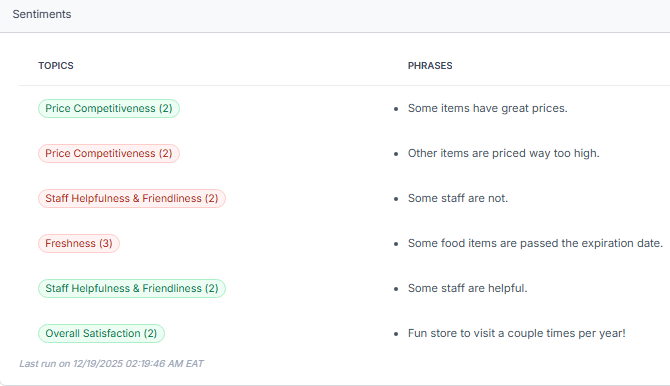
The platform filters out vague or irrelevant content to focus on genuine experience-based feedback. Results are visualized in interactive dashboards that allow businesses to track sentiment by topic and location over time. The same analysis can be applied to competitor reviews, providing a direct, side-by-side comparison on the same topics.
Google Maps Rank Tracking and Competitor Intelligence: A street-level view of local visibility.
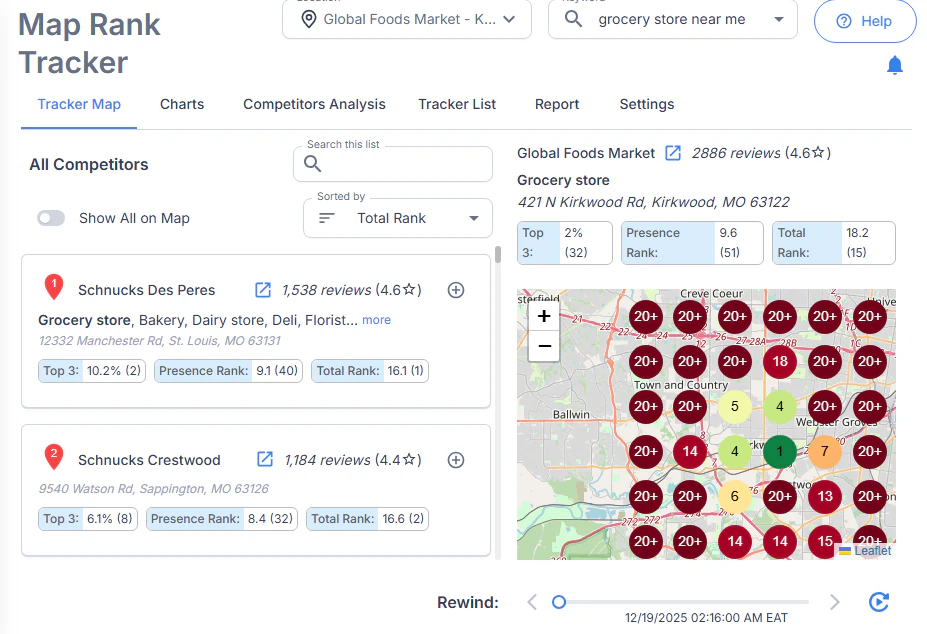
RightResponse AI’s Map Rank Tracker creates a customizable grid around a business's location and simulates Google Maps searches from each point. This provides a visual representation of where the business ranks for specific keywords across different geographic areas, revealing both strengths and blind spots in local search visibility.
Key metrics tracked include Top 3% (how often the business appears in the top three local results), Presence Rank (visibility across the grid), and Total Rank (average ranking across all points). Users can click on any grid point to see which businesses rank in that specific area.
A distinctive feature is "Rewind," which saves all previous scans and lets users replay how rankings have changed over time across the grid. The competitor analysis goes beyond rank comparison to include review volume, average ratings, response rates, and sentiment analysis of competitors' reviews using the same ABSA framework.
Flexible Pricing: Quality-first reputation management for businesses of all sizes.
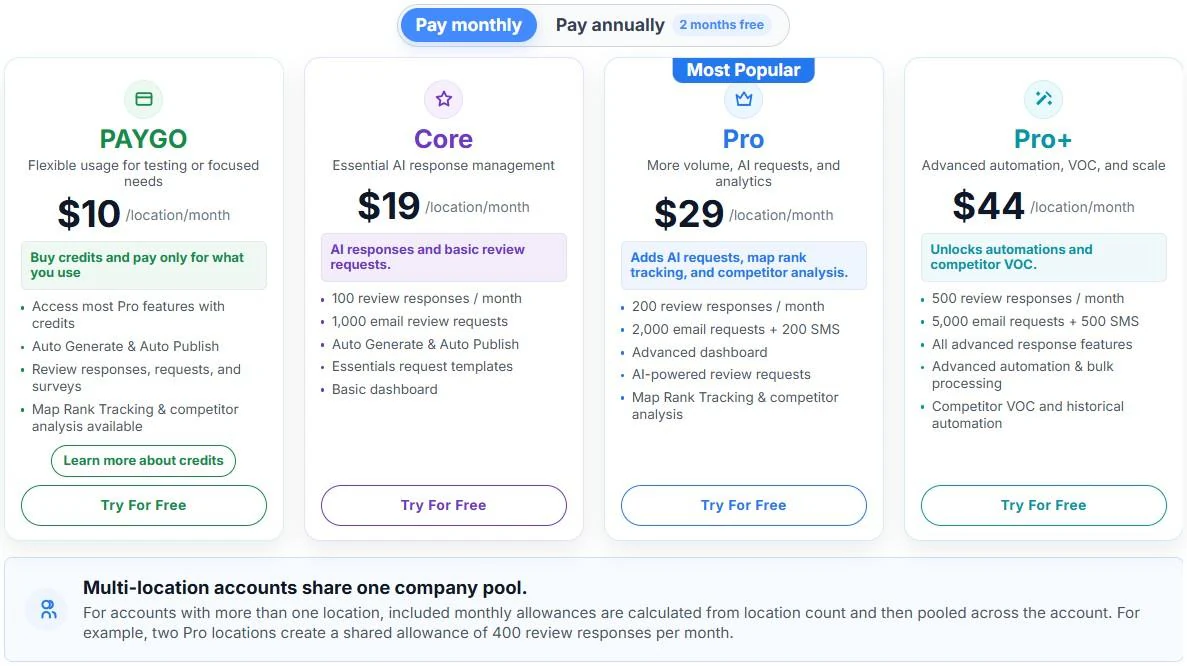
RightResponse AI charges a base fee of $10 per month per location on its Pay As You Go (PAYGO) plan, a usage-based option best for businesses that are just starting out, running low review volume, or with narrow needs.
Most businesses, though, will choose one of three fixed monthly plans, each with predictable per-location allowances:
- Core ($19/month) covers 100 review responses, 1,000 email review requests, Essentials request templates, and a basic dashboard, but no SMS, surveys, or map rank tracking.
- Pro ($29/month, the most popular tier) raises that to 200 review responses, 2,000 email requests plus 200 SMS, 200 surveys, AI-powered review requests, and Map Rank Tracking with competitor analysis (10 scans per month) on an advanced dashboard.
- Pro+ ($44/month) scales up to 500 review responses, 5,000 email requests plus 500 SMS, 500 surveys, advanced automation and bulk processing, Competitor Voice of the Customer, and 25 map-rank and competitor scans per month.
- For agencies and large multi-location brands, custom Enterprise plans add white-label, API access, and advanced reporting.
On the PAYGO plan, credit costs are straightforward: 20 credits per review response, 20 credits per sentiment analysis, 2 credits per email review request, and 1.5 credits per map rank tracker pin. A 7-day free trial includes 1,000 usage credits and access to most Pro features, with no credit card required.
The PAYGO model means businesses pay for what they actually use rather than being locked into flat per-location rates regardless of review volume, a common friction point with broader platforms.
For a location receiving 10 reviews per month on PAYGO, the total cost for responses and sentiment analysis comes to roughly $14 per location. This makes the platform accessible to smaller businesses while scaling cleanly for agencies and multi-location brands. Enterprise plans with custom pricing serve agencies and large multi-location businesses, adding API access, customized reporting, and custom AI workflows.
From a single-location business to a 200-location franchise, there's a plan to match, with higher tiers unlocking more usage and more sophisticated features.
Source: RightResponse AI
Yext or RightResponse AI: Comparison Summary
Yext | RightResponse AI | |
|---|---|---|
Primary focus | Comprehensive digital presence management | AI-powered reputation management |
Target audience | Heavily weighted toward mid-to-large enterprises (50+ locations), though smaller plans exist | Location-based businesses of all sizes, from single location to enterprise |
Review response AI | ⭐⭐⭐ AI suggestions, templates, and generative responses with tone/language guidelines | ⭐⭐⭐⭐⭐ Three-pillar system (Facts, Customizations, Brand Voice) producing responses that actively market the business |
Review collection | ⭐⭐⭐⭐ Email, SMS, QR codes with smart balancing algorithm | ⭐⭐⭐⭐ AI-personalized requests with photos, guiding questions, and employee attribution |
Sentiment analysis | ⭐⭐⭐ NLP keyword and theme identification | ⭐⭐⭐⭐⭐ Customized aspect-based (ABSA) with phrase extraction per topic |
Listings management | ⭐⭐⭐⭐⭐ 200+ publisher integrations | Not a core feature |
Google Maps rank tracking | Not included (competitive intelligence add-on available) | ⭐⭐⭐⭐⭐ Grid-based tracking with "Rewind" |
Website pages and search | ⭐⭐⭐⭐⭐ Pages, on-site search, Knowledge Graph | Not included |
Competitor review analysis | ⭐⭐⭐ Review ratings comparison | ⭐⭐⭐⭐⭐ Full sentiment analysis of competitor reviews |
Pricing transparency | Limited public pricing; sales consultation required for core packages | Core $19, Pro $29, Pro+ $44/mo fixed plans, plus $10/location PAYGO and custom Enterprise |
Free trial | Available for select products | 7-day trial with 1,000 free credits |
Learning curve | Steep; extensive platform to master | Minimal; focused feature set |
Best for | Enterprise digital presence at scale | Deep reputation management and review intelligence at any scale |
Final Verdict
The choice between Yext and RightResponse AI depends on the scope of what you need to manage and where your primary focus lies.
Choose Yext if you need a unified platform to control your brand's entire digital presence across listings, web pages, on-site search, and reviews.
Its focus leans toward mid-to-large enterprises with dedicated marketing teams and the budget to invest in comprehensive digital infrastructure, though smaller plans are available. The Knowledge Graph, extensive publisher network, and AI-powered search tools provide a foundation for managing how your brand appears everywhere customers look, from Google Maps to voice assistants to your own website.
Choose RightResponse AI if review response quality is a priority, not just responding to reviews, but turning every response into a conversion asset that markets your business to prospective customers.
The three-pillar personalization system (Facts, Customizations, Brand Voice) produces responses that are substantively different from the generic AI output most platforms deliver, while the platform's review collection, Voice of the Customer, map rank tracking, and competitor intelligence round out a full reputation management toolkit.
It serves location-based businesses of all sizes, from single locations to multi-location enterprises, and its flexible pricing, from fixed monthly plans to pay-as-you-go, means you pay for the capacity you need rather than committing to more than you'll use.
Get started with RightResponse AI's free trial here.
Both platforms serve their audiences well. Yext provides the infrastructure for enterprises to manage their digital presence at scale, while RightResponse AI gives businesses the specialized quality and intelligence to understand, respond to, and grow from every customer interaction.
Frequently Asked Questions
When should I choose Yext for my business?
Choose Yext if you need a unified platform to control your brand's entire digital presence across listings, web pages, on-site search, and reviews. Its focus leans toward mid-to-large enterprises with dedicated marketing teams and the budget to invest in comprehensive digital infrastructure. The Knowledge Graph, extensive publisher network with 200+ integrations, and AI-powered search tools provide a foundation for managing how your brand appears everywhere customers look.
When is RightResponse AI a better choice than Yext?
Choose RightResponse AI if review response quality is a priority — not just responding to reviews, but turning every response into a conversion asset that markets your business to prospective customers. The three-pillar personalization system (Facts, Customizations, Brand Voice) produces responses that are substantively different from generic AI output, while the platform's review collection, Voice of the Customer, map rank tracking, and competitor intelligence round out a full reputation management toolkit. It serves location-based businesses of all sizes, with a Pay As You Go (PAYGO) plan starting at $10/month per location plus fixed monthly plans (Core $19, Pro $29, Pro+ $44) and custom Enterprise pricing.
What are the main differences between Yext and RightResponse AI?
The main differences include: Primary focus (Yext covers comprehensive digital presence management vs RightResponse AI focuses on AI-powered reputation management), review response quality (Yext offers AI suggestions and templates vs RightResponse AI uses a three-pillar system producing marketing-quality responses), sentiment analysis (Yext uses NLP keyword identification vs RightResponse AI provides Voice of the Customer using customized aspect-based (ABSA) analysis), pricing (Yext requires sales consultation vs RightResponse AI offers a $10/month-per-location PAYGO plan plus fixed monthly plans from $19), and scope (Yext includes listings, pages, and search vs RightResponse AI focuses on review response, collection, sentiment, and local rank tracking).
Can I try RightResponse AI before committing?
Yes, RightResponse AI offers a 7-day free trial with 1,000 usage credits and access to most Pro features, with no credit card required. RightResponse AI's Pay As You Go (PAYGO) plan starts at $10/month per location, with fixed monthly plans (Core $19, Pro $29, Pro+ $44) and custom Enterprise pricing also available, so there is no large upfront commitment required.
Try RightResponse AI for Free!
*No credit card required.