NiceJob has built a solid reputation as a review generation tool for small, service-based businesses. Its core promise is straightforward: automate the process of asking customers for reviews, then turn those reviews into marketing assets through social proof, referrals, and social sharing. For busy business owners who simply need more reviews with minimal effort, it generally delivers on that promise.
Comparison research: This article is part of the RightResponse AI review management software comparison library, which connects platform reviews, pricing analyses, alternatives, and head-to-head evaluations.
To write this NiceJob review, I've analyzed the platform extensively. I believe it's the ideal choice if:
- You run a local service business and need to significantly increase your review volume
- You want a "set it and forget it" tool that automates review requests and follow-ups
- You value simplicity and ease of use over analytical depth
- You want to turn positive reviews into social media content and website widgets
- You need referral and repeat booking automation alongside review collection
However, NiceJob might not be the best choice if:
- You want every review response to actively market your business to the prospective customers reading it
- You need AI-powered, personalized responses that go beyond generic thank-you replies
- You want deep Voice of the Customer analysis that reveals the specific drivers behind your ratings
- You need to track and benchmark your performance against local competitors at a granular level
- Google Maps visibility and local search ranking are critical to your growth
In this case, you should consider RightResponse AI: a reputation management platform built with generative AI at its core. RightResponse AI treats the review response itself as a conversion opportunity, because when prospective customers compare businesses, the response is the only part the business controls. Beyond response quality, it also includes its own AI-powered review collection system, Voice of the Customer, Google Maps rank tracking, and competitor intelligence.
Because of that, I've included a detailed look at RightResponse AI later in this NiceJob review, as the best alternative for businesses that want their reputation management to actively drive growth, not just accumulate reviews. If you're ready to explore a quality-first approach to reputation management, you can start with RightResponse AI's free trial here.
Table of contents:
- What is NiceJob?
- NiceJob Pros & Cons
- NiceJob Review: How it Works & Key Features
- Where NiceJob Falls Short
- Top NiceJob Alternative: RightResponse AI
- NiceJob or RightResponse AI: Comparison Summary
- Final Verdict
What is NiceJob?
NiceJob is a cloud-based reputation marketing platform founded in 2017 by Lars Kristensen.
Kristensen, who comes from an advertising background, created NiceJob after observing that well-funded companies could outrank businesses with superior customer service. His goal was to level the playing field by helping those businesses gather and market customer reviews more effectively.
In October 2021, NiceJob was acquired by Paystone, a Canadian provider of payment and customer engagement solutions. Following the acquisition, Kristensen assumed the role of Chief Product Officer at Paystone, and NiceJob continues to operate as part of Paystone's broader platform for customer-driven growth. As of the acquisition, Paystone (including NiceJob) served over 30,000 businesses.

The platform positions itself as an all-in-one reputation marketing tool that helps businesses get more reviews, showcase social proof, automate referrals, and drive repeat bookings. NiceJob is particularly well-suited for local, service-based businesses in industries like home services (HVAC, plumbing, landscaping), professional services (real estate, accounting), health and wellness, and contractors who rely on word-of-mouth and online reviews to attract new customers.
NiceJob Pros & Cons
Pros | Cons |
|---|---|
✅ Easy to set up and use with minimal technical expertise | ❌ Pricing can be high for some small businesses ($75-$125/month) |
✅ Effective automation helps increase review volume | ❌ Basic reporting and analytics capabilities |
✅ Strong integrations with CRMs like Jobber, HouseCall Pro, QuickBooks | ❌ Limited customization for review request templates |
✅ "Stories" feature turns reviews into visual marketing content | ❌ Multi-location management can feel clunky |
✅ Responsive and helpful customer support | ❌ AI review responses don't incorporate business-specific messaging |
✅ No long-term contracts required | ❌ Competitor insights limited to review-level data (no sentiment depth) |
✅ 14-day free trial with no credit card required | ❌ No Google Maps rank tracking |
NiceJob Review: How it Works & Key Features
Review Collection: NiceJob automates the entire process of asking customers for reviews and following up until they respond.
NiceJob's core strength is its automated review invitation system.
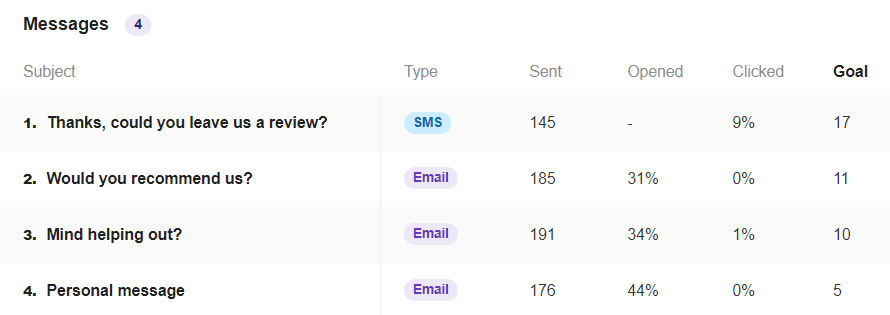
The platform integrates with business management software like Jobber, HouseCall Pro, QuickBooks, and HubSpot. When a job is marked as complete or an invoice is paid in the connected software, NiceJob automatically sends a review invitation to the customer via SMS (or email if no mobile number is available).
Source: NiceJob
If the customer doesn't respond to the initial invitation, the system sends a series of up to three follow-up emails over a 14-day period. These follow-ups are pre-written and performance-tested, though businesses can customize the messaging. Once a customer leaves a review, NiceJob's "Customer Matching" software detects the review and automatically removes the customer from the campaign.
NiceJob uses a "smart review funnel" to direct customers to the review sites where their feedback will have the most impact, such as Google and Facebook. For businesses that don't use a compatible CRM, customer information can be entered manually to trigger the campaigns.
Social Proof: NiceJob turns positive reviews into marketing assets for your website and social media.
The social proof capabilities go beyond simple review display.
NiceJob offers embeddable widgets that automatically publish new positive reviews to a business's website. The primary "Stories" widget displays reviews in grid or single-column formats, and businesses can set a minimum star rating to control which reviews appear.
The "Engage" widget adds real-time pop-up notifications showing recent reviews and customer bookings, creating a sense of activity and credibility for website visitors. For social media, NiceJob can automatically share positive reviews to Facebook, LinkedIn, and Twitter, with manual sharing available for Instagram. Users can customize the background, caption, and highlighted snippets for each shared post.
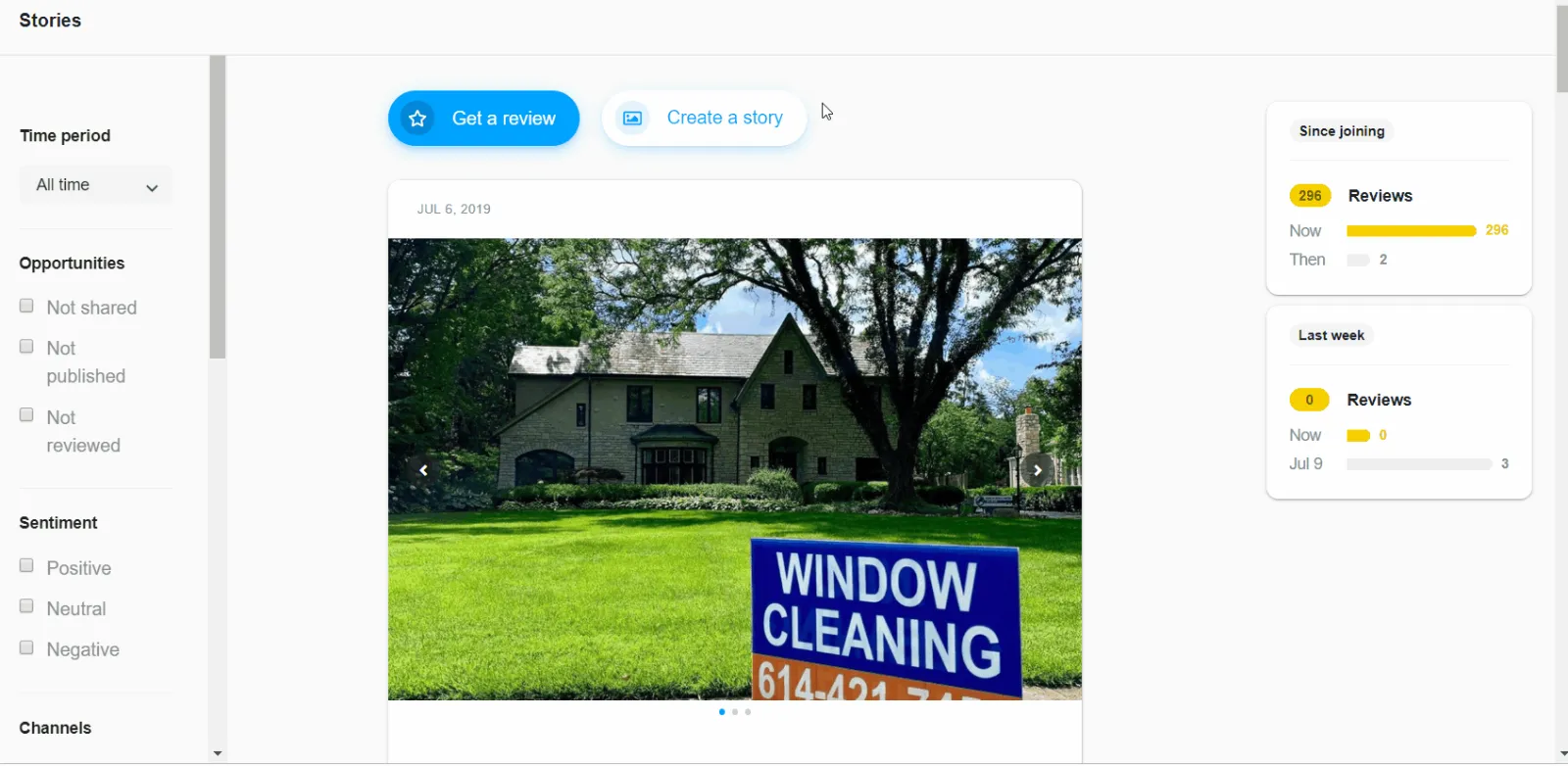
The "Stories" feature is a standout: it combines customer reviews with photos of completed work to create visual testimonials. These can be created by the business (uploading a photo before the review invitation) or by attaching photos to existing reviews. The result is a more compelling piece of content than a text-only review.
Source: NiceJob
Referrals and Repeat Business: NiceJob extends beyond reviews to drive new leads and repeat bookings.
NiceJob’s referral system is available on the Pro plan ($125/month) and works by automatically enrolling customers who leave positive reviews into a referral campaign.
Enrolled customers receive a personalized referral link they can share with friends and family. When someone clicks the link, they see the original customer's positive review as social proof and can submit their contact information to become a new lead.
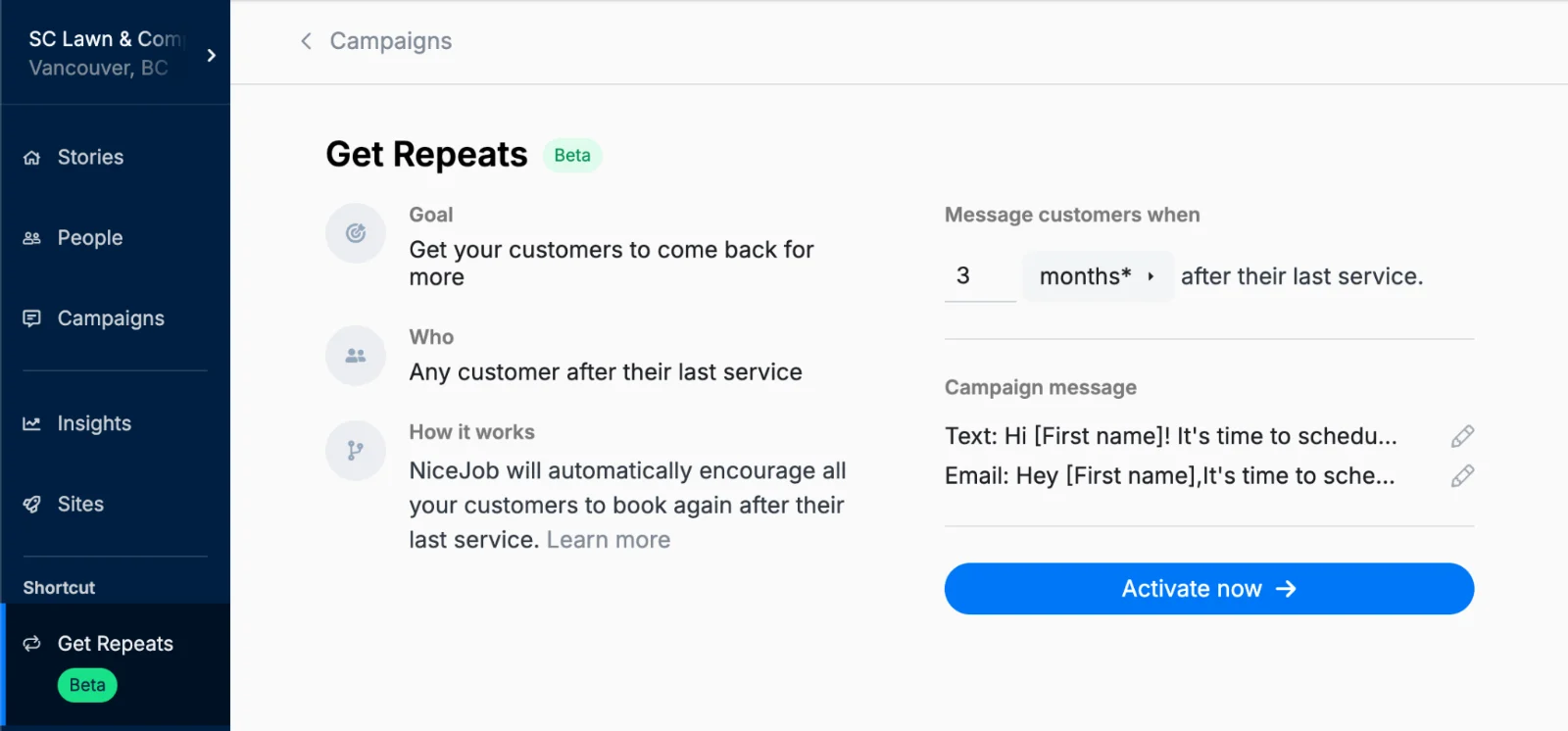
The "Repeats" feature, also on the Pro plan, automates re-engagement with past customers. Businesses define the typical service cycle for their industry (for example, every six months for window cleaning), and NiceJob automatically sends personalized booking reminders via SMS and email when the customer is due for their next service. One case study highlighted a business saving over 60 hours per month on follow-ups and generating an additional $20,000 in monthly revenue.
Source: NiceJob
Insights and Reporting: NiceJob provides a dashboard for monitoring review performance, topics, and team activity.
NiceJob’s Insights feature offers a performance dashboard showing total reviews, average star ratings, and campaign analytics.
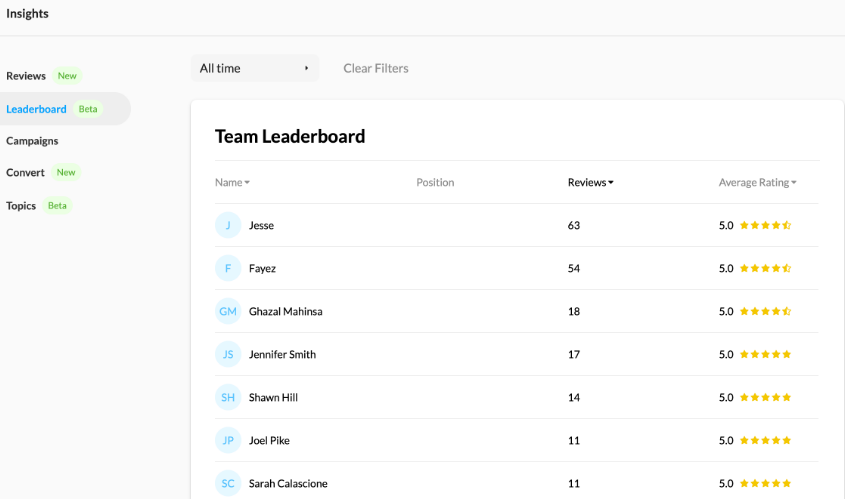
The "Topics Tracking" capability uses machine learning to identify frequently mentioned themes in customer reviews, categorized by positive and negative sentiment. A "Team Leaderboard" ranks employees based on the number and quality of reviews they're mentioned in.
Source: NiceJob
For businesses using NiceJob's website builder ("Sites"), the "Sites Insights" dashboard tracks website visitors, leads, and conversion rates against industry averages. Competitor Insights, available on the Pro plan, allows businesses to track competitors' total reviews, average ratings, review velocity, and AI-derived topic comparisons.
NiceJob also offers a "Sites" service ($99/month plus a $199 setup fee): a done-for-you website building service that integrates reviews and social proof directly into the design. The service includes custom design, SEO optimization, and a guarantee of 10% more website sales or the service is free.
Where NiceJob Falls Short
While NiceJob excels at generating reviews and turning them into marketing content, several limitations become apparent for businesses that need more than volume. These limitations reveal a platform optimized for review collection and sharing rather than for turning reviews into a strategic growth tool.
Review Responses That Don't Market Your Business: For location-based businesses, reviews function as a conversion gate; prospective customers read them when deciding between you and a competitor.
The review response is the only part of that interaction the business controls, which makes it a direct opportunity to reinforce your positioning and give prospects a reason to choose you. NiceJob does offer AI-generated replies to reviews with tone and length customization and optional auto-posting.

Source: NiceJob
However, the responses don't incorporate business-specific messaging; they can't weave in facts about your services, address the specific concern a reviewer raised with a relevant detail about your business, or actively market what makes you different.
Most prospective customers skip over generic responses because there's nothing worth reading. For businesses that want every response to work as a conversion touchpoint, this represents a missed opportunity.
Surface-Level Analytics: NiceJob's reporting provides useful top-level metrics, but businesses looking for deeper insights will find the analytics lacking.
The Topics Tracking feature identifies what customers mention and classifies topics as positive or negative, but it doesn't provide the granular, aspect-based sentiment analysis needed to understand precisely why customers feel the way they do about specific parts of the business.
For example, knowing that "staff" is a frequently mentioned positive topic is helpful; knowing that 87% of staff-related comments specifically praise responsiveness while 13% mention wait times is actionable. NiceJob stays at the first level.
Limited Depth in Competitor Monitoring: The Competitor Insights feature tracks review counts, ratings, review velocity, and AI-derived topic comparisons for competitors, which offers a useful benchmark.
However, it doesn't provide the same depth of aspect-based sentiment analysis that would allow businesses to deeply compare how their customers' experiences stack up against competitors on specific operational dimensions. For businesses in competitive local markets, this may not be enough to fully inform a differentiation strategy.
No Local Search Rank Tracking: For location-based businesses, Google Maps visibility directly correlates with customer acquisition.
NiceJob doesn't offer any tools to monitor where a business ranks in Google Maps for relevant keywords, track how rankings change over time, or understand which competitors are outranking them in specific geographic areas. This is a significant gap for businesses where local search performance is a primary growth driver.
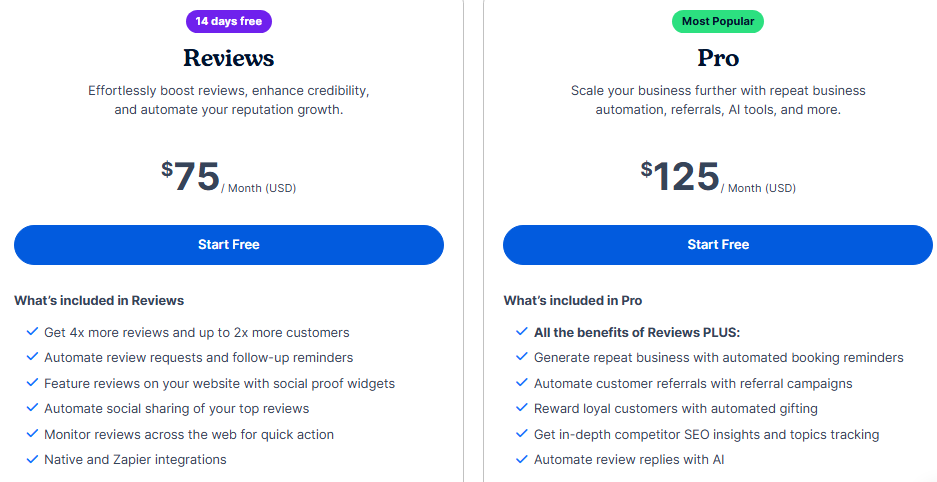
Pricing That Adds Up: At $75/month for the Reviews plan and $125/month for Pro (which adds referrals, repeats, and competitor insights), NiceJob's costs can be notable for small businesses.
The "Sites" website builder adds another $99/month plus setup fees. While there are no long-term contracts, businesses that need the full feature set may find themselves spending over $200/month before considering any additional landing pages or CMS add-ons.
Source: NiceJob
These limitations aren't oversights. They reflect NiceJob's deliberate focus on being a straightforward review generation and marketing tool. But for businesses that want their review responses to actively drive new customers and their reputation data to inform growth decisions, they point to a clear gap.
Top NiceJob Alternative: RightResponse AI
RightResponse AI takes a fundamentally different approach to reputation management.
Launched in 2024 by George Swetlitz, Shiv Pujan Singh, and Sabrina Hu, the platform was built with generative AI at its core. Swetlitz, formerly the CEO of a healthcare clinic network with over 200 locations, experienced firsthand the challenge of managing high volumes of customer feedback and recognized that businesses needed more than review collection; they needed every review response to serve as a conversion asset.
The platform serves all location-based businesses regardless of size, from single-location operations to enterprise. It also includes a sophisticated AI-powered review collection system, but its core differentiator is what happens after the review comes in: the quality of the response and its ability to actively market the business to prospective customers.
Intelligent Review Responses: RightResponse AI crafts personalized, fact-infused replies that turn every response into a conversion opportunity.
The review response system is RightResponse AI’s flagship capability, built on the principle that reviews are the conversion gate where prospective customers decide between you and a competitor, and the response is the only part you control.
Rather than producing generic thank-you replies that prospective customers skip over, RightResponse AI uses a three-pillar personalization system to make every response worth reading:
- Facts (what to say): During onboarding, the platform reads all existing reviews, responses, and the business website to build a "Fact Library" of business-specific messaging. It identifies the most important themes in reviews and maps relevant facts to each theme. When a customer leaves a review, the AI matches review content against the relevant theme and selects which facts to weave into the response. The system shows users which facts were used and which weren't, so they can make adjustments, and changes roll forward immediately.
- Customizations (how to behave): Behavioral rules and controls that govern how the AI responds in specific situations: which star ratings to auto-publish, how to handle negative reviews, and what edge cases to flag for human review.
- Brand Voice (how to sound): Tone and style settings that range from formal to casual, with customizable greetings and closings, ensuring every response sounds like it came from the business.
All three pillars work together to produce hyper-personalized, brand-aligned responses with endless variation, without losing control.
The result is responses that actively market the business. For example, instead of a generic "Thanks for your review," a response to a positive restaurant review might read: "Glad you enjoyed the steaks. Did you know we have the best mezcal bar in San Francisco?" That kind of response gives a prospective customer reading reviews a reason to visit, which is the entire point.

Under the hood, the platform uses an agentic AI pipeline that separates analytical functions from writing functions. The system analyzes the review first, detecting context, examining reviewer names for authenticity, identifying employee names mentioned, handling edge cases like review updates and rating/text mismatches, and only then passes the analysis to the writing engine.
For medical practices, the pipeline includes PHI (Protected Health Information) detection to help maintain HIPAA compliance. This separation reduces the risk of the AI generating inappropriate responses while increasing relevance.
Review Collection: RightResponse AI pairs AI-powered review requests with tools designed to maximize both volume and quality.
While the response system is the core differentiator, RightResponse AI also includes a full review collection toolkit. The platform offers two modes:
- Essentials Mode: A simple, template-based system with pre-built templates. Businesses turn it on and it runs automatically; similar to NiceJob's approach, and ideal for teams that want straightforward automation.
- Pro Mode: An AI-powered mode that generates highly personalized requests by incorporating customer data like name, service history, tenure as a customer, and recent transactions. For example: "Hey Jim, your technician really enjoyed your visit. We love servicing your two air conditioners. We really value the fact that you've been a customer for six years." Requests can include photos, which are particularly useful in real estate and home services; customers can download and upload the photo to their review.

Several features set the review collection system apart:
- Guiding questions that give reviewers inspiration about what to write. Questions rotate and change so reviews contain varied, SEO-relevant content.
- Unlimited follow-up requests. Users configure as many follow-ups as they need; seven for a roofer, fewer for a lawyer. This contrasts with NiceJob's system, which caps follow-ups at three over 14 days.
- Employee-level QR codes. Each server, technician, or employee gets their own QR code on a card they can present to customers. The system tracks scans and monitors Google to credit the right employee when a review appears, enabling incentive programs tied to individual performance.
- Review grouping for multi-location businesses. An established business opening a new location can funnel review requests from existing locations into the new one to accelerate its review volume.
Review requests can be sent via email and SMS, with contact data sourced through direct entry, file uploads, remote Google Sheets, Zapier integrations, or custom APIs.
Voice of the Customer: RightResponse AI reveals exactly what drives customer ratings.
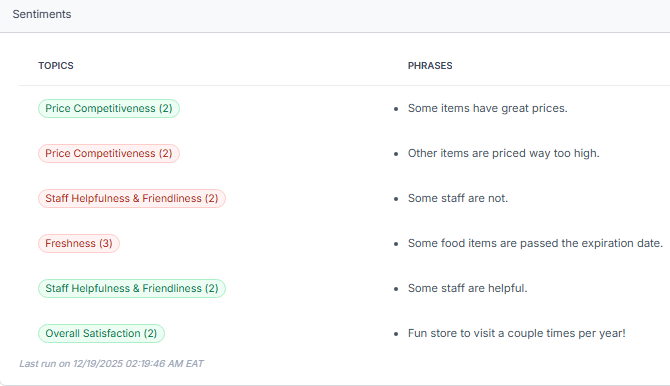
While NiceJob's Topics Tracking identifies what customers mention and classifies topics as positive or negative, RightResponse AI's Aspect-Based Sentiment Analysis (ABSA) goes deeper by assigning specific sentiment scores to each aspect of the business.
Businesses define the topics and categories they want to track, tailored to their operations. The AI then processes each review, identifying which aspects are mentioned and assigning sentiment to each one. For example, a restaurant might see that "food quality" has 92% positive sentiment while "wait times" sits at 64%. The system filters out vague or irrelevant content to focus on genuine, experience-based feedback.
Each topic comes with direct phrase extraction, allowing users to see the exact customer words behind the sentiment scores. Performance can be compared across locations, tracked over time to identify trends, and applied to competitor reviews for side-by-side benchmarking.
Google Maps Rank Tracking: RightResponse AI monitors local search visibility with a customizable geographic grid.
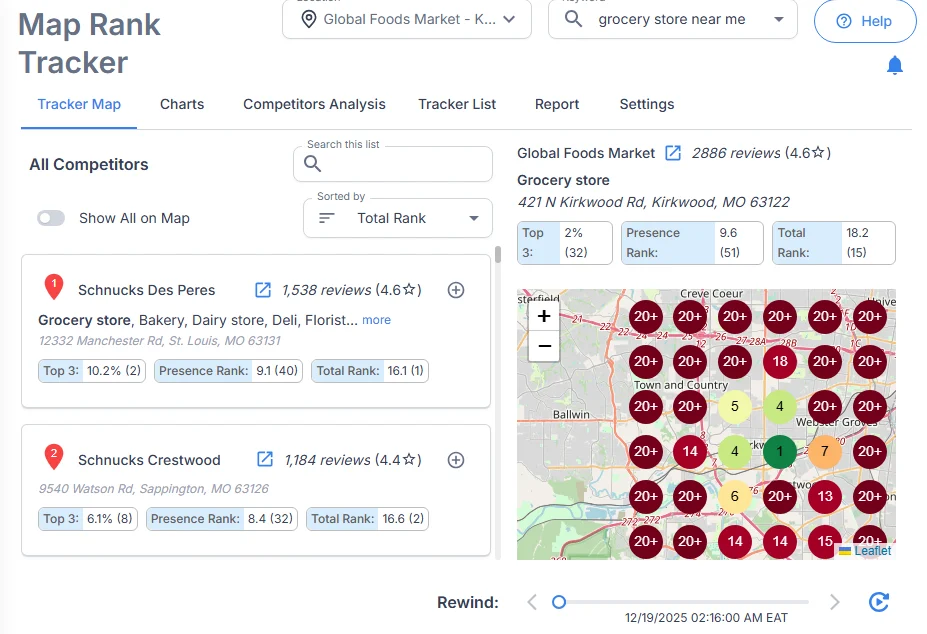
RightResponse AI’s Map Rank Tracker creates a grid of search points around a business's location and simulates Google Maps searches from each point. The result is a color-coded visual grid showing exactly where the business ranks for specific keywords across its service area.
Users can customize the grid size (such as a 7x7 grid), the scan frequency, and other parameters. Each grid point shows the business's ranking and lists the competitors that appear in that area. The "Rewind" feature allows users to replay historical scans to visualize how rankings have changed over time.
Key metrics include Top 3% (how often the business appears in the top three local results), Presence Rank (visibility across the grid), and Total Rank (average ranking across all points). The tool connects reputation management work directly to local visibility outcomes, because reviews drive search rankings, and this is where you measure the impact.
Competitor Intelligence: RightResponse AI applies the same analytical depth to competitors' reviews.
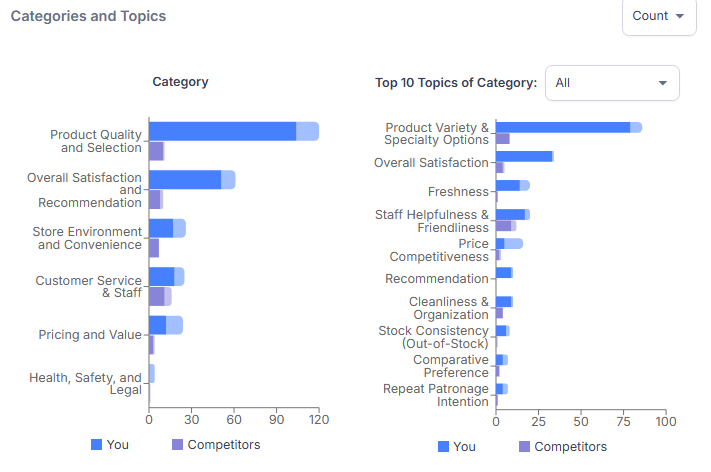
RightResponse AI’s CompetiWatch AI feature goes beyond tracking competitors' review counts and ratings. It applies the same AI-powered analysis to competitor reviews, including sentiment analysis by topic, review volume trends, response rates, and customer feedback themes.
Businesses can compare their sentiment scores against competitors on the same topics: if your "customer service" sentiment is at 88% positive and a competitor's is at 72%, that's a clear competitive advantage to leverage. The tool identifies emerging threats by monitoring changes in competitor review activity and engagement over time.
Additional Services and Tools: RightResponse AI offers more.
RightResponse AI also offers a Done-For-You service for businesses that want fully managed reputation management; the platform team handles monitoring, responding, requesting reviews, and even reporting negative reviews that violate platform guidelines.
The platform also provides a free AI review response generator on its website that any business can use at no cost, useful for trying the response quality before committing to the full platform.
Flexible Pricing: RightResponse AI offers both usage-based (PAYGO) and fixed monthly plans.
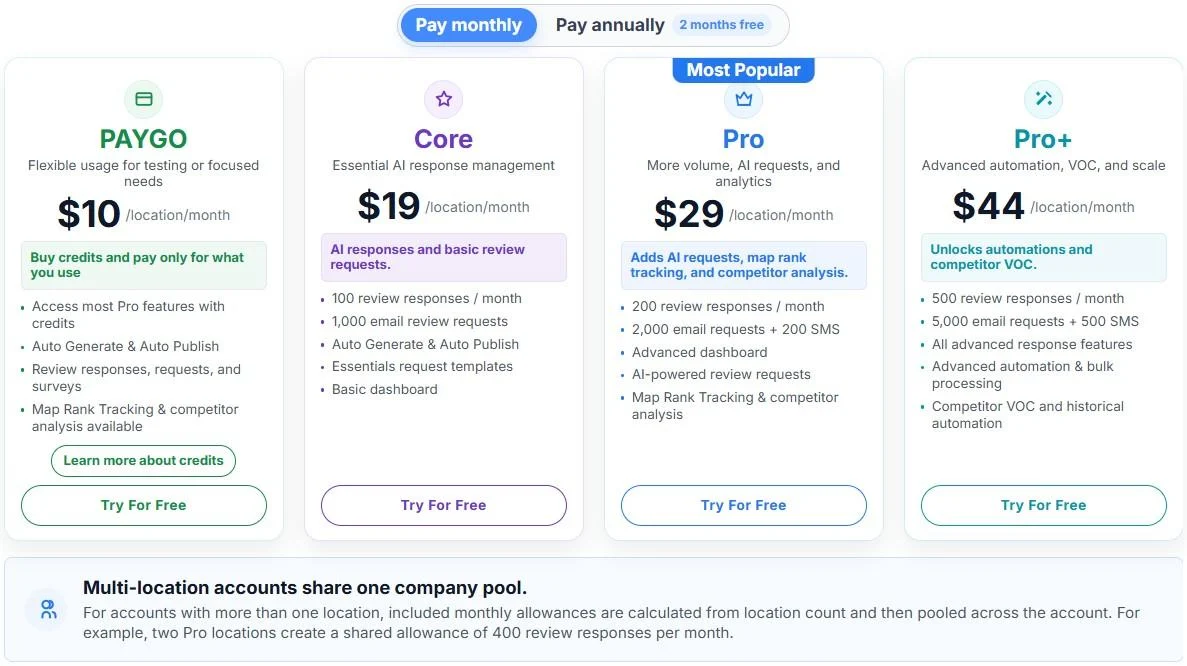
RightResponse AI uses a hybrid pricing model: the Pay As You Go (PAYGO) plan is $10 per month per location plus usage-based credits, with credits starting at $0.01 each for the first 3,000 and per-credit costs decreasing at higher volumes. For businesses that prefer predictable monthly billing, fixed plans are also available: Core at $19/month (around 1,000 invites) for review responses and simple review requests, Pro at $29/month (200 reviews, 200 SMS, 2,000 invites) adding AI-powered Pro requests, surveys, Voice of the Customer, and starter map rank tracking, and Pro+ at $44/month (500 reviews, 500 SMS, 5,000 invites) with all advanced features, including advanced automation, bulk processing, and Competitor Voice of the Customer. Enterprise plans are custom-quoted for agencies and large multi-location businesses, adding white-label, API access, and advanced reporting.
Feature costs include 20 credits per review response, 20 credits per sentiment analysis, 2 credits per email review request, and 1.5 credits per map rank tracker pin. For a business with 10 reviews per month that uses both response generation and sentiment analysis, total cost works out to approximately $14 per location, making it very competitive for lower-volume locations.
A 7-day free trial includes 1,000 usage credits and access to most Pro features, with no credit card required.
The usage-based model means businesses don't pay for capacity they don't use. Unlike flat-rate per-location pricing, agencies and multi-location brands can scale cleanly across accounts without the friction of rigid contracts or paying the same rate for a location that gets five reviews a month as one that gets 50.
Source: RightResponse AI
NiceJob or RightResponse AI: Comparison Summary
NiceJob | RightResponse AI | |
|---|---|---|
Primary focus | Review generation and reputation marketing | Review response quality and reputation intelligence |
Target audience | Small service-based businesses | Location-based businesses, regardless of size (single location to enterprise) |
Review collection | ✅ Automated invitations with smart funnel, up to 3 follow-ups | ✅ Essentials (template) + Pro (AI-personalized) modes, unlimited follow-ups, employee QR codes, guiding questions |
Review responses | ⭐⭐⭐ AI replies with tone/length customization | ⭐⭐⭐⭐⭐ Fact-infused, context-aware AI responses via Facts, Customizations, and Brand Voice |
Sentiment analysis | ⭐⭐ Topic identification with positive/negative classification | ⭐⭐⭐⭐⭐ Customizable Aspect-Based Sentiment Analysis with phrase extraction |
Competitor insights | ⭐⭐⭐ Review counts, ratings, velocity, and topic comparisons | ⭐⭐⭐⭐⭐ Full sentiment and review analysis of competitors |
Google Maps rank tracking | ❌ Not available | ⭐⭐⭐⭐⭐ Grid-based tracking with historical "Rewind" |
Social proof tools | ⭐⭐⭐⭐⭐ Website widgets, social sharing, "Stories" | ❌ Not a core feature |
Referral automation | ⭐⭐⭐⭐ Automated campaigns tied to positive reviews | ❌ Not available |
Repeat booking automation | ⭐⭐⭐⭐ Timed reminders based on service cycles | ❌ Not available |
Done-For-You service | "Sites" website builder ($99/month + setup) | Full-service reputation management (monitoring, responding, requesting, disputes) |
Ease of use | ⭐⭐⭐⭐⭐ Very intuitive, minimal learning curve | ⭐⭐⭐⭐ Intuitive with more depth to explore |
Pricing | $75-$125/month flat fee | PAYGO $10/location + credits, or Core $19, Pro $29, Pro+ $44/month |
Free trial | 14 days, no credit card | 7 days with 1,000 free credits |
Multi-location support | Basic, can be clunky | Designed for scale (single to 200+ locations) |
Best for | Building review volume and marketing social proof | Businesses that care about review response quality and its impact on growth |
Final Verdict
The choice between NiceJob and RightResponse AI comes down to what your business needs most from its reputation management: review volume and social proof, or review response quality and strategic intelligence.
Choose NiceJob if your primary challenge is getting more reviews and putting them to work as marketing assets.
It's built for service-based business owners who want to automate the review collection process, showcase positive feedback on their website and social media, and generate referrals and repeat bookings from satisfied customers.
The platform's simplicity is its strength: set up your integrations, let the automation run, and watch your review count grow. For businesses that are starting from a low review volume and need to build their online presence quickly, NiceJob provides a focused and effective toolkit.
Get started with NiceJob here.
Choose RightResponse AI if you want every review response to actively work for your business.
Prospective customers read reviews when deciding between you and a competitor; most skip over generic responses because there's nothing useful there. RightResponse AI's three-pillar system (Facts, Customizations, and Brand Voice) produces responses that are worth reading: specific, personalized, and designed to give the next customer a reason to choose you.
Beyond response quality, the platform also handles review collection with AI-powered personalization, tracks your Google Maps rankings, and provides deep Voice of the Customer analysis of both your reviews and your competitors'. It's designed for location-based businesses of any size that understand the impact reviews have on growth and want every piece of their reputation management to contribute to it.
Get started with RightResponse AI here.
NiceJob answers the question "How do I get more reviews?" RightResponse AI answers "How do I make every review, and every response, drive my next customer?" Your choice depends on which question matters more to your business right now.
Frequently Asked Questions
When should I choose NiceJob for my business?
Choose NiceJob if your primary challenge is getting more reviews and putting them to work as marketing assets. It's built for service-based business owners who want to automate the review collection process, showcase positive feedback on their website and social media, and generate referrals and repeat bookings from satisfied customers. The platform's simplicity is its strength: set up your integrations, let the automation run, and watch your review count grow. For businesses starting from a low review volume and needing to build their online presence quickly, NiceJob provides a focused and effective toolkit.
When is RightResponse AI a better choice than NiceJob?
Choose RightResponse AI if you want every review response to actively work for your business. Prospective customers read reviews when deciding between you and a competitor — most skip over generic responses because there's nothing useful there. RightResponse AI's three-pillar system (Facts, Customizations, and Brand Voice) produces responses that are specific, personalized, and designed to give the next customer a reason to choose you. Beyond response quality, the platform handles review collection with AI-powered personalization, tracks Google Maps rankings, and provides deep Voice of the Customer analysis of both your reviews and your competitors'.
What are the main differences between NiceJob and RightResponse AI?
The main differences include: Primary focus (NiceJob focuses on review generation and reputation marketing vs RightResponse AI focuses on review response quality and reputation intelligence), review responses (NiceJob offers basic AI replies vs RightResponse AI provides fact-infused, context-aware responses), sentiment analysis (NiceJob has topic identification with positive/negative classification vs RightResponse AI offers customizable Aspect-Based Sentiment Analysis), Google Maps tracking (NiceJob doesn't offer it vs RightResponse AI provides grid-based tracking), and pricing (NiceJob charges $75-$125/month flat fee vs RightResponse AI offers Pay As You Go at $10/month per location plus credits, with fixed Core $19, Pro $29, and Pro+ $44 plans).
How much does NiceJob cost compared to RightResponse AI?
NiceJob charges $75/month for its Reviews plan and $125/month for the Pro plan (which adds referrals, repeats, and competitor insights), with an optional Sites website builder at $99/month plus setup fees. RightResponse AI uses a hybrid pricing model: Pay As You Go at $10/month per location plus credits, with fixed Core $19, Pro $29, and Pro+ $44 plans, and usage billed through credits starting at $0.01 each. For a business with 10 reviews per month using both response generation and Voice of the Customer, RightResponse AI costs approximately $14 per location.
Try RightResponse AI for Free!
*No credit card required.