Synup has positioned itself as a comprehensive solution for managing local business presence online. With its evolution from a local SEO tool into a full "Agency Operating System," the platform now offers everything from listings management and review monitoring to social media scheduling and sales pipeline tools. For agencies juggling multiple clients, this all-in-one approach promises to consolidate workflows under a single dashboard.
Comparison research: This article is part of the RightResponse AI review management software comparison library, which connects platform reviews, pricing analyses, alternatives, and head-to-head evaluations.
To write this Synup review, I've analyzed the platform extensively. I believe it's the ideal choice if:
- You need an all-in-one platform combining listings, reviews, and social media
- You're a marketing agency requiring white-labeled client portals
- You want built-in sales pipeline and invoicing tools
- You need to manage listings across 60–100+ online directories
- You value having client management features alongside marketing tools
However, Synup might not be the best choice if:
- You want AI review responses that actively market your business with specific, relevant information rather than generic replies
- You find comprehensive platforms overwhelming when your primary need is reputation management
- You prefer transparent, usage-based pricing over tiered subscriptions with bundled features
- You need a response system built on Facts (what to say), Customizations (behavioral rules), and Brand Voice (tone and style) working together
- You want advanced review collection with AI-powered personalization and employee-level attribution
In this case, you should consider RightResponse AI: a specialist platform that treats the review response itself as a conversion asset. Rather than offering every marketing tool imaginable, RightResponse AI focuses on helping location-based businesses, regardless of size, from single location to enterprise, turn reviews into revenue through response quality that wins the next customer. The platform combines hyper-personalized responses (via its Facts, Customizations, and Brand Voice system) with AI-powered review collection and deep reputation analytics.
If you're looking for a specialized approach to AI-powered reputation management, you can start your free trial of RightResponse AI here.
Table of contents:
- What is Synup?
- Synup Pros & Cons
- Synup Review: How it Works & Key Features
- Where Synup Falls Short
- Synup Alternative for AI-Powered Review Response: RightResponse AI
- Synup or RightResponse AI: Comparison Summary
- Final Verdict
What is Synup?
Synup is a local marketing and reputation management platform founded in 2014 by Ashwin Ramesh in India. The company was created to address the challenges that local businesses faced in managing their online presence across a fragmented landscape of directories, search engines, and review sites.
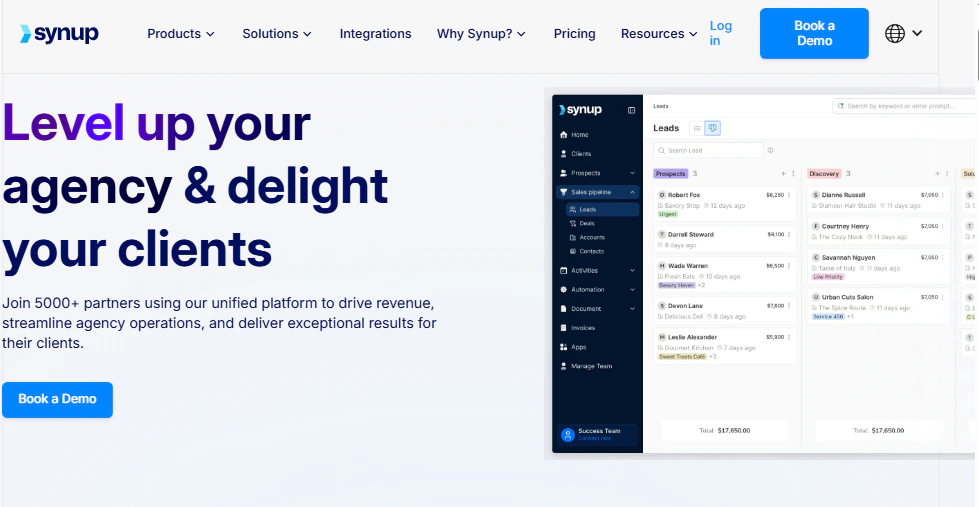
What began as a tool for listings management and local SEO has evolved into what Synup now calls an "Agency Operating System." The platform has expanded to serve not just multi-location businesses but specifically marketing agencies, offering features for sales pipeline management, client onboarding, invoicing, and white-labeled reporting alongside its core marketing tools.
Synup has raised $6.5 million in funding, including a $6 million Series A round led by Vertex Ventures. The platform serves businesses across more than 50 countries, with a network that includes publishers like Google Business Profile, Facebook, Yelp, Bing, and Apple Maps.
The ideal Synup customer is a digital marketing agency managing multiple local business clients, or a multi-location brand that needs centralized control over listings, reviews, and social media. The platform particularly appeals to those who want to consolidate multiple tools into a single subscription.
Synup Pros & Cons
Pros | Cons |
|---|---|
✅ All-in-one platform for listings, reviews, and social media | ❌ Steep learning curve for new users |
✅ Extensive white-labeling for agencies | ❌ Mixed reports on customer support quality |
✅ Built-in sales pipeline and invoicing | ❌ Contract and billing transparency concerns |
✅ Network of 60–100+ online directories | ❌ Can be overwhelming for simpler needs |
✅ Bulk listing updates across locations | ❌ UI described as "clunky" by some users |
❌ Pricing tiers may include features you don't need |
Synup Review: How it Works & Key Features
Listings Management: Synup provides centralized control over business information across numerous directories.
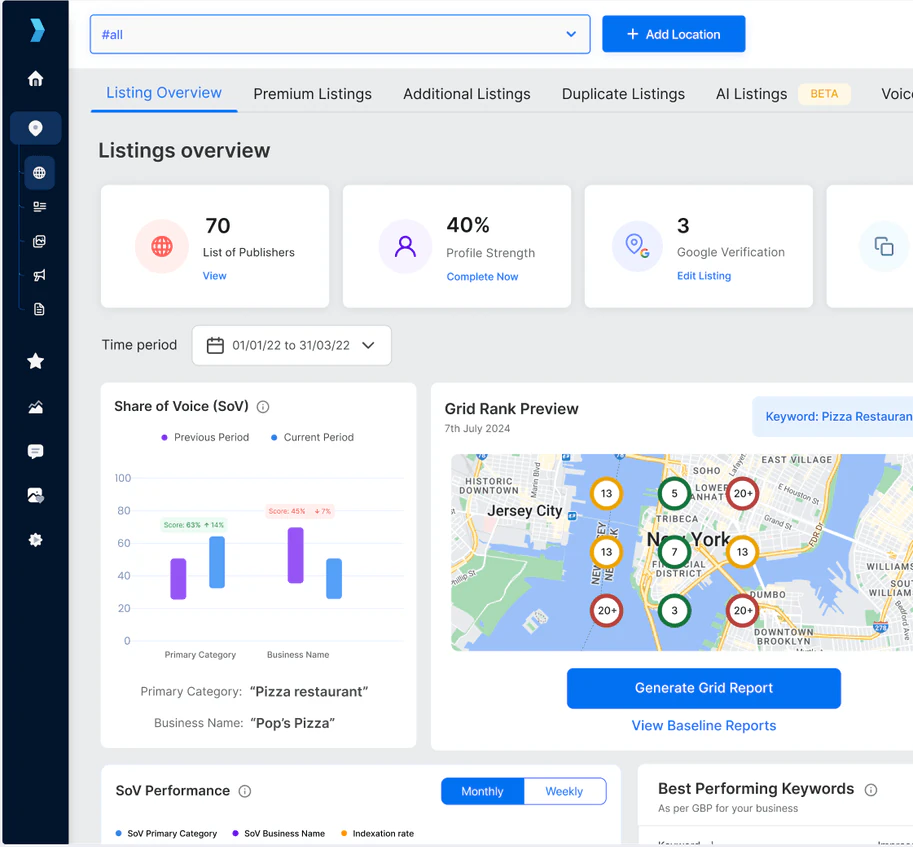
Synup's listings management allows businesses to update their name, address, phone number (NAP), and other details across a network that the company describes as 75 to 100+ online directories. The platform uses API connections with publishers to push changes automatically, and users can monitor the sync status of each listing from the dashboard.
Source: Synup
For businesses with multiple locations, the bulk update feature enables changes to be applied across all branches simultaneously. Users can download a CSV file of their locations, make edits in a spreadsheet, and re-upload to apply updates. The platform also includes duplicate listing detection and suppression tools.
Synup supports over 500 location data fields, allowing businesses to add detailed information like menus, service areas, and accepted payment types where publishers support these attributes. The platform also claims to optimize listings for voice search and AI-powered search engines.
Review Management: Aggregation, monitoring, and AI-assisted responses from a single dashboard.
The review management feature consolidates customer feedback from various platforms into a unified view. Users can filter reviews by star rating, platform, or location, and respond directly from the Synup dashboard. The platform sends real-time notifications when new reviews arrive.
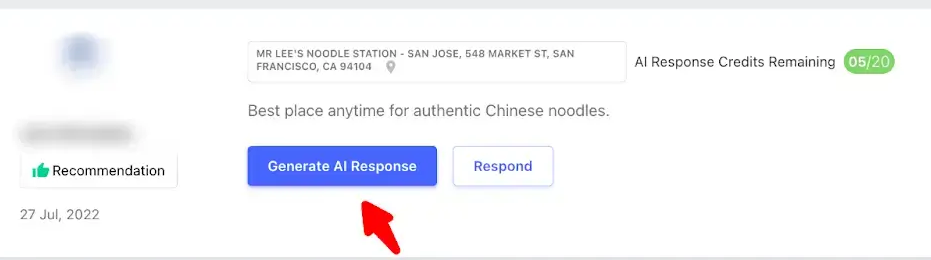
Synup includes AI-powered response suggestions to help users reply quickly. The sentiment analysis feature categorizes reviews by emotional tone and identifies recurring themes. For proactive review generation, the platform offers email and SMS campaign tools that can be automated through CRM or POS integrations.
Source: Synup
Review analytics provide insights into trends over time, with the ability to track review volume, average ratings, and response rates across different locations. The platform supports generating reports that can be white-labeled for agency clients.
Social Media Management: Multi-platform scheduling with AI-assisted content creation.
Synup Social enables users to manage content across Facebook, Instagram, Twitter (X), LinkedIn, and Pinterest from a centralized dashboard. The platform supports bulk scheduling, allowing users to plan and publish posts across multiple accounts simultaneously.

Source: Synup
AI-powered content generation helps users create posts based on trending topics, hashtags, and observances. The platform integrates with Unsplash and Giphy for adding visuals, and includes a calendar of observances for timely content ideas. Users can customize posts for each platform and preview how they will appear.
The feature includes content approval workflows for teams, with designated reviewers receiving notifications when posts need authorization. Multi-brand management allows agencies to handle social media for numerous clients from one account.
Agency Operating System: Sales, client management, and billing tools for agencies.
Beyond marketing features, Synup has built what it calls an "Agency Operating System" that includes:
AI-Powered Prospecting: Tools to identify potential clients based on industry, location, and digital presence gaps. The system can auto-enrich prospect data and generate personalized outreach.
Sales Pipeline Management: A visual, customizable pipeline for tracking deals through stages. The platform logs calls, emails, and meetings, and provides revenue forecasting.
Client Management: Centralized storage of client information, task tracking, and churn forecasting based on client health scores.
Invoicing and E-Signatures: Built-in tools for creating proposals, sending invoices with payment buttons, and managing recurring subscriptions. The platform supports multiple payment gateways including Stripe and PayPal.
White-Labeled Client Portal: Agencies can provide clients with branded access to reports and self-service tools, with custom domains and login pages.
Pricing Structure: Tiered plans with usage-based add-ons.
Synup's pricing is structured around three main "OS" tiers:
- Startup ($79/month annual, $99/month monthly): Up to 5 team members, 25 client accounts, 25 locations for listings/reviews
- Agency ($199/month annual, $249/month monthly): Up to 10 team members, 100 client accounts, 100 locations
- Scale ($799/month annual, $999/month monthly): Up to 50 team members, 500 client accounts, 500 locations

Source: Synup
Additional team members cost $5/month each, and extra client accounts cost $1.50/month each. Add-ons for enhanced features are priced separately:
- Listings Pro: $35/location/month
- Reviews Pro: $20/location/month
- Reviews Gold: $50/location/month
- Social Pro: $6/connection/month
- SEO Pro: $5/location/month
Where Synup Falls Short
While Synup provides a comprehensive feature set, several limitations become apparent for certain users. These constraints reveal a platform optimized for breadth rather than depth in any single area.
Overwhelming Complexity for Simpler Needs: The platform's extensive functionality can be counterproductive for businesses with straightforward requirements.
Users who primarily need review management may find themselves with access to sales pipeline tools, social media schedulers, and agency features they don't require. Some users describe the interface as "clunky" and overwhelming, particularly during initial onboarding.
Inconsistent Customer Support: While many users praise Synup's support team, a notable number of reviews mention slow response times and unhelpful interactions. For a platform that businesses rely on for their online reputation, inconsistent support can create operational risks when issues arise.
Contract and Billing Concerns: Several reports indicate frustration with sales tactics and contract inflexibility. Some users describe feeling locked into long-term agreements with difficult cancellation processes. This contrasts with the more transparent, usage-based pricing models that have become common in the SaaS industry.
AI Response Depth: Synup includes AI-powered review response suggestions with dynamic fields for location and brand information.
However, businesses seeking responses that actively market the business, incorporating specific facts, behavioral rules, and consistent brand voice working together, may find the approach more limited. For those who want AI that analyzes the review context first and then selects relevant business information to include, a more specialized tool may be better suited.
Learning Curve Trade-offs: The time investment required to master Synup's full feature set may not be justified for businesses whose primary need is reputation management. Smaller teams without dedicated marketing staff may struggle to leverage the platform effectively.
These limitations aren't failures; they're the natural consequence of building a comprehensive agency platform. However, they create clear gaps for businesses that would benefit from a more focused, specialized approach to AI-powered reputation management.
Synup Alternative for AI-Powered Review Response: RightResponse AI
RightResponse AI takes a different approach by focusing specifically on what many location-based businesses care about most: turning customer reviews into opportunities that win the next customer.
Launched in 2024 by George Swetlitz (who, according to company materials, previously served as CEO of a healthcare clinic network with over 200 locations), the platform was built from the ground up with generative AI to address the limitations he experienced with existing tools.
The core philosophy: people read reviews more than they read a business's website, and the response is the only part the business controls. Most responses today are generic and skippable: "Thanks for your review!" adds nothing. RightResponse AI aims to make responses worth reading by turning them into conversion assets that actively market the business.
Intelligent Review Response: Three pillars for hyper-personalized, brand-aligned replies.
What sets RightResponse AI apart is its three-pillar personalization system that works together to produce responses with endless variation without losing control:
Facts (What to Say): Users input specific information about their business, from unique selling points to operational details like happy hour schedules, service specialties, or sourcing practices. When the AI generates a response, it analyzes the review content and intelligently incorporates relevant facts.
For example, if someone complains about price, the response can mention that the restaurant uses organic, non-GMO ingredients sourced fresh from the market daily. The system shows users which facts were used and which weren't, allowing adjustments.
Customizations (Behavioral Rules): Users define how responses should behave, handling edge cases, setting rules for different scenarios, and controlling what should or shouldn't be included. For medical practices, PHI detection identifies potential Protected Health Information in reviews to maintain HIPAA compliance.
Brand Voice (Tone and Style): The platform maintains consistency with the business's communication style across all responses, ensuring replies reflect the brand's personality rather than sounding like generic AI output.
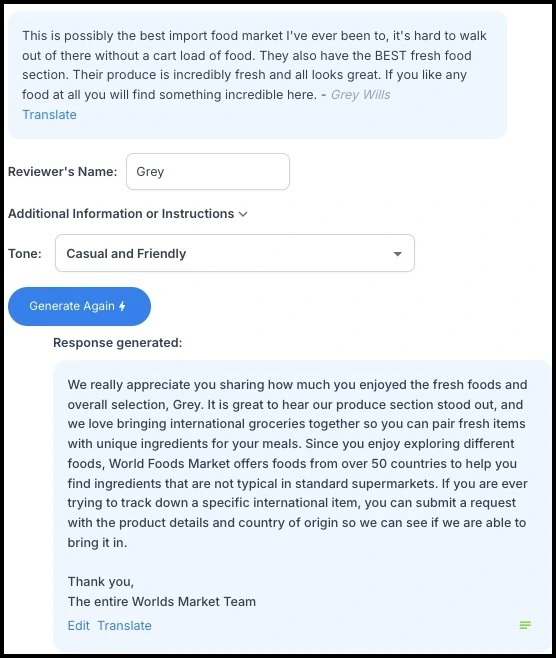
The platform uses an agentic approach: it analyzes the review before writing the response, separating analytical functions from writing functions so the AI can focus on quality output. This reduces the risk of inappropriate responses while increasing relevance. Users can configure automatic publishing for positive reviews while holding negative feedback for manual review.
Review Collection: AI-powered requests that feel personal, not mass-produced.
RightResponse AI includes an advanced review request system with two modes:
Pro Mode (AI-Powered): Generates highly personalized requests that incorporate customer data: names, service history, tenure as a customer, and recent transactions.
Example: "Hey Jim, your technician really enjoyed your visit. We love servicing your two air conditioners. We really value the fact that you've been a customer for six years." Requests can include photos, which are particularly useful in real estate and home services where customers can download and upload the photo to their review.

Essentials Mode (Template-Based): A simpler, non-AI system with pre-built templates for businesses preferring straightforward approaches. Users just turn it on and it runs automatically.
Additional review collection features include:
- Multi-channel delivery: Email and SMS options with the ability to track which converts better
- Employee-level QR codes: Each server, technician, or employee gets their own QR code on a card they can present to customers, enabling attribution and incentive programs
- Guiding questions: Help reviewers know what to write about, with rotating questions so reviews contain varied content
- Unlimited follow-up requests: Configure as many follow-ups as needed for your industry; seven for a roofer, fewer for a lawyer
- Review grouping: Multi-location businesses can funnel reviews from established locations into a new location to help it build review volume quickly
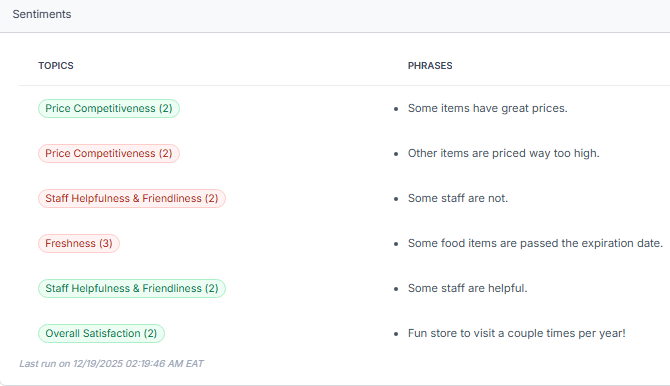
Voice of the Customer: Customized Aspect-Based Sentiment Analysis (ABSA).
RightResponse AI employs a customized version of Aspect-Based Sentiment Analysis that goes beyond simple positive/negative scores. Users can define specific topics relevant to their business, and the AI maps customer feedback to these categories, revealing which aspects of the operation drive satisfaction or dissatisfaction.
The platform automatically filters irrelevant or vague content to focus on genuine, experience-based feedback. Users can see the actual phrases from reviews associated with each topic and sentiment, providing full context behind the data. Sentiment can be tracked over time and compared across locations.
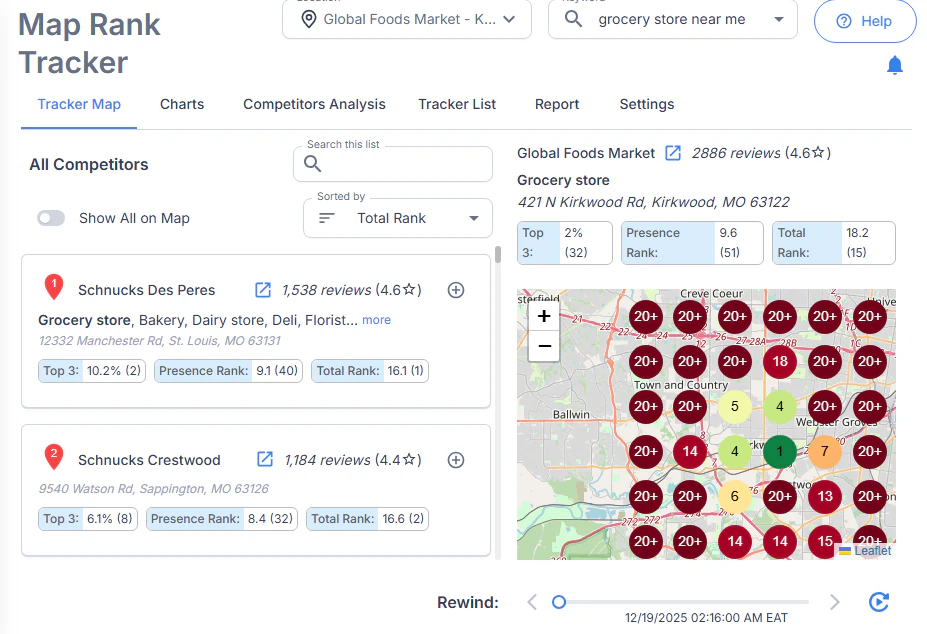
Google Maps Rank Tracker: Hyperlocal visibility insights with historical "Rewind."
The Map Rank Tracker creates a customizable grid around a business location to simulate searches from different points, providing a "street-level view" of visibility in Google Maps results. Users can see their ranking at each grid point for specific keywords and track how this changes over time.
A distinctive feature is the "Rewind" capability, which allows users to visually replay how rankings have shifted across the grid over previous scans. Rather than just seeing static historical charts, users can watch the evolution of their and their competitors' positions. The tool also provides competitor identification and analysis within the tracked geographic area.
CompetiWatch AI: Competitive intelligence from competitor reviews.
RightResponse AI's competitor analysis applies the same AI-powered sentiment analysis to competitors' reviews. Users can benchmark their sentiment scores against competitors on specific topics, read competitor reviews directly in the platform, and track competitors' review volume, ratings, and response rates.
Flexible Pricing: Pay As You Go or a Fixed Monthly Plan.
RightResponse AI uses a straightforward pricing model: a fixed monthly plan for predictable billing, or Pay As You Go (PAYGO) for low-volume or narrow needs. All plans are priced per location. The fixed tiers are Core at $19/month (100 review responses, 1,000 email review requests, Essentials request templates, and a basic dashboard; no SMS, surveys, or map rank tracking), Pro at $29/month, the most popular tier (200 responses, 2,000 email requests plus 200 SMS, 200 surveys, AI-powered Pro-mode requests, Map Rank Tracking with competitor analysis, and an advanced dashboard), and Pro+ at $44/month (500 responses, 5,000 email requests plus 500 SMS, 500 surveys, advanced automation and bulk processing, plus Competitor Voice of the Customer). Custom Enterprise plans layer on white-label access, API access, and advanced reporting for agencies and large multi-location businesses. PAYGO stays at $10/month per location plus usage credits, billed through a credit system:
- Response generation: 20 credits per review
- Voice of the Customer (VOC): 20 credits per review with text
- Map rank tracking: 1.5 credits per grid point
- Email review request: 2 credits each
Credit pricing is tiered, with costs decreasing as volume increases (from $0.01/credit for smaller purchases down to $0.006/credit for high volumes). Credits can be purchased manually or set to auto-recharge. A 7-day free trial includes 1,000 usage credits and access to most Pro features, with no credit card required.

Source: RightResponse AI
This flexible model means businesses only pay for the features they actively use; no paying per-location for capacity you don't need, and agencies can scale cleanly across accounts without being locked into tiers that bundle unwanted functionality.
Synup or RightResponse AI: Comparison Summary
Aspect | Synup | RightResponse AI |
|---|---|---|
Primary Focus | All-in-one agency platform | AI-powered reputation management |
Target Users | Marketing agencies, multi-location brands | Location-based businesses of all sizes, agencies |
Listings Management | ⭐⭐⭐⭐⭐ 60–100+ directories | ❌ Not included |
Review Collection | ⭐⭐⭐⭐ Email/SMS campaigns, CRM integrations | ⭐⭐⭐⭐⭐ AI personalization, employee QR codes, unlimited follow-ups |
AI Review Responses | ⭐⭐⭐ AI suggestions with dynamic fields | ⭐⭐⭐⭐⭐ Facts, Customizations, and Brand Voice system |
Social Media Management | ⭐⭐⭐⭐⭐ Full scheduling and publishing | ❌ Not included |
Sentiment Analysis | ⭐⭐⭐ Theme identification | ⭐⭐⭐⭐⭐ Customized ABSA methodology |
Map Rank Tracking | ⭐⭐⭐ Grid reports available | ⭐⭐⭐⭐⭐ Grid tracking with "Rewind" |
Agency Features | ⭐⭐⭐⭐⭐ Sales pipeline, invoicing, client portal | ⭐⭐⭐ White-labeling available |
Pricing Model | Tiered subscriptions + add-ons | Fixed plans Core $19 / Pro $29 / Pro+ $44 (100 / 200 / 500 responses per location/mo) or PAYGO ($10/location + credits); custom Enterprise |
Learning Curve | Steep (comprehensive features) | Moderate (focused features) |
Starting Price | $79/month (25 locations) | PAYGO $10/location + usage, or Core plan from $19/mo |
Final Verdict
The choice between Synup and RightResponse AI depends on whether you need a comprehensive agency platform or a specialized reputation management tool focused on response quality.
Choose Synup if you're running a marketing agency that needs to manage the entire client lifecycle from a single platform.
Its combination of listings management across 60–100+ directories, social media scheduling, sales pipeline tools, and white-labeled client portals makes it valuable for agencies juggling multiple clients and services. The platform rewards users who invest time in mastering its extensive features and who need the breadth of an all-in-one solution.
Choose RightResponse AI if you believe the quality of every review response is a chance to win the next customer.
Its three-pillar system, Facts, Customizations, and Brand Voice, creates responses that actively market your business with relevant, specific information rather than generic filler. The platform also includes an advanced AI-powered review collection with features like employee-level QR codes and unlimited follow-ups.
The Voice of the Customer ABSA and Map Rank Tracker connect reputation work to business outcomes. With usage-based pricing, you're not paying for social media tools, listings management, or sales pipelines you don't need. For location-based businesses of any size, from single location to enterprise, that find comprehensive platforms overwhelming, RightResponse AI offers a focused alternative that treats the review response as a conversion asset.
Get started with RightResponse AI here.
The platforms serve different philosophies: Synup provides breadth for agencies needing consolidated tools, while RightResponse AI offers depth for businesses prioritizing the quality of their customer engagement and the revenue impact of their reputation.
Frequently Asked Questions
When should I choose Synup for my business?
Choose Synup if you're running a marketing agency that needs to manage the entire client lifecycle from a single platform. Its combination of listings management across 60–100+ directories, social media scheduling, sales pipeline tools, and white-labeled client portals makes it valuable for agencies juggling multiple clients and services. The platform rewards users who invest time in mastering its extensive features and who need the breadth of an all-in-one solution.
When is RightResponse AI a better choice than Synup?
Choose RightResponse AI if you believe the quality of every review response is a chance to win the next customer. Its three-pillar system — Facts, Customizations, and Brand Voice — creates responses that actively market your business with relevant, specific information rather than generic filler. The platform also includes advanced AI-powered review collection with employee-level QR codes and unlimited follow-ups, Voice of the Customer ABSA, and Google Maps Rank Tracker. With usage-based pricing, you're not paying for social media tools, listings management, or sales pipelines you don't need.
What are the main differences between Synup and RightResponse AI?
The main differences include: Primary focus (Synup is an all-in-one agency platform vs RightResponse AI is a specialist AI-powered reputation management tool), AI response quality (Synup offers AI suggestions with dynamic fields vs RightResponse AI uses a Facts, Customizations, and Brand Voice system), Voice of the Customer (Synup provides theme identification vs RightResponse AI offers customized Aspect-Based Sentiment Analysis), listings (Synup covers 60–100+ directories vs RightResponse AI does not include listings management), and pricing (Synup uses tiered subscriptions starting at $79/month vs RightResponse AI offers Pay As You Go at $10/month per location plus credits, with fixed Core $19, Pro $29, and Pro+ $44 plans).
How much does Synup cost?
Synup's pricing starts at $79/month (annual) for the Startup plan covering up to 25 locations, $199/month for the Agency plan (100 locations), and $799/month for the Scale plan (500 locations). Add-ons include Listings Pro at $35/location/month, Reviews Pro at $20/location/month, Reviews Gold at $50/location/month, Social Pro at $6/connection/month, and SEO Pro at $5/location/month. RightResponse AI offers Pay As You Go at $10/month per location plus credits, with fixed Core $19, Pro $29, and Pro+ $44 monthly plans.
Try RightResponse AI for Free!
*No credit card required.

-1120w.webp)