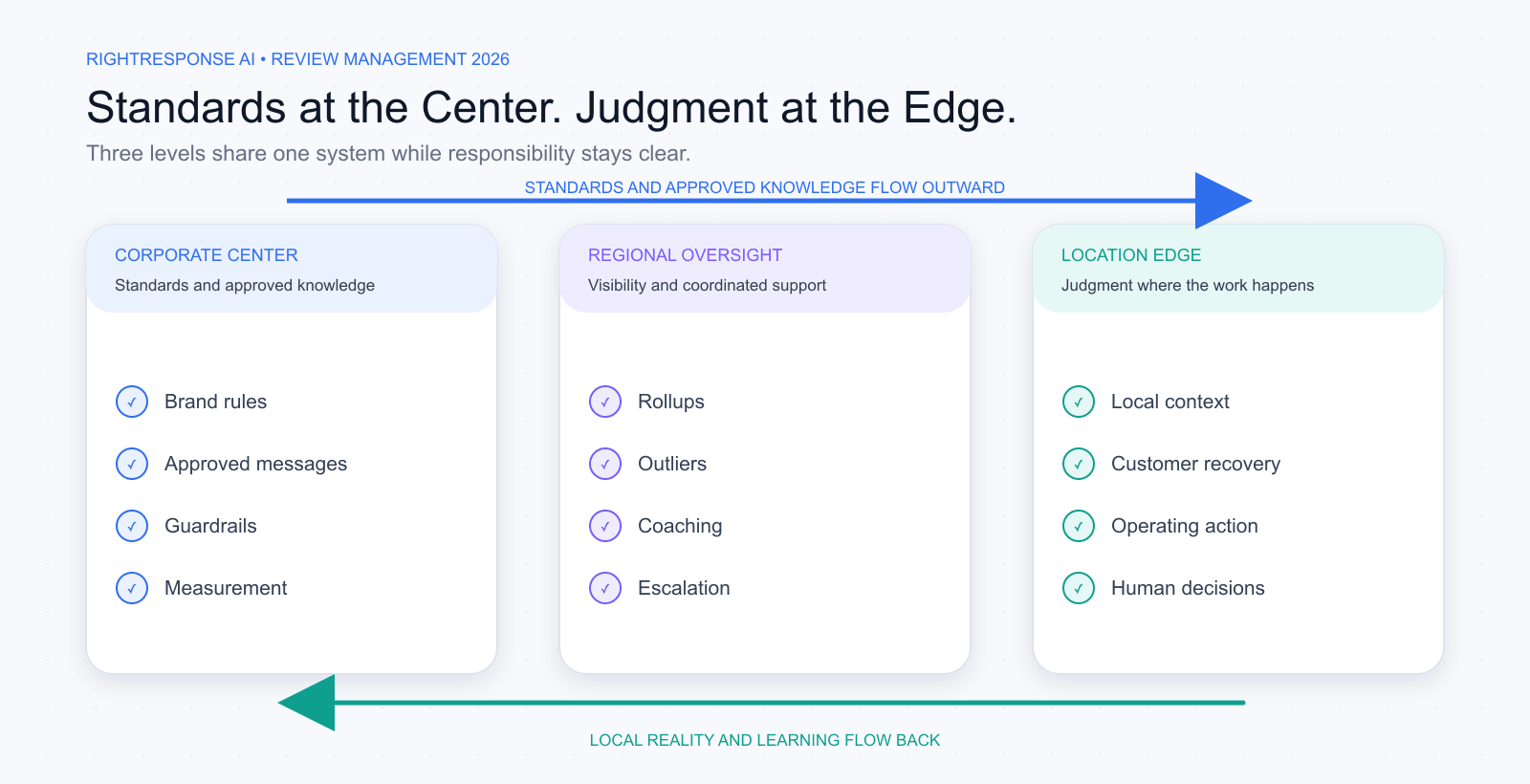
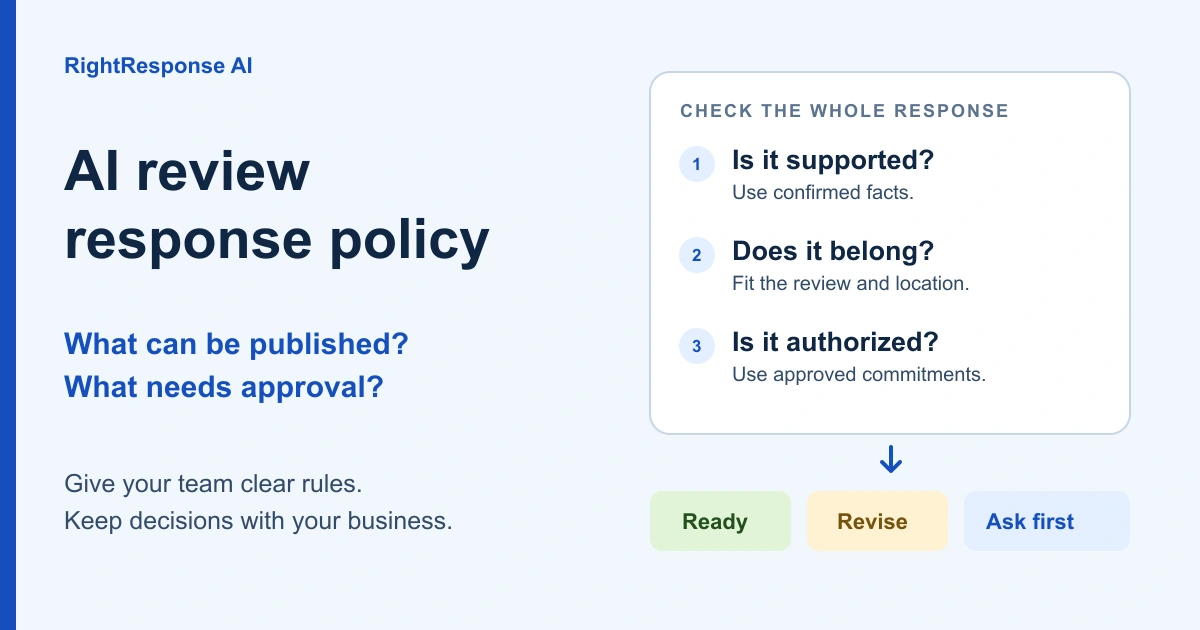
The 7 best Yext alternatives and competitors for review management, listings, and local SEO in 2026 are RightResponse AI for review aggregation, AI review responses, customer feedback analysis, and Google Maps rank tracking (base subscriptions $10–$44/location/month; Core excludes Maps and PAYGO requires purchased usage credits); Uberall for location data and local pages; SOCi for central and local marketing teams; Birdeye for listings with customer conversations and follow-up; Synup for agencies managing local presence for clients (monthly account bundles $49–$899); LocalClarity for bulk edits and publisher conflicts (Professional at $16/location/month monthly or $12 with annual billing); and BrightLocal for local SEO and citation work (one-location monthly plans $41–$65, with reputation management on Grow at $65).
Because Yext combines review monitoring with business listings, location pages, and structured Knowledge Graph records, multi-location buyers should separate two distinct decisions: upgrading review and feedback operations versus replacing directory sync and local pages.
This guide compares all seven Yext competitors for local and multi-location businesses by published pricing, contract commitments, AI review response controls, customer feedback analysis, publisher listings coverage, and Google Maps rank tracking. These businesses serve customers at physical locations or within local service areas, rather than choosing tools primarily for online-only product reviews. Pricing and product details were checked on October 14, 2026.
Quick Verdict: Which Yext Alternative Fits Your Business?
The right Yext alternative depends on whether a team is primarily upgrading review management and local rank visibility or replacing Yext's directory listings and store pages:
- Best for review aggregation, AI review responses, customer feedback analysis, and Google Maps tracking: RightResponse AI selects relevant approved business details for each response and displays which facts were used. Pro pairs these workflows with Maps grids at $29/location/month; Pro+ is $44 with higher limits, advanced automation, and competitor customer-feedback analysis. Core is $19 without Maps or competitor analysis. PAYGO starts at $10/location/month plus usage credits. Monthly and annual subscriptions are available.
- Best for replacing Yext Listings and Local Pages: Uberall fits governed location data and store pages; SOCi fits centrally coordinated search and social marketing; Birdeye pairs listings with customer conversations and follow-up; and Synup fits agency client management, with monthly account bundles from $49 to $899 for different location limits.
- Best for specialized publisher edits or local SEO citations: LocalClarity Professional fits bulk publisher edits and conflict resolution at $16/location/month monthly or $12 with annual billing. BrightLocal fits local SEO grids, citation work, and agency reporting; one-location monthly plans are $41–$65, with reputation management on the $65 Grow plan.
This comparison draws on company websites, public help documentation, blogs, and other public information. A short source summary by company is at the end.
How We Evaluate Yext Alternatives
Yext buyers often have two different purchases to consider: improving review management and replacing the system that maintains their location information. We use eight criteria to distinguish those jobs:
- Location data and publisher coverage. Which countries, publishers, fields, and entity types can the product maintain? Can staff inspect mismatches, duplicates, rejected updates, and changes made on the publisher's side?
- Reply information and controls. What business information can guide a reply? Can staff see, edit, approve, hold, or stop it, and does the workflow handle mixed feedback and changed reviews?
- Customer-feedback evidence. Does the report explain specific experiences, let you inspect the contributing comments, and compare locations or competitors on meaningful topics?
- Local visibility. Can you investigate rankings across a geographic area, inspect competitors at the same points, and compare consistent scans over time? Listing distribution and rank measurement are different functions.
- Location and client management. How do central teams, local managers, and agency clients share data, permissions, approvals, and reports?
- Setup and continuity. What integrations, field mapping, page migration, staff training, and ongoing exception work does the replacement require?
- Cost and commitment. What is the total for the same locations, products, usage, implementation, billing period, and renewal terms?
- Buyer fit. Whether the product solves the business’s main problem at the right scale, from a single location to a regional network to an enterprise with hundreds or thousands of locations, without adding tools the team will not use.
For buyers replacing Yext mainly for review management, context-aware replies, inspectable feedback, integrated Google Maps tracking, and transparent per-location pricing are the primary differentiators. For a listings-first purchase, publisher network coverage, local pages, and field-level control over location data carry more weight. The ranking reflects qualitative fit across those buyer jobs rather than a weighted feature score.
Yext Alternatives at a Glance
These seven Yext alternatives cover review management, location data, listings, local pages and local SEO. Use the table to choose a shortlist for your main job. Official published dollar prices are USD unless the vendor's quote specifies otherwise; attributed benchmarks retain the source’s dollar display and stated unit. Published rates and billing settings were checked October 14, 2026; benchmark dates appear with their sources. A location bundle is the total subscription for the stated capacity, not a rate to multiply by every branch.
| Platform | Best for | Price and scope | Commitment or trial | What to check |
|---|---|---|---|---|
| RightResponse AI | AI review replies, customer feedback, and Google Maps tracking | Per location/month, monthly billing: Core $19; Pro $29; Pro+ $44. PAYGO $10 base plus credits. Core excludes Maps and competitor analysis. | Monthly or annual. Seven days, 1,000 credits, most Pro features, no card; free use ends if credits run out. | Pro includes 10 combined scans/analyses; Pro+ 25. Allowances pool. Listings and local pages remain separate. |
| Uberall | Location data, publisher control, and local pages | Core suite quoted. Separate Wix marketplace offer: €12.87–€22.32/month displayed for Essential–Pro; channel scope and billing selection differ from an enterprise proposal. | Confirm term, billing, implementation, and renewal | Include Reviews Plus and Collaborate Plus where needed; demonstrate the exact approval and publishing modes. |
| SOCi | Central and local teams coordinating search, social, and reputation | Vendr benchmark (February 2026): $400–$1,800/location/year for mid-market multi-product packages; actual quote depends on scope. | Committed term is set in the order form; no termination for convenience in published FAQs | Price Search, Reputation, Social, local pages, and any additional governance products required. |
| Birdeye | Listings with customer conversations and issue follow-up | Reported benchmark: about $299–$449/location/month (CostBench); actual products, locations and contract are quoted. | Agreements typically annual; payment frequency can differ | Itemize response agent, messages, ticketing, and integrations; test approvals and final publisher state. |
| Synup | Agency local marketing and branded client work | Monthly account totals: Solo $49/1 location; Premium $299/up to 10; Pro $499/up to 25; Scale $899/up to 50. | Monthly or annual; 14-day Solo trial. Paid Premium charges immediately. | White labeling starts at Premium. Verify new-account credits: published enhanced launch allowances have an expired eligibility date. |
| LocalClarity | Bulk major-publisher edits and conflict investigation | Professional: $16/location/month monthly or $12/month with annual billing; enterprise/agency custom | Monthly or annual; confirm trial duration and implementation | Core publisher scope is narrower than an entire network. Email/SMS request delivery and local pages need separate scope. |
| BrightLocal | Local SEO grids, citations, and agency reporting | One-location Grow $65/month or $584/year. Grow 11–20-location bundle $197/month total or $1,772/year. | Monthly or annual; 14-day trial | SMS, citation work, and capacity extras. AI suggestions and automatic saved replies are distinct. |
Why Do Businesses Look for Yext Alternatives?
- The review workflow needs improvement. Staff may want more informative replies, clearer feedback about waiting or billing, or a better way to compare nearby competitors.
- The business needs a different location workflow. An agency may need client branding and approvals; a franchise may need local contributions under central rules; an SEO team may prefer detailed citation and publisher investigation.
- Some products are already covered. If another system handles local pages or social media well, paying for and administering another broad suite can create unnecessary work.
- The proposal is difficult to compare. A low subscription can become expensive after location capacity, usage, modules, implementation, and retained tools are added. A monthly invoice also does not necessarily mean a monthly commitment.
Start with those concrete problems. Switching platforms will not fix inaccurate source data or an unowned customer-service problem by itself.
When Yext May Still Be the Right Choice
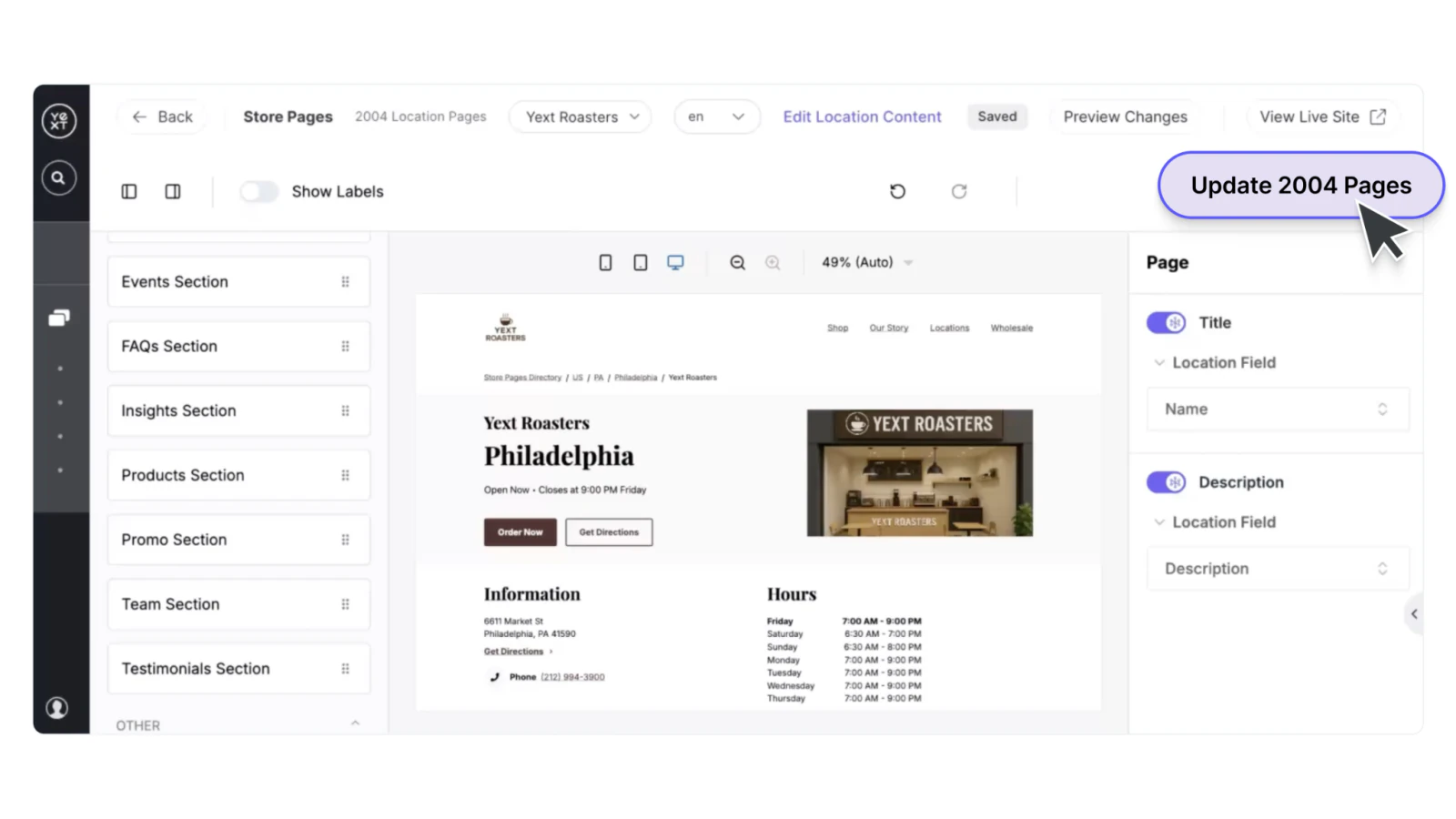
Keep Yext on your shortlist when one structured location record needs to feed listings, local pages, and other search experiences. Its Listings product distributes business information through its publisher network; the Knowledge Graph supplies the fields those products use. This matters when hours, services, professionals, and locations change frequently.
Yext Reviews also provides monitoring, review generation, response rules, and feedback analysis. Generative replies can use entity-specific information and account instructions, with approval or automatic release. Reviews Insights supports up to 30 themes, automatically classifies the previous 90 days and new reviews, and lets you open summaries, snippets, and matching reviews. Theme ratings and volume are different from sentiment for each phrase inside a mixed review.
For example, a healthcare group may need professional records, location pages, directory updates, and reviews administered together. Replacing only the review dashboard would leave the larger data and page operation to rebuild. Stay with Yext if its current tools, integrations, permissions, and contract suit that whole job. Ask it to demonstrate the settings available in your account before assuming a capability is missing.
View full-size image (opens in a new tab)
Pricing: For budgeting, Vendr reports the following per-location annual benchmarks: at 1–10 locations, $1,000–$3,000 for Listings or $2,500–$6,000 for Listings, Pages and Reviews bundles; at 10–100 locations, $800–$2,500 for multi-product bundles; and at 100+ locations, $500–$1,500 for bundles (February 2026 guide; checked September 16, 2026). These are reported benchmarks, not a current Yext quote. Product mix and deployment size matter. Get product-level pricing for the locations, entity types, and countries you need. Separate Listings, Reviews and generation, Pages, Search, Social, and Scout where applicable. Include implementation, integrations, usage, and renewal; a price for maintaining listings alone does not describe the cost of the whole platform.
The tradeoff: A central record saves repeated editing when it supplies several channels and products. That breadth also creates configuration and maintenance work. It pays off when your team actually uses the connected products and has clear ownership of the source data.
What to verify: Change a branch's hours and check the listing and local page, then generate a reply using that branch's support details. Test approval, actual publication, and the languages of your Reviews Insights themes and summaries. Those demonstrations show whether the products in your offer cover your required workflow.
1. RightResponse AI: Best for AI Review Responses, Customer Feedback, and Google Maps Tracking
RightResponse AI combines review requests, replies, customer-feedback analysis, competitor comparisons and geographic rank tracking on eligible plans while letting a business retain its working listings or page tools.
Context-Aware AI Replies Using Approved Business Details
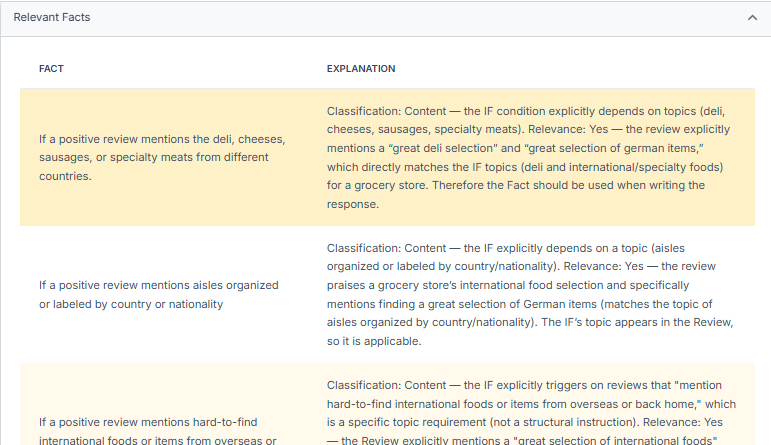
Teams configure the responder with accurate information about services, policies, staff, and locations. RightResponse AI prepares that information as structured Messages for staff approval using the company's website, review history, and business knowledge, allowing managers to edit and create as many Messages as the business needs.
Different Messages have different jobs. A Content Message contributes a relevant service detail. An Instructional Message guides the writing, such as using a technician's preferred name. A Pillar Message introduces a core business strength when it belongs. Each can contain several approved options and apply at company, brand, region, or location level.
The responder understands the review, identifies relevant Messages, decides which would help, plans the reply, writes it, and checks the result. You can inspect which details it considered and used. A fact can be relevant without deserving space in the reply; the system can leave it out. This is the practical purpose of Message-Informed responses.
Suppose a customer writes, “Alex explained the brake repair clearly and had my car ready earlier than expected.” If that shop provides inspection photos with every estimate, a reply could say: “We're glad Alex made the repair clear. Our inspection photos help you see what needs attention before you decide on the work.” This is an illustration using a supplied business fact. A branch that does not provide those photos should not use that Message.
View full-size image (opens in a new tab)
Response Controls, Approval Rules, and PHI Guard
For an individual response, staff can change the reviewer's name or tone, tell the Planner what to include or exclude, edit the wording, and regenerate it. Pro and Pro+ flag changed reviews and stars that disagree with the text. Pro+ also integrates the reason for a review update into the new reply and can address a rating/text mismatch in its wording. For a resolved complaint, that means considering the original review, prior reply, and customer's update when planning the follow-up.
The AI responder checks malicious instructions and situations needing human attention. PHI Guard, available on PAYGO, Pro, and Pro+, flags sensitive health information and shows the original and cleaned versions to help keep it out of the reply. Staff can put a response On Hold or choose Do Not Respond, and check consequential promises before release.
Choose approval requirements by star rating, separate automatic rules for reviews with and without text, a delay, and publishing hours. From an approval email, a manager can schedule, publish, or open the response for editing without a dashboard login. Direct publishing is supported for Google. Monitoring more than 100 review sources does not mean direct publication is available on every source.
Multilingual handling includes translating the review for staff, drafting in the customer's language, and translating the reply back for checking across more than 60 languages. PAYGO, Pro, and Pro+ can display Google's Most relevant review order; Pro+ also flags reviews that have disappeared from Google. Topic alerts on PAYGO, Pro, and Pro+ can notify the team responsible for a negative billing or waiting-time comment even when the overall rating is positive.
Yext and other platforms can also use business information: Yext embeds entity fields in account instructions, Birdeye uses business context and testable analysis steps, and LocalClarity uses business background and enabled location content. RightResponse AI differentiates itself by combining inspectable Message selection with response controls, phrase-level feedback analysis, and Google Maps rank tracking at published monthly rates. Buyers can give each candidate the same sample reviews and approved information to compare the finished replies directly.
Customer-Feedback Topic Analysis and Google Maps Rank Tracking
One review might praise a technician but criticize the wait. Customer-feedback analysis separates those experiences, shows mention frequency and the percentage of positive mentions for each topic, and lets you open the phrases and full reviews behind the chart. RightResponse AI develops a starting set of topics; your team can modify it to match its services and operating priorities.
Compare the same topic across locations, brands, groups, ratings, and time periods. A manager can investigate whether the waiting problem is local or widespread, then check feedback after an operational change. Pro+ adds competitor feedback analysis using the same topics, alongside ratings, review velocity, and response-rate comparisons. Reporting exports, downloads, and scheduled reports are available on Pro+ and Enterprise.
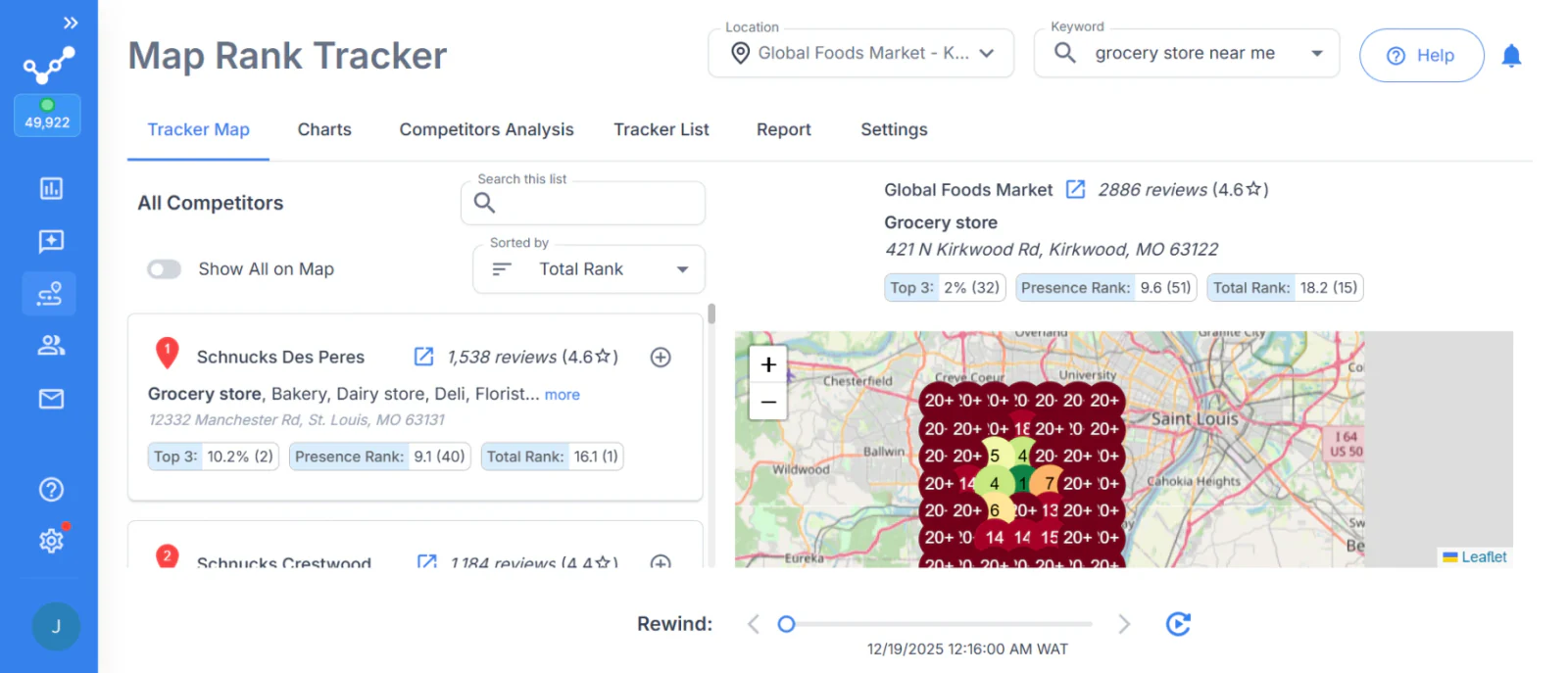
The Map Rank Tracker repeats a keyword search at points around a location. Set the grid, radius, spacing, and recurring schedule; inspect your positions and the complete grid for any competitor found in the scan. History and Rewind let you return to earlier results. Top 3, Presence Rank, and Total Rank summarize the geographic pattern. Keep the keyword and grid consistent when comparing dates.
View full-size image (opens in a new tab)
These tools answer two connected questions: which businesses are visible nearby, and what their customers say about the experience.
Automated Review Requests and Employee QR Workflows
Review Requester offers reusable templates, AI-written email and SMS, employee QR codes, and private surveys. Customer records can arrive through the RightResponse Google Sheet, a supported Zapier workflow, or direct entry, mapped to the correct location and flow.
AI-written requests can connect relevant customer or job details rather than simply insert a name. An email can include a project photo and a question about the work; SMS uses shorter wording. Preview the customer's experience in the editor before activating a flow. Set send hours and reminders; Pro+ adds a blackout period to prevent repeated requests across flows. Pro and Pro+ include private surveys and NPS.
Employee QR codes support an in-person ask, with scans reported by employee and location and weekly leaderboards. A click or scan records activity, not a confirmed posted review. Map each request to the business that actually served the customer.

View full-size image (opens in a new tab)
Pricing, the Tradeoff, and What to Verify
Pricing: The monthly subscription is USD $19 for Core, $29 for Pro, or $44 for Pro+ per location. PAYGO has a $10 per-location monthly base plus purchased credits and most Pro features. Current pricing gives the plan boundaries and usage charges.
| Plan | Replies and requests | Maps and competitor analysis | Buyer fit |
|---|---|---|---|
| Core — $19/location/month | 100 responses; 1,000 email requests; reusable request templates | Excluded | Essential replies and requests without Maps or competitor analysis |
| Pro — $29/location/month | 200 responses; 2,000 email requests; 200 SMS segments; 200 survey responses; AI-written requests | 10 combined scans or analyses/location/month | Full review aggregation, AI review responses, feedback analysis, and Google Maps tracking |
| Pro+ — $44/location/month | 500 responses; 5,000 email requests; 500 SMS segments; 500 survey responses; advanced automation | 25 combined scans or analyses/location/month; competitor feedback analysis | Higher volume and deeper competitor customer-experience comparisons |
| PAYGO — $10/location/month base | Purchased usage credits; most Pro features | Map scans, competitor analyses, and competitor feedback use credits | Lighter or changing use, with subscription and credit costs budgeted together |
Monthly allowances pool across account locations. Pro's 10 and Pro+'s 25 are combined Maps scans or competitor analyses, not separate allowances for both. An extra 20 scans or analyses costs $10/month and adds to the company pool. Pro and Pro+ can buy these recurring capacity packs; Core must upgrade. Unused add-on capacity expires after the following month. Longer texts can use multiple SMS segments, with registration and phone-number charges separate.
Core supports ten request campaigns with two follow-ups per campaign; Pro supports 20 with four; Pro+ supports 50 with ten. Pro includes 200 survey responses/month and Pro+ 500. Competitor customer-feedback analysis is included on Pro+ and also available with PAYGO usage credits. Core's basic dashboard does not include the phrase evidence, topic alerts, or Maps tools described above.
For ten locations on Pro, the subscription is $290/month, or $3,480 over twelve months of monthly billing. Annual prepayment costs $2,900 under the twelve-months-for-ten-payments policy. Usage, SMS, and add-ons remain separate. Compare a Yext proposal for those same locations and products, and include any listings or pages you will retain before calculating savings. As a budgeting reference, Vendr reports $800–$2,500/location/year for Yext multi-product bundles covering 10–100 locations (February 2026 guide; checked September 16, 2026). The exact bundle still needs a quote.
The seven-day trial includes 1,000 credits and most Pro features without a card; free use ends early if the credits run out. Enterprise and managed-service arrangements need their own scope and price.
The tradeoff: This is a specialized review platform. It does not replace Yext's broad publisher distribution, location-page system, on-site search, or corporate social program. Choose it when replies, customer understanding, requests, and Maps are the work you need to improve. Retaining a good listings system can be a sensible part of that purchase.
What to verify: If you have multiple locations, use two branches with different services and contact details. Inspect Message selection, an updated review, a mixed high-star complaint, email approval, and final Google publication. Price the shared scan allowance, request volume, SMS segments, and reporting plan you need. Demonstrate local-user permissions and any integration or managed-service responsibility required by your organization.
2. Uberall: Best for Location Data and Local Pages
Choose Uberall when you need to replace a substantial location-presence operation: listings, local contributions, store pages, and coordinated publishing. Its Listings product maintains location details across its directory network, while Locator & Local Pages builds search and location experiences from that information.
The useful buying question is what happens after a branch changes its hours. Staff maintain the location record, apply the permitted fields, and inspect publisher outcomes. Local edits and publication can have different permissions. User controls distinguish location access, field editing, syncing, review replies, and automatic-response administration. Location-data approval is a separate workflow from approving review replies.
Reviews sit in a shared inbox. Generated replies, bulk AI drafts, saved wording, and automatic replies are different modes. The bulk AI guide describes generating drafts for up to 40 selected reviews, then inspecting or editing them before release. The documented Automatic Responses route chooses from up to 20 saved replies for new star-only Google reviews.
Uberall's AI Guidelines feature on Reviews Plus supplies brand instructions and business context. That adds more than a tone setting, but someone must maintain the information and check the draft. Review approval can restrict a local user's reply to a proposal another user must approve; support must enable it. Demonstrate where that approval applies alongside automatic modes.

View full-size image (opens in a new tab)
Pricing: Uberall's package page uses a sales quote. As a narrower price reference, the Wix marketplace offer displayed Essential at €12.87, Advanced at €17.17 and Pro at €22.32 per month when checked October 21, 2026. Advanced adds reviews and AI replies; Pro adds social. These are EUR prices for the Wix channel, not a full multi-location enterprise quote; confirm the selected yearly/monthly billing option. Specify Listings, Locator & Pages, the required review features, local contribution controls, and any social or analytics products. Include location count, countries, implementation, page hosting, ongoing support, usage, and the contract and renewal term. A listings quote alone will not price the whole system you are replacing.
The tradeoff: Listings, standard Reviews, and advanced review controls have different package boundaries. Reviews Plus adds sentiment analysis, bulk AI replies, and AI Guidelines; Collaborate Plus adds flexible permissions and workflow approvals. Locator & Local Pages is another add-on. Price those together when replacing governed listings, pages, and reviews; a standard Reviews entitlement does not cover every advanced workflow.
What to verify: Have a local contributor propose a holiday-hours change, obtain approval, and follow the update to Google and Apple. Edit a location page and inspect the live result. Then demonstrate a generated written-review reply and a star-only automatic reply separately, including where approval applies. Those checks establish whether your quoted products cover the daily work.
3. SOCi: Best for Central and Local Marketing Teams
Choose SOCi when the replacement needs to coordinate listings, local search, social calendars, and reviews across corporate and local teams. Shared guidance helps those teams coordinate the work.
Genius Local Search uses location signals to propose or publish changes to local information within configured controls. A central team can manage common standards while branches supply local details. Genius Social adds local content planning, creation, and community engagement. That suits a franchise running repeated campaigns with differences between markets.
Genius Reputation drafts and publishes replies using brand voice, keywords, escalation guidance, and approval rules. It also supports conversational surveys. Its Voice of Customer groups similar feedback into themes, ties them to customer quotes, and compares locations and regions. A regional manager can investigate recurring wait complaints rather than rely on the average star rating.
For a franchise, that means separate rules for holiday-hours edits, local campaign posts, and review escalations, while regional managers inspect shared reports.

View full-size image (opens in a new tab)
Pricing: SOCi quotes the products, locations, users, and implementation. Separate Search/Listings, local pages, Social, Reputation, surveys, and any compliance or advertising products you require. Its contract FAQs say the order form determines the committed term and does not provide termination for convenience. Review rollout fees, renewal, location additions, and the notice deadline as part of the cost. For budgeting, Vendr reports $400–$1,800 per location/year for mid-market multi-product packages, plus a separate $30,000–$65,000 annual estimate for a 50-location Listings, Social and Reviews suite (February 2026 guide; checked September 16, 2026). These are reported benchmarks, not a SOCi quote or a reviews-only rate.
The tradeoff: Reputation handles replies, surveys, and customer-feedback themes; Local Search handles listing and page optimizations; Social handles local content. Their publication rules need to fit each job. SOCi Shield adds a separate layer of brand and regulatory checks when enabled. Specify that product and the local contribution rights in the proposal rather than assuming a review-approval setting governs every listing or post.
What to verify: Ask a local manager to update a branch detail and handle a review containing praise and a serious complaint. Have a regional manager open the customer quotes behind a theme. Demonstrate the approval and escalation path, the exact publishers, and any GeoRank keywords, grid, and frequency included in your quote.
4. Birdeye: Best for Listings With Customer Conversations and Follow-Up
Choose Birdeye when you want listings and reviews connected to customer conversations, requests, surveys, and issue follow-up. It suits a team that would otherwise run those jobs in several systems.
Listings AI manages business information and recommends corrections across locations. Review and customer-communication tools then handle what happens after someone finds the branch. The value is a coherent customer workflow: an inquiry, a visit, a request for feedback, a public reply, and staff follow-up when something went wrong.
The Review Response Agent guide provides a concrete example of its controls. Configured steps check for spam, analyze language, topics and severity, and use business context in generation. Conditions can route exceptions differently. Run test exposes step inputs, outputs, and response reasoning, so staff can refine the workflow before enabling it.
Human approval, suggestion, and autonomous behavior depend on the configured agent and release workflow. Ticketing Agents can create and route work from review ratings, identified issues, survey NPS, or open-ended feedback. Configure the assignee, fallback, and escalation, then run a test with the actual complaint before activating the workflow.

View full-size image (opens in a new tab)
Pricing: For budgeting, CostBench reports Starter around $299, Growth $349 and Dominate $449 per location/month (last verified August 26, 2026; checked October 21). Birdeye uses a custom quote by products, locations, and contract. Its cost explanation says agreements are typically annual. Itemize Listings, Reviews, the response agent, messaging, surveys, social, ticketing, and integrations you will use, with implementation and usage. Monthly payments can still belong to an annual agreement; compare the full commitment and renewal.
The tradeoff: Reply approval and ticket routing are separate workflows. A ticket agent can classify the issue and assign it, but a review with several issues follows the configured branch priority. Set that priority, the fallback, and escalation explicitly; approving the public reply does not configure who receives the ticket. Include both agents and the required ticketing access in the quote.
What to verify: Run the same mixed review through the agent and inspect each analysis step and the finished reply. Test the required approval path, including any timeout setting. Follow a complaint to its assigned owner and resolution, and verify a listings update at the publisher. Price that entire workflow in the proposal.
5. Synup: Best for Agencies Managing Local Presence for Clients
Choose Synup when an agency needs local listings, reviews, social work, and client reporting under its own brand. Its current Sydekick offer combines location tools with an agent that can draft and carry out configured work. This differs from its earlier Agency OS packaging.
The location editor maintains a Master record inherited by publishers, with deliberate publisher-specific overrides. For example, a Google tracking number need not replace the branch's phone everywhere. Saving queues changes; publishing sends them, and the publisher still controls arrival. Check the actual field and destination before accepting an agent's proposed update.
Sydekick can use scoped agency, client, and location information with reusable skills and playbooks. Staff review eligible posts and review replies in the Approvals inbox, edit or reassign them, and inspect their delivery outcome. Approved, Published, Saved as draft, and Publish failed are separate states. The skill or playbook decides whether work requires approval; the inbox is not a universal gate for every action.
The regular review composer and older automatic-template rules remain distinct from agent tasks. A demonstration should show the exact route your team will use. Local rank grids, review-topic reports, and AI-answer reports add client evidence, but their settings and history differ. Check a geographic result and the actual feedback behind a reported topic before sending the report to a client.
View full-size image (opens in a new tab)
Pricing: Current monthly location bundles are $49 for Solo with one location, $299 for Premium with up to ten, $499 for Pro with up to 25, and $899 for Scale with up to 50. The annual selector shows monthly equivalents of $39, $239, $399, and $719 respectively. Enterprise above 50 locations is custom. Premium's $299 is the account total, not $299 per location. White labeling starts at Premium. The 14-day trial covers Solo; starting paid Premium is an immediate charge, not an extension of that trial.
Credits meter agent work and related infrastructure use. The pricing page displays launch allowances reserved for accounts created by September 30, 2026, which has passed. Get the allowance and additional-credit rate for a new account in writing. Those terms determine how much work the apparent bundle price buys.
There is a purchasing inconsistency to settle before replacing Yext Pages. The pricing page lists custom-domain location pages among included features, but Locator & Pages describes a separately scoped build with an agreed price, timeline, and maintenance handover. Establish the page scope, hosting, build cost, and ongoing maintenance in the proposal; do not assume the location subscription covers the entire page project.
The tradeoff: The combination can suit an agency delivering several local services with client branding. It requires accurate client scope, maintained instructions, and explicit approval behavior. Confirm which workflows use scoped business memory and require approval. An agency workflow is only useful if it keeps one client's information out of another client's work.
What to verify: Configure two clients with different policies and staff permissions, generate a review reply for each, and trace approval through final publication. Demonstrate a publisher-specific override surviving a Master edit. Confirm new-account credits, white-label access, and rank history. For pages, require the agreed build, hosting, launch date, and named maintenance owner in writing.
6. LocalClarity: Best for Bulk Edits and Publisher Conflicts
Choose LocalClarity when a hands-on team needs to inspect and correct business records across major publishers. Its Local Listings workspace combines stored business data, publisher records, bulk work, and visible change history.
The useful distinction is control over a discrepancy. If Google and Apple show different closing times, staff can inspect which value is correct, decide whether to push their maintained value or accept a publisher change, and apply the correction. Bulk tools and live spreadsheets reduce repeated edits. Permission controls can distinguish reading, writing with approval, and publication.
ReviewsInbox adds source and location filters, assignments, tags, and reply state. Custom AI agents can use business background and enabled location information, with star-specific instructions, language policy, and response settings. Campaigns can deliver replies automatically or place them before an authorized person. A background describing one branch's services must be scoped correctly before automation is useful.
Review-topic analysis exposes supporting comments, and LocalClarity offers Competitor Sentiment to analyze rival customer feedback. Use it to investigate a service topic such as waiting time alongside ratings and volume. In a demo, apply the same topic and date range to your business and a rival, open the contributing reviews, and check which historical scans and retention periods your plan includes.

View full-size image (opens in a new tab)
Pricing: Professional costs USD $16 per location/month on monthly billing or $12/month billed annually. Enterprise/agency pricing is custom. Include the required source integrations and any external request sender. Review generation uses direct links and QR codes; budget a separate email/SMS sender unless the proposal explicitly includes one.
The tradeoff: Detailed major-publisher editing, approval, and audit work is the strength. Its core-publisher connections suit a narrower job than Yext's full country and industry network. A team also relying on local-page creation, configurable rank grids, or automatic review-request delivery needs those products priced separately.
What to verify: Import a small set of real location records, inspect conflicting hours, approve a bulk change, and open the publisher's live listing and change history. Generate a reply using branch-specific information and follow its approval and public state. Compare the same service topic with a rival, inspect the review evidence and oldest available period, and check every publisher your operation needs.
7. BrightLocal: Best for Local SEO and Citation Work
Choose BrightLocal when an SEO team or agency needs to investigate rankings, audit citations, correct listings, and report to clients. It brings review tools into a wider local-search workflow.
Keep three citation jobs separate. Citation Tracker finds mismatched or missing records. Citation Builder is a separately purchased service for submissions, corrections, and duplicate work. Active Sync maintains eligible publisher data through ongoing connections on Manage and Grow, with the location set to Active and syncing enabled. An audit identifies the problem; the correction service or live connection does the update.
Local Search Grid measures the same keyword from points around the business, lets you inspect competing businesses, and supports comparisons over time. That helps investigate a branch ranking well nearby but poorly across town. White-label reports and client access suit agencies that need to explain the result and ongoing work.
If you use Yext Scout to investigate AI discovery, also compare Local AI Visibility Tracker. It tracks up to 20 prompts per location across ChatGPT, Google AI Mode, and AI Overviews, with results by platform and prompt, local-competitor comparisons, and the sources AI cites. Citation gaps can pass into Citation Builder. The tracker is included in Track, Manage, and Grow; check the engines and prompts you need against your Scout scope.
Grow includes Reputation Manager for requests, monitoring, and responses. Staff can edit AI suggestions, while Auto-Replies separately selects complete saved wording by location, rating, text presence, and delay. Its guide specifies Google. That distinction matters when a high-star review contains a serious complaint: a star-and-text rule is not a semantic assessment of the issue.

View full-size image (opens in a new tab)
Pricing: One-location monthly plans are USD $41 for Track, $54 for Manage, and $65 for Grow. Grow is $584 when billed annually and includes reputation management. The published 11–20-location Grow bundle is $197/month total or $1,772/year. The trial is 14 days. Current pricing should be read with SMS, citation-service, scan-capacity, and daily-tracking extras.
The tradeoff: Rankings, citation investigations, and agency reporting make the wider toolkit useful. Citation Builder can provide credentials for listings it creates, but that does not replace recurring sync or give permanent control over a publisher. If the main purchase is nuanced reply automation and customer-experience diagnosis, compare those workflows directly rather than buy on the number of SEO reports.
What to verify: Follow a citation problem from audit to correction and live acceptance. Confirm which sites use ongoing sync and what access remains after cancellation. Run a consistent local grid and inspect a rival at a point. Open an AI prompt's actual result, competitor comparison, and cited sources. Demonstrate editable AI suggestions separately from automatic saved replies, then price the right location bundle and extra work.
Free Option: Google Business Profile
Verified businesses can maintain their Google business information, read and reply to reviews, and share a review link for free. For a manageable number of locations and Google-only work, native tools may be sufficient. Google's guide explains review access and replies.

View full-size image (opens in a new tab)
The limitation is scope and repeated work. Google Business Profile does not distribute changes to other directory networks or supply Yext's local-page system. A paid platform becomes more useful when staff need shared workflows, several sources, customer-topic analysis, or recurring geographic reports.
RightResponse AI vs. Yext: What Would You Replace?
Replacing Yext Reviews and replacing Yext Listings, Pages, or Search are different projects. List the products you use before comparing proposals. You can improve review operations while keeping a location-data system that already works.
| Buyer question | RightResponse AI | Yext |
|---|---|---|
| Which buying need favors it? | Review replies, inspectable feedback, requests, and Maps alongside existing marketing tools | Central location records feeding listings, pages, and search experiences, with review products alongside them |
| How can replies use business details? | Prepares Messages for approval, selects useful information for each review, plans the response, and shows which Messages were relevant and used | Account instructions can embed entity fields and example review/reply pairs; Response Playground tests the result |
| What controls publication? | Star/text rules, delay and hours, email approval, individual edits, On Hold, and Do Not Respond; direct Google publishing | Ordered workflow rules can assign review work, generate replies, and require user/group approval or publish automatically; source support varies |
| How can staff investigate feedback? | Business-defined topics, phrase evidence, % positive mentions, location/time comparisons; Pro+ adds competitor topic analysis | Reviews Insights themes, rating/volume changes, summaries, snippets, and matching reviews; language scope differs by output |
| What about listings and local pages? | Retain or buy separate products for broad publisher distribution, local pages, and on-site search | Knowledge Graph, Listings, Pages, and Search supply those jobs in the wider platform |
| What is the price basis? | Published monthly per-location subscriptions: $19/$29/$44; PAYGO $10 plus credits. Annual subscription costs ten monthly payments. | Vendr benchmark (February 2026): $800–$2,500/location/year for 10–100-location multi-product bundles; larger bundles differ. Custom quote. Specify products, usage, implementation and term; a Listings quote is not a complete Reviews/Pages replacement. |
| What must the Maps budget cover? | Core excludes Maps. Pro: 10 combined scans/analyses; Pro+: 25 per location/month, pooled across locations; extras separate | Confirm the search measurement, geographic controls, history, and allowances in the particular products offered |
Yext has substantive AI reply controls. Its Generative Review Response guide, scoped to Enterprise accounts, describes account instructions, embedded entity fields, example review/reply pairs, and a Response Playground. A negative-review instruction can include the correct branch's support email. Rules can create approval tasks or publish generated replies automatically.
RightResponse AI's distinction is the maintained library of approved business Messages, selection for the individual review, response planning, and a record of which Messages were relevant and used. Compare those information decisions and the resulting replies alongside each product's release controls. An AI label alone does not tell you what the customer will read.
Which Yext Alternative Should You Choose?
Choose by the work that must continue after the switch. A business can reasonably use a review specialist with a listings platform, while an agency may prefer a broader client system.
| You need | Consider | Why |
|---|---|---|
| Useful review replies, feedback, and geographic Maps visibility | RightResponse AI | Approved business-message selection and planning, supporting comments, and Maps on Pro/Pro+ |
| Location records and a synchronized page/locator operation | Uberall | Combines governed location data, publisher operations, and local pages |
| Corporate standards with local marketing execution | SOCi | Search, social content, reviews, and local teams use shared guidance |
| Listings connected to conversations and customer follow-up | Birdeye | Adds customer communications, testable reply workflows, and ticketing on the relevant products |
| Branded local marketing for agency clients | Synup | Client/location tools, agent tasks, and white labeling on Premium and above |
| Inspecting and correcting major-publisher conflicts in bulk | LocalClarity | Visible location records, bulk edits, change history, and approval controls |
| Citation work, rank investigation, and client SEO reports | BrightLocal | Audits, separately purchased citation corrections, ongoing sync, grids, and Grow review tools |
Try the Software Before You Switch
Give each vendor the same records, reviews, and required tasks for your location or a small set of locations. If you have multiple locations, include a busy branch, a quieter branch, and a location with an unusual service or publisher field.
- Change a location detail. Test a holiday-hours update, an intentional publisher override, and a rejected field. Follow the change from saved data to the live listing.
- Test pages where they matter. Check a location URL, directions, structured details, mobile layout, and updates from the location record. Establish who will host and maintain it.
- Use difficult review examples. Include mixed praise and criticism, stars that disagree with the text, an updated review, and branch-specific contact information. Remove private information before sharing.
- Inspect the information decisions. Supply approved services and policies; check what the AI uses, omits, or invents, and how staff edit or hold the reply. Follow approval to actual public publication.
- Test requests and reports. Preview one invitation, reminders, location mapping, and private feedback. Open the comments behind a reported theme. Keep the public-review path available regardless of satisfaction.
- Compare geographic results fairly. Use the same keyword, area, points, and date. Inspect competitors, history, schedule, and how much capacity the scan uses.
- Count the remaining work. Track edits, unresolved publisher exceptions, staff time, missed steps, and usage charges. Decide in advance what would make the change worthwhile.
Compare RightResponse AI plans and start a trial. You get seven days, 1,000 credits, and most Pro features without a card; free use ends if credits run out. Try your actual review and location workflows to see whether the replies, feedback, and Maps tools earn their place.
Questions to Ask Before Leaving Yext
- Which products are in the replacement? Separate listings, Reviews, generation, Pages, Search, social, and AI-visibility reporting. Name who maintains any product you keep.
- What is the full commitment? Request first-year and renewal totals, billing dates, cancellation notice, implementation, usage, capacity, and the cost of adding or removing locations.
- Who controls the accounts? Confirm business ownership of Google, Apple, Facebook, and other profiles, domain and page access, and the permissions the new provider requires.
- What data is exportable? Save entity fields, publisher overrides, review/reply history, analysis, approved wording, contacts, request settings, and available reports. Determine what imports into the replacement.
- What happens to local pages? Identify URLs, redirects, hosting, templates, locator behavior, analytics, and the source of ongoing data updates before stopping Pages.
- Who approves changes and replies? Demonstrate local and central rights, exceptions, and actual publishing status. Many-location support is not proof of the access rules you need.
- Who investigates conflicts and complaints? A submitted field or published reply is only one step. Assign responsibility for rejected listings and customer issue resolution.
Yext's listing opt-out guide says the listings remain on publisher sites after management stops. Yext stops sending updates, and publishers may use other sources and change the data over time. Establish who will maintain each listing before ending the connection.
How to Switch From Yext
If you have multiple locations, pilot the replacement with a small group before moving the whole account. Keep the systems operating long enough to check the handoff and meet your contract requirements.
- Inventory the work. List Yext products, entity types, publishers, locations, users, request campaigns, integrations, and pages. Decide what moves and what stays.
- Save data and secure access. Export available records, overrides, reviews, replies, reports, contacts, and settings. Check the files and verify business-controlled publisher and domain access.
- Prepare records and pages. Map IDs and fields to the new system; check branch and practitioner identities. Plan page URLs, redirects, hosting, structured details, and locator behavior.
- Configure the pilot. Connect selected publishers, set permissions, approve business information, and configure reply and request rules. Assign owners for failures and customer complaints.
- Test publication and continuity. Verify hours and service changes at the publisher, page updates and redirects, review ingestion, approvals, replies, request delivery, alerts, and reporting. Resolve duplicate or mismatched profiles deliberately.
- Switch over after checks. If you have multiple locations, switch in checked groups. Coordinate which system controls each publisher and pause old request sequences before enabling replacements. Avoid competing updates and duplicate invitations; monitor exceptions during the overlap.
- Close the old service after verification. Train staff, retain exports, confirm the new workflows, and meet notice requirements. If keeping some Yext products, amend the scope instead of cancelling the whole account.
More About Yext
For a closer look at specific products and replacement choices:
- Yext review
- Yext pricing analysis
- Uberall vs. Yext
- Synup vs. Yext
- SOCi vs. Yext
- Birdeye vs. Yext
- Review management software comparison library
How We Compared the Products
We compared documented workflows, buyer fit, pricing and terms across all seven alternatives. We reopened our existing company research and checked relevant product pages, public operating guides, prices, and terms on October 14, 2026. The ranking is a qualitative recommendation for the buyer jobs explained above. We have not run a controlled hands-on test of all seven products. Inherited interface images illustrate documented workflows; their original capture dates are not established, and current claims are supported by the linked documentation. (Disclosure: RightResponse AI publishes this guide and evaluated all seven platforms against the same operational, pricing, and workflow criteria.)
Final Verdict: Choosing the Right Yext Competitor
- Best for review aggregation, AI review responses, customer feedback analysis, and Google Maps visibility: RightResponse AI selects approved business details for replies, surfaces the customer comments behind each topic, compares local competitors, and tracks geographic rankings on eligible plans. Pro combines those workflows at $29/location/month; Pro+ is $44 with higher limits, advanced automation, and deeper competitor feedback analysis. Core is $19 without Maps or competitor analysis; PAYGO starts at $10 plus usage credits. Monthly and annual subscriptions are available. SMS, extra capacity, and retained listings or page tools remain part of the total.
- Best for full-suite directory listings, local pages, and multi-location marketing: Uberall fits governed location data and store pages; SOCi fits central and local marketing coordination; Birdeye pairs listings with customer conversations and follow-up; and Synup fits agency client workflows with monthly account bundles of $49–$899 for different location limits.
- Best for specialized publisher edits or local SEO citations: LocalClarity Professional fits bulk publisher conflict resolution at $16/location/month monthly or $12 with annual billing. BrightLocal fits local SEO grids and citation work through one-location monthly plans of $41–$65; reputation management is included on Grow at $65. Keeping Yext can remain the right decision when its central Knowledge Graph records and store pages already serve the organization well.
Frequently Asked Questions
What is the best Yext alternative?
RightResponse AI fits businesses primarily buying review aggregation, context-aware AI review responses, customer-feedback analysis, and Google Maps rank tracking, with Pro priced at $29 per location/month on monthly billing. If broad listing distribution or local store pages lead the purchase, Uberall, SOCi, Birdeye, and Synup offer different presence workflows; the comparison depends on the exact publisher networks and page modules required.
Can RightResponse AI replace the whole Yext platform?
RightResponse AI replaces or complements review operations: requests, useful AI replies, customer feedback, competitor analysis, and Maps tracking on eligible plans. It does not replace Yext's broad listing distribution, local pages, on-site search, or corporate social tools. Keep or separately replace those products if you use them.
Which Yext alternative is best for listings and local pages?
Uberall is a strong candidate for location data, publisher control, and local pages. SOCi suits central and local teams coordinating a wider marketing program. Synup merits an agency shortlist; LocalClarity suits detailed major-publisher and bulk-edit work. Compare the countries, fields, entity types, approval paths, and page system required by your business rather than directory totals alone.
Is there a cheaper alternative to Yext?
There are published-price options, but savings depend on what you replace. RightResponse AI costs $19, $29, or $44 per location/month on monthly billing, with a $10-base PAYGO option plus credits. LocalClarity Professional is $16 per location/month or $12/month billed annually, and BrightLocal's one-location Grow is $65/month. Synup Premium is $299/month total for up to ten locations. For Yext, Vendr reports a benchmark of $800–$2,500/location/year for 10–100-location multi-product bundles (February 2026 guide; checked September 16, 2026). Compare a current Yext proposal and each alternative for the same scope, capacity, term, and retained tools.
Does Yext already offer AI review responses?
Yes. Yext documents generated replies using account instructions, entity fields, and example review/reply pairs, with a Response Playground and automatic or human-approved workflows. The useful comparison is which information guides the reply, how staff inspect and change it, and what controls apply to publication. Do not assume switching is necessary simply to obtain AI replies.
What happens to listings and reviews when you cancel Yext?
Cancelling software is different from deleting a publisher's listing or customer reviews. Do not assume the directory records disappear, or that they will stay accurate indefinitely. Yext's updates stop for discontinued products, and publishers can receive or change data through other sources. Confirm the contract and product-specific handoff, retain business access and exports, and establish the new source of updates. Local pages and hosted products need a separate continuity plan.
Can I manage Google listings and reviews for free?
Yes. Verified businesses can maintain Google Business Profile information, read and reply to reviews, and share a review link for free. It may suffice for manageable Google-only work. It does not distribute information across other publishers, create Yext's local-page system, or replace the shared analysis and recurring reports described in this guide.
Which Yext alternative combines reviews and Google Maps rank tracking?
RightResponse AI Pro/Pro+ and BrightLocal Grow combine review management with geographic Google Maps rank tracking. RightResponse AI Pro ($29/location/month) includes 10 combined map scans or competitor analyses per location/month, and Pro+ ($44/location/month) includes 25 plus competitor customer-feedback analysis, with allowances pooled across account locations. Core excludes Maps and competitor analysis; PAYGO uses credits. BrightLocal includes Local Search Grid within its local SEO toolkit; one-location monthly plans are $41–$65, with reputation management included on the $65 Grow plan. Compare keywords, grid settings, scan frequency, history, extra capacity, and AI reply depth before choosing.
Sources by Company
Key sources for this comparison. The profiles link to more detailed operating guides.
- RightResponse AI: Message-Informed responses; AI responder; pricing.
- Yext: Listings; Generative Review Response; listing opt-out behavior; Vendr reported bundle pricing (February 2026 guide; checked September 16, 2026).
- Uberall: plans and add-ons; review approval guide; Wix marketplace offer (EUR channel-price observation, October 21, 2026).
- SOCi: Genius Reputation; contract FAQs; Vendr reported pricing benchmarks (February 2026 guide; checked September 16, 2026).
- Birdeye: Review Response Agent; Ticketing Agents; pricing and contract explanation; CostBench external price benchmarks (last verified August 26, 2026; checked October 21).
- Synup: current pricing; approval and publishing states; Locator & Pages scope.
- LocalClarity: pricing; Local Listings.
- BrightLocal: pricing; Auto-Replies guide; Local AI Visibility Tracker.
- Google Business Profile: read and reply to reviews; review links and requests.